This page provides the following information:
Food Security Status of U.S. Households in 2024
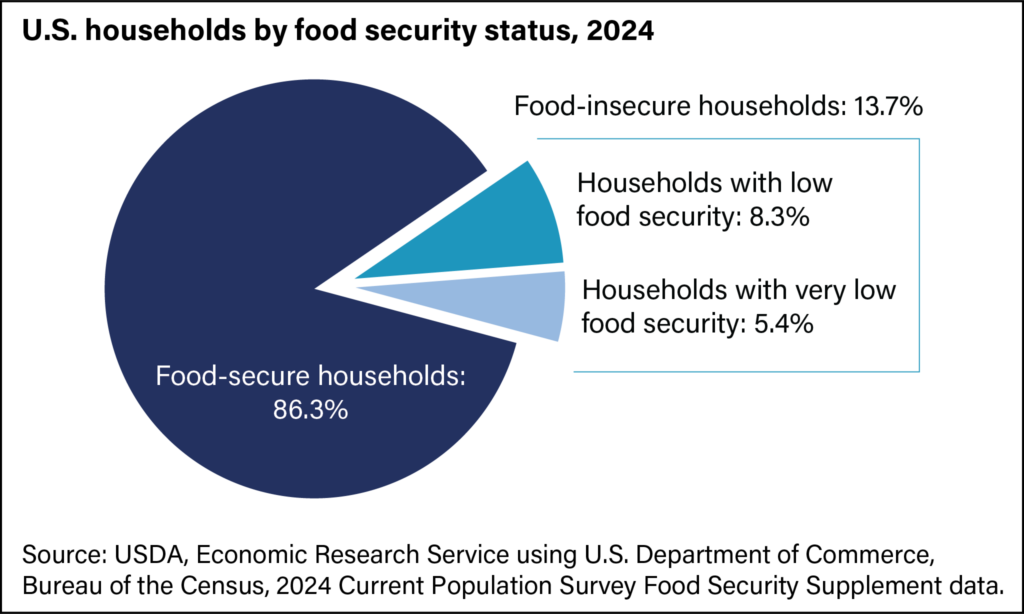
Food secure—These households had access, at all times, to enough food for an active, healthy life for all household members.
86.3 percent (115.7 million) of U.S. households were food secure throughout 2024.
The 2024 prevalence of food security was not statistically significantly different from the 86.5 percent (114.6 million) in 2023.
Download chart data in Excel format.
Food insecure—At times during the year, these households were uncertain of having or unable to acquire enough food to meet the needs of all their members because they had insufficient money or other resources for food. Food-insecure households include those with low food security and very low food security.
13.7 percent (18.3 million) of U.S. households were food insecure at some time during 2024.
The 2024 prevalence of food insecurity was not statistically significantly different from the 13.5 percent (18.0 million) in 2023.
Low food security—These food-insecure households obtained enough food to avoid substantially disrupting their eating patterns or reducing food intake by using a variety of coping strategies, such as eating less varied diets, participating in Federal food assistance programs, or getting food from community food pantries.
8.3 percent (11.1 million) of U.S. households had low food security in 2024.
The 2024 prevalence of low food security was not statistically significantly different from the 8.4 percent (11.2 million) in 2023.
Very low food security—In these food-insecure households, normal eating patterns of one or more household members were disrupted and food intake was reduced at times during the year because the members had insufficient money or other resources for food.
5.4 percent (7.2 million) of U.S. households had very low food security at some time during 2024.
The 2024 prevalence of very low food security was not statistically significantly different from the 5.1 percent (6.8 million) in 2023.
Food Security Status of U.S. Households With Children in 2024
Among U.S. households with children under age 18:
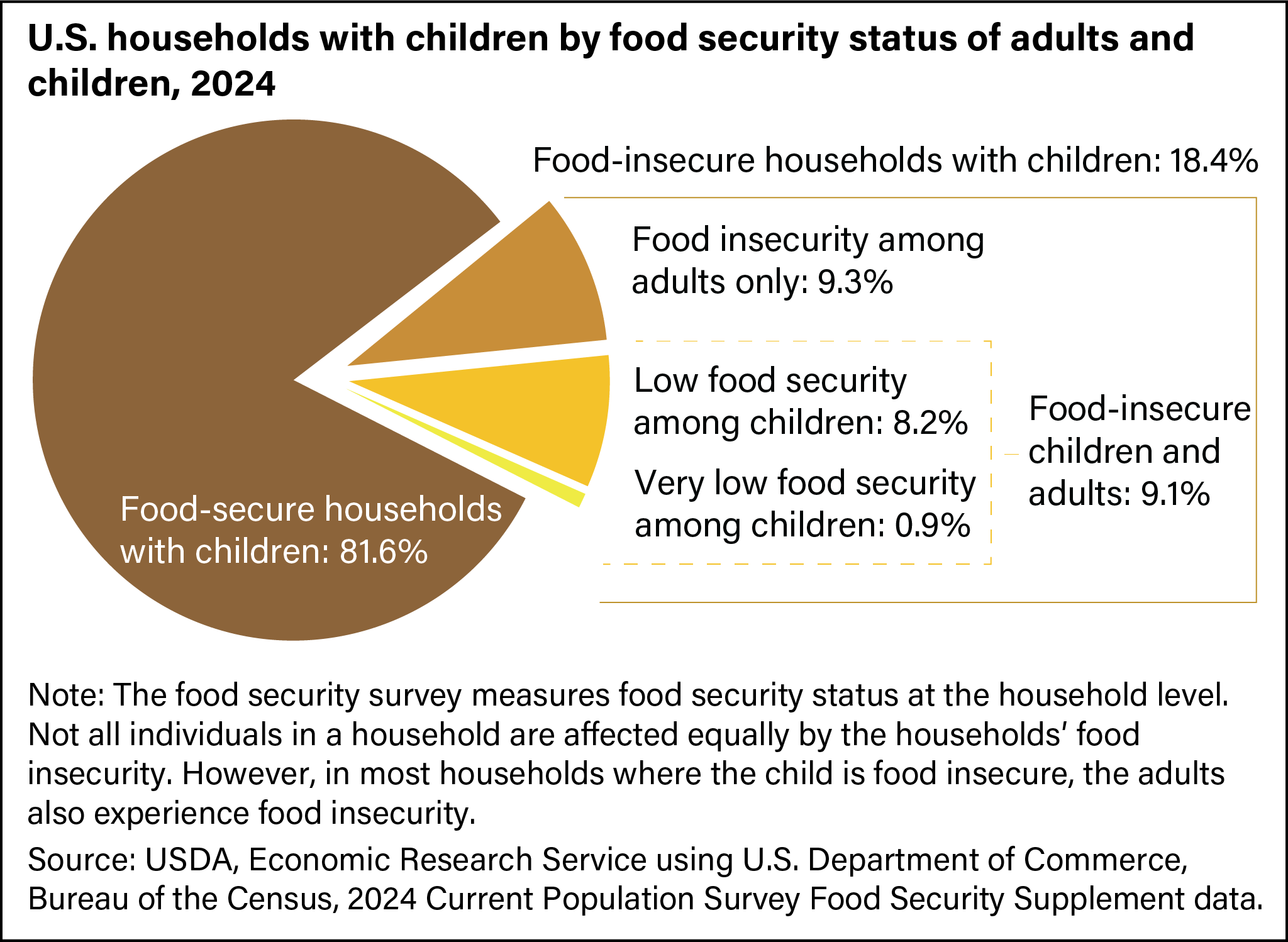
81.6 percent (29.9 million) of households with children were food secure in 2024.
Household food insecurity affected 18.4 percent (6.7 million) of households with children in 2024. In some of these food-insecure households only adults were food insecure, while in other households children also experienced food insecurity.
In 9.3 percent (3.4 million) of households with children, only adults were food insecure.
Both children and adults were food insecure in 9.1 percent of households with children (3.3 million households).
Children are usually protected from substantial reductions in food intake even in households with very low food security. Nevertheless, in about 0.9 percent of households with children (318,000 households), one or more child also experienced reduced food intake and disrupted eating patterns at some time during the year.
Download chart data in Excel format.
For more information, see the ERS report:
How Many People Lived in Food-insecure Households?
In 2024:
47.9 million people lived in food-insecure households.
33.8 million adults lived in food-insecure households.
12.3 million adults lived in households with very low food security.
7.3 million children lived in food-insecure households in which children, along with adults, were food insecure.
751,000 children (1.0 percent of the Nation’s children) lived in households in which one or more child experienced very low food security.
For more information, see Food Insecurity in the U.S.: Frequency of Food Insecurity.
Food Insecurity by Household Characteristics
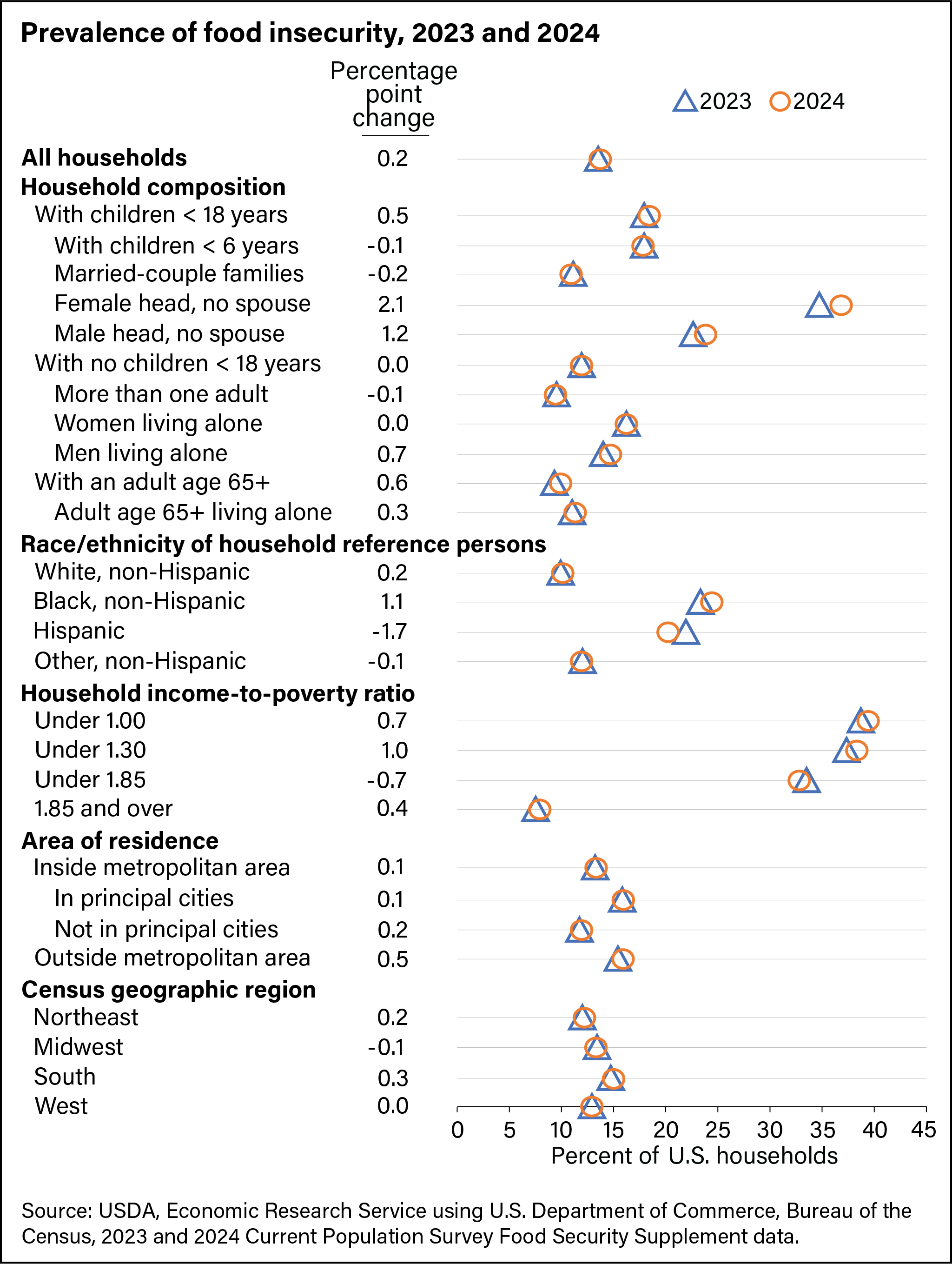
The prevalence of food insecurity in 2024 was not statistically significantly different from the prevalence in 2023 for any subpopulations. The figure below displays household prevalence rates of the percent of food-insecure households for both years, as well as percentage point changes between 2023 and 2024. Exact statistics for each year, including annual percentage point changes, can be found in the download file located below the figure.
Download chart data in Excel format
For interactive data visualizations, see Interactive Charts and Highlights.
Very Low Food Security by Household Characteristics
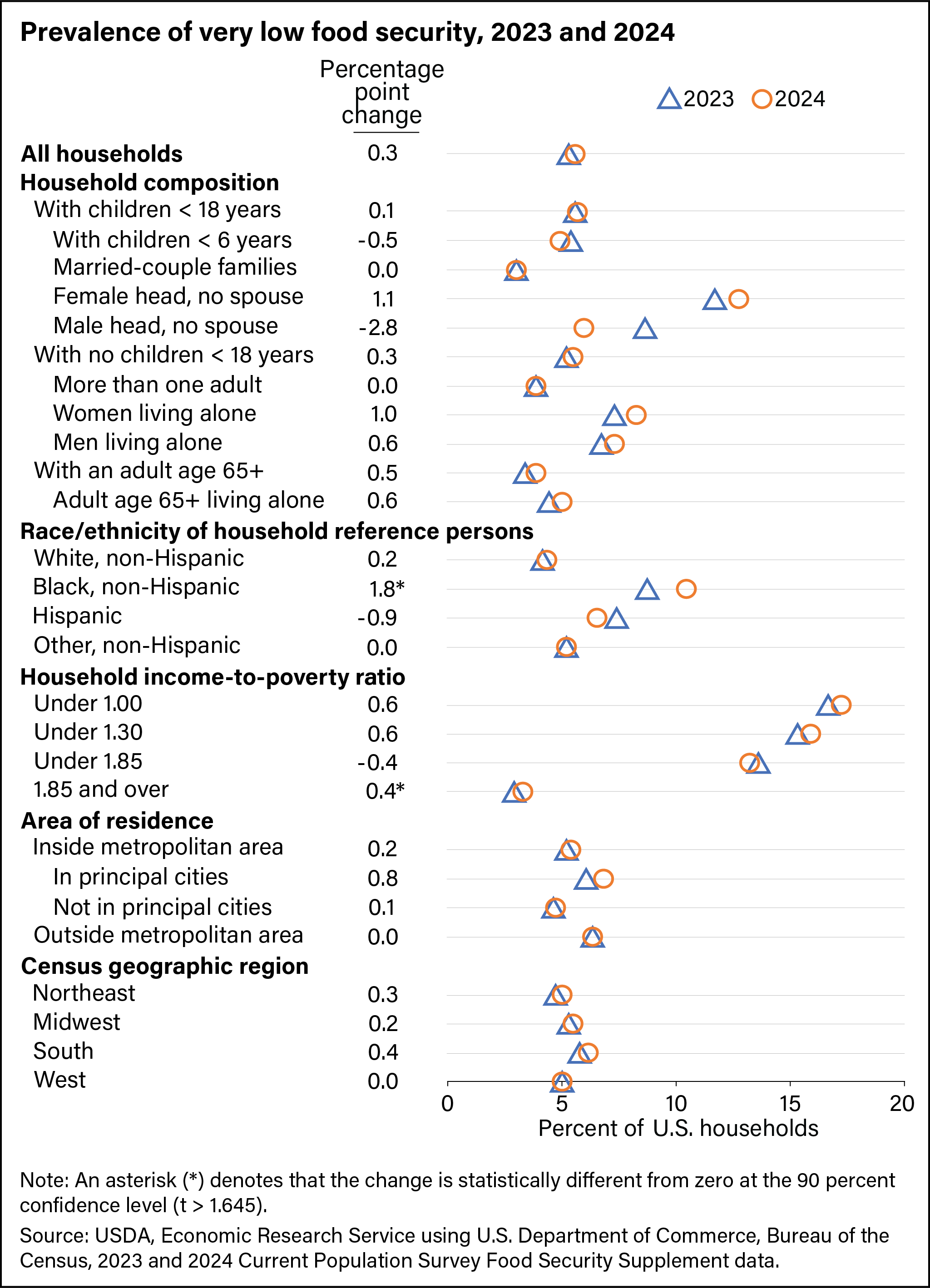
From 2023 to 2024, the prevalence of very low food security increased for Black, non-Hispanic households and for households with incomes at or above 1.85 percent of the poverty line. In 2024, there were no statistically significant decreases in the prevalence of very low food security for any subpopulations. The figure below displays prevalence rates of very low food security for both years, as well as percentage point changes between 2023 and 2024, with asterisks (*) indicating statistically significant changes between years. Exact statistics for each year, including annual percentage point changes, can be found in the download file located below the figure.
Download chart data in Excel format.
Trends in Prevalence Rates
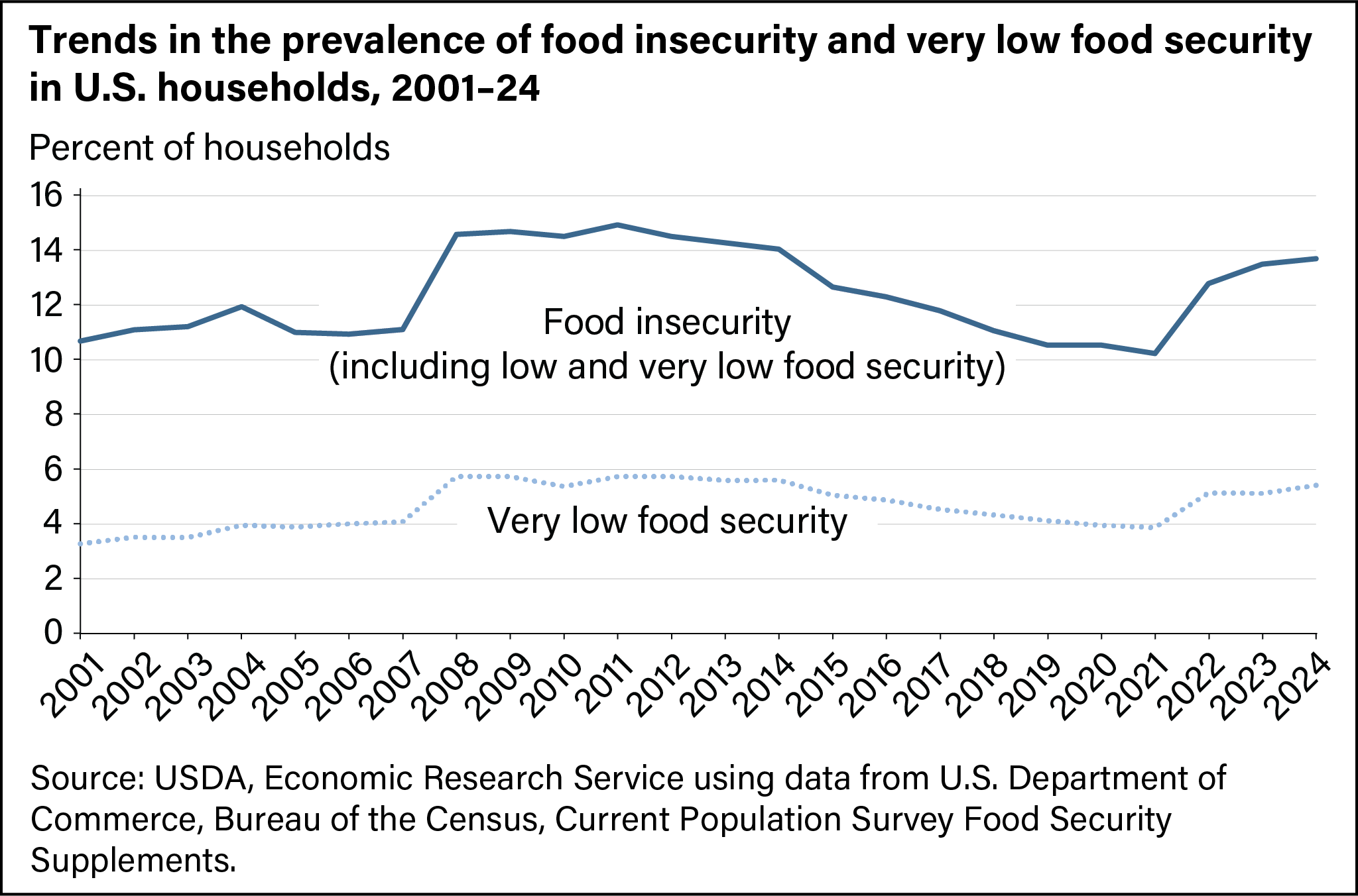
The 2024 prevalence of food insecurity (13.7 percent) was not statistically significantly different from the 2023 prevalence of 13.5 percent or the 2022 prevalence of 12.8 percent. The 2024 prevalence was significantly higher than the food insecurity prevalence observed from 2016 through 2021. Regarding earlier annual trends, a statistically significant decline in the prevalence of food insecurity from 11.1 percent in 2018 to 10.5 percent occurred in 2019 and food insecurity was unchanged at 10.5 percent in 2020. For the first time, in 2019, food insecurity was statistically significantly below the 11.1 percent pre-recession level of 2007. Year-to-year declines in food insecurity from 2014–15, 2016‒17, and 2017–18 were also statistically significant. Some year-to-year changes were not statistically significant; that is, there was no real change, or the changes were within the range that could occur from sampling variation. The cumulative decline from 2011 (14.9 percent) to 2014 (14.0 percent) was statistically significant. In the previous decade, food insecurity increased from 10.7 percent in 2001 to 11.9 percent in 2004, declined to about 11 percent in 2005‒07, then increased significantly in 2008 (to 14.6 percent). Food insecurity remained essentially unchanged (that is, the difference was not statistically significant) at that level in 2009 and 2010.
The prevalence of very low food security in 2024 (5.4 percent) was not statistically significantly different from the prevalence in 2023 or 2022 (both 5.1 percent). However, the prevalence rate was statistically significantly higher than the annual prevalence from 2017 through 2021. Statistically significant year-to-year declines in very low food security occurred from 2014–15 and 2016–17. The prevalence of very low food security was essentially unchanged from 2011 through 2014 (5.7 percent). The prevalence of very low food security was also 5.7 percent in 2008 and 2009. Before 2008, the prevalence of very low food security increased from 3.3 percent in 2001 to 3.9 percent in 2004 and remained essentially unchanged through 2007 (4.1 percent).
Download chart data in Excel format.
State-level Prevalence of Food Insecurity
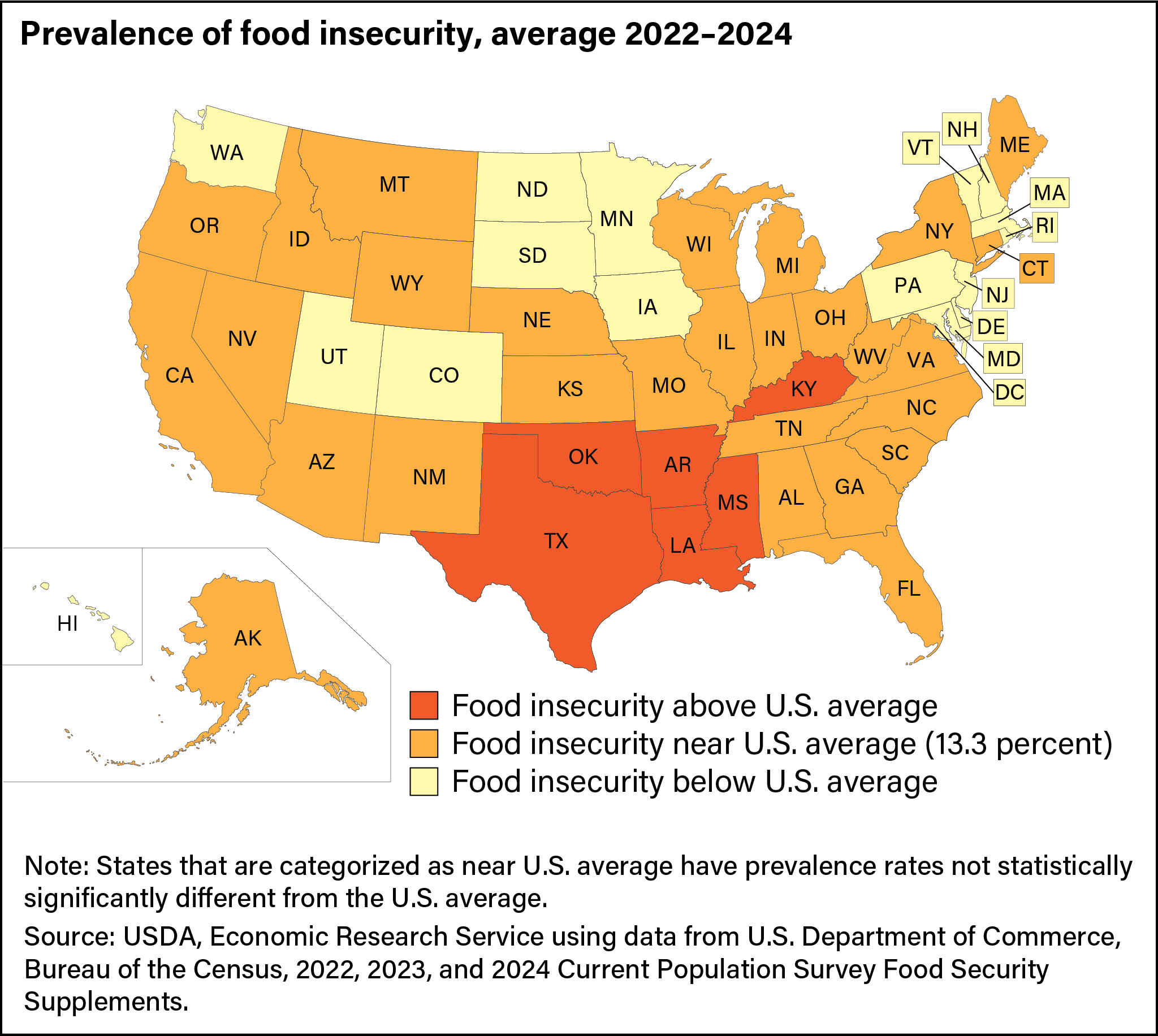
Prevalence rates of food insecurity varied considerably from U.S. State to State. Data for 3 years, 2022–2024, were combined to provide more reliable statistics at the State level. Estimated prevalence rates of food insecurity during this 3-year period ranged from 9.0 percent in North Dakota to 19.4 percent in Arkansas; estimated prevalence rates of very low food security ranged from 3.4 percent in South Dakota to 9.0 percent in Kentucky.
Download chart data in Excel format.
This section is based on the publication: