




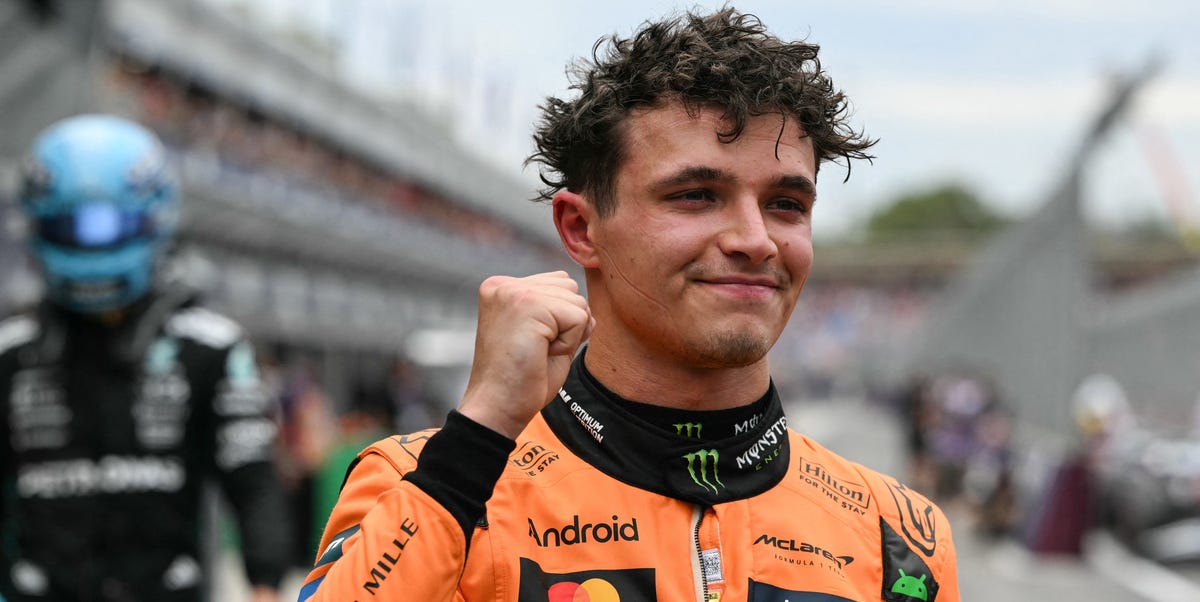
From the inner sanctum of the top-secret McLaren Technology Centre (MTC), the 50-hectare headquarters of McLaren Racing, British Formula 1 driver Lando Norris is talking to Men’s Health about an issue you’ll probably recognise: sleep, recovery and how it affects his work. Though the Bond villain-esque MTC cost around £300m to build – within it high-spec wind tunnels, state-of-the-art health facilities and a 200-metre production line – Norris, the reigning Formula 1 world champion, is pinpointing the same laser focus that won him the World Drivers’ Championship in 2025 to this more analogue part of high performance.
‘I’m a shocking sleeper,’ he admits. ‘I’m a night owl, but over the last year that’s shifted quite a bit – now I try to prioritise sleep even more; and I enjoy it.’ Not that you’d guess he’s ever had trouble with it. The chipper 26-year-old is all smiles during our conversation. You’d never know he has just stepped off a transatlantic flight and, in a matter of days, has to fly back in the same direction in time for the Canadian Grand Prix in Montreal. He also shows no signs of being a man, alongside teammate Oscar Piastri, carrying the pressure of driving for a team worth £3bn on his back. This particular focus on sleep – and thus, trying not to lose any to the demands of this role – coincides with the wider cultural shift toward recognising rest as a fundamental component of health and productivity.
As for many of us, actually getting there remains a work in progress. ‘I try and get eight hours in bed, but most likely sleep about six or six-and-a-half,’ he says. In which case, would it be fair to say improving his sleep has been his primary performance focus off-track? ‘I would say so,’ he says. ‘Sleep has probably been one of the most important things for me.’
Why Recovery Has Become His Biggest Performance Tool
As many experts would attest, Norris’ strategy to achieve the ideal night’s sleep before a race starts early in the day. In the gym, to be specific – but perhaps not in the way you’d expect. ‘Recovery has become one of the other big aspects of my life and making sure I’m on top of that, rather than just hitting the weights every single day,’ he says. ‘It makes sure that I get recovered in the best way possible.’ He points to band work (‘I dread it the most, but also tend to feel it the most’), having the largest impact on his physiology, across ‘two half-an-hour sessions a day,’ he says. ‘Band work in the morning and cardio in the evening.’
The carryover, he explains, is simple. ‘If I’ve not stretched, I’ll wake up during the night and my back and legs will hurt,’ he continues. If he’s focused on his mobility, however – which includes a focus on neck, core and glute strength – he’ll ‘always sleep better,’ he says.
During a race, a Formula 1 driver’s heart rate sits somewhere between 170 and 180bpm, cockpit temperatures can reach 50°C and through certain corners, 25kg of force runs through the neck. So though his training may not feature double-bodyweight deadlifts, mobility and functional training become equally worthwhile.
For Norris to keep making gains on his recovery across the board, he focuses on the tactic of ‘marginal gains,’ a methodology originally coined by former Performance Director for British Cycling Sir Dave Brailsford, describing how breaking down everything that goes into cycling, improving each element by 1% and then aggregating those small gains into significant increases in performance.
Once a confessed ‘fussy eater,’ Norris now applies the same focus to his recovery, and is continually looking to incrementally improve his nutrition – another closely monitored element of performance at the sharp end of motorsport. He and his peers on the grid must maintain their weight and the strength required to perform, all while losing two to three kilograms in sweat per race. Here, every calorie has to fight for its life – and rock-solid nutrition is the foundation on which races are won or lost. Despite this, he admits a ‘need to have even more focus on it.’
The McLaren driver points to supplementation with Optimum Nutrition protein, magnesium and Omega-3 as important factors in keeping his body ‘consistent and not letting it decline.’ Races in hot environments, including Singapore, Qatar and Miami, compound the need for precise supplementation, and ‘when training ramps up for some of these bigger races, [supplementation] becomes a key part to it all.’ When your 0.2-second reaction time can spell the difference between winning and losing, you can’t afford to be dehydrated behind the wheel.
At the time of writing, Norris is the reigning Formula 1 world champion and with 21 other drivers vying to climb up the grid across the season, he finds himself with a target on his back. Yet whether you’re hurtling down a straight at 400km/h (248mph) in Baku City, or more simply hoping to lock in on your wellness before work, it’s clear that pressure feels a little lighter once you’ve nailed the basics. Just ask the champ.
The Daily Habits Behind Lando Norris’ F1 SuccessLocked In
‘For me, it’s just getting the simple things right; getting the correct amount of sleep, getting the correct nutrition in and drinking enough,’ says Norris. ‘There isn’t any magic to it.’
Nap Time
If you’re feeling tired, try and get your head down during the day. ‘One of the biggest things that’s come into play is taking naps during the day,’ says Norris. ‘I might even just try and get a 20-minute nap in. They can be lifesavers.’
Perfect Prep
‘I try and get as much done during the pre-season to prepare myself, and then the season is more about sustaining the level that I’m at,’ he says. ‘I’d rather have sacrificed a bit more of my holiday to prepare for the whole year ahead.’
Sweat the Small Stuff
‘Throughout the year, it’s a lot more about the little gains and the stuff that people don’t see,’ he says. ‘It’s the half a percentage, or whole percentage, whether that’s training, recovery or sleep… it all adds up in a world championship.’
Related Stories
Ed Cooper is the former Deputy Digital Editor at Men’s Health UK, writing and editing about anything you want to know about — from tech to fitness, mental health to style, food and so much more. Ed has run the MH gauntlet, including transformations, marathons and er website re-designs. He’s awful at pub sports, though. Follow him: @EA_Cooper