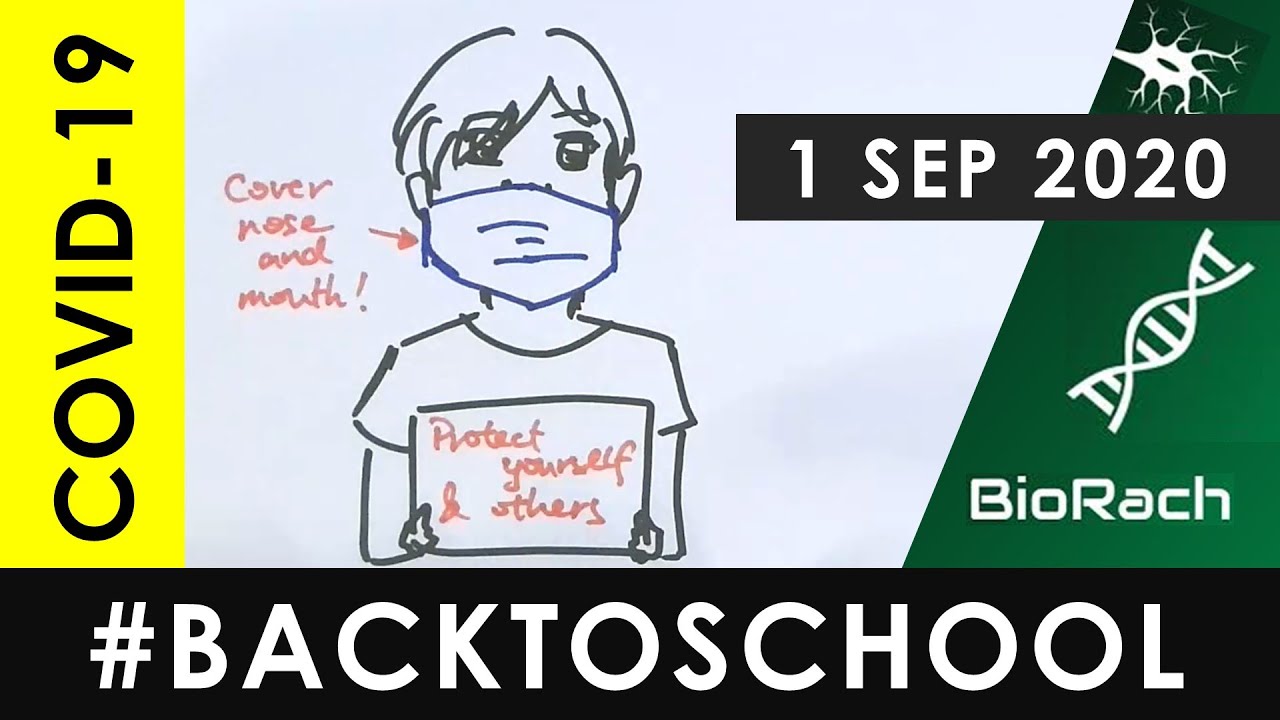
It’s nearly September, meaning we’ll all head back into school very soon. It’s been such a long time since we last were in school because of the COVID-19 pandemic, and in this video, we’ll talk briefly about what this virus is, how it relates to what you’ve learned or will learn in GCSE and some practical tips on how to keep yourself safe.
The coronavirus pandemic (COVID-19) is caused by a pathogen called SARS-CoV-2, short for severe acute respiratory syndrome coronavirus 2. As the name implies, it’s a virus, meaning it hijacks the body cells and takes over their mechanism to reproduce inside them. The body cells are destroyed in the process, which is how it makes us ill. To go into a bit more detail, the virus enters the cell through an enzyme found on our cell surface and they incorporate their viral RNA with our own DNA, so when our DNA is used to make our own proteins, the viral proteins are also made at the same time, using up our own resources and energy in the process.
Risk factors
Risk factors are things that increase the risk of someone getting or developing a disease. We don’t know enough about the virus to say if any particular factors are risk factors, but the infection cases seem to show that males, people over 60 years old and those with underlying health conditions are more susceptible to COVID. Other factors that can affect your risk includes your living or hygiene conditions and reportedly if you’re of a Black, Asian or minority ethic (BAME) background.
The symptoms
As you’d have seen on the news, there has been many talks of developing a successful vaccine for COVID-19 and indeed, that is the best hope we can have for dealing with this virus. As you may recall, vaccines are dead or inactive pathogens that are injected into our body to trigger a primary immune response without making us ill. The key goal of vaccines is to make our immune system to produce memory cells which will survive long after the pathogens have been killed. The aim is that these memory cells will recognise the actual live pathogen when it does invade our body and can quickly induce the secondary immune response, where it produces large concentrations of antibodies in a short time to kill the pathogens before it causes symptoms. If more than 90% of the population is vaccinated, we can have herd immunity where the pathogen can’t survive long enough in the hosts to reproduce and be spread to other people, meaning those who cannot be vaccinated for various reasons can be protected from the pathogen. This would mean that we are then well protected from the virus. In the case of COVID, there has been talks of an effective vaccine being developed but more testing is needed to test its efficacy, toxicity and side effects, same as what you’d do with drug trials. Recently, there has been the first report of a man who was re-infected after completely recovering from COVID. This is a really interesting discovery as there are a couple of promising findings. One is that they’ve found higher concentrations of antibodies in his blood in the second infection, which implies that the memory cells made from his first exposure are retained. Another important thing to note is that he is asymptomatic the second time around, meaning the virus was unable to make him sick upon reinfection, at least to this point in time, possibly due to faster secondary immune response. However, being asymptomatic doesn’t mean he cannot transmit the virus to others, so this would mean that recovered patients should still wear face masks and exercise social distance as non-infected people. The vaccines being developed also need to be tested to see if it can provide long or short-term immunity to help with designing the vaccination programme.
There is some very promising research being done, so let’s hope an effective vaccine will be developed in the near future.
Topics covered (AQA):
B3 Organisation and the digestive system (enzymes)
B4 Organising animals and plants (Breathing and gas exchange)
B5 Communicable diseases (pathogens, transmission, human defences)
B6 Preventing and treating disease
B7 Non-communicable diseases (risk factors)
B10 Nervous system (separates – the brain)
B12 Homeostasis (body temperature)
#backtoschool #coronavirus #physicsonline