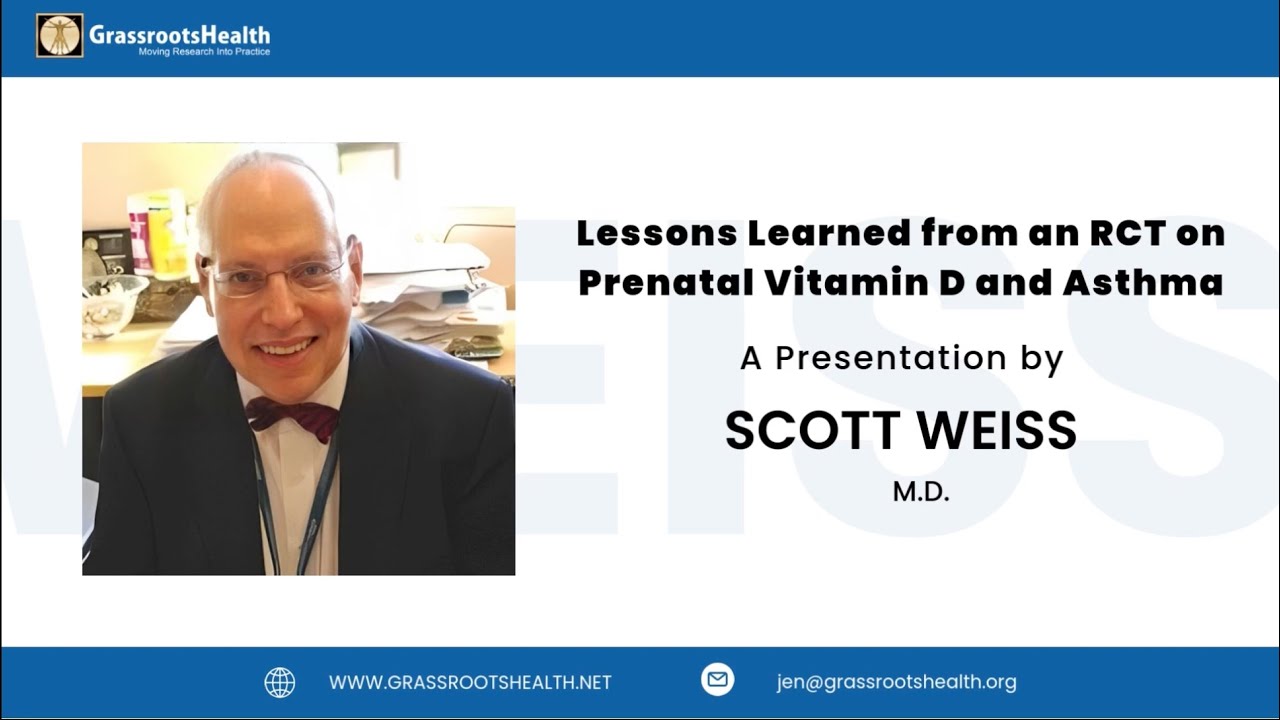
Dr. Scott Weiss, M.D. shares a presentation on the important role of prenatal vitamin D in the prevention of asthma and other negative health outcomes in pregnancy and newborns. Following the presentation, in an interview with Jen Aliano, Director of GrassrootsHealth, they discuss important topics regarding vitamin D research and study design, the challenges faced in prenatal trials, and the concept of considering the totality of evidence when evaluating research for public policy and guidelines.
Dr. Weiss is a Professor of Medicine at Harvard Medical School, Professor of Environmental Health in the Respiratory Biology Program, and a physician in the Division of Pulmonary and Critical Care Medicine at Brigham Women’s Hospital. He is also the former Scientific Director of Personalized Medicine at Partners HealthCare System and Co-Leader of the Systems Genetics and Genomics Unit and Associate Director of the Channing Division of Network Medicine at Brigham. The research facilities he oversees use state-of-the-art technologies and methods for genetic and genomic research. He co-lead a 30-investigator, 110-person research group involved in examining the environmental exposures and genetic risk factors for the development of asthma and COPD, and has led multi-disciplinary cooperative studies of asthma and COPD with international experience.
Dr. Weiss has authored or co-authored over 600 papers and co-written and co-edited 4 books, including a comprehensive textbook on Respiratory Genetics. He has received many honors and awards, including the American Thoracic Society Recognition Award for Scientific Accomplishments “Reduced Vitamin D Levels in Pregnant Women are the Cause of the Asthma Epidemic” and was recently identified as part of the top 0.004% of biomedical researchers in terms of the scientific impact of their work.
His long-standing research interests have been in the area of environmental and genetic risk factors for the development of asthma and COPD and now include pharmacogenetics/pharmacogenomics of airway disease, the fetal and natural development of asthma, the role of vitamin D supplementation during the prenatal period on various outcomes, personalized medicine and the development and application of new technologies into clinical practice.
Learn more at www.grassrootshealth.net
Video Summary:
(00:00-01:34) Dr. Scott Weiss, a Harvard Medical School professor and top biomedical researcher, began studying vitamin D’s role in asthma after identifying the vitamin D receptor gene’s link to childhood asthma through genetic and observational studies.
(03:07-04:26) Vitamin D has both endocrine effects (bone health, measured through serum levels) and developmental effects (immune system, organ development, measured in tissue levels). It plays a crucial role throughout pregnancy, from implantation to postnatal immune function.
(04:26-08:49) The VDAART trial enrolled pregnant women (10-18 weeks gestation) at high risk for having asthmatic children, randomizing them to receive either 4,400 IU or 400 IU vitamin D daily. Results showed a 20% reduction in childhood asthma, with a p-value of 0.051.
(13:09-15:13) The trial faced three main limitations: insufficient vitamin D dosing (only 75% reached target levels), late pregnancy initiation, and the presence of vitamin D in both control and treatment groups at baseline. When these factors were accounted for through meta-analysis and stratification, the reduction in asthma risk increased to 50%.
(31:50-33:14) Vitamin D deficiency during pregnancy may be a significant contributor to health disparities, particularly affecting African-American communities. Current recommendations (600 IU) are far below what experts like Dr. Weiss suggest (6,000 IU minimum).
(34:34-38:16) Pregnancy creates a dramatically increased physiological need for vitamin D, with 5-20 times higher requirements than non-pregnant state, due to fetal development needs and immune system modulation.
(41:41-44:11) Dr. Weiss advocates for using “totality of evidence” rather than relying solely on randomized controlled trials for medical guidelines. He notes that BMI significantly affects vitamin D’s effectiveness – women with normal BMI at pregnancy start showed better outcomes than obese women.
(46:28-49:22) For future trials, Dr. Weiss recommends: enrolling women earlier in pregnancy (4-5 weeks vs. 10-18 weeks), using higher vitamin D doses (6,000-8,000 IU vs. 4,400 IU), and ensuring greater baseline difference between control and treatment groups. He notes VDAART’s results likely apply to general population.
(50:04-52:54) While a new randomized controlled trial would cost approximately $10-12 million, Dr. Weiss considers this cost-effective given the potential lifetime savings from preventing pregnancy complications and childhood health issues. The main challenge is finding initial funding for such a study.