For Closed Captions:
https://secure-web.cisco.com/1BXytnVDBbBM1fwxOYzMlCpjIdmaJhFVP-euR-j7Xs1BukyX1HBvZczvgu2cvcAsfv93jHU0MoqYCuGmsvpyCiEIWach3ZVzhU9k8N107L-2HrN8IFCUuo8J0rB6XHkihgpHHrdXgUEEOnShpiUSi3VLYv92vzk-9nAvQY4BrFRA3YteEvjG7De7PysPOChHsGJACPFadtVCh8h8V0ONSPVcMuAFyQPYk8UC36SfJmmI/https%3A%2F%2Fbit.ly%2F3ScmmPy
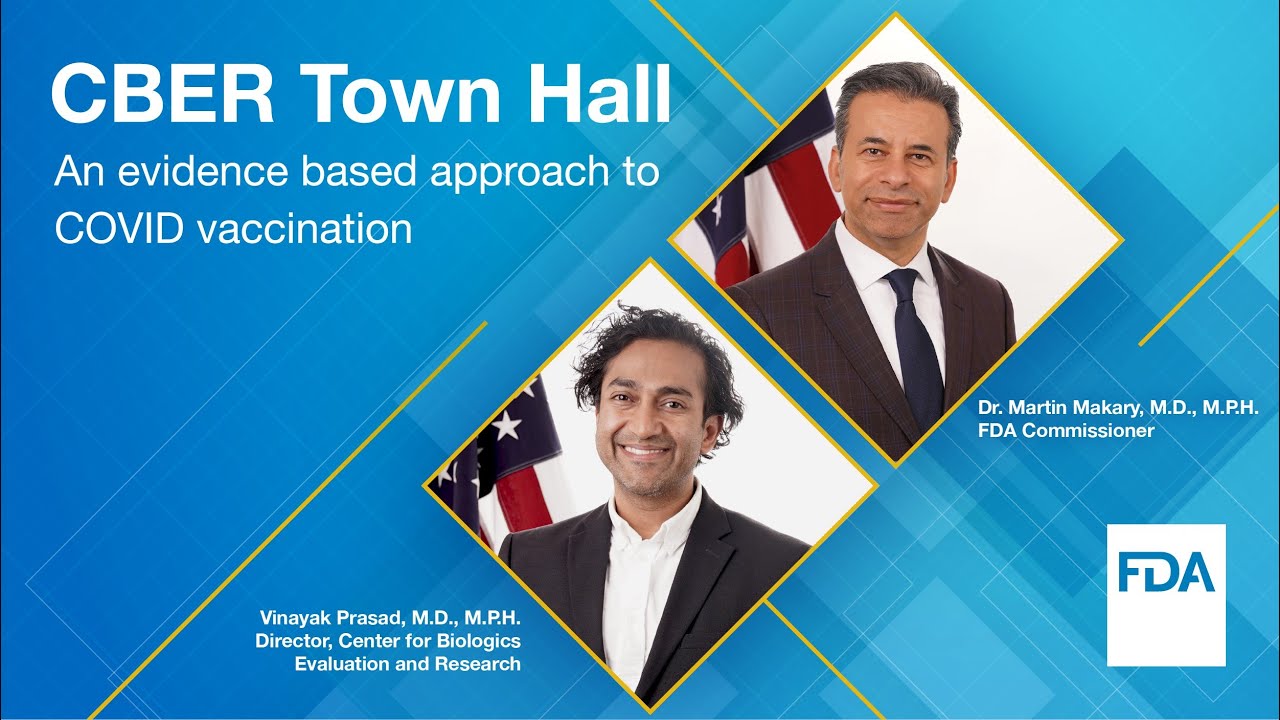
Welcome everybody to the US Food and Drug Administration’s announcement about CO 19 vaccine policy. I’m Dr. Vana Prasad. I’m the incoming director here at Sber the Biologic Center and I’m pleased to be joined by the commissioner today as I walk you through the American people directly through our ideas and thinking and our framework which we call an evidence-based approach to co 19 vaccination. So, those of you who follow the New England Journal may note that this morning at 11:00 a.m. Eastern Daylight Time, we have our article appearing in the New England Journal in a sounding board. Uh, it explains our rationale, our thinking about CO 19 policy and the vaccine space. I’m going to walk you through it here, but first just a little bit of background about me. I’m went to high school in Leaport, Indiana, and I went on to do my undergraduate at Michigan State University. Go green. I did my medical degree at the University of Chicago Pritsker School of Medicine and stayed on in Chicago to do my residency in internal medicine at Northwestern University. Then I was privileged enough to come here to DC to work in the National Cancer Institute where I did fellowships in hematology and oncology and cancer prevention. And during those years I also completed my masters in public health at Johns Hopkins University. And for the last decade or so, I’ve been a professor and physician at Oregon Health and Science University and then the University of California, San Francisco, where I predominantly see patients in the county hospital, San Francisco General Hospital. And I want to also preface this by saying that I’m a long-standing believer in and have written many at least two books on the topic of evidence-based medicine. So, I believe the purpose of the US Food and Drug Administration is always and only to act in the best interest of the American people. And this document is motivated by that spirit. People and patients are our number one stakeholder and the FDA will continue to balance regulatory flexibility with gold standard science and we make that clear in this document. This is an important message. Randomized control trials are not always needed in medical science. That’s been my position for more than 15 years now. But they are sometimes needed in medical science and this document walks you through where they are and where they aren’t needed. In terms of CO 19, further background, I think we have to admit to ourselves that America is deeply divided on the policy issue of repeat CO 19 vaccine doses or boosters. There are some Americans out there who are worried that the FDA has not fully documented and interrogated the safety harms of these products and they are categorically opposed to these products. There are also some Americans, we also have to recognize, who are desperate for additional protection and they demand these products. But the truth is that most doctors and most of the public are entirely uncertain and that is reflected in low vaccine uptake of these products. Just a couple figures, one figure from the CDC shows uptake by racial groups over time over the last season and the other statistic that less than one in six healthcare workers are getting the CO 19 booster shot. And the truth is that for most that for many Americans, we simply do not know the answer to whether or not they should be getting the seventh or eighth or ninth or 10th CO 19 booster as the current policy would have us go down the road of. So FDA thinking has evolved on this topic with changing evidence. We have a changing regulatory framework. And what has changed? Well, we have a population where many Americans have been multiply infected with CO 19, sometimes without even knowing they had CO 19. The risk of severe disease and hospitalization, thank goodness, has fallen among the American people. The efficacy of repeat doses of the products of these vaccines to further reduce severe disease and symptomatic illness is uncertain. And there are important safety considerations whose long-term impact is not fully known, and we will continue to monitor those closely. So FDA strategy in this space, here’s what we’re going to do. We will hold this year’s vaccine advisory committee later this week on Thursday and that’s a committee of experts that help FDA decide which target strains which antigens to recommend for this year’s vaccine that companies target and going forward we will apply the following evidence-based framework to evaluate all the co 19 vaccines. So based on prior immunologic endpoints that means proof that the vaccine can create antibodies in people companies can apply for and we will consider approval for 65 and older and or people at high risk of severe COVID 19. So if you’re older than 65 or you’re high risk for COVID 19, we’re going to use the immunologic endpoints we’ve been using to grant approval. This is a tremendously broad category. This effectively means 100 to 200 million Americans, those with the most favorable benefit to harm balance, will be covered by such approvals. The CDC has a has a list of the conditions that qualify at high risk for severe COVID 19. You can peruse the list. It’s also in our New England Journal paper. It is a broad list. There’s a lot of things on this list. I’ll just highlight a few. Obesity is on this list. Physical inactivity is on this list. Mood disorders including depression is on this list. and all imuninompromised conditions are on this list. In other words, at risk Americans can be reassured that they will be covered by such approvals. At the same time, we want more evidence at the US Food and Drug Administration. We want to know more about what these products are doing, especially as we enter the seventh, eighth, and ninth dose. All companies will be asked to conduct a randomized control trial testing their product as follows. against a saline placebo. We want to know the full safety profile of these products in a randomized control trial targeting people between the ages of 50 and up to 60 64 less than 65. The primary endpoint of this study will be clinical endpoints which we’ll talk about in a minute. And these data are vital to inform an updated risk benefit analysis, an analysis that’s fit for 2025. And many point to observational studies that allude to some of these end points. But the simple truth is the existing observational literature is at high risk of bias and broadly uninformative in part because the people who choose to get the booster and the people who choose not to are not really the same groups of people. They’re different in other ways despite the other than the booster. So here’s a visual schematic of what we propose at FDA. This is the New England Journal of Medicine paper. Our figure in the paper. If you’re over 65, if you are less than 65, but have at least one condition that puts you at high risk for severe COVID 19 outcomes, there will be a quick regulatory path for such products to come to the market using imunologic endpoints. We’re going to ask the manufacturers to give us more evidence for 50 to 64 year old people run randomized control trials, and I’ll describe that more. This is a huge group of Americans that could potentially enroll in such studies. 62 million Americans are out there. So I’m confident very confident these studies will acrue and be given to us as we suggest. Finally company this is a free country and companies are of course free to conduct their own randomized studies in younger populations in people without risk factors for severe coid9. They can run the research agenda they see fit and we will consider the results of those studies and we call this sponsor-driven randomized control trials. Now you may ask why 50 to 65? Well, the truth is if you look broadly across our peer nations, that is the place of global equipoise where we are genuinely uncertain globally if those patients benefit. Many countries recommend CO 19 vaccines for 65 and up and high risk. Some countries go lower to 45. So 50 to 65 we feel is an area where there’s disagreement among our peer nations. It’s a place we can bring data to this question. We can answer the question with gold standard science. In the course of preparing these remarks, people have asked me a few questions which I hope to address here. What about very young kids? And the answer to that is we encourage sponsors to conduct randomized control trials in that population. And to show you some reason why we think there’s also equipoise here. This is cumulative co 19 hospitalization by age 50 to 64. It’s approximately 55 per 100,000 over the last season. And 1 to4 is 20 per 100,000. If you go down to 0 to 4, it’s 30 per 100,000 compared to 55 per 100,000. And this is much different than say for instance 65 to 74 where it’s 150 per 100,000, a much higher risk of COVID 19 hospitalization. And final point I want to make is that these numbers include children who have risk factors for severe COVID 19. So the number these actual numbers in healthy children are likely lower. Put another way, in other words, we at FDA believe there is equipoise for 50 to 64 year olds. Airgo there must be equipoise for younger ages and we encourage companies if they see fit to conduct such studies. Now, our preferred postmarketing commitment randomized control trial will generally not exclude people who’ve had recent COVID. I think we’re comfortable with excluding people who’ve had it in the last three months, but they do need to include people who had COVID eight months ago or nine months ago for the simple fact that many Americans have. We need evidence that’s pertinent to the average American. This is a technical point, but we want the 95% confidence interval lower bound to be above 30%, which is a statistical way of saying we want to have some confidence that these vaccines change the rate of symptomatic SARS cove 2 in a meaningful way, in a meaningful amount. Symptomatic SARS cove 2 was the primary endpoint of the original randomized studies in 2020. We continue to believe that’s a fit primary endpoint, but we’re also going to look at severe disease, hospitalization, and death, which are end points I think Americans and their physicians care a lot about. We want the companies to follow these people for at least 6 months because we want to make sure that if the booster has a reduction in symptomatic SARS cove 2, that that effect isn’t washed away five months or six months later, that those benefits persist. And finally, we must develop randomized evidence. We owe it to the American people. We have launched down this multi-year campaign of booster after booster after booster and distrust of the American public and we do not have gold standard science to support this for average risk low-risk Americans. It’s not just our view here in the current um FDA commissioner and myself. It’s the prior FDA commissioner as well. This is Rob Caiff in JAMAMA. He writes, “COVID vaccine uptake is now low enough that large randomized control trials are feasible to evaluate the efficacy and safety of new updated boosters.” And again he re he stated it again in on May 9th. Quote, “In the case of CO 19, I believe it is would now be quite reasonable and even advisable to conduct placebo control trials for quote unquote boosters using updated versions of the vaccine in people who are not high- risk. Just a couple more points. What about vaccinating healthy people near or around an imunocmpromised person, including healthcare workers?” Well, to date there is no highquality evidence that in this year vaccinating those near an imunocmpromised person provides an additional benefit for the imunocmpromised person over seeking vaccines themselves. Does is it the case that it leads to less transmission to vaccinate people around an imunocmpromised person? Is it the case that it leads to less severe disease in imunocmpromised people? The FDA is very interested in sponsors choosing to conduct such studies to show it if it does. And I do want to point out that the current RSV approvals, respiratory sensitial virus, do not allow the approvals to be given to people around the vulnerable. Instead, it targets those vulnerable to the condition. So, we are bringing CO 19 policy in line with RSV. It is possible actually that such that such approvals and strategies provide false reassurance and lead to increased harms because people boosted are actually engaging in other compensatory behaviors that increase the risk for the imunocmpromised individual. The truth is data alone can answer this question. And I say the same thing for older people. What about you getting a booster to go visit grandma? Well, to date there is no high quality evidence that you getting a booster to visit your grandma protects your grandma beyond your grandma getting the booster herself. Does it lead to less transmission? Does it lead to fewer instances of severe disease? Again, we are interested in evidence to inform this claim. And again, the RSV approvals recommended for older people or those at higher risk of respiratory sensitial virus hospitalization, but not for everyone who goes to visit them. Ultimately, data are needed. A final point I’ve heard people say, what’s the role of the FDA and what’s the role of the CDC here? The Centers for Disease Control. The Centers for Disease Control may issue recommendations on who should receive the FDA approved vaccines, and we look forward to that. But the FDA can only approve products if it concludes based on the available scientific evidence the benefit to harm balance is favorable and we simply need more data to have that confidence for younger individuals at low risk of severe disease. We have to do our duty here too at the FDA. The FDA is committed and let me say this very clearly. We are committed to ensuring companies generate that evidence and we strongly suggest they complete any agreed upon postmarketing studies. Finally, I encourage you all to read our paper in New England Journal of Medicine which fleshes out this rationale. It’s geared towards a medical audience naturally, but we hope in the days to come with some podcast between myself and the commissioner that we will make this plain to the American people. And now I’m going to get up here with the commissioner. We’re going to talk about this and this is part of our philosophy at FDA where we’re going direct to the American people to explain the thinking behind our decisions which too often is opaque. So if you allow me to introduce the commissioner Dy Dr. uh Martin McCary to come up here thank you sir. Um great well thank you so much Dr. Prasad. It’s great to be here. It’s great to see everybody. Um and I I hope to meet every single one of you but for um right now let’s talk a little bit about your talk um uh Dr. Prasad. So uh very interesting observations. I think you nicely acknowledged that this is a very polarizing topic and it’s uh in general the entire uh concept of co risk mitigation has been loaded with a lot of medical dogma. I think about the time when everybody was encouraged to wear any cloth mask giving them false assurance and perhaps increasing uh a risk because the moral hazard that they felt that they were you know safe. Um so I appreciate your talk. One, you know, question that a uh family member asked me today when I was uh talking about what was forthcoming in the New England Journal is uh is the FDA in in your mind with this framework that you’ve outlined uh is the FDA going to require a randomized trial every year for each COVID annual booster? You know, that’s a great question. So, I think one thing worth discussing is as you alluded to the dogma. There were so many things that happened in the last five years that I think have bred a broader distrust in the American people from the scientific community. Well, one thing we’re just taking for granted is the idea that CO 19 vaccines will be changed every single year. And what we’ve seen over the course of the last 18 months or two years is that the CO 19 virus is different than influenza. It’s mutating at a slower rate and we’re actually still in JN1 lineage. And in fact, the WHO just a week or two ago advised that JN1 CO9 vaccine boosters are still appropriate in the current time. So what’s my point? My point is that instead of having a CO 19 strategy that’s yeartoyear where we change every single year, why don’t we let the science tell us when we should change, when there’s a major antigenic shift, when the virus really changes, then perhaps we should change our strategy. So, I don’t envision randomized trials every year, but I do think we have an obligation every few years or however long that may be to generate credible evidence for the American people to clarify that we know where we stand. I see. So, you’re saying you don’t envision a schedule uh by which randomized trials might be required. You envision a sort of adapt as we go based on the degree of antigenic shift. If it’s escaped antibbody immunity and people are wondering, uh maybe that’s a reasonable time. The virus doesn’t have a calendar. I know during the pandemic we had uh closures at a certain time of day, but the virus doesn’t know the time of day and it doesn’t have a calendar. So, I think we should react to when the virus tells us to react as you point out. Okay, great. What is you know there’s um a belief in the scientific community that is it is the BNT cell activation that is really driving the longer term protection against severe illness. And in that case um in that school of thought they people actually have suggested that customizing it to the strain each year um may result in a transient antibbody increase but ultimately that protection against severe illness is based on that BNT cell activation and if that is the case and we know to some degree it’s the case but if that is largely the case then what is the right number of COVID shots that really optimizes or maximizes that B and T cell protection against severe illness. It’s a great question. What’s the role of memory B cells? What’s the role of T- cells? I mean, the ultimate question is the way in science we approach this question of how many shots a say thin seven-year-old girl should get is we conduct studies that give us the answer to that question. I don’t think we’re in a situation where we can reason that from first imunologic principles. In the history of medicine, that’s led us astray. And so what we’re proposing is getting back to a science-based gold standard science-based way of having these approvals, but at the same time having regulatory flexibility that older people, the vulnerable people also have an access to the vaccines much sooner. I now when you presented this uh framework to me and it was in line with what uh I had been thinking about um had you thought instead about just rubber stamping vac uh co boosters every year in perpetuity had I thought about it well you know I think that uh you and myself we have written for many years uh that we think co 19 vaccines were tremendous life-saving advance but one of the problems with the policy was we pushed too hard on low-risisk populations and we didn’t push hard enough on the atrisisk populations. And so I think I did walk into the job slightly skeptical of a rubber stamp approach to co 19 vaccines but I also wanted to listen to and see where we were and I think the position we’ve crafted is actually quite a reasonable compromise position where we are making it rapidly available to many hundreds of millions of Americans but also generating evidence and it’s in line with all the European nations. To me, it’s the most sensible common sense meets evidence-based medicine strategy there could be. Now, one uh uh survey found that 85% of health care workers said no to the last COVID booster. And what does that say? Yeah, I mean I I guess can you comment on this public trust issue if I mean survey after survey shows trust in institutions like the FDA and scientists in general, it’s rock bottom. I mean we have lower trust than Congress and that’s saying something, you know. Um, and we need to rebuild that trust. And part of rebuilding that trust is having conversations like this, writing articles like we’ve done in the New England Journal, and having a common sense evidence-based framework for rebuilding that trust. I could see almost two interpretations of the very low uptake of the recent COVID booster in healthcare workers. One is that healthcare workers don’t find value in it. The other is that healthcare workers would like to see some updated clinical evidence before taking it. And I think if we’re being honest, we don’t know the rationale, but it would seem as if the universe of of possibilities would include a desire to know whether or not clinical evidence supports a benefit to taking it that outweighs the risks. I mean, I can speak personally if that if you proved it to me that there’s a benefit to someone like me, I will take it. And most of the doctors I know are responsive to that evidence. If the companies conduct these studies and those studies are glowingly positive, I think that doctors will embrace it and be able to counsel the patients in a way they haven’t been able to honestly counsel. How do you counsel a healthy, thin 50-year-old in your office who’s had COVID three times, uh, had, uh, five shots? How do you counsel that person about it’s almost impossible with the current evidence base? The HPV HPV vaccine is two doses in younger people, people under age 15 and recommended as a three dose vaccine in people over age 15. You would you you would think that when they developed the HPV vaccine, they didn’t know how many doses to recommend and they sort of, you know, reviewed the data as they went and perhaps they recognized that the BNT cell activation was sort of optimized after two doses in younger children and perhaps in older children it may have taken three. Maybe somebody had an idea, I don’t know, that maybe people should take the HPV vaccine each year. But ultimately they arrived in this equilibrium and it was probably based on a combination of clinical evidence, clinical wisdom um looking at the antibbody uh levels and BNT cell activation and the ultimate clinical endpoint and that is did it still confer the benefits of the HPV vaccine including cancer risk reduction? Yeah, reduction in CIN23 for the positive strains. you’re you make a fair point which is that there are so many vaccines we have approved and are going to approve in the future and we don’t default to this yearly schedule uh without good evidence that that yearly schedule is of a benefit uh in this particular case I think we we have a really good balance between the vulnerable people the people still at high risk will still have a rapid path to access but people at at average risk and low risk you know they need evidence um is this approach a contrarian approach I see I see that word is sometimes used. My objection to a lot of uh media writers using the word contrarian to describe anything about co 19 policy from masking toddlers which I was skeptical of to boosters in perpetuity which I’m skeptical of. My my disagreement with that word is that no one to my knowledge has ever surveyed the attitudes among all scientists on this question. To call something contrary to the accepted wisdom you have to know what the accepted wisdom is. What do the average scientists think? And I think the statistics you give that most healthcare workers, not just 50% but 80% are not getting this booster suggests that maybe the scientific consensus is not the consensus of the New York Times and the Boston Globe. Maybe it’s something different. Uh and if they want to call us, if they want to use the word contrarian, fine, but do a survey to see what the average doctor believes. And then I’m free of free to call whatever op minority opinion contrarian to that. Um, I think the most compelling information uh in the New England Journal paper is the vaccine COVID booster recommendation schedule in so many other countries in Europe and around the world. And so it would almost seem as if the current US strategy which is urging every single baby and teenager and child and healthy American and high-risisk American encouraging every single one to get a booster every year. That is the outlier contrarian approach. That is the contrarian approach. And now we are back in line with the rest of the world. And you know, from a a public health standpoint, is there a concern um of us urging people to do something with such absolutism when the evidence isn’t fully behind this repeat booster strategy and healthy people in perpetuity and then people sort of becoming skeptical of other vaccines or other health recommendations. I think you’re spot on. I mean, and as a general rule in medicine, if you’re too fervent about something for which you lack data, history can often prove you wrong and you will forfeit the trust of the American people and your patients. You know, that’s just a general rule. And I think we do see a broader broad and growing distrust of all vaccines. You know, one of the decisions the CDC made was to add this to the routine childhood immunization schedule, which at the time I wrote was my concern was it would lead to a backlash not just against one vaccine where people may be skeptical, but of other ones that have much longer track records, much more safety data. I think we see that we we are getting close to a crisis of public trust in vaccines. And in order to get over that, I think we have an obligation at FDA to generate data in populations where there is genuine e genuine equipoise. We don’t know the answer to the question to further earn back the trust of the public. You’re referring to adding the uh perpetuity annual co boosters on the vaccine children on the vaccine schedule for healthy children at the CDC. Yeah, it’s a decision that I thought went far beyond the available evidence and a decision that has resulted in I think in backlash and now we see reduced rates of important vital vaccine programs. I really appreciate your attention to this so potential ripple effect of losing trust because we are seeing a an epidemic of distrust right now. Um a recent JAMAMA study found that roughly 70% of the public uh trusted hospitals and doctors that is had a high degree of trust in the medical field just before COVID in 2019 and that number is around 40%. That was a 31 point drop over just four years. We’ve never seen that before. Now of course nobody was perfect in their understanding of COVID. we were learning as we go and the people I had the most respect for are the people who evolved their position as the data came in and um so this um issue of the ripple effect is something that um it sounds like you’ve been thinking a lot about I think it’s important to think about and it’s also important to think about the specifics of this case which is that you talk about changing your scientific view as the evidence changes well the virus has changed many Americans have been infected multiply multiple times the risk of severe disease is lower. This is not uh June of 2020. This is 2025. So our policies at FDA, the standards for evidence have to also shift. Um the most robust evidence for the vaccines was the very first study. Since then, we’ve had a reduction in the evidence standard for dose after dose after dose. In some ways, our policy will encourage I have to choose my words. I I hear the lawyer in my ear. encourage encourage the companies to conduct the appropriate postmarketing commitments that they’ve agreed to. Yeah. I I would honestly like to know the the answer to the question I get posed by a healthy 52year-old individual that says should I be getting the COVID booster this year? I honestly don’t know the answer to that question. I think it’s a scientific unknown and there are many endpoints you can look at. There are many factors to consider. The original studies that were randomized control trials are now four and five years old. The virus is much different. There’s been a significant antigenic shift and there’s been a shift in the population. There’s now broad population immunity whereas I think the original studies often excluded people with prior infection. So it was a very different group and it was a much uh it was a much different time. Um did RFK write your your New England Journal paper? My medical writer’s RFK. Well, no. Um, uh, I actually have never spoken to RFK and I’ve never met the man. You might be able to help me out with that. Um, I I don’t know the guy. Um, and so, no, this was developed by, uh, me and and you. And, uh, the only authors on the paper, the only people who wrote the paper. You know me, for a long time, I’ve been critical of medical writers. Uh, so we wrote this paper ourselves. Yeah. And um I would just add to that this is in line with his general instinct that we need more clinical trial data uh in making um decisions. Um but um um you I asked you uh early on to think about this issue and to present a framework for COVID annual booster regulation and uh you presented this uh framework to me and then we discussed it and so I think um it’s you’ve really hit a nice sweet spot in terms of uh evidence-based an evidence-based approach and a practical approach and also um sticking to the general promise that we are not going to be removing vaccines from the market that are already approved. So, is it a good time to ask you for a raise then? Sure. Sure. Okay. Um, generally speaking, are you a provaccine person? Yes. I think uh as a uh hematologist oncologist who took care of imuninompromised patients as an attending for a decade including many people post-authus stem cell transplant I am a extreme provaccine person because these im patients who are imuninompromised are extremely vulnerable and they benefit from vaccination in myriad ways and we pursue vaccination in people postrplant uh with the same vigor and commitment that pediatricians pursue vaccination it’s an important thing um but again vaccines are like drugs I think it’s important for the American people understand that the right drug to the right person at the right time is life-saving, but that doesn’t mean that every single thing is perfect as is, that we can’t improve, that there aren’t safety concerns we take very seriously. And at FDA, we do that. Even in the short time I’ve been here, a number of things have been brought to my attention where we need to take action and strike the balance between preserving the benefits of these products, but being careful and cognizant of the safety concerns. Yeah, I remember uh learning about Dr. Jenner’s development of the cowpox vaccine for small pox. Really an amazing story. I’ve had the privilege of doing a deep dive and researching it and writing about it. And in the 1700s really um his idea was rejected because of a dogma that there’s no way this could be actually happening. and they were ignoring clinical observations of uh nursemaids that had um exposure to the cowpox uh basically the the v the vi the virus itself and they were noted to not be getting smallpox and for a long time uh Dr. Jenner had really encouraged vaccination and there was the earliest group of antivaxers probably in the history of the world right around that time including some in the United States when the vaccine was brought to the United States around 1799 around 1800 a Harvard professor tried to champion this it was positioned as a opportunity to have a national vaccine program I think to President Adams uh for whatever reason I don’t know couldn’t find the details uh President Adams did not act on that recommendation. President Jefferson later did and really that was the the birth of vaccinations in the United States. It’s really an amazing concept and I I love the idea of vaccinations and I’ve seen vaccines save lives and do incredible things as we’ve seen in an imuno compromised population in my own clinical practice. And there’s another lesson there which is that change in medicine isn’t always easy. You know, there are lots of advances in medicine that aren’t always easy. And I think there’s going to be some people out there who are concerned about various aspects of our framework, but ultimately I do think this is a step forward and a lot of these questions will be answered by next calendar year when we start to get the interim results of some of these studies back and we will have more information to tell the American people. And you know, the results of these studies could surprise everybody. We don’t know what that, you know, that’s the whole point of running a study. You don’t know what you’re going to get. So um my observation is there have been some uh great milestones from vaccines. At the same time um the anthrax vaccine was a total disaster. The swine flu vaccine was a total disaster. Um the rotovirus vaccine was removed from the market. The original uh one was removed from the market. Um, there have been HIV vaccines that increased the acquisition of the virus. Um, I mean, your point’s well taken that not every single thing that’s labeled a vaccine has been in advance, but thankfully at the FDA, we’ve tried to shield the American people from a lot of such things. Yeah, good point. Um, shifting um, we you talked about endpoints with vaccine trials, how you’d like to see some clinical benefit as the end point, not just an antibbody increase. uh can you talk a little bit about the different types of endpoints in vaccine trials for the co boosters and what you’d like to see and what you’d like to see as a sort of condition of approval versus you’d like to see in some post marketing commitment. Yeah, that’s a good point. So I mean I think when we call we call it symptomatic SARS cove 2 but what it usually mean that’s the primary endpoint of the original vaccine studies and what that means is that if someone’s out there and they’re in the vaccine study and they start to feel sore throat runny nose they start to have symptoms of COVID they’re asked to swab themselves and submit the swab in and so the end the primary point is not did you feel sick but if you felt sick did the swab test positive for the virus that we care about COVID 19 and that that endpoint is roughly called symptomatic SARS cove 2 and that’s what we’re asking manual manufacturers to power their study to have a lower bound that excludes a 30% a 30% or more reduction in that endpoint which I think is quite reasonable and fair and one of the initial concerns of the of the vaccine is that a vaccine where it’s barely better than placebo might do more harm than good by creating a false reassurance and I think that’s a quote from uh Phil Krauss who used to who used to work here um so we’re asking them to improve symptomatic SARS cove 2 but of course we’re also looking at severe disease hospitalization and death we’re not asking them to power the study for those end points because that will make the study very very large. But we are looking at those end points and I think when we get the results of this study, doctors could look at it and interpret it in you know as they see fit. They can counsel the patient. Well, this is what you get. This is how long it lasts for. Here’s what we don’t know and here’s what we do know. Um and I don’t attempt to prejud I don’t know that I’m not a fortune teller, you know, that’s why we run trials. And so we’ll see what we get and then it’ll allow the American people and their physicians to make these choices in a more informed way. So, taking that one step further to the world of cancer research and cancer um therapeutic regulation, there are a lot of different thoughts as to what the end points should be for approval of cancer therapeutics. Uh some say it’s surrogate endpoints, some have long been champions of uh clinical endpoints, that is overall survival or disease-free survival. Where do you stand in sort of that spectrum of uh interest in the different endpoints and what do you see as a requirement for approval in general? I really think for that we need both. You know, we will at FDA for life-threatening conditions that affect small populations that are very dire where there are few treatment options. We will expedite approval through surrogate endpoints, endpoints that show tumor is being reduced or we’re delaying the time until relapse. We’ll expedite those approvals through accelerated approval and a number of other pathways available to us. But that doesn’t mean we’re not also interested in overall survival. We can ascertain that with the long-term follow-up of trials or with post marketing studies or with real world data. And there’s a number of innovations in this space including work on target trials and and and and other sorts of advances um in the causal inference space from real world data. So the answer to the question is really both. You know, we we have to and we will always embrace surrogate endpoints for people who have uh very concerning diseases, very rare conditions, few treatment options. We have an obligation at FDA to expedite those products to those patients who desperately want them. We also have an obligation to check on the back end and make sure that we’re we’re actually achieving what we thought we were. So what I’m hearing is surrogate endpoints are a valuable endpoint for approvals in the cancer space, but we also should be looking at overall survival and meaningful clinical endpoints, not turning a blind eye to them. And that is something that potentially big data could help with, right? Yeah. And I think sometimes, you know, people see a quote a quote of a tweet of mine, but if you read my books and my 500 papers, you’ll see this is my consistent philosophy for 20 years in medicine since I’ve been writing. uh always to embrace both and surrogate endpoints are also helpful to understand the mechanism through which the drug is benefiting people. Um so we’ll continue to look at both and real world data is exciting and we have a mandate here at FDA to think about more creative and interesting ways to use it. That’s great. Anything else you’d like to add? Well, I appreciate you doing this and uh I think it’s good for people to hear what we’re thinking as we have these conversations. I mean, we want to be as transparent as possible. were soliciting input all the time from the great scientific minds here and from uh people in the outside world and I think it’s good for this conversation to be a running dialogue that people can see and we’re going to bring you know we we we have a podcast now FDA direct we’re going to bring in reporters and have them on stage with us they can ask us any questions they want we’ll answer directly um and uh we’ll make those videos available on X on YouTube and sort of all the platforms people are aware of I think it’s a good thing for me as an outside observer of the FDA for a long time. Um I I always felt like I wanted to learn more about how FDA officials were thinking through their decision-m and I guess our only goal in this sort of direct to the American public kind of videos is to make that as transparent as we can. That’s great, Dr. Prasad. Great to have you here. Thanks so much and thank you everybody for being here. Great to see you. Thanks.