
💛Visit our online shop: https://bwth.in/shop
One of the skincare industry’s golden starchild comes in the form of niacinamide, or vitamin B3! Because we love this ingredient we thought we’d also give love to another vitamin B ingredient, commonly known as panthenol (Vit B5). These subtle but powerful ingredients really can do it all, like reduce hyperpigmentation while brightening the overall complexion, even out skin tones, reduce sebum filled large pores and even strengthen the skin barrier! What else do we want right?! Find out how we use it in a routine, why you may not react so well with it, and which products we loooove! Leave us your faves below and don’t forget, it always starts from within 😊- BW
Thank you for Paula’s Choice for sponsoring a portion of this video. If you haven’t noticed, their products are our jaaammm, so obviously all opinions are completely our own! 💗
—————————-
Check out our articles👇
Best Niacinamide Products to Target All Your Skin’s Needs
〰https://bit.ly/2XU6Ony
How to Use Niacinamide to Minimize Large Pores
〰http://bit.ly/2UgBXPp
9 Biggest Skincare Mistakes Causing Acne & Large Pore
〰️ http://bit.ly/2SSWN6P
—————————-
Watch Our Latest Video: https://bwth.in/latestvids
New episodes released weekly, SUBSCRIBE here!
💧https://bwth.in/subscribe
Don’t be a stranger 👻:
Instagram: https://bwth.in/ig
Facebook: https://bwth.in/fb
Reddit: https://bwth.in/reddit
Felicia’s IG: https://bwth.in/igfel
Rowena’s IG: https://bwth.in/igro
Blog: https://bwth.in/blog
For a full list of our recommended products: https://amzn.to/2wrRzHG
—————————-
P R O D U C T M E N T I O N S
Paula’s Choice 20% Niacinamide ($48 USD)
〰https://paulachoiceusca.l3km.net/bdGov
Paula’s Choice 10% Niacinamide Booster ($37.40 USD)
〰https://paulachoiceusca.l3km.net/OAnxW
The Ordinary Niacinamide 10% and Zinc 1% ($6.20 USD)
〰http://bwth.in/niacinzinc
Good Molecules Niacinamide Toner ($14 USD)
〰https://shop-links.co/1701386852736220527
CeraVe PM Lotion ($17.14 USD)
〰https://shop-links.co/1701386886539418202
Ordinary Hyaluronic Acid 2% + B5 ($7.10 USD)
〰http://tidd.ly/7854e363
La Roche Posay Hyalu-B5 Serum ($29.99 USD)
〰https://shop-links.co/1701386897611517723
Paula’s Choice Hyaluronic Acid Booster ($30.60 USD)
〰https://paulachoiceusca.l3km.net/RV19N
Zitsticka Skin Discipline Supplements ($44 USD)
〰https://shop-links.co/1701386923191445043
—————————-
Sources:
Panthenol:
https://www.ncbi.nlm.nih.gov/pubmed/2408409 (TEWL)
https://www.ncbi.nlm.nih.gov/pubmed/7476595 (Pantothenic acid deficiency 1995)
https://www.ncbi.nlm.nih.gov/pmc/articles/PMC4065280/ (randomized 2014 study)
https://www.sciencedirect.com/topics/chemistry/pantothenic-acid
https://incidecoder.com/ingredients/panthenol
—————————-
Why watch just one, check out our other vids, hehe:
Interviews with cool peeps:
🎈Glow Recipe (Christine and Sarah): https://bit.ly/2rQhQ0w
🎈Go-To Skincare (Zoë Foster Blake): http://bit.ly/38Bj9Qz
🎈KraveBeauty (Liah Yoo): http://bit.ly/37rAs6y
🎈Baalm & Fresh Face (Mandi Nyambi): http://bit.ly/2S31Sdq
🎈Banish (Daisy Jing): http://bit.ly/2HlaLZM
Acne:
🎈Day + Night Routine: https://bit.ly/2MMatP0
🎈3 Foods to Avoid for Clear Skin: https://bit.ly/2u9VCHA
🎈Routine for Acne + Hyperpigmentation: https://bit.ly/2FdBmHm
—————————-
Beauty Within explores the world of skincare, beauty and wellness.
For business inquiries: collab@beautywithin.com
—————————-
© All Rights Reserved.
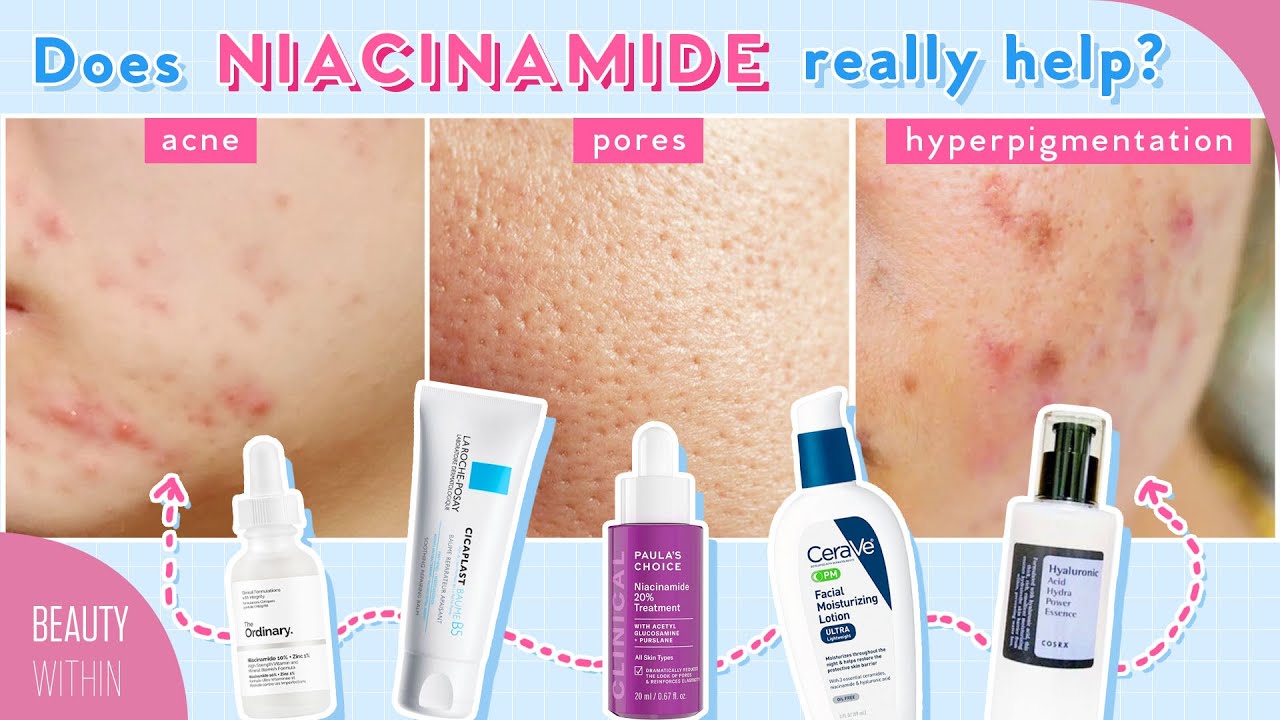
Stable reliable friend! (Fel: Yeah.) Like Felicia 🙂 *Fel is so touched* It’s okay. We stabilize each other. We’re the vitamin Cs and Bs. Hello our favorite people! And welcome back to Beauty Within. It’s your hosts, Felicia and Rowena. And it’s not often in skincare that you come across an ingredient that can offer benefits to ALL skin types and improve multiple skin conditions like hyperpigmentation, acne, balancing sebum, evening out those blotchy areas, and really strengthening the skin barrier and more all at once! But there is one that is called Niacinamide. We’re not gonna say that it’s going to work the same wonders for every single person out there. Because at the end of the day, we’re all very different. But if there were an ingredient that comes close like a superhero that doesn’t wear a cape, it would be the friendly and powerful vitamin B3 or niacinamide. (Fel: Yeah!) And we’ve discussed the basics of niacinamide in a previous video. But on top of that, today we also wanted to present to you all another very underrated vitamin that can work magic for the skin in the B family called panthenol, which is also known as vitamin B5. By the end of this episode, you’re going to know exactly how these two essential vitamins work on our skin, the truly magical benefits it can give, if you do happen to get irritated why this may be happening, and when and why we should all be trying to incorporate these two amazing ingredients into our skincare routine. Stat! So without further ado, let’s present to you niacinamide and panthenol! Starting off with my best friend in skincare! Sorry Ro. *Ro frowns* But the love is real when it comes to niacinamide. So as we mentioned, niacinamide is also known as nicotinamide. Which is also known as vitamin B3, which is a water-soluble vitamin. It’s an essential vitamin that our bodies need that we don’t produce ourselves. So we need to get it in foods that are high in niacin like liver or mushrooms. Nay to liver. Yay to mushrooms. Just, you know, it’s for the record. Liveeeeeer. Yuum! (Fel: Have you had liver?) I mean I’ve tried like (Fel: chicken liver.) fao fa fa fo (Fel: foie gras) like once and I’m like, “Mhmh I cannot!” And it’s also found in a lot of different types of food. And we convert the niacin into active niacinamide, which then acts as a precursor to coenzymes called NAD and NADP. Basically, these coenzymes are essential and helps us by boosting the cellular metabolism in our bodies. And in basic terms, this means that they give our skin cells the energy to carry out cell functions. And when we talk about skin, we’re talking a lot about the health of our cells. So cell functions include more than 40 biochemical processes! Including really important roles like repairing our DNA and cell turnover, which is, as we know, super important for youthful, clear, and glowing skin. Yes, cell turnover for liiife! But even though we can get niacinamide through our diet, because it is water soluble, it can’t be stored in our bodies for long. So applying niacinamide topically to the skin is the most effective way to really give our skin that boost and give it all the benefits that we previously mentioned. Now, what can it do when it’s applied to our skin? I think the question is, “What can’t it do?” (Fel: Seriously.) First, it helps with lightening hyperpigmentation and those dark spots and areas on our skin, as well as the overall brightening of our complexion. Niacinamide works as a tyrosinase inhibitor in the skin. And tyrosinase, we mentioned in our hyperpigmentation video, is the reason for pigmentation and the discoloration that forms on our skin. So niacinamide, when used topically, helps to make sure the cells aren’t holding onto too much pigment and reduce the transfer of the dark pigment from the melanocytes to the keratinocytes. So it essentially nips it at the bud! Right at the root of the hyperpigmentation problem. (Ro: Woo!) Woo! On top of that, not only can your acne marks, sunspots, and other forms of hyperpigmentation be lightened. But also because you’re applying it to the entire face, usually in a toner, serum, or moisturizing form, it will help to brighten the entire face, making it seem more glowing and radiant all around. And there are a lot of studies that support this benefit. One is a study that showed eighteen women using 5% niacinamide on one side of their face with a neutral vehicle on the other. And it was found that after eight weeks of use, there was significant lightening of hyperpigmentation on the side where the niacinamide was used. If you want a more solid breakdown of how exactly this works, we explain it all in the video we’ll list for you below. Next major benefit is that it helps with acne and balancing oils because niacinamide is proven to have antimicrobial and anti-inflammatory properties. And the amount that it can really help with this also comes down to the concentration and the specific product formulation. When we have breakouts, it’s usually because of inflammation going on inside, coupled with overactive sebum production in the sebaceous glands. All mixed with dead skin cells and bacteria! A chicka-chicka! What what! Party party! And one really important thing to know is that acne-prone skin actually has an acidic pH more than normal. And oily, acne-prone skin is also very low in an essential fatty acid known as linoleic acid. And this can be a component that causes the pores to get clogged and, therefore, create breakouts. So what niacinamide does is calm down the inflammation that can cause redness surrounding those areas, balances the skin’s pH level to control sebum secretion, and, therefore, really help with the healing of active breakouts. (Fel: Yeah.) So when you apply it, it’s like a “woosah” for the skin. Next is an essential one when it comes to skincare in general. And that’s skin barrier! Our skin is in itself a protective barrier. And within the skin, it has its own ecosystem of fatty acids, ceramides, bacteria, pH, [and] microbiome. All of these are alive and thriving. So our skin is a little civilization in and of itself. (Fel: Yeah.) So it’s like a city, and it has to be strong to protect and survive, right? And the skin barrier consists of the acid mantle, which acts as the barrier to these harmful external bacteria, viruses, and other contaminants like free radicals in the air that can really penetrate into our skin and cause damage. When the acid mantle is weak, it’s unable to protect us. And this is what leads to dry, cracked, [and] inflamed skin. And [it] can easily also lead to breakouts because more bacteria can enter. And this can also be the reason why you can have really dry skin but also be breaking out. And that’s something that you guys leave in the comments all the time. And it’s because the skin barrier isn’t strong enough. It’s already broken down, and the bacteria is coming in causing breakouts. So niacinamide helps by signaling to the skin cells, “Beep beep beep beep! Time to produce more ceramides and fatty acids!” It’s like morse code. Doo doo doo doo doooo! And with this, it will help rebuild the skin and retain the hydration in the deeper layers of our skin to keep it from evaporating away. So going into our favorite niacinamide products. There are a few because it’s one of those ingredients that you can find in a lot of different products throughout the routine. So the first one we want to mention is a new one! And it’s from Paula’s Choice: the Niacinamide 20% Treatment! Oooohoo! This is one of the most potent forms of niacinamide that’s out there on the market! (Fel: Yeah.) The highest we’ve used is the 10% from Paula’s Choice. And that one already works really really well. *Fel agrees* So this 20%, Paula specifically formulated for herself. And so already with the 10% booster, if you guys aren’t familiar. I use that in with my serums all the time. I mix it in with a moisturizer. I use it day and night. And it’s basically a holy grail in my skincare routine, any season. So this is just like, “I’ve graduated from that and I want more! I want a PhD! I want my masters in niacinamide!” This one specifically has the added benefit of vitamin C derivative, ascorbyl glucoside, formulated within it. This is probably the best way to use niacinamide AND vitamin C together. Because you know it’s designed in a way that’s especially beneficial to the skin and takes out any hesitation in whether they can be used together. Which is the biggest question out there. (Ro: Yeah.) “Can I use vitamin C and niacinamide?” Yes, you can. It’s also got other really awesome ingredients: the licorice root extract and the green tea leaf and flower extract, as well as the ECGC potent antioxidant that’s only found in green tea. And everything in this formula is actually very soothing and calming for the skin. Probably to go alongside that increased percentage of the niacinamide. Acetyl glucosamine is an ingredient that’s actually found in the space between our skin cells and has shown to work almost like niacinamide to increase moisture content in the skin. And so reducing dryness, as well as an increased elasticity. Boing boing! (Fel: Boing boinng!) And with all the ingredients in this working together, it’s like an even bigger boost in reducing hyperpigmentation and pores and any areas where there’s uneven skin tones. So it really just does it all at a maximum capacity. A personal favorite of mine is that it helps reduce huuuge pores! They’re like this big. (Ro: Yeah!) And they just like *shrinkity shrink* Yeah, and they’re so filled! So how you use it is you apply a few drops of this 20% niacinamide once or twice every day after cleansing, toning, and exfoliating. And I think if you don’t exfoliate and loosen the gunk, the product won’t be able to penetrate as well. And at night, you can layer with other treatment products as needed and follow with moisturizer. During the day, always always always finish with a sunscreen rated SPF 30 or greater. And, as always, if you haven’t used niacinamide before, then we definitely suggest starting at around at 5%. Because 2% to 5% also has been proven to give all the benefits. Ok! Another product that you probably will have seen [or] heard is The Ordinary Niacinamide 10% with Zinc 2%. This is a cult favorite. It’s very affordable. And with the addition of that 2% of zinc, this formulation helps more with the balancing of sebum production in the skin. So if you find that you’re maybe getting more of those combination symptoms, you know, the t-zone gets really oily and then your dry in other areas, then this could be something that you might want to try out. You can also use this morning at night after toning and before moisturizing. And this formula is very simple, very straightforward as you would really expect from The Ordinary products. (Ro: The Ordinary.) So you might not get as much of the other added antioxidant benefits as maybe the other formulation. But at the end of the day, [it] comes down to what you want to try out, what your skin needs at the time, and, of course, personal preference! As with all skincare. (Fel: Correct!) Next is the Good Molecules Niacinamide Toner. This is a toner that also includes brightening ingredients like vitamin C, arbutin, and licorice root extract. (Fel: Yeah.) And we used this one before (Ro: One of your faves.) Yeah. It’s just very simple to use – use at any time! (Ro: Yeah!) It heals the skin. And another product that’s also similar, but in a moisturizing form, is the CeraVe PM Lotion. And you’ll find niacinamide in the moisturizer. And this one has a really smooth consistency. It’s almost like a gel. It’s lightweight. And it’s also oil-free. And with this formulation, the niacinamide is paired with a bunch of ceramides, which CeraVe is known for. So it’s just great to use at any time for skin barrier. Skin barrier strong health! *yeaaaah* If you’re one of those people who have used niacinamide and it didn’t work, you might be wondering like, “What is the cause?” So there’s niacinamide and there’s also nicotinic acid. So nicotinic acid is actually the one that can cause vasodilation and cause that redness in the skin. But the thing to note, very simply, is that most skincare products use niacinamide and not nicotinic acid. It’s pretty safe in general. But if you have any of those symptoms, you might just want to look at the ingredients. And as with any ingredient, sometimes niacinamide will be [a] superstar, [Fel: it’s different.] and sometimes it will just be like, “Wait, why am I-” (Fel: Yeah.) Cause some of you guys comment too like, “Why doesn’t it work for me?” (Fel: Yeah.) Skincare. I know. (Ro: Life.) You just never know. (Ro: Life’s not fair!) Alright! Then we have vitamin B5. Also known as pantothenic acid. But we’re mostly familiar with panthenol. So what exactly is it? And why do we never hear of it? Pantothenic acid, or vitamin B5, is another essential nutrient that’s also present in our bodies naturally. And pantothenic acid helps us to gain energy from the foods we eat. As well as form red blood cells, synthesizes the nutrients in our body, and plays a key function for our adrenal functions. And adrenal is really important ’cause it has everything to do with regulating stress and the amount of salt in our body. It even regulates hormones and cholesterol production. So if you have high cholesterol, this is your jam. Which is why there’s a lot of vitamin B5 supplements. Then there’s panthenol, which is the derivative of pantothenic acid. Which is what we’ll see very commonly in our skincare. It’s also known as provitamin B5. And this is an ingredient that’s found literally everywhere. Seriously everywhere! It’s present in all the foods you eat, even honey. You can also find it in haircare, makeup, and pharmaceutical products like ointments for insect bites and cuts. Panthenol and pantothenic acid are relatively two sides of the same coin. Panthenol is the nutrient that enters our body and skin before it transfers into pantothenic acid. This is when the body takes in the vitamin B5 to let it work its magic ~ *vacuum it all in* Which skin types benefit from panthenol? Since this nutrient is so versatile and essential for body and skin functions, all skin types can benefit from panthenol, even babies! (Fel: Yeah.) What’s amazing though is that people with dry or flaky skin, and even people with acne, can find that vitamin B5 works especially well. So how does this nutrient work in the skin and in our skincare products? When panthenol’s applied to our skin, it’s like a supercharged version of one of our favorite ingredients: (Both: hyaluronic acid!!) It has humectant and emollient-like abilities to simultaneously deliver the moisture, soften the skin, and seal in all the moisture that’s in it. On top of that, once panthenol transforms to pantothenic acid, we start seeing more benefits to the skin. It improves skin moisture, decreases and prevents water from escaping out from our skin, which we know as transepidermal water loss or TEWL, and also aids in wound healing, and even helps calm inflammation down. According to a study conducted in 2011, it was found that products with formulation containing anywhere between 1% to 5% panthenol concentrations produce significant decreases in TEWL after 30-day applications. And what’s even more impressive is that TEWL levels were still reduced for two hours after washing the formulation off. Which means that panthenol is a really good ingredient for maintaining the status of that healthy skin barrier. This is really big news because dry and flaky skin types most likely have compromised skin barriers that cannot hold on to the moisture because it keeps escaping. So this is great! (Fel: Yes!) So when you see this in your skincare products, it’s there because it helps to reduce any form of irritation that could occur from using any of the other ingredients that are formulated in it. So it just helps to rebalance, stabilize, and calm the skin. Panthenol for liiiife! (Ro: Yeaaah!) Another benefit! Back to the good old acne-prone skin. There are a lot of videos that have claimed that taking pantothenic acid, like ingesting it, has helped to significantly reduce or even cure their acne . And some of them is pretty bad. It’s cystic. There was a published paper in 1995 that suggested pantothenic acid deficiency as one of the leading causes for acne. Although there wasn’t any real study conducted to confirm this theory. Then we also found a study in 2014 that tested this theory using subjects with mild to moderate acne. And what they found was that the group who took the pantothenic acid supplements for 12 weeks had significantly reduced inflammatory acne versus the group that took the placebo, or you know the sugar pill. So you can see ingesting it also really helps heal it from within. What’s also interesting about the study is that although the results showed that the supplements worked well to treat acne, it’s still not known how exactly pantothenic acid works in the body to lead to those effects. But what they believe is that the acid’s antibacterial and skin softening activity really helps to regulate the skin barrier function, which then leads to less breakouts. And because pantothenic acid is one of those nutrients that helps to regulate hormone levels, this is also why it might be so effective for acne. Seeing as acne formation is also highly related to hormone fluctuations. Can agree to that! The good thing is it’s actually very rare for someone to develop any reactions to panthenol because it is so versatile, it’s very safe to use, and it’s just naturally present in our bodies. But if this does happen for a very very small percentage of you, it usually comes out in the form of maybe a rash or some sort of atopic dermatitis. But usually we’d like to say you’d want to look at the other ingredients formulated because it might not actually be the panthenol. Now let’s talk about using vitamin B5 in our skincare routine. Here’s a tip to really boost your moisture levels to the max! Doll it up! On freshly cleaned skin, you can use a humectant product like glycerin [or] hyaluronic acid and fill it up with any product that contains a panthenol to really lock in all that moisture in your skin. So it’s usually, you know, moisturizers anyway. The first product we want to talk about is The Ordinary’s Hyaluronic acid and B5 Serum. So now we know that that’s vitamin B3 AND b5 in the serum (Ro: Yes!) that work together. Yes, as a skin barrier army. (Ro: supercharge.) So for this specific serum, as with most The Ordinary serums, it’s quite goopy [and] it’s quite thick. Compared to the La Roche-Posay Hyalu B5 that’s in the blue bottle that I used to really like. (Fel: Yeah.) The smell is just too overpowering. Yeah, it really is! That was the only reason I didn’t use that one, but I’m sure the benefits were really great. It was great! It was amazing! So now we know hyaluronic acid really works well with the vitamin B3 and the vitamin B5 as a collective family. (Ro: Yes!) Skipping together on the field! And then there’s also the Paula’s Choice Hyaluronic Acid Booster. You know we are absolute fans of the whole booster series because it just really helps at any given stage of your routine where you just feel like you need a little more of a pick-me-up just literally to boost your products. So after doing some research on vitamin B5, because my dad has really high cholesterol, I was like, “Dad, you better start taking some vitamin B supplements!” Because it helps with reducing the bad cholesterol and the bad fats and increase the good ones! And recently, we also got sent the ZitSticka Skin Discipline Supplements. And then I looked at the back and it’s all vitamin b3/b5 – (Ro: It’s so cool too!) ’cause it’s like suspended – (Fel: Yeah!) in like liquid oil. (Fel: It’s like a clear liquid.) Yeah. Okay, so it’s really great because it smells minty! (Ro: Ohh!) Yeah! Not like those nasty kind of like fishy vibes that you get. But it still takes you like 10 years to swallow it. It does, but the minty refreshing smell really adds to the ease of swallowing I guess. I turned around one day, and Felicia’s just like *gag* and then puts the pill on her desk ’cause she’s like, “If I don’t take it out, the shell is gonna melt in my mouth!” Can you imagine it would just burst in your mouth? And that would be horrifying! And then she had the look of absolute utter defeat on her face! Just like, “I’ll try again later.” (Fel: “I’ll try again.”) *sad tears* World’s smallest violin! Yeah, but I’m really excited to give that one a month’s trial. I’ll get back to you. Maybe I’ll put it in the notes below. Because yeah, it’s just all vitamin B. But if you’re curious, just always ask your medical professional [or] your doctor. Because it won’t work with everyone in the same way. Alright, so that wraps up the vitamin B family! There’s actually a lot more vitamin Bs within said B family (Fel: Yeah.) like biotin and a lot of things that we might actually be familiar with. But we just feel like for skin, it’s more vitamin B3 and vitamin B5 that you will see a lot of (Fel: Yeah.) and that’s actually directly beneficial. (Fel: Yes, to your skin.) Biotin will just make your – the hairs on your skin grow. (Fel: The hairs [and] the nails.) Yeah, ’cause it stimulates the passage ways in that it connects. So just a thing to note as we’re on our way out. The vitamin B3 and 5 are very stable. So vitamin A is not that it’s unstable, but can cause a lot of side effects like drying . While vitamin C is just super unstable to air. Temperamental! (Fel: Temperamental, yeah.) And that we were also reading a study where you have to actually heat vitamin B3, the niacinamide, up to 120 degrees over like 72 hours in order for it to change to niacin. So it’s actually very hard for it to go rancid or oxidize. (Ro: Yeah.) Stable reliable friend! (Fel: Yeah.) Like Felicia 🙂 *so touched* It’s okay. We stabilize each other. We’re the vitamin Cs and Bs and As. And the dry and the oily. (Fel: Correct!) And the wet. Wow. So that’s it for vitamin B! If you have any questions, leave them below. And we’ll see you in the next episode. Byeee! Byeeee! Byeeeee! *Thank you for watching <3*