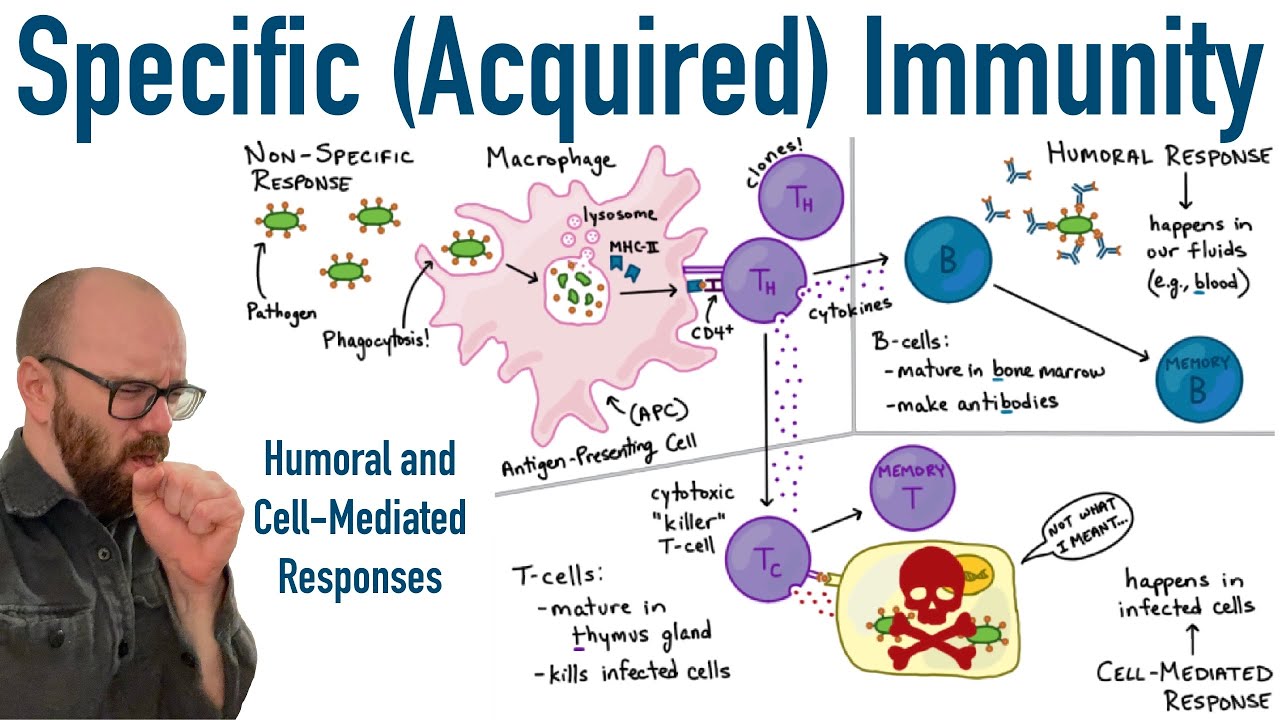
CORRECTION: What I labeled “CD4+” in the diagram is actually the “TCR,” which stands for “T-Cell Receptor.” The CD4 glycoprotein is a coreceptor with the TCR, but it’s not shown in my diagram.
—–
📗 MY COMPLETE GUIDE to the LYMPHATIC & IMMUNE SYSTEMS 🦠
The Complete Guide to the Lymphatic & Immune Systems (ebook)
🧑🏽🎓Learning anatomy & physiology? Check out these resources I’ve made to help you learn! ↙️
📗 FREE A&P SURVIVAL GUIDE 🧠
https://siebertscience.ck.page/anatomysurvivalguide
📘 A&P STUDY CARDS 🫀
Anatomy & Physiology Study Cards
🫁 COMPLETE LIST OF ALL MY A&P VIDEOS 💀
https://www.siebertscience.com/science/anatomy-physiology
🧠 COMPREHENSIVE A&P SYSTEM GUIDES 👀
https://store.siebertscience.com
—–
🩻 Support the channel and get access to blank and labeled diagrams for all of my anatomy & physiology videos! – https://www.patreon.com/siebertscience
—–
This is how our bodies learn to identify a new pathogen and develop immunity to that pathogen in the future.
0:00 Introduction
0:48 A Wild Pathogen Appears!
2:11 Phagocytosis and Presenting the Antigen
3:27 T-Helper Cells
4:29 Humoral Response (B-Cells and Antibodies!)
7:07 Cell-Mediated Response (Killer T-Cells!)
9:18 Recap
11:13 More bad acting…
_____
Image used:
“6VSB spike protein SARS-CoV-2 monomer in homotrimer” https://commons.wikimedia.org/wiki/File:6VSB_spike_protein_SARS-CoV-2_monomer_in_homotrimer.png, 5-HT2AR, CC0, via Wikimedia Commons
hey everyone i gotta admit i’m feeling pretty sick today i feel kind of achy all over whatever virus or bacteria got into my bloodstream it had to make it past my innate immune defenses my skin my stomach acid if it got in that way a bunch of white blood cells like neutrophils and natural killer cells somehow it’s lingered on past all of those sorry but the good thing is that i’ve got specific immunity that’s developing right now so hopefully i won’t have a problem with it next time so this video is all about specific immunity or adaptive immunity my immune system is learning how to fight off this particular pathogen calling in the big guns you might say so let’s jump to the the white board or whatever and get started so let’s say we have a pathogen invading the body it could be a bacteria it could be a virus but it’s something in our bodies that shouldn’t be there i’ve got the pathogens drawn in green and on the surface of the pathogens i have these little orange circles which are the antigens antigens are just little proteins that are on the surface of the pathogen that we can use to identify what that pathogen is all of the bacteria and viruses that can make it into our body have different antigens that present on their surface and so if we can learn to recognize each bacteria or viruses antigens we can fight off that specific bacteria or virus and that’s what this whole process is about learning to recognize a particular virus or bacteria and then recruiting cells that are ready to fight it off as quickly as possible now in this diagram on the top left we have a non-specific response that means that this top left part of the diagram all the stuff that happens there would happen no matter what the pathogen is that’s entered into our body it could be this specific one i’ve got drawn in green or it could be covet or it could be chickenpox it could be anything then we have a humoral response as well as a cell mediated response those are both specific immune responses meaning that we’re going to develop some cells there that are specific to this pathogen it’s like they’re just going to train in fighting off this one pathogen and not worry about anything else they’re going to be specific to this pathogen and so this is all about converting from our non-specific response to our more effective specific responses to the pathogen so the first thing that’s going to happen is we’re going to have a special cell called a macrophage macro means big and phage means to eat so this literally means a big cell that’s going to eat the bacteria or the pathogen that’s invaded our body you can see it wrapping its cell membrane around that pathogen in a process called endocytosis we call it specifically phagocytosis and phago just meaning to eat and cyto meaning a cell so this literally means to eat another cell so that macrophage or big eater cell is going to phagocyticize the bacteria and it’s going to store it in what we call a vacuole at that point it’s going to take these little compartments called lysosomes that are filled with enzymes and it’s going to inject those enzymes into the vacuole and those enzymes are going to break apart that pathogen it’s going to break it into little pieces and some of those pieces will be the antigens that are found on the surface of the pathogen the macrophage is going to have a specialized protein which is called mhc2 or major histocompatibility complex 2 and that mhc2 protein is going to grab onto some of those antigens and present those antigens on the surface of the macrophage because they’re presenting this antigen or saying hey here’s how you can recognize this pathogen we’re going to call the macrophage an antigen presenting cell it’s presenting the antigen now once the macrophage is presenting this antigen another cell is going to come along called a t helper cell now the macrophage and the t helper cell are both white blood cells they’re just different types of white blood cells and the t helper cell is going to use its specialized protein called cd4 plus to recognize and learn what that antigen looks like now on the diagram i drew that as an orange circle but in reality it’s detecting the shape of it it’s not just going to be a circle like that it’s going to be a protein which folds lots and lots of times to make these really complex and strange shapes it’s learning what that shape is at that point this t helper cell which now knows what the antigen looks like so it could recognize the pathogen it’s going to clone itself it’s going to make a whole bunch of copies of itself because the more of these t helper cells that we have the better we’re going to be able to fight off the bacteria or virus that’s entered the body now again these t helper cells have just learned the specific pathogen what it looks like so we’re now into what we call specific immunity which is going to be this humoral response and our cell mediated response okay so all of these t helper cells they’re going to go around now and release something called cytokines so cytokines are these little chemicals cyto means cell and kine or kina means to move and so these are gonna sort of move other cells into action that’s where they get the name cytokines they cause cells to move into action one of the cells these get released to are called b cells now for b cells which are another type of white blood cell you need to remember the three b’s the first b is that these mature or differentiate and become b cells in the bone marrow t cells although all white blood cells come from the bone marrow originally t cells are going to develop or mature into t cells in the thymus gland hence the name t so b cells bone marrow t cells thymus gland that’s where they get their names the second b is that b cells are going to make antibodies b for bodies and antibodies that b cells make are going to be specific for the pathogen that we’re trying to fight off the b cell has learned what this pathogen looks like it’s been called into action by the t helper cells and their cytokines and it’s going to make antibodies they’re going to latch on to this specific pathogen now this needs to be specific because if it wasn’t if this b cell was making antibodies it latched on to just any old protein on the surface of a cell and that would be attacking our red blood cells it would be attacking our normal healthy cells that would be bad so this has to make antibodies that are specific for this pathogen now that’ll do a couple things one it’s going to neutralize this pathogen think about it if that pathogen is covered in these antibodies then it can’t infect other cells and it can’t grow it can’t do any of the things it normally would do in our bodies having these antibodies also makes it a target for some of our own cells if other macrophages or natural killer cells or neutrophils come along and they see something with a bunch of antibodies attached to it they know it’s time to strike so other cells will kill off this pathogen more easily because of the antibodies the third b to remember is that this happens in the fluids of our body and an example of that would be our blood that’s what humoral response means humoral means happening in our fluids so that includes our blood but also includes our lymphatic system our lymph nodes and lymph vessels as well as the interstitial fluid which is all the fluid like between the cells throughout our body so remember for b cells they mature in the bone marrow they make antibodies and this all happens in our blood now this is all well and good we’re going to fight off this pathogen really well with our newly specialized b cells that are making antibodies for that pathogen but we want to be able to fight off this bacteria or virus again in the future and not have to get sick again so a lot of these b cells are going to stick around as what we call memory b cells they’re just going to be chilling in our body hanging out ready to fight off that pathogen if it ever makes it into our bodies again we’re waiting for you so that’s our humoral response and we’re gonna be ready to fight off that pathogen again if it ever gets into our body let’s say a year or two down the road now this is all happening in the fluids of our body but unfortunately some of our cells may have already been infected and the antibodies can’t really make it into our infected cells to fight off the pathogen that’s infected those cells so we have to have a separate system or a separate response which is going to take care of our cells that have already been infected so here we have a normal cell in the body this could be a skin cell or a digestive system cell or whatever cell in the body and it’s been infected with this bacteria or virus so we have to do something about that this is especially important for viruses because what viruses do is they make it into our own cells and they’ll use the machinery of our cells like ribosomes and stuff in order to make lots of copies of themselves then they’ll kill the cell burst open and go infect a bunch of other cells so if we’re able to neutralize this before the virus is ever able to make copies of itself in infected cells then we’re gonna be able to fight off this viral infection a lot more effectively now our infected cell won’t call for help like this but it will present some of the antigens from those pathogens on the surface of it it’s sort of a call for help so our t helper cells during this are going to be releasing cytokines which are going to stimulate cytotoxic t cells into action the cytotoxic t cells are going to detect this antigen which is presenting on the surface of our infected cell and that’s how it’s going to know that this is a cell that it needs to neutralize so a couple things to remember about t cells t cells mature in the thymus gland that’s where they get the name t cell and what they do is they kill infected cells and so this is going to release these specialized chemicals called perforins which will break open the cell membrane and a bunch of enzymes as well which are going to kill this infected cell for infected cell this is not how you probably thought the story was going to end it’s a tragic ending for our infected cells but for us it’s a happy ending because it’s better off if these cells die if we can kill them off really quickly before this virus is able to replicate and destroy the rest of our cells so bad for that cell good for us and so some of those are going to stick around is what we call memory t cells so if we get sick in the future these are ready lying in wait to fight off that particular pathogen we’re waiting for you and so that’s how we go from a non-specific response to developing immunity to some bacteria or virus that we’ve been exposed to in the past all right let’s do a quick recap so we’ve got some pathogen that’s entered into the body and a macrophage or dendritic cell is going to phagocytosize or eat that bacteria or pathogen then it’s going to release enzymes from lysosomes those enzymes will break that pathogen apart into its little pieces a specialized protein in our macrophages called an mhc2 is going to grab on to the antigens and it’s going to present those antigens on the surface of the macrophage or dendritic cell which we call antigen presenting cells because they’re presenting the antigen t helper cells are going to come along and the t helper cells will use cd4 plus their specialized protein to detect the shape of that antigen once they know the shape of that antigen they’re going to start cloning themselves so we have a whole bunch of t helper cells that know what that antigen looks like the t helper cells are going to release cytokines to stimulate b cells to make antibodies and those antibodies will be specific to that pathogen they’ll neutralize it by locking on to it as well as make it easier for other cells such as macrophages and neutrophils to destroy that pathogen some of those b cells will stick around as memory b cells so we can fight off this pathogen in the future and remember the three b’s of b cells they mature in the bone marrow they make antibodies and all this happens in our fluids particularly our blood that’s our humoral response now onto the cell mediated response which is what we do to cells that have already been infected by this pathogen the t helper cells release cytokines to stimulate cytotoxic or killer t cells the killer t cells will detect which cells have been infected by looking for antigens presenting on the surface of those infected cells once they detect one they’ll release perforins which poke holes into the cell membrane as well as enzymes which will make it into the cell and destroy that cell so that bacteria or virus can’t replicate within that cell and can’t go out to infect other cells in the body t cells of course mature in the thymus gland which is where they get the name t and some of those t cells are going to stick around as memory t cells so their body is able to fight off this pathogen again in the future without having to go through all this process and getting sick again so how convincing was my fake coughing and fake sickness do i have a career in acting all right thanks for watching good luck fighting off those pathogens