Unwrap the truth about your food 👉 Get the ZOE app https://joinzoe.onelink.me/XebC/9r7grdmf
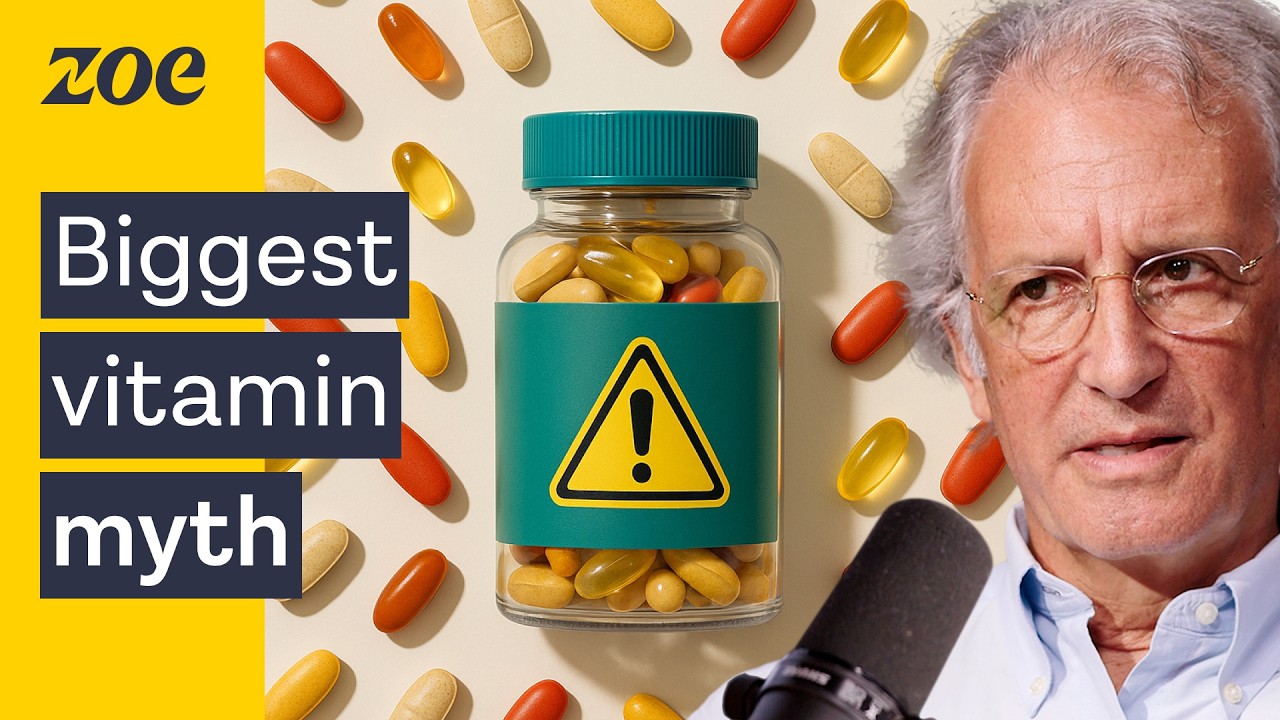
We’re told vitamins are essential for our health. That they boost our immune systems, fight fatigue, and protect us from disease. But what if most of it isn’t true?
In the 20th century, vitamin supplements were hailed as a breakthrough, curing diseases like scurvy and rickets. But that success story took a turn. In the US, a law passed in 1994 — helped by a Hollywood ad campaign — removed almost all oversight from the supplement industry. Since then, a $40 billion business has grown in the shadows. One where marketing beats science, and health claims are made with barely any evidence.
Dr. David Seres is Director of Medical Nutrition and a Professor at Columbia University’s Institute of Human Nutrition. David is known for calling out pseudoscience and misinformation, and promoting critical thinking and an evidence-based approach to health.
For over 25 years, he’s worked as a physician nutrition specialist, caring for critically ill patients who rely on life-saving nutrition support. He received the Excellence in Nutrition Education Award from the American Society for Nutrition. In this episode, he helps us debunk the vitamin supplement industry.
🌱 Try our new plant based wholefood supplement – Daily30: https://zoe.com/daily30?utm_medium=zoe_podcast&utm_source=podcast_platform&utm_campaign=d30
*Naturally high in copper which contributes to normal energy yielding metabolism and the normal function of the immune system
Follow ZOE on Instagram | https://www.instagram.com/zoe/
Timecodes
00:00 The marketing trick vitamin companies use to fool you
02:03 Did Mel Gibson really help deregulate vitamins?
03:57 How vitamins went from miracle cures to a $40 billion industry
06:06 The shocking story of the anti-regulation ad that beat the Vietnam War
07:40 The legal loophole that lets supplements claim they ‘support heart health’
08:38 Why supplements don’t need the same proof as drugs
11:10 In the US, there is no one checking supplement claims
12:14 Can you just make up a health claim and sell a pill?
14:42 How companies twist ‘petri dish’ science to sell you products
16:40 The vitamin that unexpectedly increased cancer risk by 18%
18:41 An easy way to understand why most health studies are wrong
20:30 How a memory supplement company manipulated its own study for 7 years
22:50 The only type of study you should trust for health advice
26:31 Why does scientific advice on health keep changing?
30:25 The popular diet advice I used to give that was completely wrong
32:14 The only time you should be taking a vitamin supplement
33:40 Does vitamin C actually do anything for you?
34:37 The truth behind vitamin D ‘insufficiency’
36:29 Can taking too much vitamin D be dangerous?
37:50 Do vitamins help even the most critically ill patients?
42:42 What about taking a multivitamin when you get older?
45:35 Are probiotics a waste of money?
48:25 What is the single best way to eat for your health?
51:12 Why we still don’t have perfect evidence for the ‘best’ diet
52:57 The one thing you should do tomorrow for your health
📚Books by our ZOE Scientists
The Food For Life Cookbook | https://amzn.to/4amfIMX
Every Body Should Know This by Dr Federica Amati | https://amzn.to/4blJsLg
Food For Life by Prof. Tim Spector | https://amzn.to/4amZinu
Free resources from ZOE:
Live Healthier: Top 10 Tips From ZOE Science & Nutrition | https://zoe.com/freeguide
Gut Guide – For a Healthier Microbiome in Weeks | https://zoe.com/gutguide
Have feedback or a topic you’d like us to cover? Let us know here: https://gf6hx47iu5g.typeform.com/topicsuggestion
Episode transcripts are available here: https://zoe.com/learn/category/podcasts
The biggest myth about vitamin supplements is that vitamins are nutrients, so therefore they must be safe. And it’s not true. It’s not true. For example, vitamin D at high doses can be very toxic, potentially even deadly, and they’re available without any safety testing. Then what should we be taking? Dr. David Sears is director of medical nutrition and a professor at Columbia University’s Institute of Human Nutrition. For over 25 years, he’s worked as a physician nutrition specialist caring for critically ill patients. In this episode, he exposes the cracks in the vitamin industry and reveals what could really work to improve your health. Vitamins have been held out as something that will give you extended health and longevity. And the advertising often says supported by dozens of studies. Men with prostate cancer were seen to have low levels of vitamin E. And so a study was done where people were given vitamin E, but they had about 18% increased rate of prostate cancer. You got those low levels because of the prostate cancer, not that the low levels caused it. It’s only through manipulation of the statistics that they can say vitamins supports heart health or supports brain health. So final question, David. Sure. Everyone knows that that’s vitamin C that’s really good for you. Surely that’s an exception, isn’t it? [Music] David, thank you so much for joining me today. Oh, it’s such a pleasure to be here. Thank you so much. I’m so honored to be asked. So, we have a tradition here at Zoey. We always start with a quick fire round of questions from our listeners. Are you up for that? Sure, fire away. And we have some quite strict rules, especially for professors. You can only say yes or no or a one-s sentence answer if you absolutely have to. Okay. Did Mel Gibson help deregulate vitamins in the US? Yes. Can supplements make health claims without real proof? Yes. Did scientists contribute to an obesity crisis by fearing fat? Maybe. Can supplements be sold in the US without approval from public health bodies? Yes. Pretty amazing. Final question. What’s the biggest myth about vitamin supplements? The biggest myth about vitamin supplements is that if some is good, more must be better and will have health benefit and will be safe. And it’s not true. It’s not true. I love it. I think those were some rather remarkable answers to the Q&A. Mel Gibson has never made it into the Zoey podcast before. I love it. So, all quite startling and I’d like to start maybe at the beginning of this sort of supplement story because I understand when they were first discovered like vitamins were a real breakthrough. They like fix deadly diseases. You know, I was brought up at school in England, they talked about like scurvy and like sailors would die and they discover vitamins. I mean the whole the whole nickname of of British sailors as limeies was because they ate limes and they ate limes because it cured scurvy because there’s vitamin C in limes and there wasn’t vitamin C in the usual diet of a sailor. So that is like a brilliant example about how vitamins can save lives and there are many others like the B vitamins that are added to breads and so forth at least in the US. So what’s interesting is today we’re in a place where this supplementation is hugely widespread right in the healthy population. Yeah. And the research team here at Zoe said it’s now a $40 billion industry. And so I would really like to understand with you like how we got here and maybe we could just start with like what these vitamins were originally designed to treat and how successful they were. Sure. The history of vitamins is miraculous because there were different deficiencies in different populations in the world. Iodine included uh which would cause goer and cretinism in children. Vitamin D as I mentioned which caused ricketetts, vitamin C in sailors etc. And each one of these was an enormous public health boon. I think that ever since then we’ve been waiting for the next big huge discovery around vitamins and there I think we there aren’t any left that we are aware of. Why do you think that the promise of vitamins has become so like attractive for people who view themselves as healthy and who are not suffering from you know a deficiency that they’re aware of or a doctor has told them they have. There’s a a general feeling in being human that one would like to control one’s destiny and and and health is this mysterious black box that if you are able to do something now that will give you extended health and longevity that’s very attractive to be able to do that and vitamins have been held out as this without good proof but nonetheless the ability to market them in the way that they’re marketed suggestive of health benefits has fueled this. So when did they move from being this sort of niche thing to treat a particular disease to sort of wide spread usage here in the states I think it was probably a gradual sort of thing. I know that in the ‘9s a a law was passed uh to deregulate the industry, but at the time there was already enough money in the industry to have made large donations to political campaigns and so forth in order to promote the uh passage of the law. Is that where Mel Gibson comes in who you mentioned at the beginning? Could you tell me about that? There was a bipartisan effort to pass this law called the Dietary Supplement Health and Education Act of 1995 and DSHA or Da as some people call it. And the primary promoters got people to believe that this was nutrition and it was nourishing. And people also believed that the FDA was trying to regulate these substances uh when in fact no such effort was under ongoing and Mel Gibson was uh hired to do a commercial uh in which he is uh in his home in his kitchen in his bathrobe surprised by a SWAT team arresting him because he’s got vitamins and he called for people to write to Congress and that advertising campaign got more letters written to Congress than the entire Vietnam War. Wow. It was very successful. So the ad was saying that I was going to like have my vitamin C taken away. Yes. What was this legislation going to do? So this legislation essentially deregulates what the anything brought to market that’s called a a dietary supplement. And by that it takes away the ability for the US Food and Drug Administration to regulate these substances and left specific ways in which the supplements were allowed to advertise suggestively. So it’s actually written into this that you can say it that this stuff supports heart health or supports brain health without really any direct evidence of it. So that’s written into the legislation. It says we agree that when you sell this supplement you can say it supports heart health. I think that the actual wording may not be there, but these have been agreed to in subsequent rule passing, but these are called structure and functional claims. It’s complicated as to how to actually interpret that, which actually makes it harder to to to regulate, but suffice it to say that they’re still not allowed to say that they treat or cure any kind of a disease unless it’s been approved by the FDA. And so they are allowed to make these health claims. that different from what would happen if you were a drug or if you were something else in terms of the claims you can make? Couldn’t be more different. So a drug company has to undergo a series of randomized control trials which where where people are randomly assigned to either the drug or a standard treatment or a placebo and studied over time to determine whether or not the product does what it’s supposed to do. And then that research has to pass muster with the FDA in order to be allowed to be sold as a medication or a drug. Dietary supplements are treated as if they were a completely different thing where they are nutrients. So therefore, they must be safe. Thus, we don’t want to deprive people of the ability to access them. And so they’re available without any science necessary, without any proof of benefit necessary. And frankly without any safety testing although there is some accountability if something is dangerous. I think it’s a bit shocking everything that you just said David. Yeah. And so basically there was this law supported by this brilliant piece of advertising which was presumably funded by the industry presumably. Uh and one can find that on Google. Just put Mel Gibson in dietary supplements. And so suddenly they are carved out from the way that you would treat drugs. but also sort of given sort of permission to make claims here, right, in a very different way, right? I’d like to get on to that in a minute, but before we do that, do you think that most Americans understand how unregulated this industry is? I I don’t think so. No. What do you think the impact is therefore on people’s behavior and and their health as a result of this? There’s a $40 billion industry. There are statistics on how many people take dietary supplements and it’s astounding. I I’d have to look it up. I don’t recall the exact amount, but but more than half of Americans take some form of a dietary supplement. Now, I know that there are differences between like the regulations here in the States and elsewhere. The team says that in the European Union, in the UK, which is still basically following the same rules as as in the EU, apparently the European Food Safety Authority has rejected over 90% of submitted claims since it was formed in 2008. Is there anything equivalent in the states that is like looking at these claims and rejecting them or accepting them? There’s no requirement for submission of a claim to be able to sell these products. So I am not aware of any similar kind of commission. So what would prevent you from saying take this pill, it’s going to, you know, make your heart healthier? What does in fact in any way Well, you have to say it supports your heart health. But I I could be very wealthy. I’m a I’m a wellestablished credible nutrition physician, scientist, etc., etc. I could very easily take my credibility, put it on a label, and sell crushed up rose hips and tell you that it it supports your kidney health and make a lot of money. There’s really nothing that precludes that. And does it support your kidney health? There’s not any direct evidence that taking extra vitamin C or rose hips has any benefit for the kidneys. So you’re basically saying you could make a claim that you think makes no sense in science and that’s fine. That’s pretty close to it. Yes. Fascinating. There has to be some indirect evidence that I mean for instance people who have kidney stones or bladder infections. There is some evidence that that increasing the acid level in your urine might help either of those. But there is no direct evidence of doing so by taking vitamin C has any benefit. In fact, the the studies of uh cranberry juice and cranberry juice concentrate uh supplementation for urinary tract infections have been pretty much u uh disappointing. So we’ve got this huge industry which is also extraordinarily unregulated given that it’s able to make claims around health originally built on this very legitimate case of like treating diseases and even now I mean we talked a lot a lot about the skepticism but I think that there are certain people and stages of life when physicians do recommend vitamins and that’s important. Maybe we should talk about that for a second in this context. And I’ll be honest, I I’m taking vitamin B12 because I actually developed a deficiency. And so I’m not suggesting that in certain situations, vitamins aren’t absolutely necessary, but for the general healthy population, less so. Can I be honest? It’ll just take a second. Creating this show takes a lot. research, interviews, editing, all of it week after week. But we do it because we believe in it. We want to help millions of people live healthier lives. And if you’re still watching, it probably means we’re doing something right. So if you believe in this, too, just hit that subscribe button. It’s small for you, but it means the world to us. Now, let’s get back to the show. So, I’d love to discuss how we’ve gone from these vitamins for people who have a deficiency to this much broader market where they’re being sold sort of with all of these claims and what’s really going on so that you can understand it because I think what happens is it’s very hard to differentiate between products that actually work and maybe even, you know, medicines and those that haven’t. Could you just help me to understand like how the science is being used to, you know, sort of trick someone and contrast that with what you would view as like the right way to do the science? Sure. A couple things. Um, first of all, the some of the evidence might come out of a petri dish where a cell might react to a substance and and then that cell being part of an organ system that you can sort of take very indirect evidence like that to to say, well, it is involved in the normal biology of this this tissue, so therefore it supports that tissue. I mean, that sounds good. What’s wrong with that? Well, the the problem with that is that it’s indirect evidence and biology is very complicated. It’s it’s it’s incredibly wonderfully complicated and that that if there’s one reaction to a certain perturbation, there’s bound to be other counterreactions in order to keep things smooth. And so I like to say that if you do A and get B and do B and get C and do C and get D, the likelihood of doing A and getting D is close to zero because of all the intervening processes that that that can happen. It’s never it’s never a straight line in biology. You could see something like in a like a sort of petri dish, you know, like when I was at school doing, you know, biology and I can show that I add this one chemical and something happens to one cell, but that isn’t the same as saying that if I take this ingredient like as a human being every day that suddenly I’m less likely to get dementia. Right? So the the other problem beyond that the biology is complicated is that there’s a lot of good evidence that anything that’s an association that’s found in nutrition between a level and some sort of health outcome um that those associations are actually more likely due to the underlying condition than they are due to the level of the nutrient. So let me give you an example. Men with prostate cancer were seen to have low levels of vitamin E and selenium. And so a study was done, a proper study over 10 years where people were given vitamin E, selenium, both or a placebo. And anyone who received either vitamin E or selenium had a about 18% increased rate of prostate cancer. So the decreased levels that were seen were due to the cancer itself, not a cause of the cancer. And subsequent studies have shown not only that there’s a a causal relationship between vitamin E, selenium, and prostate cancer, but also uh uh cancer recurrence. So you’re saying they like measured people who had prostate cancer and they discovered that they were low in you said selenium and vitamin E. Vitamin E and they’re like, “Oh, that looks bad. So, what about if we supplement people who don’t yet have prostate cancer and hopefully that will mean they don’t get prostate cancer.” They did a big study where they also compared it with people who didn’t get any of these intervention and they got the exact opposite of what they expected, which is if you took the selenium and the vitamin E, you actually increased your chance of getting prostate cancer. That’s precisely correct. And this was a very large study. It was, I think, 30,000 men over 10 years. It’s called the Ohio Men’s Study. and up until recently at least it was uh posted on the National Cancer Institute website as a precautionary tale and there are many more. Help us to understand that because I think a lot of people listening to that will be like well that doesn’t sound right. You were low on this thing and now we’re giving people higher amounts so surely that must stop you getting prostate. Well, it doesn’t work that way because you have to at least conceive of the notion that you got those low levels because of the prostate cancer. not that the low levels caused it. So it could work both ways and in this case it absolutely showed that the low levels did not cause the prostate cancer. So this example might be we were discussing before that we were both a bit grayer than we were maybe when we were younger. So you might say ah people who are getting grayer hair are getting older. So if we just stop you getting gray hair you won’t age. But we’re both laughing because it’s obvious that even if you stopped us getting gray hair we’re going to keep aging. Well, take it to the extreme. The more times you breathe, the closer you are to dying. Thus, please stop breathing because I’d like you to live for a long time. And there are so many different examples of this happening in in in biology and in nutrition specifically. And so, how does this link back to the claims around vitamins? And so you’re explaining how these vitamin companies take something in a petri dish and then they make a claim about how it’s great to take this vitamin. And I think you were then using, you know, this example with prostate cancer to show how that doesn’t work. How does that turn out for real in a claim that I might see in a supplement, you know, at the drugstore? Well, you’ll never see that kind of science reflected in those claims because there’s no requirement that those claims are any more than suggestive. And are there other ways that the supplement industry might use science in a way that sort of deceives you versus like the reality of what’s going on? The advertising um often says supported by dozens of studies or has been studied by Unfortunately, one of the only ways to regulate any of this is through legal action in the US. And the only way to bring legal action is if there’s fraudulent advertising or they break the rules and make claims directly about a disease. Uh, one such example was a memory supplement that it that was litigated for seven years and finally the company lost their appeal and and lost in in court and has changed their advertising. But they for the longest time claimed that the reason that they could say that they helped memory was based on a study that was done. they did something that was completely improper from a statistical perspective. If you take a a large enough data set and analyze it enough times, you’ll find something. It’s a statistical certainty that you’ll find something that is statistically significant but not relevant and not properly statistically significant. So they took a subgroup of findings in this study that they had done. It was a randomized trial, but the the the overall outcome which was based on validated scoring which only included the whole thing that it showed nothing but that these subgroups that they found, they found after 30 or 40 uh subgroup analyses, they found two that went in the right direction, which made no sense if you looked at which ones were and were not statistically significant. But they thought they could then claim that they had good evidence that they that they improved memory. It was a biological impossibility that this product would work. It was a protein and proteins don’t get out of the intestine intact and they most certainly don’t get into the brain intact. There are barriers that biology has provided to prevent that from happening. So it really had no chance of working. And David, cuz that’s like a really strong story. Are we sure that they don’t work? You’re saying that they like they said, “Hey, we’ve done this study. We’ve got these results. We’ve claimed that this memory pill is going to make your memory pill better.” Like, yes, we’re sure their study, which was done properly in a large group uh and in a validated uh memory score failed. And it’s only through manipulation of the statistics that they were able to claim any benefit. What we really want is a study that gives us information that’s actionable, gives us information that talks to us about cause and effect. So the majority of research that people hear about on the evening news and and so forth is what we call observational. Observational research takes two things to see if they both occur at the same frequency or a similar frequency in a certain situation. So thus, do men with prostate cancer have lower vitamin E levels? Yes, they do. But the problem is, as I’ve discussed, that cause and effect. And in this situation, it’s been shown that the low levels are the effect of the underlying condition, not the cause. In order to be able to speak to cause and effect, you need to do what’s called a randomized trial. And a randomized trial takes a population and randomly assigns them to a treatment or a standard of care or a placebo, which is a, you know, like a sugar pill. If that’s the only thing that’s different between the two groups to see whether or not that thing works. Now, biology is complicated. I’ve said this before. people are very heterogeneous in their makeup and their their genetics and their underlying conditions and their you know all of the different things of their environment and their socioeconomic status. And so in order to sort of smooth that out, instead of having white rats that are all of the same genetic makeup, what we have to do is do large studies in order to drown out the potential confounding variables such as I’ve mentioned. And so I’m guessing you’re going to tell me that most people selling supplements do not do randomized trials of their supplement before they sell it. That’s correct. Is it quite common nonetheless to do randomized trials for your supplement? It’s actually fairly common to find randomized trials done, but usually it’s by scientists. It may sometimes be, you know, supported by the industry, but um the results of most of those studies have failed to show benefit in the in the general healthy population for any of these supplements. Many supplements now have many different things in them, don’t they? They’re not just a vitamin. There’s lots of different things. What’s the difference between the randomized trial you’re describing and saying this is based on science and I’ve got papers against these ingredients. Sure, because that sounds good. Well, it does and that’s how it’s easily used to sell, but you’re corrupting the science to say that because let me let me explain it a little bit differently. There’s a lot of data and a lot of data is observational and showing these correlations versus doing good randomized trials which show which lead to better conclusions around cause and effect. And what’s also confusing is that yes, okay, maybe it is based on science, but at what level is it? Is it science in a petri dish or is it real actual science in real people or even in animals to show the health benefit from giving more of a substance? So we talked a lot I guess about there have been issues around claims around supplements. I guess it’s also true that one of the reasons that there’s like mistrust around science is that scientists can also make mistakes, right? And they can change their mind and say that we said something in the past and now we said something now. And I think that that can cause a lot of like loss of trust amongst the public. I’m glad you raised this because uh it’s it’s one of the things that I think we’re suffering from as a society to a great extent to the point where being an expert immediately makes you suspect. You know that people think that that you’re just in it for the money or you’re in cahoots with the drug companies or or whatever. I think we got there by not caring enough about how we message uh our recommendations and and the strength of the evidence on which the recommendations are based. When I say evidence and when when somebody says evidence-based medicine, what they’re really saying is that the quality of the data comes from a variety of levels of evidence where the highest level of evidence is randomized control trials. But the lowest evidence of just a a a case report or two could influence guidelines on which we base our medical practice or our dietary practices etc. So people need to understand these nuances and we’ve done a terrible job as science of explaining them, changing major dietary recommendations when we discover that that perhaps they were incorrect and basing them on observational studies initially that perhaps didn’t really rise to the level of making public health recommendations. Like for instance, I think you mentioned earlier the idea that we should completely do away with all the fat in our diet. And while it’s not proven, there was certainly a rapid rise in obesity when people started to adopt that kind of a diet. I think scientists need to look inward at their responsibility for this. But from the science, information consumer’s perspective, I could fully understand how somebody would look at us changing our mind about something or eggs in or out this time. I mean, if you know anything about the US dietary guidelines, this was a joke for years that when we change our minds, it suggests we don’t know what we’re doing. Or because why I follow guidelines is to live longer, happier, and healthier. And the stakes couldn’t be any greater than that. You’ve just told me that what you told me before might have shortened my life or ruined my health. I don’t want to listen to you anymore. And for whatever reason, it’s been hard to get the scientific community at large to recognize this and to take part in how we communicate this to the to the public so that people understand these nuances. When we make recommendations, they are the best we’ve got at the time. And this happened with CO. people were very angry that that that the recommendations seemed to be moving. I think Dr. Fouchy did the best he could communicating during CO as to why the recommendations were changing. But that’s kind of a a new thing that that that science has really stood back and said, “But we’re science. We are credible and you should listen to us as opposed to explaining, you know, why the the the recommendations might change.” And I guess I can see how this is hard to then know how to navigate because you are putting this really important thing about your health and you’re asking experts to help to advise you and then they change their mind and then you see all these supplements which tend today to be promoted by you know influencers and people that you have this real you feel you have this real relationship with with great confidence. Yes. And I guess you’re looking for for that reliability. Before I switch on to what we should do, I would love to talk about maybe nutrition in this context for a minute. Certainly. You’ve mentioned before about you know low fat, where were you on low fat in in the past and where are you today? Well, I was with all of my colleagues and that was the recommendation uh you know when I early in my career uh trying to counsel people on weight loss and so forth. That’s what we told people to do because that’s what we were all led to believe was the evidence. And what is your view on that advice that you gave? It was bad advice. It was bad advice. In fact, a low-fat diet may in some people at least be predisposed to weight gain. So, it probably made it harder. In order to eat a low-fat diet, you’ve got to eat a relatively high carb diet. And carbohydrates have an effect on appetite hormones and so forth that we’re discovering. Now, my sort of simple rule after 8 years at at Zoey is that you recognize a good scientist because they say, “Oh, I’ve changed my mind on things.” And they also say, “I don’t know.” So, I I really like the fact that you’re talking about the things you’ve changed your mind about. Agree on that because I think it gives you a lot more confidence about the things that someone says with confidence because they are open to to changing their mind. Now, I think we’ve sort of unpacked sort of both the regulatory environment, which is a sort of free-for-all. We talked about like the science that you’d like to see about like randomized control trials for that exact product to prove that it works, but also how the science can get distorted and misled either intentionally where you’re sort of cherrypicking this particular um papers or something that you did in a petri dish or even unintentionally. We’ve also said like scientists can also just make mistakes. I’d love to bring this back round to the beginning about pills and supplements and now say okay given all of this what really should be the advice and I’d love to start with the vitamins and talk about what should we all be taking. So what we should be taking is the time to make sure we have a relatively balanced diet if we have the luxury and the the ability to afford it. And really in my not very humble opinion that is reliably eating food that looks more like it looked when it either was harvested or alive swimming in the ocean etc. So less processed, more sort of healthy and fresh. But that’s easier said than done. And uh for people who are unable to access that, then to do the best they can with that. As far as taking supplements is concerned, unless you have an identified risk or a deficiency that your doctor has recommended that you take a supplement, there is really no benefit to any of these with a couple of minor exceptions. And so for the general healthy population, the recommendation is don’t waste your money and that what you’re doing may in fact have risk that has not been identified because these have not been studied properly in long-term studies such as I’ve mentioned with the vitamin E and and selenium. It’s a very powerful statement. I’d love to run through a few specific vitamins because people I think will say, “Yeah, yeah, yeah, yeah.” But I know I need to take vitamin C because everyone knows that that’s really good for you. Come on, David. Surely that’s an exception, isn’t it? No. The studies in vitamin C have shown really no solutary benefit for again for healthy people who don’t have a deficiency with one minor exception and that is in performance athletes. A couple of studies have shown that that intense skiers and marathon runners had fewer colds if they took vitamin C, which is a thorn in my side, but the data is the data. And those were randomized trials. So, if you are one of those in one of those groups and want to decrease your frequency of common cold, then perhaps vitamin C is something that you should consider, but at much lower doses than what are usually prescribed. And if I’m going to the gym a few times a week, don’t I get to count like um Yeah. No. Okay. So, you think really of no benefit? Really of no benefit. What about vitamin D? Oh, boy. So, vitamin D is a real headache for those of us who want to adhere to science on this. The story of vitamin D is actually kind of interesting in that uh some years ago a laboratory arbitrarily decided to label a certain range of vitamin D level as insufficient based on very weak evidence but they labeled it insufficient. So now all of a sudden 50% of the population has vitamin D insufficiency and it created a billions of dollar industry in vitamin D testing. So that’s that’s piece number one. In the randomized control trials of the general population, vitamin D has not shown to have much benefit. There have been some studies in older folks that that showed maybe a slight decrease in in the incidence of falls, but really not anything that’s enough of a bang for your buck that I would recommend taking it. And and of course, all of these these have the potential for side effects and and and deletious effects. So, just to confirm, David, you are not taking vitamin D. I am not taking vitamin D. And you think that at least for like the healthy population again even if the lab test says that they’re insufficient in vitamin D that you don’t need to go and take this. Right now this is debated hotly in the very lowest of those levels um as to whether or not this really constitutes a deficiency or not. But without really good study I really can’t support that. When it’s just a matter of opinion, people like to butt heads. When there’s good, strong evidence, there’s no fight. Is there any harm from taking mega doses of vitamin D? Yes. Uh vitamin D at high doses can be very toxic. There are real potentially even deadly consequences. So, I think again, particularly for people who might not have heard anyone talking about um vitamins on on previous podcasts, I think we’ll be really shocked because I think they’re generally presented as like something with no downside. Like, why not take it? It’s sort of like insurance. You can’t harm yourself. After all, they sell it like, and it looks just like the things you get as medicines and we know it’s all that’s all supposed to be like safe. So, when could it be dangerous? Vitamin D helps regulate your calcium uptake from the intestine and and if you save too much calcium, you can put deposits down in different tissues, the kidneys, the coronary arteries, and so forth. And I should be very careful to say that there are some studies that associate the use of calcium supplementation with an increased incidence of coronary disease, but that’s not a randomized trial and it’s not a cause and effect relationship proven. But it worries me enough that without any good proof of benefit and with the potential for harm, this is just one example of how it might be harmful. Um that that I would shy away from taking it. So David, I I think you’re caring for critically ill patients who are relying on lifesaving nutrition support when you’re with patients. Is that right? That’s correct. So in those cases, are there a lot of sort of exceptions to the skepticism that you’re talking about? you know, do you in those cases suddenly are you giving them all of these different vitamins? No, no, no. And in that situation, there are many examples of how we’ve been misled. Vitamin D being a big one. Vitamin D is a fat. So, it doesn’t just float around in the bloodstream. It has to be adhered to a protein. And that protein level drops during illness. So, the vitamin D level drops during illness. And so of course because there’s an association between vitamin D levels and survival, everybody promoted vitamin D supplementation in the ICU. And when the randomized trials were done, they did they showed no benefit. Now if you go to the search engine that we use to find articles, it’s called PubMed, you will find about 400 such studies in critically ill patients looking at the correlation between vitamin D levels and uh survival and then analyses and and summaries and so forth of of that phenomenon. And there are four or five randomized control trials, but those all showed no benefit. Um I I received a call in April of 2000 when COVID was just starting to take off. I got a call from a journalist and said, “Did you see this article?” Now, at the time, the big journals had made it possible for you to submit an article and have it be viewed publicly, clearly labeled as not reviewed, but but before peer review so that people could get a sense of what was going on. Uh scientists could get a sense of what was going on and do something about it. And somebody had done this with an article that correlated historic blood levels of vitamin D with some COVID outcome. I don’t remember what it was, whether survival or incidence, it doesn’t matter. And the authors had concluded that vitamin D might improve COVID. Well, I explained to the journalist that this was very derivative. It wasn’t direct evidence. It was very poor quality evidence. So it really didn’t amount to something that was actionable except perhaps to design a a study, a proper study. He said, “Thank you.” and wrote a responsible piece on this. But it appeared on the national news two nights later. I’ve been tracking this and now we’re over 2,000 papers discussing the relationship between vitamin D and COVID. And the four or five randomized control trials that were done showed no benefit whatsoever. So this is the kind of thing that happens even in medicine when we mislead ourselves about vitamins and so forth. We would love for vitamins to to be something that would have a benefit to our patients, something magical that we hadn’t discovered, but mostly we’ve failed in that. Another example in the critically ill patients was vitamin C. There was a a lot of interest in using vitamin C in large doses in very very critically ill patients based on some observations and that’s how it always starts though I got to stop and say it always starts with good observations but the observations are what we call hypothesis generating they they give us a question that we want to study so anyway vitamin C associated with outcomes in the seriously critically ill patients a lot of interest in that and randomized trials failed to show enough of a benefit and potential harm so that we don’t do that. I’m a little shocked by all of that to be honest because I would have expected that okay sort of healthy people able to eat a healthy diet, you know, vitamins don’t help. But I would have thought people who are like really really sick in intensive care would have been the sorts of group who would benefit from something like this because you know they’re not going to be like eating a nice like plantheavy diet and all the rest. I we all know what hospital food is like. So I’m actually really shocked that you’re saying even in that extreme a situation where it sounds like there’ve been a lot of randomized control trials there’s no benefit. That’s correct. So where does that leave us as we go into old age? Because I have also heard people say, well, you know, the evidence against vitamins is not so strong as we’re, you know, we’re healthy, but you know, in the same way that we believe in certain vitamins when you’re pregnant and there’s strong evidence like it seems like it makes sense to move to sort of like a multivitamin once you’re, you know, 65 plus or something like that. And I’m looking at you now thinking that you’re going to tell me something really unexpected about this. Yeah. You know, again, there is some suggestive evidence that people who take multivitamins may have a decreased incidence of dementia and some other things, but it’s it’s still very weak. And given the frequency over my career with which I have been surprised by the harmful effect of something, I really just can’t get behind the idea of of wholesale supplementation simply because you’re over a certain age. And is that because you’re cautious that potentially we’re like taking in these individual chemicals like more than we would do through our natural food and therefore it potentially has a harmful effect rather than it just being a waste of money. That would be well both and and and that would be one of many different possible reasons. But as I said, biology is complicated and we don’t know until we have really good studies done. And it’s never quite made sense to me that people don’t think of vitamins taken for health benefit in the same way they would think about medications. If you’re taking them for salutoy health benefit, why would you not want to make sure that they’d been properly tested? And the answer, I think, goes back to people wanting control of their health outcomes, not trusting the experts and so forth. And I understand that, but I wish we could uh get people to think about this in a different way. I think also a lot of people listening to this are going to be really surprised that it isn’t more tested, that there aren’t more like proper randomized control trials for each of these things proving that it works because they are sold to look like medicines, the marketing around them, let’s say, you know, even maybe the influencers behind them like this all feels like they’ve done some real tests and I think you’re saying there’s a mix between they haven’t or even where they’ve been doing these like some of these vitamins you’re talking out like the results have been much less compelling than than I would have expected. Right. I also just want to point out that that these studies are expensive to do to do a 30,000 person 10-year study. It costs millions of dollars. and and you know the vitamin supplement industry doesn’t have I don’t think the kinds of money that I don’t I don’t know maybe they do that the drug industry has to support these kinds of studies and the government has not been forthcoming the US government and in supporting these kinds of studies to a large extent and I think that it’s likely that these studies would fail to show benefit enough that the industry is not that interested in doing them. I don’t know that for sure, but it’s just one is my supposition. So, David, what about probiotics? Probiotics are bacteria that are given for health benefit. And it’s a very funny term because most of the probiotics are not normal inhabitants of the intestine. And there have been decades and decades of looking at supplementing these bacteria to look for a health benefit. And there have been some small ones. There’s there were some studies that said that it might decrease the incidence of ear infections in kids, you know, some such, but but these are essentially yogurt bugs for the most part. There’s some yeasts and some others that are not, but they’re not normal inhabitants of the intestine. Therefore, they don’t survive much past the stomach. So, to expect a salutoy benefit from any of them seems to me far-fetched. Uh, that’s changing. There are some bugs that normally inhabit the intestine that people are experimenting with, but that’s still in experimental stages and the these have been around for 30, 40, 50 years on the market. I think your listeners would also be interested in hearing about some of the other terminology around this. You you’re hearing a lot these days about prebiotics. A prebiotic is simply something that the bacteria eats and in most cases it’s a fiber that’s fermented by the bacteria. Now there are a lot of reasons why that might have a solutory health benefit in that the breakdown products of fiber fermentation uh include substances that are food for the colon. But the idea that giving more of this uh has a positive benefit has not been proven and and in fact some of the studies that have been done have been really disappointing and they’re hard to do because the main thing that we’re looking at are things like developing colon cancer. But a prebiotic is just a fiber. I will also say that there are many fibers on the market that are fermentation resistant and that’s because they’re used for constipation because they pull water into the intestine. You don’t want a lot of fermentation if you’re giving a lot of fiber because the other byproduct is gas. So, you know, one of the side effects of taking these is is a lot of bloating and gas. So, the you know, with the with the good comes the bad. Then the newest and latest which the term has been around forever but there are some products that are being sold as sin biotics s y n biotics and sin meaning together just means a prebiotic and a probiotic put into together in a pill and given to you. So you are, I think it’s fair to say, you know, one of the world’s top physician nutrition practitioners, right? You’re combining this together with people who are really sick. So like this really matters. Having sort of laid waste to the supplement landscape, what is the best way to eat for our health? Well, as I said, I think first of all, we’re really unsure of our uh recommendations. It’s important to understand that because our recommendations are not based on long-term randomized trials and I don’t know that we’ll ever get those in actual diet because they’re very difficult to do. Imagine being told you have to eat a certain way for a decade. It’s less impossible than than we had thought previously. People are getting much better at behavior change interventions. Uh but suffice it to say that those kinds of studies are extremely difficult to do at best and so that that we don’t have good randomized trials over long periods of time yet. Now there are some shorter term randomized trial where for instance the experimenttor provides the diet but those are again expensive and take a long time to really figure it out. And then we have to look at the heterogeneity the differences between people. It may be that you and I would have better health benefits from different diets. That I I might be uh healthier in the long run with a high-fat diet where you might be healthier in the long run with a low-fiber diet. It’s the ability to pull apart the the biology and understand this in its infancy to being able to personalize nutrition which is really being promoted. I I don’t think it’s ready for prime time. And if you were going to give the core tenets, it’s only what we have, right? We have to give advice based upon the data that we have. What would be the key things that you would be advising someone for eating for that? for people who can afford it, a diet that’s that’s got a lot of things that look more like what it looked like when it was harvested or when it was on the hoof, the wing or in the water to avoid the heavily processed foods and really to shift away from meat uh and animal products. But I I’m not sure that that completely doing away with them in the diet is necessarily the right thing to do. For instance, speaking of B12, there is no such thing as a vegan B12. It’s all from animal sources. And the way that they sell vegan B12 is by taking B12 that’s from an animal and growing it in a yeast that’s take that takes it up. And then now it’s yeast B12, but the yeast didn’t make it. One thing that comes up a lot on on this podcast from other scientists that I haven’t heard you mention is this idea that for most of us in the West, we’re actually living with a deficiency of fiber and a deficiency of sort of a diversity of plants. Yes. What’s your view on that? I am of the opinion that it’s probably real based on the evidence that’s available. I want to make sure that I say this in that way because it really it could turn out to be that eating uh nothing but Fritos is the healthiest diet in the world. But I doubt it. I’m saying that I’m it it is my current opinion that that seems to be the way we’re headed if we were able to ever do the the kind of study that we’d have to do. There is enough uh suggestive evidence. Again, it’s suggestive and and and smaller studies that have been done that use things that are sort of way points, things that that that identify risk. Those studies are suggestive enough for me to get behind this enough to say that if you want recommendations from me, I don’t know what I’m talking about. Science doesn’t really know what it’s talking about, but as best we can tell, this is probably the way to go. And you say that with that note of caution because you feel that unless you’ve been able to do this randomized control trial, so you’ve randomly associated people between like eating beef burgers and bacon on one side and plants and olive oil on the other hand, you haven’t got this highest level of test and so you feel that you can’t have that level of conviction you’d like to have about this choice. That’s a that’s well said. Yeah, I I don’t have the conviction because of the lack of good evidence. So, final question, David. Sure. If you were going to say one thing to people listening to say this is what I would suggest you, you know, do tomorrow, what would it be? It would be look at your diet and uh don’t go to the drug to the vitamin store. Brilliant. Thank you very much. I’d like to do a quick summary of what we’ve covered. And I mean the thing that really sticks in my mind is that there is no benefit from vitamins even from people who are so sick. They’re in intensive care and they’re like hooked up to things and they are definitely not able to like eat a healthy diet. And I’m shocked by that because I sort of like well surely they would be benefiting from vitamins. Well, in truth, most of them at least there’s an attempt to feed them with food uh you know, buy a with a tube with a product that has vitamins and minerals in it, but to varying success depending on how sick they are. It’s quite striking to me. And then you said more broadly that we’ve ended up in a situation particularly bad here in the US, but you know, it’s replicated, I think, around the world where the level of regulation around supplements is very low. They’re able to make a lot of scientific claims, but ones that you wouldn’t be able to make with medicines. Most of the time they haven’t run some sort of randomized control trial on their product, which you’ve said over and over again is like this is the high bar of whether or not to really believe in a in a result. Correct. and instead they’ve done some amazing jobs about running advertising campaigns either to allow regulation in the first place in the US or just to support their products and to convince us based upon often much looser claims that this works and then I think we talked about some like specific vitamins cuz I was like sure sure but come on vitamin C and you were like no unless you’re a downhill skier or run marathons and for vitamin D much to my surprise you said Again, there’s a story about a lab creating like a range that says half of the population in the US was deficient and that wasn’t based on any real science and that they’ve now done all of these follow-up studies and again you can have much lower levels of vitamin D and it didn’t matter and they looked at this vitamin D supplementation and again you’ve said in the vast majority of cases it doesn’t seem to have have had an impact. So for you, you know, don’t take vitamin D and actually if you take like super doses of it, you said you could actually be risky. Well, don’t take it unless you’ve discussed that with a doctor. There are guidelines as to the levels and the and the risk factors associated with low vitamin D levels. So that those pop that population has been sort of addressed in in medical guidelines. So make sure that you you follow what your doctor says. And as I went through, you know, asking you about this, you’re like, well, what about when you’re older? And you’re like, no, also, you don’t really see the evidence. So, I think what’s amazing is with all of this research you’ve done, you sort of come out very skeptical about these traditional vitamins. And I think what you’ve also said is the current generation of probiotics that are out there are really based upon things that you could happen to grow easily rather than anything that lives inside your gut. So fundamentally you need to think about the food that you’re eating and how do you get you know the right sort of food which you describe as you know avoiding processed food you know getting things much closer to to whole food and plants the sort of things that come up everywhere but finished I think with really interesting challenge which is you know you’ve changed your mind repeatedly you feel like you’ve made advice like lowfat in the past that now you know is wrong and it makes you personally feel much more cautious about giving really strong advice because you recognize that you can’t do those sorts of um randomized control trials on an entire diet and so ultimately it’s always going to be this sort of blend of data. David, it was such a pleasure. A pleasure for me too. I really enjoyed it. If you enjoyed this conversation with David all about supplements, I know you’ll enjoy this episode all about the vitamin D supplement debate with Professor Tim Spectre and Dr. Federica.