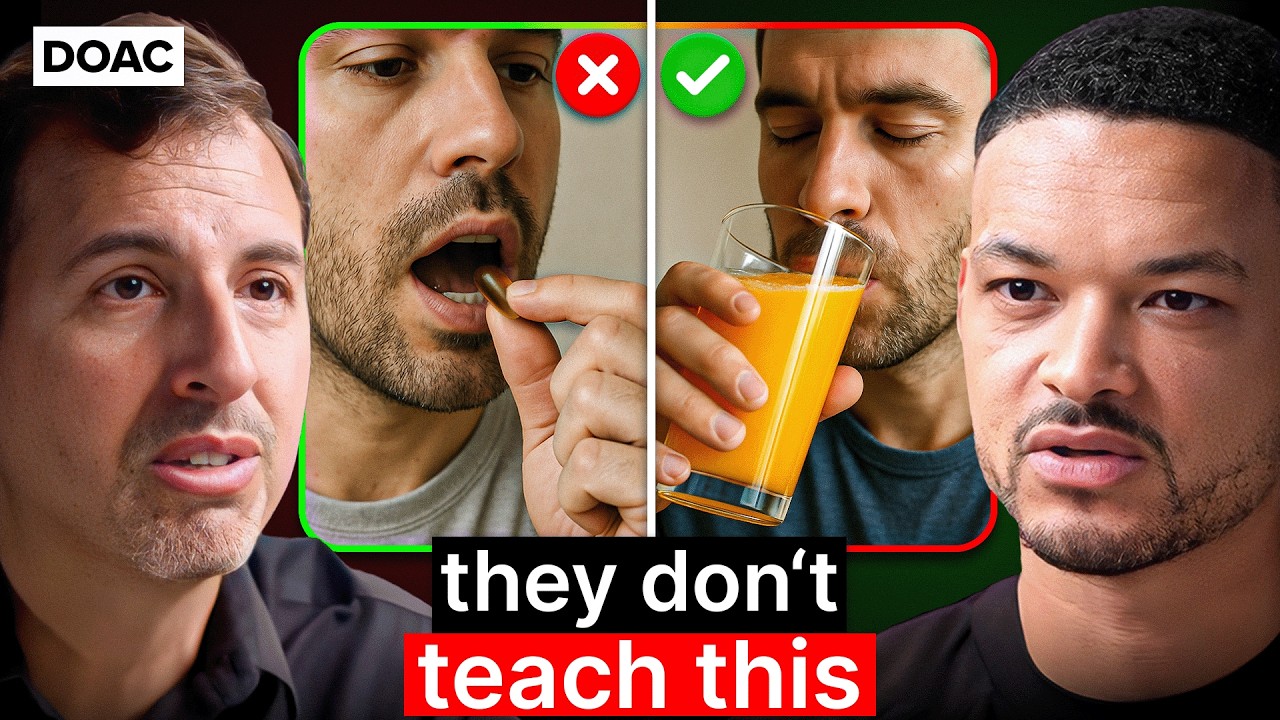
Most people think taking vitamins or avoiding the sun is harmless, but new science shows otherwise. Vitamin D expert Dr. Roger Seheult explains the shocking truth about supplements, sunlight, and sleep, and how they could be silently raising your risk of dementia, cancer, and autoimmune disease.
From why one billion people worldwide are vitamin D deficient, to how caffeine, circadian rhythms, and even fevers shape immunity, Dr. Seheult breaks down the latest research and reveals the simple daily habits you need to protect your brain and body.
Discover:
• Why vitamin D deficiency is linked to dementia, cancer, and immune dysfunction
• The hidden dangers of over-supplementing and why you must check your levels
• How sunlight, skin colour, and latitude change vitamin D production
• The surprising role of sleep, fevers, and hot-cold therapy in boosting immunity
• The truth about water, air, and nature in building long-term resilience
📺 Watch the full episode here – https://youtu.be/wQJlGHVmdrA
❤️ Subscribe to our main channel –
www.youtube.com/TheDiaryOfACEO
#thediaryofaceo #doac
Do vitamin D supplements work? Oh yeah, certainly they do work and they’ve tested them. Yeah, there’s a number of studies that have come out. Martino uh actually published in the British Medical Journal. This was back before 2020. Uh it was a metaanalysis of randomized control trials showed that people who supplement every day with vitamin D had lower risks of acute chest syndrome. The other uh one, there was a recent study that came out that showed that people who supplemented with 2,000 international units a daily of vitamin D had a lower risk of all cause autoimmune conditions. We’re talking rheumatoid arthritis, Crohn’s disease, ulcerative colitis, you name it. Uh that that was a a study that came out that we actually reviewed that on our on our MedCram channel because I’ve heard before in the past that a lot of vitamin supplements we take don’t even get into our bloodstream and into our bodies. Yeah. So so vitamin D is very interesting. Uh it is a supplement and it is a vitamin but it’s also a hormone. Okay. It’s it’s it actually manipulates um um DNA production. So it’s it is quite interesting. But these these are are wellescribed randomized control trials. So if you’re looking at uh the autoimmune condition, this was actually a study that was designed looking at cardiac disease. They actually had two arms. One with a uh omega fatty acids and in vitamin D. And they showed that in the vitamin D group there was a statistically reduction statistically significant reduction in autoimmune conditions. I supplement with vitamin D. And just here’s the the the here’s the concern I have is if you are going to supplement with vitamin D, make sure that you get your levels checked. Why? The reason is is because it is a fat soluble vitamin and it is possible to take too much. What happens if you take too much? It can affect uh calcium metabolism and you can have issues with calcium uh too high levels of calcium. It’s very rare. Um, but it can happen. And I don’t mean to say that in a sense that I would I dissuade people from supplementing because I think supplementation can be good. But at at some point, you want to get a level checked to see where you are. The other reason is is because uh based on your body habitus, based on your skin color, because uh people with darker skin, it’s harder for them to make their own vitamin D. They need to be more time outside, especially if they’re at high latitudes. So like me living in the UK. Exactly. I need to be outside more. It’s going to be harder for you to make as much vitamin D as as somebody who for instance if you were living at a lower latitude or if you had lighter skin. Yeah. What is vitamin D doing in my body? Oh, good question. Lots of things. So, vitamin D, if you were to look at the the structure of vitamin D, actually I actually did research on this uh interestingly in college. I used to make starting material for the graduate students. It’s it’s a lipid soluble molecule. And because it’s lipid soluble, it’s able to go right through into the nucleus and actually go onto the DNA and uh combine with proteins that actually affect the transcription of your DNA. So in other words, depending on which cell type we’re talking about, it can cause a lot of interesting changes. So it affects calcium metabolism. There’s vitamin D receptors on your immune system. So it affects your immune system, affects calcium metabolism, a whole host of things. My team did some research and found that approximately 1 billion people globally have a vitamin D deficiency and about 50% of the global population h has insufficient levels of vitamin D. Absolutely. Yeah. Yeah. So the the issue is is that as the world becomes more industrialized, as the world becomes more welloff, they’re able to create dwellings and they’re able to air condition those dwellings. And we as human beings tend to avoid extremes. We don’t like things too hot. We don’t like things too cold. Well, I let’s face it, in our cars, we have something called climate control. We can set the we can set the temperature and that’s what the temperature is going to be. There’s there’s other implications which we can talk about in terms of hydrotherapy perhaps if we get to that. But um the issue is is we don’t like those extremes. We don’t like going out into the sun and when we don’t do that we uh we suffer the consequences. Is there a way for me to get vitamin D without supplementation and without going into the sun? Yes. It’s in certain foods as well. Mushrooms for instance uh certain types of fish. They’re um they they have vitamin D in them as well. This is a strange question, but do you think our body knows which foods we’re deficient in? And really what I’m saying there is if I’m vitamin D deficient, do you think there’s a part of my body that knows that I I need to eat mushrooms? It’s a good question. And that makes me hungry for mushrooms. I don’t know about that particularly. I can say this though. In people who don’t get enough sleep, we tend to have a predilction to eating more carbohydrate- richch foods. That one we do know. Okay. And and we can and this is the reason why people who this is the reason why many scientists believe that people who don’t get enough sleep tend to have food choices that tend to put weight on. Of these cards that we have left in front of us from the new start framework, which one are you compelled to talk about next? Water. Water. Yeah. Okay. So, tell me what you mean by water because people will think, “Yeah, I drink enough water.” Well, first of all, we I don’t think we do drink enough water. But I what what everyone talks about you know the internal use of water and it makes sense but as I was talking about before the the external use of water can actually be very impressive and it has to do with body temperature and it has to do with the immune system. So we’ll talk about water but let’s sort of set the framework for that conversation. Your immune system is broken up into two fa into two types. There’s the innate immune system and the adaptive. We’ve become very familiar with the adaptive immune system during COVID because all of the talk was about antibodies and antigens and the fact that SARS KV2 was mutating and would the vaccines that made antibodies against them be uh still functional. All of that where we have like where we literally have a key with a keyhole that it fits into and turns the lock and these antibodies and they fit. That’s all the adaptive immune system. It’s very important, but it completely uh eliminates or or removes from discussion the innate immune system. The innate immune system is really the body’s first defense. And what’s happening there is there’s these cells that are circulating, cells like monocytes and natural killer cells and a number of other other cells which scour the body always looking for something that looks foreign to it. and it can tell based on the molecular patterns of these uh of these u invaders that they’re not supposed to be there and they should be eaten up. The major aector of this innate immune system is something called interferon. Interferon is a very important molecule in the body and it is effective. It is so effective at preventing viral infections that just about every single viral infection that plagues the human body today has a defense mechanism against interferon. It is it is a prerequisite. There’s no self-respecting virus that can think that it’s can infect the human body without dealing with the issue of interferon. Period. Think about interferon as the security guard at the bank. And if you are want to rob a bank, you’ve got to have a plan for how you’re going to deal with the security guard. Otherwise, you’re not getting the money. Does that make sense? Yeah. So there was actually an article that was published a couple years ago where they talked about this this battle between interferon and emerging viruses and what viruses are doing to try to get around interferon. You may recall that back in 2002 we had an outbreak of something called SARS which especially was pretty bad in China but also in Canada. The reason why we were able to secure that outbreak was because that everybody who came down with SARS developed a fever and so it was easy to tell who those people were and and we were able to hospitalize and isolate them. The issue with SARS KV2 and indeed many infections like the common cold is that you don’t necessarily get a fever. And fever is really important. And you’re like what does this have to do with water? We’re going to talk about this interferon production goes up with temperature and in fact the body’s fever mechanism is one of the ways that it tells the body that it needs to increase interferon to deal with the viral infection. Is that why you feel hot? You feel hot. You may actually feel cold. And the reason why you might feel cold and even have chills is because the way you feel is a product of what your temperature is and what your thermostat in your body is set to. So if your body and your if your body’s thermostat is saying, “Okay, here we are at 986 or I guess in in terms of Celsius 37° and you develop an infection, the body’s going to say, whoa, we have an infection and we need to increase the body temperature.” We’re going from 37° or 986 up to 38° or or 100.4 because your actual body temperature is below where your body wants it to be, you’re going to feel cold. You’re going to shiver to try to increase that temperature. So, you go up with that. Now, once the fever is done and the infection is done and it comes down, you’re going to have you’re going to break a sweat. So, that’s that’s why when someone, oh, he’s sweating, that means the fever is breaking. That means your temperature is coming down. So you typically you’ll feel cold, you’ll feel like you’re shivering, you’ll want to get into bed and and and put the covers on and that’s when your temperature goes up. That and and that’s for a reason because what happens when the temperature goes up in your body is that creates an environment where the virus that can’t replicate very well. All viruses really cannot replicate very well at high temperatures including SARS KV2. It’s also a signal to your body to produce more interferon. So there was a study that was published uh last year where they looked in mice which by the way have the same body temperature as we do and they found that there was like five different regulatory proteins all of which led to one endpoint and that was to produce this thing called interferon. All of them jumped in production when your body went from 37 degrees to 38 degrees. That’s basically right below a fever, right? So, the point, the take-home point that I got from all of that was that we should not really be treating fevers unless they’re so high that there’s other complications that could occur like, you know, uh racing heart rates or or um or having seizures. But we do this all the time. We treat fevers because it feel makes us feel bad and we think that by treating the fever, we’ll feel better. But what we’re actually doing is we’re we’re cutting the legs out from our immune system because part of the immune system response is to generate a fever and the and the fever generates interferon. Now I don’t want to overstate this but let’s compare the innate immune system to the adaptive immune system. The adaptive immune system is pretty specific for a particular variant of a virus. And for a virus that mutates very rapidly like SARS KV2 the immunization may be very good in terms of binding but if that that virus mutates that binding is going to be affected in some way it may not affect hospitalization but maybe in terms of of preventing infection do you understand what I’m saying? So the different variants we had the alpha variant then we had the the delta variant then we had omicron etc. Those are material changes for the adaptive immune system. For the innate immune system, for interferon, it doesn’t matter. Interferon is just as effective against alpha as it was for delta as it would be for omocrron. So, so let’s set this up again. water. We said that water has a very high specific heat, which means that if I apply hot water onto the human body, it’s able to transfer heat. This is why people can get burned with boiling water. We don’t obviously want to burn anybody, but if we’re able to put them into a sauna, if we’re able to put them into a spa, if we’re able to use hot towels and apply to the human body to heat up their body to cause a sweat, in other words, if we’re able to induce artificial fevers in patients who have these infections, there seems to be evidence that the interferon response will be will be better. Uh there was a study that was done looking at lymphosytes and taking them out of the human body and at different temperatures once it hit about 38 39 degrees there was off the charts uh 10 t-fold increase in interferon which is exactly what you would want to have. Now how do I know that interferon levels are so important in things like co 19? Well, there was a study that was done that showed that high levels of interferon correlated with more mild uh uh SARS KV2 infections and that people that had low interferon levels had very severe CO9 infections. So you suggesting that we should be in the sauna more often? Yes. And it’s based on data that is has been well documented in in the Finnish sauna. uh um uh realm. So people who use sauna four, five, six, seven times a week are more likely to have less uh death from cardiovascular disease than people who use sauna once a week. And in Finland, once a week is kind of the standard. And why do they say to do hot and cold therapy together? So they would uh I I would argue that uh the reason why it has been argued to do this and this goes back to uh a number of papers that have been written back over 100 years ago is what you’re doing when you’re doing hot for a long period of time let’s say 20 minutes in the sauna and what you’re doing is you’re heating up the body and uh and and the whole purpose of that is to increase the body temperature. What the what the cold at the end does is it does two things they believe. The first thing that it does is it causes vasoc constriction. So you put a brief amount of cold onto the body. It’s going to cause vasoc constriction superficially so that when you’re done you’re not going to lose as much heat through those blood vessels and so you’re going to keep the core body temperature higher for longer which is exactly what you want to do. The other thing that cold water does again is the vasoc constriction. When you it’s well known that when you take a cold shower, your blood vessels constrict. And when when you look at a blood vessel on end in in a person who’s living and circulating, there are a number of white blood cells that are latched on to the inside surface of that blood vessel. When that blood vessel contracts, a lot of those white blood cells that were stuck get kicked off into circulation and they go off and they do whatever it is that they’re going to do. It’s called dearenation. So, two things for cold right at the end. Doesn’t have to be very long, maybe just a minute. It causes uh actually to keep your body temperature higher for longer, ironically. And number two, de margination. So, that’s water, which is the W. Um, of these, which one do you want to pick next? Which one do you find most compelling? Let’s talk about air. Uh, real briefly. So we said that air is not just the lack of toxins but actually benefits. So first of all we want to have good oxygen. We want to get rid of carbon dioxide especially in buildings when there’s no ventilation. That’s not good. But there’s been actually a number of studies looking at plants and trees and the fact that they can give off things like phitonides. What’s that? These are are aromatic compounds that the tree actually gives off. And when we look to see the effect of these compounds on the human body, they’re actually very beneficial. They interact with our immune system and elevate our immune system and actually can make us more relaxed. There’s there’s a lot of data in the Japanese literature on on this in the what they call the haninoi cypress forests where they looked at um these CEOs. There’s a podcast about CEOs. There’s these CEOs in Japan and they took them from their their jobs and basically took them up into the mountains of the Haninoi Cypress and had them walk around, took blood tests and they found that the natural killer cells which are so important in terms of immunity were not only increased in number but they were also the the um the the enzymes within them that break down diseases and viruses was also increased. So when they brought them back down to uh the city in Japan, they put them up in hotels and they infused some of these uh these chemicals, these u naturally produced uh fit sides they’re called and they had almost exactly the same effect in in these uh in these uh subjects. So you think plants and being out in nature could actually be giving us much more than just clean air. It’s giving us chemicals which help us fight disease. Absolutely. So, so again, here’s this dichotomy inside versus outside. What do you get when you’re outside? We’ve already talked about exercise. We’ve already talked about uh sunlight and now we’re adding to it fresh air. Not just the fact that you have uh low pollutants, which is certainly very important, but the fact that when you’re around green plants, when you’re around green trees, there could actually be a benefit. By the way, the benefit that they found lasted for about seven days. So just going out one day a week um can actually have that benefit. If you love the D CEO brand and you watch this channel, please do me a huge favor. Become part of the 15% of the viewers on this channel that have hit the subscribe button. It helps us tremendously and the bigger the channel gets, the bigger the guests.