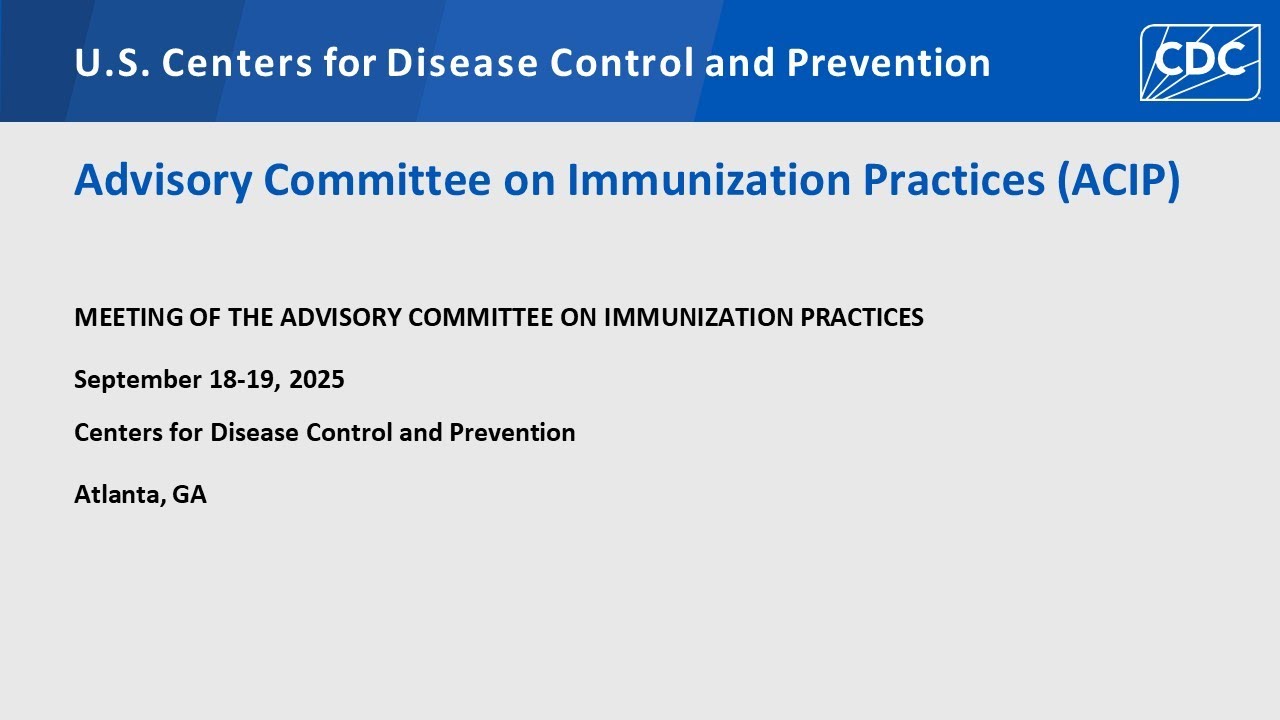
The Advisory Committee on Immunization Practices (ACIP) is a federal advisory committee that develops recommendations on the use of vaccines in the civilian population of the United States.
Good morning. We’re calling the meeting to order. Good morning everyone. My name is Mina Zade and I’m serving as the designated federal officer for the Advisory Committee on Immunization Practices. Welcome to the September 18 to 19, 2025 meeting of the Advisory Committee on Immunization Practices. I will now go over a few logistical items for this meeting. All presentation slides are available or will shortly be available on the ACIP website. For participants joining by Zoom, a few quick reminders. Please keep your line muted unless you’re recognized to speak. When the discussion period opens, use the raised hand function in Zoom if you would like to be recognized. Questions will first be taken from voting ACIP members and exeicio members followed by liaison representatives as time permits. The Advisory Committee on Immunization Practices is a public body and transparency and engagement are central to our work. This meeting includes two oral public comment sessions today at approximately 3:50 p.m. Eastern and tomorrow at approximately 1:45 p.m. Eastern time. Requests to provide oral comments must be submitted online in advance. Priority is given to advanced requests and when demand exceeds a available time, speakers are selected through a blinded lottery. 19 speakers were selected for this meeting and have been notified. We thank all who expressed interest in sharing comments. Members of the public were also invited to submit written comments through regulations.gov. The docket number for this meeting is CDC-2025-0454. More details on the public comment process are available on the ACIP meeting website. In accordance with ACIP policies and procedures, members agree to forego certain vaccine related activities during their tenure. For activities that may enhance expertise, the CDC has issued limited conflict of interest waiverss. For example, members conducting vaccine clinical trials or serving on data safety monitoring boards may present on those vaccines, but may not vote on related matters. For other vaccines from the same company, members may join discussions but must abstain from voting. At the beginning of each meeting, ACIP members disclose any conflict um any relevant conflicts of interest. We will now proceed with roll call beginning with ACIP members followed by exeicio members and liaison representatives. For exeicio members and liaison, I will call your organization. Please respond with your full name and confirm your presence. We will begin with the ACIP chair followed by the members in alphabet alphabetical order. Uh good morning. My name is Martin Korf. Um I have no conflicts of interest. Thank you, Dr. Blackburn. And if you’d like to say something about the background, you can do that as well. Awesome. Great. Uh, my name is Hillilary Blackburn, uh, farmd MBA, and I’m honored to join you all as the first pharmacist to serve as a voting member of ACIP. I currently serve as director of medication access and affordability at Ascension RX and I earned my far my doctor pharmacy degree from the University of Mississippi School of Pharmacy and completed a PGY1 residency at the University of Mississippi Medical Center. Over the last 15 years, I’ve worked across hospital community specialty pharmacy and health plan settings. And as a practicing pharmacist, I have administered hundreds of vaccines and completed national immunization certification. I’ve held numerous leadership roles within professional organizations, including at the national and state level. Been a dedicated preceptor for student pharmacists from multiple colleges of pharmacy and serve on the dean’s external advisory committee for two colleges of pharmacy. I’m honored to bring a pharmacist perspective to the important work that we do as part of the ACIP and views are my own not of my employer or other groups of which I am a part. Thank you Dr. Griffin. Good morning. My name is Dr. Evelyn Griffin. I’m an OBGYn from Baton Rouge, Louisiana. I am board certified in um by the American College of Obstetrics and Gynecology, by the American Board of Lifestyle Medicine and the Institute of Functional Medicine. I was amongst the first to be a gynecologic robotically assisted surgeon in the nation. In my clinical practice in abstetrics, I had been part of initiatives for maternal immunization including dtheria, protessesus and tetanus. And in my overall practice, I um I feel like uh if I was to be given a label, I would call myself pro-informed consent because of med medical ethics for discussing risks, benefits, and alternatives with the patient. During the pandemic, I myself was COVID vaccinated. I am honored to be on this community. Thank you for having me. Good morning. I’m Joseph Hibellin. I’m a boardcertified uh psychiatrist coming to this committee in part for the immense mental health aspects of uh vaccinations and diseases. I’m a distinguished visiting professor at the University of Bristol in the UK. I have 30 years of research experience at the NIH in basic science, animal, human, and epidemiological studies and data. I have uh 285 publications with an impact factor of 30. I had to look that up, figure out what that meant. Apparently, it’s um not only exceptional, but rare. So, I didn’t know about that about myself. Um the critical issues I bring to the committee are an appreciation of calculating risks and benefits of getting vaccines and not getting vaccines. Backgrounds in immunology, neurodedevelopment and translational sciences. I’ve been on panels from NATO to the WHO to the National Academy of Sciences twice. uh to the dietary guidelines uh twice to UK parliamentary inquiries and um the department of defense and the American psychiatric association. Thank you. And I have a neutral mind towards vaccines uh approaching this with a scientific equity. Thank you. We’ll skip uh or Dr. Levy will join us momentarily. Dr. Malone. Thank you. Um Dr. Kirk Milone, I first got my PhD from USD UCSD in physiology and pharmarmacology with my thesis being on the inflam the mechanisms for inflammation in myioardium. I went on to medical school at Jefferson Medical School. Did my residency at Travis Air Force Base in the United States Air Force. uh then went on to do my pediatric cardiology training at um UCSD RAY Children’s Hospital in San Diego. Following that, I was served as a um pediatrician and pediat pediatric cardiologist in the Air Force. I also served as a flight surgeon and did two tours in Iraq as a flight surgeon. Uh I have been board certified in pediatrics and pediatric cardiology for over 20 years. I have experience in vaccinating children and international medicine in over 23 countries involving those without access to vaccinations and I currently care for many of those who are suffering from vaccine postvaccine syndrome. Uh currently I am an clinical associate professor at Texas A&M College of Medicine excuse me and performing inpatient and outpatient cardiology at a children’s hospital in Texas. I have co-authored two articles on the risk and benefits of CO 19 vaccine specifically regarding post vaccine myocarditis and it’s an honor to be here. Thank you. Mention whether you have a conflict of interest. No conflicts of interest. Thank you Dr. Robert Malone. Hi Robert. I’m Robert. I’m a uh Maryland licensed physician. I hold a MD from Northwestern University, master’s degree from UC San Diego in the Sulkq Institute, molecular biology and biology laboratories. I had uh um disclosures and inventions uh multiple patents in the late 1980s and and early 1990s having to do with DNA and RNA vaccines. I I’ve been involved in both bench research with numerous discoveries uh in while I was teaching pathology to medical students for many years. Uh I’ve also uh completed a fellowship in both pathology and a fellowship in global clinical research at Harvard. I’ve been involved in designing, developing, and providing oversight for approximately 40 phase 1 clinical trials, 20 phase 2 clinical trials, five phase three clinical trials. Uh served as medical director and medical monitor on phase one and two and three clinical trials, mostly focused on vaccines. I am a vaccinologist. I’ve spent most of my career developing vaccines and uh um that experience includes uh significant work with the department of defense supporting a variety of vaccine products. I originally started off uh um in HIV vaccines. I served here in Georgia as head of a clinical for a $330 million Barta contract for developing cell-based influenza vaccines focused on the clinical aspect of that. I have experience in plague anthrax V turmia tuberculosis Ebola Zika ryentoxin bachelinam toxin and engineered pathogen vaccines. I hold a uh or have been granted a secret clearance by DoD. uh I have over a 100 papers uh something like 15,000 citations uh um uh and have uh really extensive experience in uh public policy as it relates to vaccines including uh serving in multiple times as study section chair for typically large contracts at NIH been an adviser to the World health organization on multiple topics relating to infectious disease and made presentations at WHO about vaccine technology particularly for influenza. Um I have no conflicts of interest. I uh thank uh the CDC and uh HHS for the opportunity to serve uh here as a unpaid member of the advisory committee on immunization practices. Thank you Dr. Meisner joining us remotely. Thank you Vina. Let me say uh good morning or good afternoon or good evening. I’m delighted to uh have an opportunity to participate in uh the discussions today. I am an independent contractor with Tanel Government Services supporting Barta and I’m a professor uh at the Geel School of Medicine uh at Dartmouth. Thank you. and please state conflict of interest. Thank you. I have no conflict of interest. Thank you. Pagano. Yeah. Good morning. I’m James Pagano, a retired emergency medicine specialist with over 40 years of clinical and administrative experience. Over the course of my uh career, vaccines have provided significant and at times life-saving benefits to hundreds of my patients. These have included tetanus, tetanus toxoid, flu, dtheria, ptasus, hepatitis B, hepatitis B immune globulin, and yes, COVID. I’ve also been vaccinated myself numerous times against all these diseases and toxicities. So, I’m not antivax. I am pro the intelligent and informed utilization of these potentially life saving uh medications in a manner that reflects the current state-of-the-art regarding their benefits, the target populations, optimal dosing and timing and yes of their potential adverse effects in some people and I have no conflicts. Hi, my name is Vicki Pebbworth and uh my career began over 45 years ago. I started as a bedside nurse where I took care of patients who were sick with vaccinereventable diseases and I gave lots of vaccines. I eventually went on to uh get a degree in public health in health services organization and policy and also nursing at the University of Michigan. I am recently certified in bioeththics. I have previously served on two other vaccine policymaking committees for uh nearly 10 years. I was with the Food and Drug Administration’s Verac Committee, the VI uh vaccines and related biologic products advisory committee, and also served on two subcommittees at the National Vaccine Advisory Committee, the vaccine safety working group, and the 2009 H1N1 vaccine safety risk assessment working group. I’ve also served as a consultant to the CDC’s board of scientific counselors and also to the institute of medicine on the topic of vaccination and public trust. I have published peer-reviewed literature and I serve as a peer reviewer for a couple of journals on topics related to vaccination, vaccine uptake, the effects of state laws and vaccine safety. I currently volunteer as a director at the National Vaccine Information Center and the National Association of Catholic Nurses. My comments reflect my own opinions and not necessarily those of the organizations I am affiliated with and I have no conflicts of interest. Thank you, Dr. Paul. Am I next? Yes, please. I’m Raymond Pollock. I’m a semi-retired uh consultant and former professor and head of the abdominal organ transplantation at the University of Illinois. Uh I was also a principal investigator in multiple clinical trials as well as a principal investigator in NIH sponsored research in transplant iminoiology. Um I’m happy to be here and thank you for the opportunity to be of service and uh I have no conflicts of interest. Thank you Dr. Stein. Hi, I’m Dr. Kathy Stein. I’m a professor of epidemiology. My PhD is in epidemiology and bioatistics. And I have a 20-y year career of focused in infectious disease epidemiology with public with over 115 peer-reviewed publications and several review papers and other things besides I’ve also done some work in bioeththics especially focusing on informed consent. and I’ve mentored several masters and PhD students have who have gone on to um careers in public health and medicine. Um much of my infectious disease research um has been collaborative in the field of immunology and thus has had implications for vaccine design. Um I am a professor of epidemiology at Case Western Reserve University. My views are my own and I have no conflicts of interest to report. Thank you. We’ll move on to our exeicios starting with um CMS. Please uh provide your name. Andrew Johnson, Centers for Medicare and Medicaid Services. Thank you. Hersa, Captain Reed Grimes, Health Resources and Services Administration. Thank you. IHS Matthew Clark representing the Indian Health Service. Thank you. NIH U. Michael Carilla representing NIH. Thank you. And FDA, Tracy Beth Hogue, FDA. Thank you. And we’ll go back to Dr. Ratziff. Um, if you please do your introductions and say if you have any comments. So first I don’t have any conflict of interest. I’m Rzzaf Levy from MIT. Um on the faculty there from uh 2006. I have a PhD in operations research. Um and I’ve been uh working uh for um most of my career academic career uh on the on trying to think about uh risk benefit trade-offs and optimization of them in in many complex systems that operate under a lot of uncertainty with great consider consideration to risk and a lot of my work has been uh focused on human health. I’ve been working for many many years with uh clinical teams on the ground uh trying to optimize uh clinical and operational processes in large healthcare systems. Um uh working extensively with healthcare data uh I’ve been working on uh using data uh to optimize the quality and safety of the manufacturing of biologic drugs. uh developed the drug safety models uh epidemological models uh also worked on issues related to access to healthy food uh agriculture and food supply chains and their impact on health and I uh I’m honored to be here and work with my colleagues uh on the committee and the CDC and FDA uh today and tomorrow. Thank you. I will now call the liaison and please state your name if you’re on the phone. American Academy of Family Physicians. Good morning. Dr. Laura Morris representing AAFP. Thank you. American Academy of Pediatrics. American Academy of Pediatrics. American Academy of American Academy of Physician Associates. Good morning, Dr. Sandre Dealama, AAPA. Thank you. American College Health Association. Good morning. Ashley Halberter, American College Health Association. Thank you. American College of Nurse Midwives. Carol Hayes, present. Thank you. American College of Obstetricians and Gynecologists. American College of Obstitricians and Gynecologists, American College of Physicians. Good morning. Dr. Jason Goldman, board certified internal medicine specialist with over 25 years of clinical experience, clinical affiliate professor of general internal medicine at Florida Atlantic University, and president of the American College of Physicians, present. Thank you. American Geriatric Society, American Geriatrics Society, America’s Health Insurance Plans. Good morning, Lori Colloya, present. Thank you. American Medical Association. I’m Dr. Dr. Sandra Fryhoer, practicing general internal medicine physician in Atlanta and adjunct associate professor of medicine at Emery, representing the American Medical Association. Thank you. American Nurses Association. Barbara Resnik, I’m present representing the ANA. Thank you. Thank you. American Osteopathic Association. Association. Good morning. Massud Mammudi, American Osteopathic Association. Thank you. American Pharmacist Association. Hi, good morning. Dr. Kelly Good representing the American Pharmacist Association. Pharmacist and Pharmacy personnel are the most accessible healthc care providers and serve as the primary immunizers for patients across the country. Our association represents these professionals and is committed to supporting science-driven evidence-based recommendations that enhance public health. I appreciate the opportunity to contribute to this ACIP meeting. Thank you. Thank you. Association of Immunization Managers. Hi, good morning. Molly Howell representing AIM. American Immunization Registry Association. Good morning. Rebecca Coyle representing ERA. Association of Association for Prevention Teaching and Research. Good morning. Chrissy Molen representing APR. Thank you. Association of State and Territorial Health Officials. Morning. Dr. Dr. Meredith Allen representing Astro. Thank you. Biotechnology Innovation Organization. Phyllis Arthur representing bio. Good morning. You council of state and territorial territorial epidemiologists for Christine Han representing CST National Association of County and City Health Officials. Yes. Good morning. My name is Dr. Judith Schlay. I am a family physician uh at the public health institute at Denver Health and I am representing NICHO which are uh supports 3,000 local public health agencies in our country. Great. Thank you. Canadian National Advisory Committee on Immunization Matthew Tennis present. Thank you. Infectious Disease Society of America. Floros Infectious Disease Society of America present. Thank you. International Society for Travel Medicine. International Society for Travel Medicine, National Association of Pediat Pediatric Nurse Practitioners. Good morning. This is Stacy Buchanan, doctorally prepared nurse practitioner as well as instructor professor at the Emory School of Nursing. Thank you. National Foundation for Infectious Diseases. This is Dr. Bob Hopkins, medical director for NFID. We’re here for the science and for our patients. Thank you. Thank you. National Medical. Good morning. This is Naima Joseph with the American College of Obstaricians and Gynecologists. I was not unmuted previously, but we are present. Thank you. Great. Thank you so much. Um, National Medical Association National Medical Association, Pharmaceutical Research and Manufacturers of America. Yeah, good morning. This is Dr. Michael Lebar. I’m the I’m a board certified and practicing emergency physician and chief medical officer at pharma. Thank you. Pediatric Infectious Diseases Society. This is Grant Pollson with Pediatric Infectious Diseases Society. Thank you. Society for Adolescent Health and Medicine. Hi, this is Amy Middleman representing SAM and looking forward to hearing scientific evidence to recommendation presentations that are so critical prior to any public health recommendation. Thanks so much. Thank you. Society for Healthcare Epidemiology of America. Society for Healthcare Epidemiology of America. Okay. Thank you. I will turn it over to the chair. Uh thank you so much. Uh good morning. Uh I wish to welcome all of you with special welcome to the five new voting members of this committee. Uh most of all I would like to welcome members of the public who are listening to these proceedings. Uh we are currently experiencing heated controversies about vaccines and a key question is who can you trust? Here’s my advice. When there are different scientific views, only trust scientists who are willing to engage with and publicly debate the scientists with other views. With such debates, you can weigh and determine the scientific reasoning by each side. But without this, without it, you cannot properly judge their arguments. For this reason, I lament that the American Academy of Pediatrics has ended their participation as a liars member of this committee. Neither have they accepted my invitation for an open public debate on vaccines with equal time for each nor an invitation for private conversations. A few weeks ago, the CDC director was removed and three members of the CDC leadership resigned, citing divergent opinions about vaccines. On vaccines, this committee is the key advisor to the CDC director, but during her short tenure, she never contacted me as the ACIP chair about any of her questions or concerns, which would have been natural if she had such concerns. Neither was I contacted by any of the three CDC leaders who subsequently resigned except for receiving a good suggestion by Dr. uh Descalakis during the June ACIP meeting which we adopted. Of the four Dr. Jernigan has done important research on influenza vaccines but the others are not vaccine scientists. Why would these CDC leaders ignore us instead of seeking advice from fellow scientists who have spent decades studying vaccines with other CDC staff? I’ve had frequent and excellent interactions since I became the chair of this committee as well as going 20 years back working with CDC. Some are very good and the rest they are fantastic. All are hardworking and I cannot thank them enough for the work they’re doing. After the four CDC leaders departed, nine former CDC directors wrote an op-ed in New York Times falsely claiming that members of this committee are quote unqualified individuals with quote dangerous and unscientific views. This committee has a wide variety of vaccine expertise. Other committee members have already described their own credentials. Uh as a professor at Harvard Medical School, I developed epidemological and bioatistical methods for postmarket vaccine safety studies that CDC regularly uses, including three methods used for CDC presentation at our la last ACIP meeting in June. I have authored dozens of scientific articles about vaccines with vaccine scientists at CDC, FDA, and leading universities. And I dare to think that my contributions to vaccine research is highly regarded by my colleagues. Since we authored the same scientific articles, are my co-authors also unqualified and unscientific vaccine scientists? Of course not. The majority of our many vaccine safety studies did not find problems with vaccines. So by dismissing us as unscientific, the former CDC directors are de facto questioning not only us and our scientific research, but they also questioning the safety of many childhood vaccines that we have shown to be safe. The fact is that we are honest vaccine scientists that let the data speak whether the results go in one direction or the other. That is always how science should operate. In April 2021, when CDC instituted a pause on the Johnson and Johnson vaccine against COVID, despite a vaccine shortage during the middle of a major COVID wave, I was the only vaccine scientist to publicly object to that decision, one that I believe led to unnecessary death among older Americans. After noticing blood clots in postvcination young women, it was reasonable to advise them to take another vaccine. But the decision to remove the Johnson and Johnson vaccine from all ages must be viewed as one of the most disastrous vaccine decision ever made by CDC. Because of my public objection, I was fired from the CDC committee that was monitoring the safety of CO vaccines. But four days after firing me, CDC lifted the pause as I had suggested. At this time, I was clearly the most pro-scientist uh pro I was clearly the most pro- vaccine scientist in the country while becoming the first person fired by CDC for being too provaccine simply because I chose to debate the science rather than go along with the crowd. As this committee clearly stated at our last meeting, we strongly support the use of vaccines. At our last meeting, all our decision were provaccine. This includes the vote to remove mercury for vaccines. Mercury is a known toxin just like lead and cigarette smoke and we should minimize exposure to such toxins as the effect is cumulative. If you had to choose between buying similar hot dogs with or without mercury for your kids, raise your hand if you would pick the mercury containing hot dogs. Nobody would. Uh FDA has banned mercury from beauty products such as skin creams and soaps. Vaccines are more important than cosmetics since there are equally good mercury free free vaccines. Removing mercury has only positive public health consequences while increasing the integrity and trust in the vaccine program. One of the city lead CDC leaders that resigned cited our vote to remove toxic mercury from vaccine as a reason for his resignation. I found that surprising. In contrast to that, I want to take this opportunity to thank the many mothers and fathers who over many years have fought hard to remove mercury for vaccines. You have falsely been called antivaxers, but your stance is not only pro-children, but also pro-s science, pro public health, and pro vaccines. The members of this ACIP committee are committed to reassuring the public and restoring public confidence by removing unnecessary risk and harms whenever possible. That is a pro- vaccine agenda. While all Western countries recommend important vaccines such as the one against meals, there’s a wide variety in the recommended vaccine schedules. This does not make some countries antivaccine countries. The vote that we will take at this meeting falls well within the national variability seen between countries. We welcome scientific critique of any of our votes as there are gray areas due to incomplete scientific knowledge. but false accusations that we and other respectable vaccine scientists are unscientific and dangerous antivaxers that just adds legitimacy to antivax positions damaging both public health and the confidence in vaccines. Such false accusations are only logical if their purpose is political. Again, I suggest that you should only trust scientists that are willing to debate fellow scientists with different views. I hereby invite each of the nine former CDC directors to have a live public debate with me concerning vaccines. They are doctors Besser, Cohen, Foge, Freden, Copland, Roer, Satcher, Shuchett, and Winski. If they are unwilling to engage in an open and honest debate with a chair of a committee of this committee that they are so severely criticizing then I advise that you should not trust them. I also make the same invitation to the recently departed CDC leaders. If they want to be trusted they should all accept. Thank you very much and then we can proceed with the regular program of this meeting. Uh we have a short update on working groups. We have a number of working groups that are working hard. Uh and that’s where a lot of the actual scientific uh uh work is going on and uh you will hear uh from some of these the deliberation of some of these working group at this meeting. Uh we also have two new working groups that we are setting up. one working group on vaccines in pregnancy and the other one is the childhood and adolescent vaccine schedule. Uh most of the working groups consider a singular vaccine or a group of related vaccines. Uh but it’s also important to look at interaction effects or if it’s best to do one vaccine before another or concepts of the whole vaccine schedule. So that is what this uh this new working group will be looking into. And of course vaccines during pregnancy we always have to be very very careful and considerate uh as with with not just vaccines but with drugs of anything that we give to a pregnant mother uh because of risk of for example birth defects. So we will have those two working groups and uh at some point in the future uh we will be uh discussing the results of those working groups at these ACIP meetings. Uh the first topic that we’re going to talk during these meetings is the misos mubella and barricella vaccines the call mmv. Uh this is the vaccines where uh protecting against all these four diseases uh in one vaccination in one needle. Um and that is the vaccine that was developed to replace uh two separate needles. One for misos mrobella MMR and then a separate needle for visicellas uh to to uh reduce the number of needles that a a child receives. uh we’re going to first going to uh hear about the background on MMR for from Dr. Arjun Schneasans uh from here at CDC. So uh please thank you Dr. Coldov. Good morning. I’m Arjentasan acting chief medical officer in the national center for immunization and respiratory diseases at CDC presenting today the background on measles mumps rebella and vericella vaccine. Do we have those slides? There we go. I want to mention up front that this presentation does not include data on safety related to m vaccine either pre or post-licure. Those data will be discussed next by Dr. Sue. Next slide please. Measles mumps rebella and vericella caused significant health burden prevaccine in the United States. Highlighted on this slide are several severe consequences of these diseases. During the last major reubella epidemic in the US in 1964 to 65 in one year 11,000 pregnant women lost their babies. 2100 newborns died and 20,000 were born with congenital rebella syndrome that causes deafness, heart defects and developmental delay. Before the introduction of the measles vaccine, each year an estimated 48,000 hospitalizations and 4 to 500 deaths were due to measles. Prevaccine mumps was the leading cause of viral encphilitis and sudden onset deafness. And for ver vicella each year in the early 1990s 10,500 to 13,500 hospitalizations and 100 to 150 deaths were vicella related. Next slide please. The introduction of vaccines to protect against these diseases in the form of monovalent and combination measles mumps reubella MMR or measles mumps reubella vericella or MMRV coupled with attaining and maintaining high coverage rates for more than 90% led to dramatic reductions in disease burden in the US. Elimination of endemic measles in 2000, elimination of endemic reubella in 2004, a 99% decline in MS cases by early 2000, and a 97% decline in vicella incidents by 2019. Next slide. Two options are available in the US for measles, mumps, rebella, and vicella vaccination. Combination MMRV vaccine or MMR vaccine plus vicella vaccine. Vaccination is recommended as two doses with the routine ages being 12 to 15 months for the first dose and 4 to 6 years for the second. The MMRV vaccine available in the US proquad manufactured by Merc was licensed by FDA in September 2005 based on non-inferior immunogenicity of the antigenic components compared with simultaneous administration of MMR vaccine and vericella vaccine. The efficacy of the measles, mumps, reubella and vericella components of MMRV vaccine was previously established in clinical studies with the monovalent vaccines. At the time of MMRV lensure, the burden of disease for these diseases was too low to perform efficacy clinical trials in the US. Of note, imino bridging trials are an established approach for the development of vaccines. Next slide. Imogenicity after the first dose of MMRV vaccine versus MMR plus Vicella vaccines in children’s aged 12 to 23 months was assessed in four randomized clinical trials. 5,446 people received MMRV vaccine and 238 received MMR plus Vicella vaccines at separate injection sites. In these studies, the end points assessed zero conversion rates and geometric mean tighters were similar between the two groups and met the pre-established criteria for non-inferiority. Immunogenicity after the second dose of MMRV vaccine versus MMR vaccine with and without the Vicella vaccine in children aged four to six years was assessed in one randomized clinical trial. 399 people received MMRV. 205 received MMR plus placebo and 195 received MMR plus vericella vaccine. Findings also met pre-established criteria for non-inferiority. As you heard during the last meeting, an ACIP working group assessed the evidence for safety after MMRV compared with MMR plusV in 2008 and 2009. Their assessment on vaccine performance was that given the non-inferior immunogenicity, effectiveness was assumed to be equal. Next slide, please. This slide illustrates the timeline of recommendations for MMRV vaccine use in the US. Upon lensure in September 2005 for use in children aed 12 month through 12 years, MMRV vaccine was preferred over separate administration of MMR and Vicella vaccines consistent with ACIP recommendations at the time on preferred use of combination vaccines. In February 2008, a preliminary vaccine safety finding from two post-licensure studies that found an increased risk of febal seizures after the first dose of MMRV vaccine led to ACIP removing the preference for MMRV vaccine use versus MMR and vericella vaccines for both dose one and dose 2. After further examining the safety and other evidence including use of MMRV vaccine has the benefit of requiring one less injection than the alternative of MMR plus vericella vaccines, epidemiology of febal seizures, parent and provider input and consultation with ethics experts. In June 2009, ACIP issued updated recommendations. Next slide. These updated recommendations are the current recommendations and state that for the first dose of measles ms rebella and vicella vaccination at age 12 to 47 months either MMR vaccine and vericella vaccine or MMRV vaccine may be used. Providers who are considering administering the MMRV vaccine should discuss the benefits and risks of both vaccination options with the parents or caregivers. At the time of the publication of the recommendations, CDC provided implementation guidance that unless the parent or caregiver expresses a preference for the MMRV vaccine, CDC recommends that MMR vaccine and Vericella vaccine be administered for the first dose in this age group. For the first dose at age greater than 48 months and for the second dose at any age through 12 years that is 15 months through 12 years MMRV is generally preferred over separate injections of MMR vaccine and vericella vaccine. Next slide. No post-licensure vaccine effectiveness estimates are available for the MMRV vaccine used in the US with measles and reubella being eliminated in the US. MS and Vicella at very low levels. There are not enough cases of disease or outbreaks in children to assess vaccine effectiveness in the US. Those vaccinated with MMRV or MMR and Vicella vaccines continue to have very low rates of disease for measles, MS, reubella, and vicella. In the US, there have been no reports to CDC indicating concern for lower MMRV vaccine effectiveness compared to use of the separate component vaccines, consistent with the imogenicity results seen in the clinical trials. Next slide. As far as utilization, MMRV vaccine accounts for 15% of firstdose measles, MS, rebella, and vericella vaccination among children aged 19 to 35 months. In most states, MMRV vaccine is used for about 10% to under 20% of first dose based on the first and third quartiles. In children aed 4 to 6 years, MMRV vaccine accounts for 75% of second dose vaccination. Next slide. To conclude, MMRV vaccine is one of the two options for vaccination of US children for protection against measles, mumps, reubella, and vicella. As the ACIP assessed in 2008 and 2009, given the balance of risks and benefits of a first dose of MMRV vaccine compared with the first dose of MMR vaccine and Vericella vaccine and the importance of individual values and preferences in weighing these risks and benefits, maximizing choice is an important ethical principle and decisions should be made by providers and parents or caregivers on a case-byase basis. The two vaccination options MMRV vaccine or separate injections of MMR vaccine and vicella vaccine are considered equivalent in terms of protection against disease. Due to the current recommendations, most MMRV vaccine in the US is among children aged 4 to 6 years for the second dose of MMR and vericella vaccination. Vaccination for measles, mumps, reubella, and vericella has led to at least a 97% reduction in all four diseases compared with the prevaccine era. Thank you. Uh thank you so much uh for that presentation. Uh from the members, do we have any questions or comments please? Dr. Milone. Uh yes. Um, could you address the issue of how much aduant there is in an MMRV versus an MMRV and a vericella that are used separately? Is the aduant similar or different? Thank you. I’m going to ask my colleagues. We have a number of subject matter experts on the line who might have that information. Do we have the CDCme room on the line? Does someone want to address that? Thank you. This is uh the NCDME room. Uh there is actually no adguant in either of the uh MMRV or the MMR plusV vaccines. Thanks. Thank you. Uh so as many of the members have been interested in risk benefit assessments. Um you’ve described a great deal of the benefits and you mentioned febrile seizures as a risk. Uh what is your opinion about the risk benefit ratio of harm from febrile seizures or harm to the side effects uh versus the uh benefits for the individuals in the population. Dr. Sue is going to present on the risk profile. It’s not my position to comment on the risk benefits. Thank you. Uh Dr. criminal. Yeah, I just I’d have a blanket statement regarding this topic area because of my prior work as an expert witness in the case of Craying versus Merc having to do with MS vaccines because I signed an agreement to allow me to view extensive internal communications within two manu vaccine manufacturers. I am legally bound to not uh uh do any research or have opinions relating to these products because they include the MS components. I just wanted to make that clear. Um I won’t be voting and I have no opinion on this consequent to pre-existing legal agreement uh from my years ago service as an expert witness in the case of Kring versus MC. over. Thank you for that clarification. Uh Vicki, could you please clarify the difference in the amount of antigen for vericella in the two different uh options? Let me turn to the CDC SMA room and see if someone has the answer to that question. Thank you. Hi, this is the NCR SM room. Um, can we have our backup slide number 12? Thank you. On the screen is the um is the amount and we have another theme that can comment further. So viruses and viruses are synella it’s same between MMR and MMRV the V component of MMR the V component of MMRV is the same virus as in single antigen varicella but it’s at a higher potency you can See there are 399 logs PFUS versus about 3.13. So it’s about seven times higher the amount of VCV in MMRV. But the viruses are identical between the two vaccines. I want to remind everyone to please state your name before you speak. Thank you. Dr. Yeah, I just as a follow-up question. So, what is the is there a biological or clinical reason for that different uh amount of uh antigen? Why why why in the when it’s being given as part of the MMRV you need more versus separated when it’s given separately? What is the rationale for that? Um yes, this is Dr. Mona Marin from NCD. Um the initial clinical trials done by the manufacturers had the same amount of V from the single antigen in the MMRV and the antigenic response the imunologic response to the V component was suboptimal. Therefore, manufacturers did several clinical trials with different potencies of VCV and uh they ended up with this um as as the best in terms of imunogenic and u adverse events. Uh when this issue was discussed um in 2008 2009 um the evidence seemed to lead to an potential interference between the measles virus and the variciseras virus when they are put in the same vaccine in the same syringe. we have more a a stronger response imunologic response to the misles virus more fever more like rash um and but we have the same um imunological response um after the single antigen varicella vaccine so that’s the reason it was based on uh obtaining uh similar uh immune response and what do we understand the mechanisms that explains that like uh I I understand the outcomes that you describe. It seems that you observed some outcomes but do we do we have a deep understanding of the biological mechanisms that can explain why we see different responses with with different vaccines and different combinations? Yes, there is a a final answer um if if the manufacturer um is on the line and can elaborate further. Uh I think the manufacturers scale to talk later. So maybe they can respond then if uh if they’re not available now. Okay. So uh uh we’ll hopefully get that answer later on. So we’re going to continue uh Yes, I know. So uh before we continue with the next uh question, one more question. Okay. Yeah. Um, could you clarify the evidence on amunogenicity after the first dose of MMR? If the majority of children develop protective antibodies after that initial dose, what is the scientific basis for recommending a routine second dose? Is it mainly to address primary vaccine failure, waning immunity, or both? And in that context, is there consideration in using antibbody titers to verify response after the first dose rather than universally giving a second dose? Let me ask the CDCme room if someone has an answer to that. Thank you. This is Oliver with NC happy to um start and then we may have another theme who can uh who can add. Um so I would say that antibbody tighters are one aspect uh of the uh protective response. We do know that you see higher uh antibbody tighters after two doses. Um and so that is a component of it. We know uh especially for uh the measles component that the second dose helps pick up the kids who did not have a protective response to that first dose. Um so two doses are recommended. that was what was studied in the um in many of the efficacy studies. Um and we know that two doses provides that additional protection um overall. And do you have the percentages? So if you want to pull up slide extra slide 15 that has the serapositivity rates the percent fold rise and tighter and the geometric fold for multiple doses for um the proquoad which is the MMRV or you can see the MMR plus Veravvax in the bottom of each of those groups is the separate vaccines. Do you have any without from the primary? This is after the second dose. Do you have any after the the primary dose the sero uptake? Yes. Sorry. slide 13 that is after the pretty good update. Uh thank you very much uh uh Dr. Cody Mesner I have you for two topics so if you address the MMRV Q&A now and then the other one about the roll call we do a little bit later. Thanks uh Dr. called off surely. Um I I want to thank um uh Dr. uh Seren Serinavan I and I’m not pronouncing that correctly but thank you for um that overview. I wanted to add one comment in terms of the MMR uh component and a lot of attention recently has been focused on the the importance of the measles vaccine but you also noted how important the reubella vaccine is. The last uh pandemic in the United States was in 1964 and 1965 and there were thousands of infections in in pregnant women and as you correctly pointed out there were 11,000 fetal deaths and 20,000 infants who were born with congenital rebella syndrome. This is a devastating illness with congenal heart disease, retardation, uh eye problems. Uh it’s it’s devastating. And then in 1969, uh Dr. Stanley Platkin and his colleagues at the Wistar Institute developed the um Reubella vaccine and that has been so effective. Um there are usually fewer the in recent years fewer than five cases of congenital reubella a year in the United States and those are primarily among women who were born um in countries that do not administer the reubella vaccine. So I think it’s important to focus on the absolute importance of making sure that every child is vaccinated against not only measles, mumps and vericella but also vericella also reubella. Uh thank you. Uh thank you for that. And now Dr. Phyllis Arthur. Thank you. No actually my my question was answered. Thank you. Uh so thank you for that and thank you for the excellent presentation and a good discussion. That’s exactly what we want to have at these meetings. Before we go to the next presentation, I think we’re going to do a roll call for missing persons to see if they have arrived late. Thank you. American Academy of Pediatrics American Geriatric Society, International Society for Travel Medicine, National Medical Association. Hi, Kenchmater for AGS. Thank you. Society for Healthcare Epidemiology of America. Thank you and thank you for all of you. We we are very grateful to have uh the vast majority of the lives and members uh here uh with us today. Uh Dr. Cody Meisner. Uh thank you uh Dr. Caldorf. I uh just wanted to express my appreciation for the societies that are particularly focused on infectious disease and and vaccines. Um Dr. Goldman, Dr. Fryhoffer, Dr. Mano, Dr. Pollson. Um it’s it’s so important that they’re here. And I, as I said last time, I think it’s a grave mistake for the American Academy of Pediatrics not to participate um in in these discussions. I think what the AAP is doing is moving themselves to irrelevance and the the importance of the AAP is going to wayne if they refuse to participate uh in in in these conversations. over. Uh thank you very much. And now we’re going to continue uh with the presentation on fear seizures following vaccine m vaccine by Dr. John Sue. So please thank you. Excuse me. Um are the slides being displayed on screen? Excellent. Thank you. Next slide, please. So the ACIP chair requested from the immunization safety office a presentation on febal seizures post administration of MMRV versus simultaneous administration of separate MMR and Vicella vaccines by two different age groups 1 to two and four to six years old. Please use data both from randomized trials and from the vaccine safety data link or VSSD presented from the VSSD project. The uh next slide please. So the material in the next few slides have been covered by Dr. Servasan. So I’ll be brief. MMRV vaccine was licensed in the US in 2005. Interim recommendations in 2008 removed the preferential recommendation for MMRV and updated recommendations were made in June 2009. Next slide please. During February 2008 through June 2009, the MMRV vaccine safety working group reviewed multiple sources of data including two post-licensure studies for Merc and VSSD. Next slide, please. In brief, the 2009 updated MMRV recommendations included guidance stating that unless the parent or caregiver expresses a preference for the MMRV vaccine, MMR vaccine and Vericella vaccine be administered for the first dose in children aged 12 to 47 months. MMRV vaccine remains generally preferred for the second dose. For more details on these recommendations, please see the May 2010 MMWR recommendations and reports. Next slide, please. The next few slides provide some background on the MMRV vaccine and on federal seizures. Combination vaccines like the MMRV vaccine decrease the number of injections a child receives, increase vaccine compliance, and increase vaccine coverage rates. Currently, the MMRV vaccine is licensed for children 12 months through 12 years of age. The vaccine is routinely recommended for the following ages. First dose is recommended at ages 12 to 15 months. The second dose is recommended between the ages of four and 6 years. Proquad is the MMRV vaccine product licensed for use in the United States. Next slide, please. Febal seizures are defined as seizures that occur in febal children or children with fever. By five years of age, 2 to 4% of children have had at least one feebal seizure. They occur primarily between the ages of 6 months and 5 years with peak occurrence between the ages of 14 to 18 months. Like any seizure, febal seizures are distressing and can be worrying. However, febal seizures are typically short, lasting less than 15 minutes, and the majority resolve without complications. Febral seizures occur most commonly with fevers caused by common childhood illnesses such as middle ear infections, viral upper respiratory tract infections and rosiola. They can be associated with any condition that results in fever including vaccination. Also, a family history of febal seizures increases the risk of febal seizures. Next slide, please. Pre-licensure studies of MMRV vaccine among children aged 12 to 23 months observed that fever and measles-like rash were reported at a significant sorry significantly greater rate during 0 to 42 days following vaccination in children who received a first dose of MMRV vaccine than in children who received first doses of separate MMR vaccine and vicela. vaccines at the same visit. Fever fever was observed in 21.5% of MMRV vaccine recipients compared to 14.9% of separate MMR vaccine and Vericella vaccine recipients with a risk difference of 6.6% in a 95% confidence interval between 4.6% and 8.5%. In light of these findings, CDC and Merc initiated separate post-licensure studies to evaluate if an increased risk for febal seizures might be associated with the first dose of MMRV vaccine. Next slide. The following slides describe findings from these post-licensure studies. Next slide. On this slide, postv vaccination interval is shown in the left column. The middle column shows data from a VSSD study and the right column shows data from a merc sponsored study. Almost all participants were aged 12 to 23 months. The studies were among different populations and used different methods, yet both found significant associations in the first two weeks after vaccination. The VSSD after review of medical records confirmed an increased risk of febal seizures during days 7 through 10 after MMRV vaccine compared to MMR plus fericella vaccines. The attributable risk was 4.3 per 10,000 doses administered. The merc sponsored study also observed an increased risk of febal seizure during days 5 through 12 after MMRV vaccine with an attributable risk of 3.8. 8 for 10,000 doses administered during the 0 to 30 days post vaccination. The observed relative risk for the VSSD study was 1.4 with a 95% confidence interval of 1.1 to 2.0. For the merc sponsored study, the relative risk was 1.1 with a non-significant confidence interval. Next slide, please. This slide shows outpatient visits in VSSD for fever after vaccination among children aged 12 to 23 months during 2000 through 2008. The x-axis shows days after vaccination and the y-axis shows the number of outpatient visits for fever for 100,000 doses of vaccine. The different colored lines represent the different vaccines. The chart shows that visits for fever increased after any measles containing vaccine during days 7 to 10 after vaccination. The greatest increase occurred after MMRV vaccination. Temporal scan statistics revealed significant clustering during days 7 to 10 for all measles containing vaccines all with a p value less than 0.001. There were no temporal clustering of fever fever visits after veracola vaccination alone. Next slide. This slide shows the same data but for number of seizures after vaccination among children aged 12 to 23 months during 2000 through 2008. As with outpatient visits for fever after vaccination, seizures after any measles containing vaccine peaked during days 7 to 10 after vaccination with the most seizures after MMRV vaccination. Temporal scan statistics revealed that seizures clustered most significantly during days 8 to 10 after MMRV vaccination with a relative risk of 7.6 and a p value of 0.001. Day 7 to 10 after MMR and vericella vaccination at the same visit with a relative risk of 4.0 and a p value of 0.001 and day 7 to 11 after MMR vaccination alone excuse me with a relative risk of 3.7 and a p value of 0.001. No seizure peak or significant temporal clustering was observed after vicella vaccination alone. Next slide please. When we examine the biomedical literature for post-licensure data on febal seizures following MMR or Vericella vaccination, one study identified a significant increased risk of febal seizures during 8 to 14 days after vaccination as compared with unvaccinated children. The results suggested approximately one additional febal seizure for 3,000 to 4,000 children vaccinated with MMR vaccine. No increased risk of febal seizure among children aged 12 to 23 months after Vicella vaccine was observed during the 0 to 30 days after vaccination. Next slide please. A systematic review and a metaanalysis published in 2015 addressed risk of febal seizure following MMRV vaccination and included studies that used Priorix tetra MMRV vaccine or proquad MMRV vaccine. The analysis included both clinical trials and postmarketing observations. Some studies included participants as young as 9 months of age. The clinical trial review and analysis showed no significant differences in incidence of febal seizures between MMRV and MMR with or without vericella vaccine after any doses across multiple risk windows. Additionally, receipt of concominant use of MMRV and other pediatric vaccines was not shown to be a significant predictor of fbral seizure. However, postmarketing review and analysis showed an approximate two-fold increase in risk of seizure or febal seizure during 7 to 10 days or 5 to 12 days after MMRV vaccination in children aged 10 to 24 months. Next slide, please. A Cochran review of MMRV in children was published in 2021 and included analysis of risk of febal seizure after MMRV vaccine compared to separate MMR and Vicella vaccines. The analysis included five cohort stoies cohort studies four of which addressed first dose vaccination only. Overall, there were significant findings of increased risk of febal seizure in children receiving MMRV vaccine compared to separate MMR and vericella vaccines during the 0 to 42 days following vaccination and during the 7 to 10 days following vaccination. The review also analyzed the risk of febal seizure after MMRV vaccine grouped by brand compared to separate MMR and Vicella vaccines. Of the five cohort studies included in this analysis, one studied Pyrex tetra MMRV vaccine and included the study’s original findings as well as post hawk explanatory analysis of results. The findings for risk of febal seizure with prior tetrammrv vaccine compared to separate MMR and varicella vaccines were not significant. The four other cohort studies in the analysis showed significantly increased risk after proquad MMRV vaccine compared to separate MMR and vericella vaccines during the 0 to 42 days following vaccination and 7 to 10 days following vaccination. Next slide, please. In summary, post-licensure studies both in the United States and in Europe have assessed federal seizures in children aged 12 to 23 months who received the first dose of MMRV vaccine and compared to children who received separate dose one injections of MMR and Vicella vaccines at the same visit. Despite using different methods, populations of children and different formulations of MM MMRV, the studies show remarkably consistency in findings. Next slide, please. In conclusion, studies have identified an increased risk for febal seizures during dose following dose one of MMRV as compared with dose one of MMRV plus fericella only during the one to two weeks after vaccination. The risk of febal seizures occurring during other periods after vaccination is similar between receipt of the first dose of MMRV and MMR plus vericella given on the same day. Next slide please. And next slide please. MMRV is licensed as a twod dose series with routine recommendation for the second dose of MMRV vaccine between ages 4 to 6 years. The risk of febal seizures is lower among children aged 4 to 6 years than among children aged 12 to 15 months. In the MERC pre-licensure trials, lower fever rates were observed among children aged 15 to 31 months receiving the second dose of MMRV compared to after the first dose of MMRV. Similar rates for fever were observed among children aged four to six years receiving second dose MMRV compared with second dose of MMR and Vicella on the same visit. Next slide please. In merc in the merc sponsored studies among children aged four to six years no federal seizures were observed in either comparison arm. Next slide. In a VSSD post-licensure study, very few seizures were identified by ICD9 codes in the electronic data after measles containing vaccines with no significant differences observed 7 to 10 days after MMRV, MMR plus fericella or MMR alone, although rates were higher after MMRV. Next slide, please. Electronic medical record review of the four seizures occurring 7 to 10 days after MMRV revealed that two patients were diagnosed with aphibbral seizures and one record was considered improbable as whether fever or an acute seizure had occurred was unclear. Thus, only one febal seizure diagnosis was confirmed. And the absolute risk for febal seizure 7 to 10 days after second dose of MMRV was one feebal seizure per 86,750 doses with a 95% confidence interval of one per uh with an upper limit of 15,570 or 1.2 federal seizures per 100,000 doses of MMRV. The upper limit of the 95% confidence interval indicates the risk 7 to 10 days after MMRV is no higher than one feal seizure for approximately every 15,500 doses. Similarly, the risk of febal seizure 7 to 10 days after MMR plus fericella is no higher than one febal seizure per 18,282 doses of same day separately administered MMR plus vicella. Next slide, please. The systematic review published in 2015 included analyses of the incidence of febal seizure and risk following the second dose of MMRV vaccine. Data from pre-licensure studies showed no statistical differences in the incidence of febal seizure in children receiving MMRV alone compared to children receiving MMRV vaccine and one or more other pediatric vaccines at the same visit. Similarly, there were no statistical differences in the incidence of feveral seizure in children receiving MMRV and one or more kinds of other pediatric vaccines at the same visit versus those who received one or more other pediatric vaccines without MMRV vaccine. The systematic review also addressed the post-licensure VSD study from the previous two slides which concluded that MMRV and separate MMR and Vicella vaccines were not associated with increased risk of febal seizures among children aged four to six years. Next slide, please. In summary, among children aged four to six years, data do not suggest that children who receive dose 2 of MMRV have an increased risk of feal seizures after vaccination compared with those who received dose 2 as MMRV sorry MMR plus vicella vaccination at the same visit. Next slide. So to conclude, there’s a small increased risk for febal seizures after first dose of MMR and MMRV vaccines. The risk is slightly higher with MMRV combination vaccine after the first dose. Studies have shown a small increased risk for febal seizures during the 5 to 12 days after a child has received their first vaccination with MMR vaccine. Studies have not shown an increased risk for febal seizures after the Vicella vaccine. There is no increased risk of febal seizures after vaccination with MMRV vaccine in children aged four through six years. Next slide please. I appreciate the opportunity to present these data and be happy to answer any questions. Thank you. Thank you Dr. Thank you Dr. very clear presentation. Um I have one question. So you mentioned vaccine coverage rates and that that can be affected by whether you take one vaccine another. And I think it can go maybe in both ways. Uh in one way uh children don’t need they don’t like needles. So fewer needles might mean that it’s more likely that they get vaccines. But also uh if there’s adverse reactions to vaccines then that can create questions about vaccines not only among the parents but siblings or or neighbors or cousins. So it seems to me that the aspect of vaccine coverage rate could actually go in either direction. So are there any studies that sort of shows that quantifies uh these two things of what coverage could could how it could be influenced by the number of needles versus seeing adverse reactions that then get talked about in the neighborhood and if either of those is bigger than the other are there any of those studies that sort of try to quantify what those two effects are which ones is bigger so if I understand the question Dr. Coldorf. Uh you’re asking if there is a correlation between um vaccine coverage, use of combination vaccines and uh occurrence of adverse events. Um for that uh I believe that there may be some experts in the theme room who may be able to address coverage. I let me ask the theme room because I know we do have some data. I think Dr. Cer if this might be helpful. Uh there there was a survey that was done on parents and providers to get some sense of of some of these issues. I don’t know if there’s data addressing exactly what you’re saying, but let me ask room uh if we could uh have the uh backup slide on the survey that was done and any comments you have on this coverage issue. Thank you. Hi, this is uh the SMCME room. Um uh don’t know if we have data specifically addressing that question. What we do have some data from the National Immunization Survey. Uh this was published in 2024 and this was the national immunization survey child COVID module. Um it did ask uh parents to please think about all other routine vaccines such as those for measles, polio and tetanus and then overall how hesitant are you about those other vaccines for your child. And um the results showed that only 14% of parents with children aged 6 months to four years expressed hesitancy about those other routine childhood vaccines. So is that among among the parents whose child had a feeble seizure or what was the population there? Uh this was a random digit dial survey. So children um all comers not specifically targeted towards parents whose children had had a fibral seizure. So my question is if a child has a feeble seizure is one of these one of 2,000 who has a feeble seizures because of MRV instead of MR plus V. So what how does having having the child having that fee seizure, how does that affect the parents willingness to give children subsequent vaccines for that child or vaccinating the ch uh siblings, the younger siblings later on or how does it affect uh because they’re going to mention this to their neighbors or the people in the uh in the in the preschool or whatever. How does it affect sort of then their their friends their neighbors or friend circles or their siblings tendency to get vaccines or their cousins or whatever. So that the fact that there was an unnecessary feeal seizure how much that that influenced sort of the the hesitancy or tendency to for others around them as well as their family to get vaccinations because that affects the coverage. It’s not just the number of needles that also affects the the tendency to be to to coverage of vaccines. Yeah. Thanks, Dr. Cold. This is Sarah Oliver back in the NCERD SM room. If we could go back to the background slides on from our presentation, it’s a slide 27 um from the background on MMRV presentation. So I would say we don’t specifically have um you know data from a survey where uh children had previously had febrow seizures. However, the work group in 2008 2009 that was discussing this there was a survey specifically for parents. Yeah, slide 27. There we go. Um there was specifically a study among um mothers who asked uh where this question was asked. You can see that uh down there at the bottom it said almost a third of mothers would be resistant. Uh about a quarter were neutral at around 40% would accept. So it really was a range across the board. What I would say is that when the work group uh discussed this previously and what we know from vast experience with uh vaccine administration is the best discussions about vaccination and risks and side effects are h um occur between the pediatrician and the child and the parent. So what the decision was at the time was that the parent should have the choice and should have the option for MMR and Vicella separately or the MMRV. Uh the risks were made known and the recommendation from CDC was that the pediatrician include that in the discussion. Um but that the parent should have that discussion. says the pediatrician is the best one who would be able to understand that family and know the balance of benefits and risks for that specific child in that specific situation. Thank you. I understand that we don’t uh Thank you. I understand that we don’t have data and that it’s very hard to sort of quantify how much vaccine hesitancy would increase through these u additional feeal seizures. So we have a few other comments. We have Dr. Cody Misner first. Thank you um Dr. Caldorf and thank you Dr. Sue for um your presentation. I will just add the perspective that this discussion um is really a deja vu for me because we had extensive discussions on this very topic oh 15 years ago approximately and it’s one of the very few settings where the recommendations from ACIP differed from the recommendation from the American Academy of Pediatrics that is the ACIP um felt that uh the doctor uh could administer an MMR plus a V. And it was interesting the American Academy of Pediatrics uh did not express a preference uh for for the 12 to 15month-old dosing of uh these vaccines. The feeling was that uh and I remember that someone did a calculation and um it a a pediatrician who had a busy pediatric practice would perhaps see one patient um who had a febal seizure after receiving MMRV at 12 to 15 months rather than um the two being separated. So, first comment, second comment, and uh Dr. Sue and uh Dr. Oliver, correct me if I’m wrong, but I think of febal seizures after just an MMR vaccine um given at at 12 to to 15 months as about one per 3,000 doses. Um am I am I correct on that? And so if one uses instead of MMR plus V in two different arms, one administers MMRV in one arm, um the risk of a febal seizure um is essentially increased by twofold. Is is that a reasonable way to think about it? Thank you. Uh we can see slide 13 please. So um I in this slide previous studies have demonstrated that after MMR there is observed additional risk of one per 3 to 4,000 children vaccinated. Um so when you say two-fold increase in risk that is correct sir. Right. And then right and then the other point regarding an MMRV at four to six years of age is that and I think you said this that um um more than 95% of febal seizures occur before uh four years of age. It’s only a couple of percent that occur in children after four years of age due to any cause. Is that correct? I I would um ask for the SME room to provide details, but I’d say that risk of feal seizure after five years is rare. Thank you. Uh thank you Dr. RF. Yeah. Uh two three three uh quick thoughts and so just to follow up on the first question by Dr. Croof, I would think that there should be data on this, right? like we know which it’s probably documented in diagnosis which which children had the uh seizure and we know what their future what after that what vaccines they took and when so I think we can actually we don’t need service for that we can just look on the data um and I I guess that that’s also potentially can affect our what we see in the second dose because um potentially there is a subset of children that is more sensitive to uh the immune response to these vaccines. And since they experience such a um an extreme response of after the first dose, maybe they don’t they don’t go to the second dose as quickly or not at all. So I I I just would caution the fact that we don’t see after the second dose does not necessarily mean that there is no potential mechanism here, but potentially it’s a kind of a survival bias thing. But m maybe one thing that bothers me is that we are focusing on symptoms and we are I’m not sure we have a good mechanistic understanding of what’s going on here. It seems that uh on the face of it, it seems that there is one vaccines with higher level higher dose higher quantity of the antigen that seems to cause at least for some of the children a more extreme immune response and we are measuring it through fever and uh seizure but potentially there are other other things that are going on. So my question is did we ever test those children that had the the seizure to see if they have a unique uh immune response uh with other biomarkers that ju just to try and understand the mechanism of what’s going on here because from a safety perspective I’m very concerned when we just focus on what we measure and we don’t try to get to understand the biological mechanisms that are taking place here and yeah I know it’s not easy but it doesn’t look like we are making any real effort to understand this. I’d like to echo that because children who are very young like this may have a heightened IL1 is the cytoine that causes fever. And so the question for the manufacturer and for those who studied this is whether is one or other cytoines were measured in the serum of these children who were febrile. And did they look at cytoine gene polymorphisms or other genetic predispositions to febrial responses which then segus to your second concern is that looking at downstream at the second dose there may be a selection bias in eliminating those children because most pediatricians to the best of my knowledge will not revaccinate somebody who’s had a prior history of febal seizures. So we may be looking at a selection bias in looking at the second dose. So the question then for the what we would have to consider as a recommendation is what to do with the child who has had a history of febal seizures. How do we manage their vaccination schedule the second time around? Um with regard to biological mechanisms. Yeah. Were I isle one levels measured by Merc or any other investigators in looking at febile seizures or the genetic makeup of these children? Um I would defer to experts perhaps in the SMB speaker room with regard to biological mechanisms. And then the second question was to emphasize what RF said was is there a selection bias then in looking at the incidence of febal seizures for the second dose? So that’s we don’t have to get a a response to every comment here. So that’s perfectly fine. Uh I think that uh Dr. Le’s comment is is is excellent that the data is there if you wanted to look at uh if the effect of a fee seizure the child that affects either subsequent vaccination for that child or uh vaccination for the younger siblings. I don’t think that has been done but it’s certainly the data exists if you wanted to do it. I think next on the list is u uh Dr. Milhon. Yes, thank you. Um, I just wanted to remind everybody that a febrile seizure is diagnosed retrospectively. A seizure happening to a family for 15 minutes is an enormous long time for a child to seize. So just when we talk about these things and do I see in my practice that if a family has had a febrile seizure, are they excited to get the next vaccine? No. Am I excited to give them the next vaccine? No. I It opens my eyes. Do we know that a natural occurring fever from a viral that is brought on not through a vaccine has the exact same mechanism as a fever that comes upon by a vaccine. That is for a virus that in rare cases causes encphylopathy. We know that increasing temperature decreases three seizure threshold in all people. Right? That’s well known. Is there an additive from the measles vaccine decreasing the the seizure threshold more? Um, so I I think that’s a question that’s reasonable to ask, but but like I to your point, Dr. Coldorf, I think families are are are very concerned. I think there’s an increased hesitancy through all families right now. And I think that that’s what we’re here to do is try to give them the best risks benefits of these things as we can. Um, do we know have the febal seizure, excuse me, febriel seizure children seen first dose? Do we have a long-term follow-up on all those kids? Um, the ask of uh the ask of us was to present data on risk of febal seizure. I would have to go back and look at data with regard to longer term outcomes. Thank you. And next on the list is Dr. Stein. Thank you. So I I I’m curious how the risks um are communicated like how is that actually done? Because I find it striking that a lot of this data you have existed before the guidelines and so the guidelines were informed by those data and then you also presented a lot of data that have been generated and published after those guidelines. And so I’m curious since the there is a parental choice here, how is that risk communicated to the guardians? Ask they ask if anyone in the theme room has the knowledge of that from the MMDR. Was there language in there on how to communicate or has CDC produced documents on how to communicate? I’m not sure. I’m seeing if anybody knows. Um yeah, NCDSM room. uh we uh developed um one pages um for providers how to talk to the parents. Um it it was in a table format. These are the risks. These are the benefits. This is what it means. And we also I think we developed a one pager for parents to be aware of the this increased risk with um MMRV versus MMR plus V. So yes, we uh we provided um you know call them communication materials to help pediatricians um discuss this risk in a way that the parents would understand. And this is Dr. Oliver. If we look at the usage data too, we know that 85% of the kids who are getting um these vaccines are getting them separate at that first visit. So it’s 15% um kind of on average of kids that are getting MMRV at that first visit. Um you know presumably after again the discussion with the uh the pediatrician and the provider um uh over kind of the risks and the benefits. Thanks. Uh thank you. Next on the list is Dr. Griffin. Thank you. Thank you for your presentation. There are studies that are suggesting lasting neurologic impacts in children. So I was wondering if there are any studies that the manufacturer or others are performing for children education performance. You mean children after seizure? After febral seizure. I’m sorry. Yes. And I have a comment afterwards. Okay. Um I would again defer to experts within the SM room please. Hi, this is Julian G um from the SM room. Um we are not doing any long-term safety studies, but um if the manufacturers are available, they may want to comment on this. And my comment to this would be, you know, the um product has been licensed since 2005. it would be helpful to for parents to uh have that awareness or that reassurance that these studies are performed. Um a secondary question I would have is are any of these studies tested against a true placebo a saline placebo? I would have to go back to you on that one. Um there are so most of the studies that I’ve seen are in comparison with MMRV versus MMR plus Vericell separately. There were one or two studies where um well I’ll hold over there and I can get back to you with a firmer answer if desired. uh it it is um difficult to decipher then the the risk if we’re if we’re comparing MMRV versus MMR plus V then does this not automatically hold us to a confounding factor. Um the retort to this typically is that it is unethical to hold a vaccine versus true placebo study because it’s unethical. Um because the sentiment is that the vaccine is considered uh safe and effective. However, um I think that is probably the most ethical thing to do in a day and age where parents are uh through full informed descent not getting their uh children vaccinated. And I will share from a perspective I I have seen parents um who have opted to not vaccinate their children be some of the most educated people I have spoken with um bringing in studies and and showing their rationale for not uh vaccinating. And so in this day and age where we do have um I believe a rising percentage of parents who who are not vaccinating in an informed manner I feel that it is ethical to invite those parents for such a study and say okay since you are making this informed choice let’s um let’s study this. So I think uh I would invite that idea to have a true placebo um study. Thank you. Let me ask the IRDME room if they have a comment on the on this issue. Thank you. Yes, we’d like to add that a placebo uh study would be a randomized control trial and in that case you cannot if you select only people who um avoided vaccination or who expressed an interest to not being vaccinated. There may be confounders introduced. they may the the children maybe they had some experience with adverse events. So you cannot select participants based on um their willingness they have to agree to be part of either the the study group or the the control group. Yeah. The the point of a randomized controlled trial is that they have the exact same um likelihood of receiving the placebo or receiving the vaccine. Um, so the the families would have to consent to that. And I think uh at a time where we’re seeing the highest measles cases we’ve seen in uh in many years, it would be uh a concerning to ask parents to uh risk the chance that they would receive a vaccine um that would not end up protecting them from measles, mumps, reubella or vicella disease. Yes, thank you. I do appreciate that that answer. Um I I would I would push back that in in today’s day and age parents are asking for uh more such studies and even if it is an um more observational studies of vaccinated versus unvaccinated that the populace would welcome this. Uh thank you as one comment. Uh one way to do ethical uh vaccine trials with the placebo control is to randomize them to the timing of the vaccine. different countries recommend the MMR vaccine at different uh age. So one could randomize it for example giving them at age 12 months versus giving them at age 18 months for example. So one can do randomized placebo control trials in an ethical manner to also then so that’s possible but we’ll continue with the list here Dr. Blackburn. Yeah. So in reviewing the studies on the MMRV or MMR plusV, I noticed that they were designed with both vaccines given on the same day. Could you explain the rationale for conducting the trials this way? Wouldn’t simultaneous administration of the MMR plusV yield similar adverse results, similar feed feed brow rates as the combination product MMRV. Whereas evaluating these vaccines when separated by at least 28 days might provide clear insight into differences in potential adverse reactions. Given that the typical pediatric visit schedule includes visits at 12, 15, 18, and 24 months, there would be opportunities to administer the vaccine separately. And was that considered in the study design? I’ll ask if anyone in the theme knows ifme room knows if that was considered in the study design. Um the the studies were designed to compare MMRV with MMR plusV because MMRV is designed to replace two vaccines or two injections in one. So the the comparison needed to be between the what if we give them separately what if we give them in the same syringe but there are some studies I mean the same studies looked at comparing with a MMR arm with an MMR arm or with a V arm but the bulk of the studies were comparing the two vaccination options to see if you give one injection would you get the same imunogenicity How would the adverse events be separate vaccines? Then you don’t need a combination vaccine. You can give MMR at 12. You can give varicella at 15. But that would not be replaced by one injection. The children will still get two injection. Uh thank you Dr. Pos. I have a question and a comment related to the vaccine information statement for MMR MMRV. Is there language in that statement that uh prior feebral seizure or seizure of any sort after vaccination is contraindicated? Um I’m not sure. I somehow don’t think there that it’s a contraindication. This goes to the informed consent issue. Also, I noticed and to what Dr. Pollock mentioned about selection bias in potentially what we’re seeing the data related to the second dose of MMRV at age two or four to six years of age. Um I noticed that the VSSD data did note both febral and aphibbril seizures. Uh although it was not statistically significant, but it kind of raises the question about non-significance maybe because of selection bias. Um but also um I feel like we need to address the the the assumption it sounds like that feebral seizures are largely benign. I’m not sure what the clinical significance is of these seizures. Um what do we know about them? And is this this goes back to should that end up being a contraindication to ever getting uh that vaccine again? So um with regard to the uh information statement, I I would defer to the information statement, the information contained therein. Um, if there’s an SME on the line, perhaps someone could indicate it’s on there. Go ahead. We have a a comment uh question on the vaccine information statement. Let me ask the IRD SMA room to comment on that. Thank you. Uh yes, we can uh report that the vaccine information statement for MMRV does contain a sentence that says talk with your healthcare provider if you have a history of seizures or has a parent, brother or sister with a history of seizures. Contra indications are set by FDA. And also in the same vis um under risks of a vaccine reaction there is um um bullet with a few sentences. Seizures often associated with fever can happen after m vaccine. The risk of seizures is higher than after separate MMR and varicella when given as a first dose and then your healthcare provider can advise you of the appropriate vaccines. Uh, thank you Dr. Mesner. Thank you. Um, thanks Dr. Caldorf. Two points I’d like to make. Um, first of all, um, febal seizures occur in 3 to 5% of all children. They’re common and every pediatrician um is experienced in febal seizures and um we know that the prognosis is excellent. The major concern as Dr. Caldorf has pointed out is the anxiety it generates in other family members and that’s entirely understandable and it’s a very frightening experience but I think people are very comfortable in saying that a febal seizure is not associated with any sort of impaired performance or neurocognitive development or school problems. It’s uh it’s a it’s a a frequent occurrence, but every pediatrician is is quite familiar with febal seizures. Number two, the issue I think we’re discussing uh it really comes down to do we should parents get two doses or should they get one dose of these uh uh measles ms and rebella and vicella and the disadvantage of giving two doses or as was s suggested separating the two dosis is that we know compliance falls. And the advantage of combination vaccines is that children and adults are more likely to complete the um vaccine uh uh requirements if um it’s given as a single dose. So the second and then the reason the argument against giving MMRV at 12 to 15 months is that there is this very slight increase in uh febal seizure activity. And I think the way it is currently stated by the ACIP um in in the MMWR is quite appropriate. If a parent is more concerned about a febrile uh seizure, she can have the the vaccine administered in in different arms. if she’s not if she’s more concerned about uh reducing the number of immunizations by uh one dose, she can have the combination vaccine. And I think as um Dr. Oliver pointed out uh about 85% of children are now receiving the the uh the a vaccine in each arm and that’s fine. I think I mean I’m not quite sure where we’re going with this discussion. I think that the current wording is appropriate over uh thank you and uh Dr. Levy. Yeah. So I I guess I feel a little bit un feel unease because it seems to me that we are making a lot of assumptions uh that we really understand what we are seeing. And uh I I want to remind ourselves that we we call a lot of the time it turns out that we called different things the same just because we did not understand uh the underlying mechanisms that could be very different but the way we measure them uh made us believe that we actually seeing the same thing. So I think just building on the comment that we we saw before we heard before um it’s not clear to me that a a seizure fal seizure that comes after a viral infection is the same as what we are seeing here and I think we need to investigate that because uh if it’s not potentially our assumptions about uh the long-term and the short-term u uh implications may not be uh true. So I I think we need to adopt a little bit a safety approach that doesn’t just limit it ourselves to what we measure but also recognize that what we measure is limited and we need to try and understand the mechanisms and I have to say I’m listening to the discussion and I my impression is that we don’t really know what’s going on other than that the fact that a vaccine that has a higher level of antigen seems to cause um more frequent uh events like this Um so I I would really encourage um all the agencies that are uh responsible for this to really launch more more investigations that include some measuring the the kids that had seizures and following them long term. I I I I don’t think we can just stay with the mindset that safety of vaccines is is limited to the 30 days 40 days after vaccination. uh because the essence of vaccines is actually to make long-term biological impact on our body and give us long-term immunity which is the benefit but uh if we assume that the benefit is long-term I think we also need to consider the fact that some of the adverse impacts could also be long-term can I answer yes um and I thank you for that comment I think it’s a very uh well taken point. Um, rediff my response is that febal seizures are pretty well defined. We know for example that a febal seizure obviously occurs when a child um usually less than 5 years and usually less than four years of age uh has a fever. It’s a generalized seizure that is it doesn’t involve one limb or another. We know that it lasts or we’ve it’s been defined as lasting less than 15 minutes and usually they last just a few minutes. So, uh they also do not recur within 24 hours as part of the definition. So we have a pretty reasonable definition of febal seizures and uh the vast majority of febal seizures do not occur in association with vaccines as as we’re seeing. So I just for one, I’m not sure putting limited resources into this um activity um is is will give us the greatest bang for the buck. I think that we’re so familiar with as a pediatrician for more than 30 years, we’re so familiar with febal seizures and I I think most pediatricians would would say that that the prognosis is excellent apart from the emotional impact on the family. Over. Uh thank you. We have time for two more uh um person then we’re going to have to end so we can move forward to them. uh the statement from the vaccine manufacturer. So the next is uh Dr. Milhon. Thank you. Um I I as someone I’m not sure how many on the on this committee um actually do an electronic medical record. Um, I know that there is a lot of dependence on the ICD codes that are generated and I’ve heard that some people consider if there is an ICD code generated on a certain condition of a child, then that didn’t happen. I will tell you as a practicing physician, the amount of time I can spend trying to look up ICD codes to make sure that every one of them is there and exactly the precise I ICD code that the child has is often um time prohibitive. Um, I think that it’s important that when we look at data, we look at clean data. And I think the cleanest way to have clean data is to have an ICD code that is febrial seizure temporally related to a vaccine and then you have a feal seizure that’s not. If we’re going to be looking retrospectively at ICD codes, I think this is very important. But I I also encourage people who are not in clinical medicine who are using ICD codes to generate research that these are not perfect these are not a perfect data set. Um so those are my thoughts. Uh thank you. And the last now from Dr. Pas. I just want to um thank you Dr. Meisner for your uh comments and your clinical expertise on this. But I want to uh push back just a little bit and note that there is a study out there published in 2023, the long-term neurodedevelopmental outcomes of febral seizures and underlying mechanisms that states both clinical and animal studies show that febral seizures have detrimental effects on neurodedevelopment that cause attention deficit hyperactivity disorder, increased susceptib ability to epilepsy, hippocample sclerosis and cognitive decline during adulthood. However, the mechanisms of febal seizures and developmental abnormalities and disease occurrence during adulthood have not been determined. Um, so it goes on, but I think this is a topic that merits being put on the agenda at some point uh to evaluate uh as part of the safety work that we need to be paying attention to. Uh thank you so much and uh thank you for a very good uh discussion and again thank you for those that presentation Dr. Sue. The next one is u I think we have a comment from the MMRV vaccine manufacturer. Are you on the line? Yeah. Can you hear me? Okay. Yes. Yeah. Thank you. Please go ahead. Yeah. Thought uh this is Rick Halped. Uh I’m the head of infectious disease and vaccines medical and scientific affairs at Merc. And for the record, I’m a I’m a pediatrician and saw many children die from infectious diseases that included numaccoal, hib and vericella. Uh and now these are all vaccinereventable. Um I’d hate to go back in time to a period when we saw uh invasive diseases. um ProQuad MMRV has been evaluated through well-designed highquality clinical trials um and post-licensure uh effectiveness and safety and and those data have been shared with regulatory authorities, public health agencies, medical societies and have been published in journals. Um this issue of febro seizures the slight increased risk after the first dose was initially described by a observational study that we conducted with Kaiser in 2009. Um so this has been something that’s been well described for 15 years now and and has led to the current recommendations uh which are that um there is no risk for the second dose. So it’s preferred to give MMRV for the second dose, but for the first dose, the preference is for separate MMR and Vicella vaccination to to be given. Um but the language allows for a provider andor family to select MMRV um as the dose given in the first dose. As we’ve discussed this morning, that has led to about a 15% utilization, but the vast majority of children receive separate MMR and Vericella at one year of age. It’s important to note that the that evidence indicates and major public health organizations and professional societies agree that combination vaccines improve completion and ontime vaccination leading to higher adherence and fewer delays in disease vaccination or disease prevention, sorry. And recent CDC surveillance data reveal a troubling decline in kindergarten vaccination coverage where rates for measles ms and rebella potentially serious and fatal diseases have fallen below 95% threshold which is required to sustain measles herd immunity. Considering these trends, any policy decision that compromises the clarity or consistency of vaccination guidance for MMRV has the potential to further diminish public confidence. I think that’s really important in your deliberations and and I thank you. I I can go back and answer some of the questions that you may have had um for for us. The one the one point I would make is that there was one question about what do we understand uh uh about the immune response and why was there a a higher amount of antigen um for vericella that was put in MMRV and it’s important to note the increased antigen was only for vericella there was no change to the antigen content for MM or R in the in in the combination vaccine and it’s it’s essentially related to what was needed to demonstrate an appropriate emological response to show non-inferior inferiority of the immune response of MMRV compared to the separate MM at R and V. Um, and it’s very likely that this relates to um local interference of of uh of the antigens when they’re when they’re given in the combination product. Uh that’s all from me. Thank you. Uh thank you. Um I would like to make one correction to make sure that uh credit is given to where credit is due. Uh the discovery that MMRV had an excess risk of feal seizures compared to MR was done here at the CDC. So it’s the CDC that deserves the credit for finding that out. It was done through the uh vaccine data data link and it’s rapid cycle analysis where the CDC evaluates uh new vaccines uh on with weekly data feeds and it was detected I think after about 25,000 doses. So it was a very quick detection and it shows the the excellent work that people here at CDC and in this particular VSD is doing to monitor the safety of vaccine. Uh are there any other comments or questions uh on this presentation? Uh Dr. Hiblin, a brief comment concerns that we are looking at a risk benefit of febrile seizures which may or may not have long-term consequence. likely not. um as compared to falling below a 95 90% coverage rate uh for herd immunity. And um the consequences of that are devastating for pregnant women losing their babies, newborns dying and having uh congenal roella syndromes. And that uh it seems that we have to be very careful of driving this nonvaccination uh group below 90%. Appears we have to be very conscious that this may be driven by fear and may be driven by most pe the fact that most people don’t don’t think about uh they think of vaccines being either good or evil and either I should have my child vaccinated or not vaccinated and they don’t understand and the discussion of the subtleties that we’re going through. So if we make a major change um in what has been a very vaccine campaign, I think we have to have a darn good reason as to why we’re making that change from what Corey Meisner and and we had got we had better have a very good reason as to why we changed that advice. Uh thank you. And I think we came before now to the proposed recommendations and a discussion of those. Uh if we can get those proposed uh recommendations up on the screen, that would be great. U I would like to stress that in this vote we are not voting on any changes in uh what diseases uh children are vaccinated against nor are we proposing any changes in the timing uh of these vaccines. So that’s not part of the the vote or discussions. One can have different views on that but that’s not part of what we’re doing today. So uh the vote is on u uh the pediatric vaccine schedule should be updated to reflect the following changed for measles moms rebella and vicella vaccines given before age four years the combined MMRV vaccine is not recommended and two children in this age group should receive separate measles uh moms rebella vaccines and versella vaccines MMR plus B uh and again we are not neither voting on children above four to six years because we know that there’s no difference in the risk of seizures among those older children. So uh this is the the vote the proposed uh uh vote. Uh and u do we have the discussion now then before we do uh oh yeah okay but we have the discussion now of this and we’re voting not until the end of the day after public comments. Uh Dr. Could you clarify how this is different than the current recommendation because that that the 2009 recommendation sounds like the the two separate shots. So there’s two main differences. One is that the current says that both are recommended with the preference for MMR plus V. Uh the other one is that some children get a second dose uh before age four. uh for example if there’s an outbreak a child might get a dose at seven months of age but then they have to be because it’s not doesn’t have the efficacy long so it has to be then get a dose again at 12 or 15 so then that’s the second dose uh so they will also re so right now um so so they also change so that everybody who gets the dose whether it’s the first or the second dose it will be not m will not be recommended whether it’s first or second dose Those are the two differences. Uh Dr. Lever, uh yeah. So the way I think about it is uh let’s say that someone would uh guarantee us that the adherence would be the same. Let’s just for the sake of discussion, it seems to me quite reasonable that most of us would think that the separate uh uh vaccines are better because there is there is some harm or adverse events are being caused in access. Um I I think some of us maybe feel more kind of comfortable that they know and they understand that it’s just like a local impact of that event and some of us are more concerned. But I think I think I suspect that if we would somehow be guaranteed uh that all all things are equal between these two options the adherence is the same. I think the choice would be clear. So that kind of brings to me in my mind the discussion to what extent we believe that two separate doses are going to have materialistic impact on adherence and um I’m not fully convinced which option which fact we are all concerns on reduction in adherence to vaccines but it’s not clear to me that the fact that we see a reduction suggests that the reduction would come or would be affected by the fact that we separate these two vaccines for the first dose. In fact, I actually tend to believe more that safer and less adverse events are going to increase trust and adherence. Uh so that given that at the very best I don’t think we have good evidence either way. Uh I I would uh I would go with the option that seems to be uh safer that also gives less less quant lower quantity of the antigen to the children. I think that that’s something that makes sense to me. Uh thank you Dr. Pesworth. I just want to clarify that currently 85% of the first dose is MMR plus V. So we’re talking about 15% of vaccinations at 12 to 15 months is currently MMRV. Correct. Okay. Uh yes that that is correct and uh I mean I want I want to sort of give praise to the pediatricians because uh they have both options but 85% is is choosing to uh administer the MMR plus B because of the fewer seizures and just an anecdotal uh uh thing when my my twins were vaccinated uh I asked the nurse if it was the MMRV or the MR Plus V and she said, “Oh, it’s the MMR plus V because and she gave us the per exactly the correct reasons for why that is the case without knowing that I do vaccine stuff.” So, uh she knew she knew her stuff and of course the physician in the office knew his stuff. So, so I think we we should praise the pediatricians and the nurses who are 85% are sort of trying to minimize these fear seizures. I think um uh we actually a little bit ahead of schedule. So that’s uh that’s a good Oh, okay. Uh Dr. Meister, thank you. Um Dr. color and let me um make two comments here. Um first I would like to go back uh to your statement which I agree with. Um just to clarify that the recommendation to give me misel msson reubella before 12 months of age is for um young children who are traveling with their family to an endemic area and might get exposed to to measles. uh and that should not be included as the two do part of the twod dose series that a child who gets an MMR before 12 months of age as you correctly pointed out still needs to get a second and a third dose and um so uh but I just wanted to make sure that that that was that was clear to everybody and I also want to point out that the MMR RV vaccine that is the tetravalent or quadrovalent vaccine is not licensed before 12 months of age and it’s not licensed after 12 years of age. So it can only be used in that window. The second point um is that I wanted to say is that just taking the other side of this of the first bullet here. Um what we’re saying is we don’t trust parents to make a decision. Some parents don’t want to administer two doses of a vaccine if they can receive one and get the same degree of coverage. And I’m not sure. I mean, I prefer that that that families have the option to make a selection. And if we go with the first bullet here, um that won’t be an option. We know that most are getting as we’ve said uh 85% are getting the the two doses but if a parent wants to get uh a single dose why are we taking away that that option over thank you uh thank you and Dr. Goldman, thank you so much. Uh, I will reiterate the question I asked at the last meeting. Are we going to have a thoroughly vetted evidence to recommend framework presentation that looks at all the harms, benefits, acceptability, feasibility with input from practicing clinicians and liaison in order to make an informed decision. I would argue that this recommendation is going to create more confusion among the public. It does not involve the aspect of actual practicing clinicians in how we deal with vaccine hesitancy and how we talk to our patients. And also when you make this recommendation, you now give license to insurance companies and the vaccine for children’s program not to cover this vaccine. And finally, you are taking away the choice of parents to have informed consent and discussion with their physician on what they want to do for the health and benefit of their children. So I urge this committee not to change the recommendations if they truly want to give the power to the parents to decide what is best for their child and allow them to make the choice in consultation with their physicians. And if we are going to have these recommendations, I urge the committee to go back to the very welldone evidence to recommend framework that we have been using for years to make sure all data is done transparently so we can have that debate and discussion that you requested at the beginning. Thank you, Mr. Chairman. Uh thank you. And Dr. Hopkins, uh my comment was very similar to Dr. Goldman. I will seed the time. Thank you. Uh thank you uh Dr. Middleman. I would also like to echo Dr. Goldman’s cogent comments. It is critically important that we um present all available evidence to make these decisions in one coherent scientifically vetted presentation presentation so that um all providers and patients can understand the full breadth of information. It’s so important to talk about what the evidence shows versus what people may believe that is not necessarily supported by the evidence. Thank you. Uh thank you for that. Uh my personal view is that we had two very excellent and uh informative presentation by Dr. Sid Vasan and uh Dr. Sue. So I thank them for that very much. Uh we will have one other short presentation from the VF. So I can can follow up question on this. Okay. I I would be interested really truly can you articulate what information is missing from that was not discussed or considered because uh you may it seems that you made very strong statement that suggests that there is information that is not being considered here. Are you disputing the evidence that there is increased uh fibro seizures after the MMV MMRV or what what is the additional data that you feel was not considered currently? Well, if I may, it’s more than just the data considered. It’s also the clinical experience, the work groups. All the liaison have been removed from the work groups. You do not have those subject matter experts with the real world experience to understand the implementation of these vaccines and the concerns of the patients. You don’t have the voice of the patients we take care for. You’re not looking at all of the aspects of how we evaluate vaccine implementation. you’re looking at very small data points and misrepresenting how it works in the real world and how we take care of our patients. So no, this was not a thoroughly vetted discussion. I want to see how we implement it, how it’s accepted by the population, how what’s the feasibility, what’s the equity, what are the harms and benefits. You have not considered all of those aspects in this presentation. There’s something to be said about physicians real world experience with their patients. Uh Dr. Middleman um sorry I had taken my hand down because uh Dr. Goldman was handling it beautifully, but I echo his comments and um we really need to see all of the data together with the with the vast breadth of scientific data that does not just include the few studies um that were presented here. So I I just have to respond to that that I trust the CDC staff that they brought all the relevant data to the question. I I’m sure we can trust them and I also look and some of my colleagues and I think that some of them are uh pediatric uh doctors and have experience in caring for PA for patients but if you will be able to articulate missing data I think all of us will appreciate uh hearing about this. So thank you. May I respond to that? Uh we have Dr. Hopkins first. I certainly appreciate the data that was presented by our CDC colleagues uh as being thorough and informative, but we’ve not considered issues around equity. We’ve not considered issues around the implications of these decisions for our patients and for the practicing physicians who are carrying out uh these actions. those missing elements and going through the full evidence to recommendations framework mi does not provide us a full opportunity to review all of those elements. Thank you. Uh Dr. Goldman, Dr. Hopkins said it perfectly. Okay, so uh thank you and I’m glad we’re having this discussion. Uh we will now move forward to a short presentation by the VFC. I’m not sure which who is represent representing from uh okay I think it’s in the process here so take your time and if you give your name before to start the presentation. Good. Thank you. Okay, while we are waiting, we have another uh comment from uh JSH L A Y. So, thank if you can go ahead. This is uh Dr. Schlife representing NICHO. I just want to bring up one comment that I think is important for the practicality of this recommendation. At that age of 12 months, the young children are getting a number of vaccines. So, we’re adding now an additional one. And some parents want to have fewer injections. We can be giving up to seven vaccines at one time for a child. And so, we want to make sure that we have informed consent about what the parent wants. And that’s a very important consideration for me on the front lines giving vaccines. That’s very important when you have children that need so many at a certain time. Dr. Stein, so I pulled up the vaccine information sheet and it does say that there is an increased risk of um febri um fever and seizures after the combined shot versus the two separate shots. And I understand the epidemiologic concepts are really hard to explain to most people. I’m just wondering I’m just wondering and and since we have the medical professionals on the line like how is that actually communicated and is there is there sometime I’m very seriously curious is there sometimes a rush like is it hard when you have a line of patients coming in to clearly provide informed consent on Yeah, that’s good, too. I I think that you could hear from a doctor and we might say one thing. I think what would be fairer is to ask the patients how many times they felt all the risk and benefits of any vaccine or medicine was given to them. When we gave them Bactrum, do we tell them the risk of Steven Johnson syndrome? Do we talked about all the different things about when we treated a an illness we thought was probably virus but might have some viral activity? Did we tell them when we gave them a moxicone, they might get a rash from that if it’s EBV? I think the the people who really know this are the parents. And what I hear from the parents most of the time is I didn’t hear anything. I I think that’s honest. And I think if they were to say that what we’re doing the best we can for your child, this is the best thing. This is what’s been recommended. This is the best thing. Okay, it’s a busy practice. I think if we’re honest about informed consent between physicians, PAs, extenders, pharmacists, I believe we are probably failing to meet the standard of true informed consent. Thank you. We’re going to try with the DFC if that Do you have to go? Martin, can I do that now? We’ll go with the VFC right now. Thank you. Good afternoon. My name is Jeannie Sani. I’m going to walk you through the VFC resolution update. Next slide, please. So, we’re going to go through this and everything that’s shown in red font is the change from the resolution that’s um currently um approved. Next slide. So the purpose of the resolution of course this is all new and the purpose of the resolution is to update guidance on the use of combined measles ms reubella and vericella vaccine. Next slide. Because there’s three types of vaccines in this resolution. There are three components. There’s um one for the measles ms reubella one for vicella and one for the combined. So we’re going to walk through these. There are no changes in the first two components of the resolution. Next slide. So this is the eligible groups for the MMR component. Next slide. This is the recommended schedule for the MMR component. Next slide. This is the dosage intervals and dosage. Next slide. This is the contraindications and precautions. Next slide. For the vericella component, the eligible groups. No changes. Next slide. For the recommended schedule and dosage intervals. No changes. Next slide. For the dosage contraindications and precautions. No changes. Next slide. Now for the combined measles, MS reubbella and vericella component. The eligible groups would change. Um children at least four years through 12 years. This had previously been 12 months on the lower end. Next slide. for the um the the recommended schedule and dosage intervals. We will be removing a link to a a previously um approved recommendation. And the language that you see here is the language that was just voted upon. I’ll give you a minute to look at it. We didn’t vote. Oh, I’m sorry. I know. Okay. I’m sorry. And you’re not voting now. My apologies. It’s the language you just discussed that for a potential vote. My apologies. Sorry. Next slide. Um and then in for the dosage intervals, we’re also removing a link to a previously published statement. There’s no changes to the recommended dosage or the contraindications and precautions. Next slide. Um, this final statement is included in the VFC resolutions in general that things that are published after the fact within six months are incorporated by reference. Um, there was a typo here and it was 12 months and it was supposed to be six months. I was using this opportunity to correct that typo. Um, and that concludes my presentation. Uh, thank you very much. And as is common, uh, when when we do vote, there will be two votes. first one vote and then there’ll be a vote on the F VFC. So that’s a sort of standard procedure that it does that similar to what we did uh uh in the June meeting. So we have uh Dr. Griffin, we have a few more minutes before lunch break. So thank you. Uh as far as practical experience is concerned, I’d like to echo comments of Dr. Milone. As a mother, um it was often just commented as I came in with my children. uh it’s time for their shots and uh no additional um description uh vis the vaccine information statement was uh given to me at times not consistently every time um with the expectation of course that you read it when it’s in hand but not explained um I understand this may be u a bias because I’m a physician it what could have been understood or expected that I understood this already um but I asked many uh of my patients s and uh friends that are non-f physician or not in the medical field and they had a very similar experience almost across the board. Uh and this is of course anecdotal. Um as far as the uh extra uh data, I believe everyone in this committee would be uh very open to extra data to review. Um and I will echo my earlier comments regarding um and I apologize if I misspoke regarding a randomized control trial. I understand and and know that of course the ethics behind the the conduction of these trials. That is why I I feel that we need to expand the studies that we look at and the raw data that we look at um in our considerations to that point of having more considerations, more experiences. All of these collated statistical analyses started from one anecdote and that’s how we look at these children is individuals that then collectively have um either rendered benefit or succumb to risks. Thank you. Uh thank you. And we have time for two more before lunch. Uh Dr. Schlay. Uh yes. I just wanted to comment when uh we I’m just going to speak in our clinic at the public health institute of Denver Health, we run a a large-scale immunization program. We give the VFC form, VIS form beforehand. We go over it and then we vaccinate. So people have informed decision about vaccines. It is the requirement that the VIS is given prior to vaccination and that’s something that we follow and I think local public health agencies throughout the country do the same thing. I can’t comment on anecdotal information but that is the stat the requirement and we try to uphold that. Thank you. I’m going to correct myself. We will do two more from now. So Dr. Middleman, thank you so much for recognizing me. I just want to be really um I just want to make sure that people understand in the public that there is a breadth of data, many many studies that address the process that used to take place, the evidence to recommendation process that the um advisory committee on immunization practices specifically used to make sure people were aware of all elements of a public health discussion. Um, a public health recommendation should never be based on anecdotal evidence because as you all know, the physician has to worry about an individual patient, but public health providers have to worry about the health of the entire public. It’s really important to make sure all elements of public health are considered including the public health import of the disease, the risk and benefit of the intervention, the feasibility of the intervention, the acceptability of the intervention, and the cost benefit ratio as well as equity. I would urge the committee, I haven’t heard any information about urgency related to this decision. I’m not sure why it has to be made today. I would urge the committee to follow the methodical process of an evidence to recommendation process before voting on something that affects the public health to this degree. Please, please do that for public uh confidence and in order to make sure the science is adequately and appropriately vetted. Thank you. Um I guess I should apologize for that anecdotal thing about my twins when they got vaccinated. Um but I think we have had a very good discussion here, very science-based. uh we had excellent presentations from our CDC colleagues and I think there’s been an excellent discussion uh about a variety of aspects of these vaccines. So now the last person is Dr. Pesworth. Uh I just wanted to say that I do recognize that at the 12 to 14month visit I believe it was um the liaison from um nature mentioned that many many vaccines are given and so that that is impressive in the sense that already 85% of pediatricians uh and parents are choosing the um MMR plus the be separately. So there’s that. The other question I have is sort of a technical one. The language that is was posted for the vote. It says recommends. Does that that doesn’t mean though that the MMRV that is licensed by FDA is prohibited from being given to certain patients. So the so I just want to make sure I that the pediatrician or whomever would have the option of choosing to give a licensed product that that do you know I’m trying to ask so this committee recommends or does not recommend uh it is FDA who decides what can and cannot be used right that is the case for all vaccines um our vote does have consequences sometimes on uh uh insurance coverage including from CMS. Uh so that is a factor but uh it is FDA always who decides what is allowed to be given and what’s not allowed to be given that is not we do recommendations. Uh so thank you. So I think it’s time for uh it might be useful to have our VFC colleague comment on how the ACIP recommendations impact the vaccines for children because they pay for a large number of pediatric vaccines. Please do. Sure. Um thank you. So actually um a recommendation that says something is not recommended means that it will not be covered by the VFC program for use in children. If there there are ways to talk about individualbased decisions where you can actually have that coverage, but as it is written now, the VFC program, if the resolution that I shared that you will vote on later, I know you have not voted yet, um actually would would mean that VFC would not cover this vaccine even if a parent chose that that was what they wanted um with their physician. And yeah, that that is the correct information. So, thank you for saying that. uh from CMS. Please state your name. Yes, Andrew Johnson with CMS. Um I would also further add that it would have coverage implications in the uh Medicaid and children’s health insurance program uh and could also have uh in individual and group market uh group markets uh have effect for either coverage uh overall under the first under the first bullet uh category or could have uh uh uh impacts for out-ofpocket uh co-pays for example. Uh thank you for that and just to be clear that this is coverage for the MMRV vaccine. Uh there will be no changes in the coverage for the MMR vaccine nor for the varicella vaccine. So they will be fully covered just as before. There will be no changes there. That’s correct. It would not have any on the on the second there would be no uh implications there uh simply on the on the first. Yeah. No nothing implications either on the second dose. Correct. We’re mostly mostly or on the second dose. You are correct Mr. Uh so we do need the lunch soon because I think many of us are hungry but Dr. Hibbo so just to be clear in the point for the proposed change that measles most vaccine given before four years of age is not recommended. That means that it would not be paid for in the vaccines for children program. It wouldn’t be covered. It wouldn’t be covered for children who are under four years of age. Okay. So that implies that the parents choice unless they want to pay for it themselves, the parents choice is taken away. if I if they would if parents would choose to have one one jab and one vaccination um it would not they have a hard time accessing clinical care if um they they understand the risks and benefits that option is basically taken away from them in many right VFC would not cover the vaccine for those children. Yes. Okay. Yes sir. So uh thank you everybody for this very interesting uh uh thoughtful uh deep and spirited uh discussion. Uh that’s exactly what we want at this ACIP meeting. We will now break for lunch and we are reconvening here at 5 minutes past 1:00. So thank you very much everybody. Uh I hope that you all enjoyed your lunch break and that uh we will now continue with uh this meeting. So if you please sit down. Uh that was a very nice and uh informative discussion about the MMRV vaccine. We’re now going to do a different vaccine hepatitis B vaccine. Uh there are many things that one could uh discuss about the hepatitis B vaccine but uh what we have been assigned to do today is very specific and that is one we only considering the birth dose of the hepatitis B vaccine that is the one that’s given within 24 hours of birth and we only consider that for women who have tested negative for hepatitis B. So if a woman tests uh positive for hepatitis B or if it’s unknown, we are not considering any changes for uh that population. Uh so that’s not uh on our sort of what we have been assigned to do. We’ve only been assigned to evaluate uh the birth dose of hepatitis B uh if the mother has has been tested and uh if she tested negative. Uh so thank you very much for that and uh we have uh two presentations uh and the first one is from Dr. Adam Langanger from CDC uh working the presentation on hepatitis B dose vaccinations. So please go ahead Dr. Langanger. Uh did I not hit that? There we go. Uh good afternoon everyone. Um I’m Dr. Adam Langanger. I’m the acting principal deputy director for the National Center for HIV, Viral Hepatitis, STD, and TB Prevention. It’s my pleasure to be here with you today to talk to you about the hepatitis B dose vaccination. I do not have to say five or six words all um strung together all at once. I’m just going to call it the birth dose. Infection with hepatitis B virus or HPV causes the disease that we refer to as hepatitis B. In 2022, there were an estimated 254 million people living with the hepatitis B worldwide. Some HPV in infections will clear with no long-term impact to health. However, many infections will progress to long-term or chronic hepatitis B infection. Chronic hepatitis B is incurable and can lead to severe liver disease, liver cancer, and death. Next slide, please. HPV can be transmitted to infants in several ways. I’ll start with focusing on motherto- child transmission. also referred to as perinatal transmission and later get into household or community transmission. Without any medical intervention, up to 85% of infants born to women with hepatitis B will become infected. Risk of progression from acute to chronic hepatitis B is related to age. Children infected early in life are most likely to progress to chronic infection. About 90% of infants perinatally infected with HPV will develop chronic hepatitis B and about 25% of people infected with HPV during childhood will die prematurely due to hepatitis B related complications including liver sterosis and liver cancer. However, what is less well understood is that perinatal transmission is not the only reason why the birth dose is important. And I’m going to cover those other reasons over the course of this presentation. One quick note for clarity. For the purposes of this presentation, when I uh use the term childhood, I’m referring to the first 10 years of life. Um before any potential exposure to HPV from sexual contact or drug use uh that might occur during adolescence. Uh and the term infant, as everyone knows, refers to the first year of life. Next slide, please. [Music] Up to 2.4 million persons are living with hepatitis B in the United States, half of which are unaware of their infection. About 70% of people with chronic hepatitis B in the US were born in countries with intermediate to high prevalence of hepatitis B and were predominantly infected at birth or during early childhood. Historically, hepatitis B was relatively common among children in the US. However, decades of evolving hepatitis B vaccination recommendations among infants and children have resulted in the bulk of reported cases now being reported among unvaccinated adults. In 2023, 14,400 acute hepatitis B cases were estimated to have occurred in the US with the highest rates among adults aged 40 to 59 years. Next slide. While illness and death are obviously the most serious outcomes of chronic hepatitis B, there are also very high lifetime cost to individuals in the health care system. Nwen and colleagues analyze claims data during 2004 to 2015 for adults diagnosed with chronic hepatitis B. The amounts shown in the figure represent mean annual costs adjusted to $ 2015. The figures in the yellow box are adjusted to $205. The estimated annual costs on a per person per year basis of treating one patient with hepatitis B in the US adjusted to $225 are up to nearly $94,000 for those with less severe disease and up to nearly $325,000 for those requiring a liver transplant. Other cost data sources also tell us that more than $1 billion is spent on hepatitis B related hospitalizations in the US every year. Next slide. Two types of products are available for prevention or prophylaxis against perinatal HPV infection. the hepatitis B vaccine which provides long-term protection against HPV infection and is recommended for both preexposure and postexposure prophylaxis and hepatitis B immune globulin or HBIG which provides temporary protection and is indicated only in certain postexposure settings. Combined, hepatitis B vaccination and HBI big are highly efficacious in preventing motherto- child transmission, preventing transmission in about 94% of children born to women with hepatitis B. Hepatitis B vaccination is the cornerstone of hepatitis B prevention and control. And the sooner that the hepatitis B vaccine is provided after birth, the greater its effectiveness in preventing perinatal transmission. The table to the right side of the slide shows the results of several studies which have consistently found that the sooner that the birth dose is given, the more effective it is at preventing motherto- child transmission. Next slide, please. The hepatitis B vaccine was the first vaccine to prevent infection with a cancer-causing virus and has been available in the US for more than 40 years. Two single antigen hepatitis B recombinant vaccines are FDA approved for the vaccination of persons starting at birth. Recompact HB which was approved in 1986 and Endure XB which was approved in 1989. An extensive body of literature resulting from more than 40 years of use demonstrates that the hepatitis B vaccines are safe and effective in protecting infants from hepatitis B. Several Institute of Medicine reports as well as the WHO’s global advisory committee on vaccine safety have concluded that the hepatitis B vaccine is safe and effective. Additional safety information will be delivered later by my colleagues in the immunization safety office. Next slide, please. Full hepatitis B vaccination is a multid-dosese series typically consisting of three doses with increasing zero protection after each dose. The proportions of infants with protective antibbody responses after each dose were obtained through a systematic review of 43 studies. Typically, antibbody levels were measured one to two months after administration of each dose. Among healthy infants, 25% and 63% achieve protective levels of antibodies against hepatitis B surface antigen after the first and second dose respectively. However, full protection is only achieved with the complete vaccine series. The threedosese hepatitis B vaccine series produces a protective antibbody response in 98% of healthy term infants and 95% of healthy infants overall. Zero protection from vaccination lasts for decades. In one Alaska based study, over 90% of participants were estimated to still have protective immunity for more than 30 years after vaccination. Next slide, please. Since 1988, universal hepatitis B screening by testing for the presence of the hepatitis B surface antigen has been recommended for all pregnant women in the first trimester of pregnancy, as has testing later in pregnancy for women who have risk behaviors that increase the uh the risk of acquiring hepatitis B as well as testing at delivery for women whose test result was unknown. While hepatitis B laboratory testing is a complex subject, for simplicity, I will refer to testing for hepatitis B surface antigen as just testing. Hepatitis B vaccination has been recommended at birth for all infants born to women with a positive test since 1984. It was further specified that it should be within 12 hours of birth in 1988 and among all infants born to women with unknown test results since 1991. Similarly, HBG has been recommended to be administered within 12 hours of birth for all infants born to women with a positive test since 1984 and among infants weighing less than 2,000 grams born to women with unknown test results since 2018. Next slide please. In 1991, the US adopted a strategy for universal hepatitis B vaccination of all infants. The timing of the first dose of hepatitis B vaccination among infants born to test negative women has evolved. In 1991, the recommendation indicated that it was preferred that the first dose be administered before the newborn was discharged from the hospital, but no later than two months of age. Beginning in 2005, the first dose was recommended to be administered at the birth hospital and this was subsequently updated in 2018 to specify that the dose should be given within 24 hours of birth. Next slide, please. Universal birth dose provides a critical safety net for infants who may have unrecognized exposure to HPV infection during pregnancy or early childhood which can result in catastrophic outcomes. Reasons for gaps in post-exposure prophylaxis among among infants born to test positive or unknown mothers include lack of prenatal care, gaps in prenatal screening and testing and administrative errors, including errors in interpreting the test results, all of which can lead to missed opportunities to intervene. As an example, one case report involved a pregnant woman who was test positive but had results miscommunicated in the record and as a result her infant did not receive postexposure prophylaxis. The infant later presented at three months of life with fulminant hepatitis which unfortunately resulted in the death of the child. This was not a one-off event. Unfortunately, the immunization action coalition documented over 500 other HPV transmission events uh during 1999 to 2002 where appropriate postexposure prophylaxis was not administered. Next slide, please. In the US, analyses of available data find that a range of about 12 to 16% of pregnant women receive inadequate or no prenatal care. A similar percentage are never tested for hepatitis B during pregnancy. Additionally, despite a robust national perinatal hepatitis B prevention program, the program is estimated to identify less than 1/ half of infants estimated to be born to test positive women each year. Further highlighting the role of universal birthdose vaccination as a critical safety net against gaps and protections against perinatal HPV transmission. The figure on the right side of the slide compares modeled estimates of the number of infants who are born to HPV in infected mothers in the US each year during 2009 to 2017 to the number of such births that were actually reported to CDC’s national perinatal hepatitis B prevention program. The dash line between 2014 2015 represents a change in the modeling methodology. Next slide please. As I mentioned earlier, birthdose vaccination provides protection to infants against perinatal transmission and acquiring infection in early childhood. This is a really critical point that is often overlooked in discussions of the birth dose. HPV transmission occurs through perccutaneous or mucosal exposure to infectious blood or body fluids. The virus can remain viable for over seven days on environmental surfaces at room temperature and exposure to only a tiny microscopic amount of blood or fluid is enough for a child to be infected. Unvaccinated infants are at risk of HPV infection if they live with a person who has chronic hepatitis B, not necessarily their mother. If people come to visit their homes who have HPV infection or if they go to daycare or other places where even minuscule amounts of infectious blood or fluids might be present. About half of people with HPV in infection are unaware of their infection. So they could unknowingly expose infants that are in their care. There are many more ways that a child can become infected with HPV other than sexual or drugrelated exposures. Prior to widespread imple implementation of birthdose vaccination, studies found that among certain groups of US-born children born to immigrant mothers with no evidence of HPV infection, 7 to 11% of those children tested positive. With no evidence of maternal infection, these infections had to be attributed to community or household exposures. The sooner that an infant starts the hepatitis B vaccine series, the sooner that the baby will be protected against these early childhood exposures. The current recommendation is to start the hepatitis B series on the very first day of life because there are important benefits even among infants born to test negative mothers and there is no evidence that the risk of already rare adverse events is any greater among newborns than among older infants. Next slide, please. [Music] Next slide please. So we can go ahead and move to slide 13. Great. Three decades of datadriven evidence-based evolving hepatitis B vaccination recommendations among newborns and infants have paralleled marked reductions in acute hepatitis B cases in the US. Following the 1991 recommendations which included providing hepatitis B vaccination within 12 hours of birth for infants born to women with unknown test results as well as introducing universal hepatitis B vaccination for all infants. The total reported number of acute hepatitis B cases in the US dropped 69% from 18,03 cases reported in 1991 to 5,494 cases reported in 2005. Further following the 2005 recommendation specifying that the first dose of universal infant hepatitis B vaccination occur prior to hospital discharge and the subsequent specification that it should occur within the first 24 hours of life. The reported number of acute hepatitis B cases fell an additional 60% from 5,494 cases per year in 2005 to 2,214 cases in 2023 which is the most recently available year of data. Remember though that after adjusting for ascertainment and under reporting the estimated true number of cases in 2023 was actually 14,400. Next slide please. Potential risks of rescending the universal hepatitis B recommendation include increased cases of perinatal HPV transmission that raises the lifetime risk of chronic liver disease, cerosis, sepet hepatoscellular carcinoma, Fulman and infantile hepatitis and liver transplant. Increased administrative complexity and failure points for providers and health systems. A lack of a safety net given gaps in access to prenatal care, HPV screening, and HBIG access. disproportionate harm to patients who don’t have insurance or have low healthcare engagement, lower rates of hepatitis B childhood vaccine series completion, and higher lifetime health care costs from missed opportunities to prevent and eliminate hepatitis B. The potential benefit to rescending the current recommendation is a potential reduction in the already rare cases of birthdose vaccination adverse effects. When they do occur, these adverse events tend to be mild. The worst adverse event you could imagine, anaphilaxis, uh, has been very rarely reported at only 1.1 cases per 1 million vaccine doses administered. Next slide, please. Prior to this meeting, CDC was asked to address four specific questions today related to the hepatitis B birth dose. We will address the first two questions now and my colleagues from the immunization safety office will present data in response to the other two requests. The first request was to survey hepatitis B vaccination recommendations in developed countries with a focus on at what age is the first dose recommended for one children born to test positive mothers and two all other children also in these countries. What is the prevalence of HPV infection in pregnant women? Next slide please. This map depicts the birth dose vaccination policies by country. The countries in green recommend hepatitis B vaccination at birth universally to all infants regardless of the mother’s hepatitis B status. The countries shown in the orange color recommend hepatitis B vaccination at birth only among infants born to mothers with HPV infection. The countries in yellow recommend birth dose universally but only in select regions of the country, not the entire country. And the countries in red do not have a policy calling for the administration of a birth dose. There are 43 countries without a recommendation to administer a birth dose. With support from Gabby since 2024, many have either initiated introduction of the birth dose this year or expressed interest in introducing the birth dose in their immunization schedules in the next 3 to 5 years. Next slide, please. This slide shows hepatitis B vaccination policies and schedule in the 38 countries that were requested by ACIP including the US. Among infants born to test positive mothers, 36 countries including the US recommend the birth dose to be given at birth simultaneously with HBEG either before discharge from the hospital or within 24 hours of birth. There are two exceptions, Ireland and Denmark, although both countries primarily do provide the vaccine within 24 hours of birth. For children born to test negative mothers, eight countries provide a universal birth dose vaccination to all children within 24 hours, following the same schedule as children born to test positive mothers. Of the 38 countries assessed, 26% provide the birth only the infants born to test positive women. But they do recommend universal infant hepatitis B vaccination to other infants at the ages shown on the slide. Canada’s schedule differs by province. There are only four countries among the 38 that provide the birth dose only to infants born to test positive women and also do not have universal infant hepatitis B vaccination. uh those countries are Denmark, Finland, Iceland and New Zealand. These countries are not included in that lower portion of the table for age of first dose for children born to test negative women. Next slide, please. This slide presents the 2023 or the most recent public data estimates in the last 10 years for prevalence of test positivity among pregnant women in the 38 requested countries. Birth dose vaccination policy is also depicted for each country. Prevalence estimates of hepatitis B among pregnant women were available in 20 countries. Nine countries had less than.5% prevalence among pregnant women and all of them have selective birthdose vaccination policy while eight countries reported a prevalence ranging from 0.5 to.9% and three countries reported a prevalence greater than 2% among pregnant women. There are no data available on the prevalence of hepatitis B in pregnant women in the US in the last 10 years. Only six of the 38 selected countries have national registries that can track hepatitis B screening among pregnant women and estimate prevalence on an annual basis. The other 32 countries, including the US, do not track the prevalence of hepatitis B during pregnancy on a regular basis. Next slide, please. [Music] Following on the information presented in the previous slide, which shows the lack of data on the prevalence of hepatitis B among pregnant women in most of the 38 selected countries, this slide shows the most recent available data, either from surveys or national databases that present the percentage of pregnant women who were tested. Of the 37 countries selected to compare to the US, only 19 had publicly available data on the percentage of pregnant women who had been screened for hepatitis B. The green bars show countries where the 2030 global hepatitis B elimination screening target of 90% or greater was met. In the US, it is estimated that 14% of pregnant women are not screened for hepatitis B. The US is one of five countries among the 38 not meeting the 2030 global screening target and one of three countries which are shown in the red text that do not have universal healthcare coverage. In summary, most of these selected countries cannot track whether they are succeeding in preventing perinatal transmission of HPV. But unlike the US, they provide universal health care to all the population so that everyone has access to free prenatal care and vaccination services leading to high screening rates among pregnant women and timely administration of hepatitis B vaccination and post-exposure prophylaxis. This is a critical difference between the US and the countries that allow for selective birth dose. As previously mentioned, one of the primary reasons for recommending universal birth dose in the US is to serve as a safety net for infants born to mothers with unknown test results. Also of note, to date, no country in the world has reverted from universal to selective birth dose recommendations. In fact, as mentioned earlier, several countries are working towards a universal birth dose recommendation. Next slide, please. The second question that was posed requested a systematic review of the results from randomized trials concerning the administration of the hepatitis B vaccine within 24 hours of birth. Next slide, please. The existing uh published systematic review search uh returned 833 studies and the updated systematic review returned 1,390 studies. These were further assessed using the inclusion criteria uh that came with the request. 17 studies met the inclusion criteria, seven from the previous existing systematic review and 10 from the updated review. Next slide, please. This slide shows the Cochran risk of bias judgment results stratified by domain across the 17 included studies. Across the individual domains, there was a high risk of overall bias primarily due to the domains of randomization and measurement of outcomes. All studies were randomized but it was not always specified in the study methods how exactly the randomization occurred. Similarly, for bias related to measurement of outcomes, limitations were likely assigned due to poor reporting regarding whether the study investigators were blinded to the study outcomes. As you know, unblinded investigators may potentially skew study results. Next slide, please. The 17 studies were categorized by intervention study type including evaluating efficacy, timing of vaccination, product or formulation differences, dose and schedule or HB co-intervention. Specified outcomes of interest including cure protection, efficacy and safety outcomes were evaluated within each category. Other intervention characteristics included the vaccine type administered such as endur, recombax or other hepatitis B vaccines as well as the dose and schedule. Next slide please. Beginning with two efficacy trials that evaluated cur protection, the birth dose achieved high levels of cure protection among infants born to women with hepatitis B with infants who received the birth dose vaccine and HBI big having higher cur protection versus vaccine alone. The comparative efficacy study on the bottom of the slide also shows high levels of cure protection across both hepatitis B vaccines that were given at birth to infants born to test positive women. Next slide please. In these two efficacy studies, that is efficacy at preventing pediatric HPV infection compared to infants who did not receive the intervention among infants born to test positive women. We see a up to a 94% reduction in transmission with birthdose vaccine alone and up to 99% reduction when birth vaccine was paired with HB. Next slide, please. In the effic the one efficacy studied in the group that examined adverse events, the birth resulted in few systemic adverse events with most adverse events uh being characterized as a mild fever. Next slide please. In the timing of vaccination study, hepatitis B vaccine was I was either given at birth, two months or six months of age compared to the comparison group uh who all started uh receiving the vaccine series at the end of the trial at 18 months of age. This trial was conducted among infants who were born to test negative women. This study showed high levels of cure protection at 91% with no significant difference in adverse events reported based on the timing of the first dose of vaccine. Next slide, please. Many of the return search results were product or formulation trials which compared different products and formulation to each other to demonstrate non-inferiority. Across the seven product or formulation trials that reported zero protection, high levels of zero protection were demonstrated. For the four studies reporting efficacy, there was equivalent efficacy in the prevention of perinatal transmission between the intervention and comparison groups. And among the five studies that reported safety, there were few local or systemic adverse events among infants in either arm, which is shown here on these forest plots. Next slide please. For the four dose and schedule trials, we assess zero protection among infants born to both test positive and test negative women. The studies demonstrate high serum protection in the intervention and comparator arms except for the GAR study which had the comparator arm as no birth dose at all. However, the Gorar study demonstrated 96% zero protection in the intervention arm eight weeks after the last dose of hepatitis B vaccination. Next slide, please. For the two dose and schedule trial studies that reported efficacy, efficacy was equally high among infants born to both test positive and test negative women. Next slide please. For the one dose and schedule trial study reporting safety outcomes among infants born to both test positive and test negative women, there were very few local or systemic events reported and no difference in local or systemic adverse events between the intervention and the comparator arms. Next slide, please. The updated systematic review did not identify any new placebo control trials assessing efficacy. Given that the efficacy of the hepatitis B vaccine was established in the 1980s, this is unsurprising as many scientists consider it to be unethical to withhold a proven safe and effective intervention simply to include a placebo group. There were also limited reporting outcomes for pre-term low birthw weightight and extremely low birthw weightight infants and there were no reported morbidity or mortality incomes outcomes uh reported in the updated rapid systematic review. The studies were heterogeneous and many of the studies were done before the wide application of the consort statement which seeks to improve the reporting of randomized trials. The risk of bias was primarily due to the domains for randomization and outcome measurement. Although bias is always a concern, studies having a high risk of overall bias can still provide useful information, especially if the directionality of the outcome is consistent across studies and the magnitude of the effect is large. Next slide, please. So in conclusion, the body of evidence in the existing systematic review and the updated systematic review include outcomes in zero protection, efficacy, and safety for birth dose series in infants born to test positive and test negative women. The CDC hepatitis program’s interpretation of these data is that the birth dose induces high serum protection, demonstrates efficacy, and is safe. These findings continue to support the comprehensive decision by the ACIP to recommend universal birth vaccinations first in 1991 and then further strengthen it in 2005 and 2018 as part of the nation’s larger strategy toward hepatitis B elimination. I want to thank all of you for your attention and for your interest in the topic. We do have a number of CDC hepatitis B experts on the line and we’d be happy to answer any questions you might have. Thank you. Uh thank you very much for uh uh that presentation and I think we have u uh Dr. Griffin please. Thank you for your presentation. Um question regarding uh your mention at the end regarding bias. Um of the 17 studies that you had used um how many of them were had declared a conflict of interest? I wonder I’m sorry. Do you mind repeating the last part? Um, of the 17 studies that you had cited in review of the study um how many of them had declared a conflict of interest? Uh, I’m going to actually ask one of our experts on the line who uh helped to conduct the uh rapid systematic review to address that. Uh, yes. Hi, I’m Lisa Yandach. Um to my knowledge uh there was not uh reported conflicts of interest but um we will uh I’ll get back to you on that. I don’t have that immediately available over. Okay. I had um looked at the 17 studies and we don’t um as an ASIP group we don’t have a open access but what I could uh find because I I would like to share that in order if you do not have uh journal access to um get access to any one study costs um it can be anywhere between $45 to $60 each study. So when we’re reviewing these matters we can be looking at hundreds of studies that we’d like to review. So, in particular, these 17 that were used here, um, just doing my own search, there were declarations of eight out of the 17 conflicts of interest. The one that were specifically used that were in the study for adverse events, um, five out of the eight had conflicts of interest, uh, that were declared. There could be more of them. The other three I I was not able to, uh, assess. Um the so this is a concern. Um this did include pharmaceutical conflict of interest where the pharmaceutical company funded the study and provided the vaccination. Um just wanted to point that out. Um I appreciate in the study the uh tragic anecdotal report on slide 10 regarding the death. Um that was a tragic event from 1999. I am wondering what is the uh death rate from hepatitis B uh from the time that the product uh was the hepatitis B vaccination was approved and what is it now in comparison? I’m also going to ask one of the experts on the line to address that. [Music] Uh, was the person trying to respond muted or try again or should we go to the next person? Okay, we’ll go to the next person. Uh, Dr. Levi, please. If I may, I’m apologize. Please, if I may, um, per CDC numbers, uh, death rates of hepatitis B and and I ask this question because of course it can be it can vary depending on population assessments, um, US population, um, if we are looking at it in 1991, um, there were 912 deaths. 1991 is when the, um, this product was approved and then, uh, 2021 it was, 1740. um percentage rates uh would show that this is an increasing death rate despite adoption of um the vaccine. Thank you. Um may I may I just I’ll update the conflict of interest. Um my team’s aware of three uh studies that uh reported conflict of interest. So correction to the record. Thank you. Um and this is Carolyn Wester from the division of viral hepatitis and uh as Dr. the index said we will look further into the question about the death rates but I do want to point out for surveillance purposes um death rates that are reportable are through the national vital statistics system and there’s been an evolution of reporting um over the several decades that were just acknowledged from the beginning to the ending points thank you Dr. Le uh thank you. C can can you go back to the slide with the red curve that shows the incident uh incident rates over time of acute B please. Thank you. 13 I believe that was 13 is I think it’s number one 13. Yes. Okay. Great. Thank you. So, um, I’m looking at this and, um, we see the reduction and I, and I think I’ve seen a slide, uh, I don’t know if you have it at the back on the backup slides that break this these cases into age groups. Um, do do you have it in the backup slides that we can take a look at it or maybe? We we do not have that in the backup slides right now, but we can certainly get it for you. Sure. I I think we can we can we put put it back put it put it up. I think I I this is the slide that I Yes. Sorry for the delay. So go to the next one. There this Okay, great. So this is the break this I I believe that this is this is the data that was provided to us as as background here. I believe the data is breaking it out into age groups that I think are telling an interesting story unless I misunderstand the the graphs. So it does tell us that the introduction of vaccination of babies to born to uh HP HP B positive women had a significant impact on the decrease in the of the cases and you see that the bottom graph uh the zero to 19 is going down. However, uh after 2005 uh when the universal uh vaccination was uh on the day of birth was introduced, there is no more visible reduction in the in the lower ages. In fact, most of the reduction is coming from uh the older ages. And um maybe I’m misreading that, but to me it says that this is a very very important vaccine that should be given to the high-risk populations. And the high-risisk population seems to be babies born to uh have be positive mothers and other populations that uh you know drag drug addicts and other populations that are at high risk that we should try and vaccinate them to prevent that this horrible disease. But I’m I’m not sure I see the impact of universal vaccination on and definitely not on the day the day day zero of life. In fact, I I don’t see even the the the I don’t I don’t even see why where’s the argument to vaccinate even younger younger children at all that are that live in a you know normal environment. So it will be good because you mentioned these other mechanisms of infections. Do we have even data? We have data that suggests that children are actually getting uh infected u assuming that they were not born to uh he positive moms and live in kind of a normal environment or even I I don’t know at all because when when you look on your own data again maybe I misunderstand the the data that I see here in front of my eyes but uh I’m not sure I’m I’m I’m I see the case of why vaccinate every kid every baby regardless of the status of the mom is so important. And I do see by the way that the vaccine is absolutely critical to those that are born to have be positive and other people that at risk. Um absolutely critical horrible disease. We need to prevent it. Uh but I’m I’m just not sure I see the the data that suggests where is the benefit. Maybe again maybe I’m misreading this. So um thank you very much uh Dr. Levy. I believe I heard two questions in there. one was why are we seeing uh the declines in the in the older age groups as you move from left to right um and you don’t see it so much in in the younger age groups. Uh and then there was the question about are is there data around um showing that that people are being exposed through these community and and household exposures. Um so the first one I think what you’re observing is the result of the birth cohort effect. Um so if you think about someone who was born in 1991 and uh who received uh vaccination um at that point um in 2011 they would be 30 years old. Um and so they would not show up in um the younger cohort. they would be in that third 30 to 39 cohort. Um, and so as time goes on, the people who benefited from the change in policy at the very beginning of the policy are moving into different age groups. Okay. So, but I’m just doing the math here. 2005 is when the universal started. So the youngest will be or we based on your assumption that should we should still not see any impact of this because these these babies born after 2005 are not going to be in those higher level ages right higher ages. So it seems to me that at best we can maybe be optimistic to hope that that will have a tangible impact in the years to come. But I I’m I’m not sure we have currently data that suggest any meaningful uh impact of it. Again, maybe nobody knows what will be in the future, right? So, Adam, could I add something? Uh we’ll take it in order. So, uh we’ll put you on the list. Uh Dr. Middleman, the next person is Dr. Stein. Thank you. And so, I have two questions I’d like to re ask. One that Dr. Levy asked about the the um the occurrence of hepatitis B in children born to mothers who are confirmed hepatitis B negative because in terms of incidents I think that would be really helpful. And the second point I’d like to make, I you did a really lovely job of pointing out summarizing all those studies um all the clinical trials and and my recollection or the notes in front of me show that only two of them had were specifically stratified out um children born to hepatitis B neg confirmed negative mothers, but they were both um quote high bias, right? And you you explained what the that means and I understand what that means. And so my so the question tied to my first one is what is the data? How good are the data about incidents of hepatitis B in children born to hepatitis B confirmed negative mothers. Okay. Now I’m going to go ahead and ask one of the experts on the line to address that. Um yeah, thank you Melissa Yand. Thanks for the question. So I think you’re referring to slide 30 in the deck. Um looking at comparative efficacy on hepatitis B service antigen negative moms in the dose and scheduling trials and the risk ratio there demonstrates equivalence between the the intervention and comparator arms for efficacy. So um the high efficacy highlights that there was efficacy in both the intervention and the comparator arms. Um the randomized efficacy literature is primarily focused on HEP B service antigen positive moms where the effect size or the outcomes of interest including ser protection efficacy and safety are uh measurable and uh uh in and actually have larger effect sizes and infections of infants of he B surface ne hepatitis B surface antigen negative moms typ typically arise from mist or late maternal infection or early horizontal exposure. um from an infected household member or potentially a caregiver. Uh so really this is why there there’s always been a push around the universal birth dose policy to to be this larger safety net to address these gaps. Um we did cover uh some I think some information there about um in one of the slides um on on the the 7 to 11% um prevalence rates uh around um community or household spread um in certain communities. And so uh this is why you know again going back to the the recommendation for universal birth dose provides this critical safety net and this is based on ongoing risks to infants in the window between birth and the eventual f uh first dose and I think also that the universal he birth dose uh was put in place because after we after targeted riskbased vaccination strategies failed to prevent perinatal and early childhood transmission and in fact only 26% of people report a risk factor. So uh so in fact among reported cases for acute hep 26% report an associated risk factor. Um so over from my side. Thank you. Uh thank you very much and I’ll actually put myself on the list. So um I had two comments. Uh one is if we go to slide 18 uh what is the prevalence among women here? uh we can see that in uh in Western Europe it’s uh is less than 1% and in some cases less than half a percent. So the most important country though is the United States and there was no information there. So I try to figure it out from the previous slide. So if we can go to slide number three. So uh since there was no uh data available for pregnant women, I figured uh the prevalence among pregnant women is probably approximately might be the same uh as the prevalence among the general population of women around ages 20 to 40. So we can see from this graph that the prevalence among people from between 20 and and 40 is between 2% and uh.9%. Uh but that’s uh so that would be an average of maybe about 6 or.5 6%. Now uh this is both men and women and we know that the prevalence among men is uh is higher than women. So I think women has about maybe uh twothirds of the prevalence. So if we do for women we will get to about 4 to 5% estimate. So that means that the US is actually among the lower uh lower uh compared to the western European countries. So so we should be proud of that that uh we have fairly low rates u and not because of CDC and many others. So congratulations Uh we can also see from this graph that we have the total infections are the orange and then the blue ones are immigrant infections. So about 80% would be immigrant infection while 20% would be uh US-born uh women. So if we then take what is the prevalence among usborn women that will probably be less than.1%. So that’s very very low uh which is very good and of course we don’t yeah so I just wanted to sort of point out that uh in comparison to the European countries which do not have a birth dose because among the western European countries it was only Portugal that have a universal birth dose but uh US we’re doing quite well we have very low low rates uh compared to even the the Europe western European countries that do not have the universal U birth dose. So that was one of my comment. My second comment is on slide 27. Uh so so so obviously the the concern here is about um uh adverse events at the day of birth and usually we we sort of accept that uh vaccines later in life can sometimes give a fever or rash. I think we are all a little bit even more concerned about that at the first day of birth if they have a fever or so on. So if we look at these adverse events we have two groups here. One is the uh localized symptoms where there were five among 178 in the vaccinated group and in the systemic symptoms is 10 out of 178 and I asked CDC if if this was a if there was an overlap but they didn’t know. So but if if we do if we so we don’t know if some of these five were also among the 10 and in the nonvaccinated group it was three and four. So if we do a a simple statistical test here if we if we pull these two group the localized and systemic then we get uh a p value of 0.054. So it’s just borderline statistically significant. And of course the sample size is very small here. The relative risk is about little bit over two. So there’s clear that there are some adverse events I think uh or more adverse event uh for those who uh get their dose at birth. Uh so so I think that’s in that’s one of the many considerations that we have to take uh when we make this uh this uh this vote later today. And I think there were more comments than questions. So uh I think can I ask a clear quick question about this is just to how long were these clinical trials? So the safety data comes from what what what is the surveillance time are we watching them for how how many how long we are watching the babies these results for what what kind of monitoring time window I I think these are short-term uh iris events but doing any of the doses. Yeah. What is short like two days, three days, five days, one week? What’s mean? I think five, five days. So what we can say that over the first five days there may be uh higher advers and beyond that we don’t know basically because we never looked. Is that is that the is that kind of the bottom line of if you would like they they can answer the question. Please um please the uh one of these on the line I believe has an answer to your question. Uh yes, please uh if you could go to the last uh last slides, the extra slides um slide number 44 and slide number 45 please. You’ll see both the sample size and the latest follow-up period in months. Most of the uh safety uh safety signals were done because this was after the first dose. We were asked to look after tw um 24 hours. So um but the latest follow-up period is is shown all the way to the end of of the time period shown on for each of the studies over and there is data about those longer periods of time that we that can be looked at like what what the data what is the overall comparison of the adverse events over over the longer period of time. This is as as long as the study went. Excuse me. I guess the question is is if you’re following someone up, what are you following them up for? What signals specifically were they looking for that might be a um adverse reaction to a vaccine which may now be confounded with an entire schedule. So I I I think that’s the question is if there if there’s a 24-hour 24-month follow-up period, uh what were their criteria? Was it hospitalizations? Was it additional fevers? Was it um hepatitis? I guess that’s the that’s the question I would have. Is that fair, Dr. Levy? That’s what I was trying to ask. Thank you for helping me clarifying the question. Yes, if you could turn to slide 41 of the extra slides and you’ll see the time points used for these studies. So, ser protection reported the first time point immediately following the last dose in the series. efficacy was the latest available time point with the ongoing intervention and safety at birth was the closest time point immediately after the birth dose as requested by the question. Thank you. So it was for for sero protection not side effect. Do I understand that correctly? The followup period. Okay. Thank you. Just to make sure they understand. So there is no follow-up of side effects beyond the very few days after after birth. I just want to know the fact. Thank you if you can clarify this. Yes. Um I it was different across the studies but um I can get back to you on that. Thank you. Appreciate it. Thank you. Uh thank you so much. And we had on the list also CDCM if you wanted to make some comment not just a question here but [Music] thank you this is Carolyn Wester from division of viral hepatitis I just wanted to respond to some of the comments or questions that were raised on slide um 18 regarding seral prevalence in the US and um yes first of all in the context that was mentioned during this slide There’s not um disease surveillance registry that would answer this question. Um however uh there are there’s a national survey and Hannes the national health and nutrition examination survey u and the 13 to 2018 data estimated that the national prevalence in um in the US was.3%. Now there is um concern that that may under capture populations with the highest burden um of hepatitis B in the US. However, uh sex um based stratification showed the same u prevalence among both females and males in that survey and also a similar rate among reproductive age adults aged 25 to 49 years. Uh there was difference by country of birth um with US born.1% and non- US born 1.2%. 2%. And then there was a modeling study um basically that estimated in 2015 about.5% um prevalence uh um or.5% of the babes that were born in the US that year were born to have the surface antigen positive women of whom 40% were estimated to be US-born and 58% were um um estimated to be among non- US-born women over and uh The last thing is just in the context of the age stratifications and yes absolutely there’s been um a generational impact over the last three decades of these evolving recommendations um among infants and children. The one thing I would say is that um the infant vaccination recommendation which was introduced in 91 actually was also for prior to discharge from the hospital. It did allow for up to two months of age with a preference for um administration prior to um discharge from the birth hospital over. Uh thank you very very much and I’m I’m I’m glad that my back of the envelope calculations were very similar to your much more precise calculations. So I so I appreciate that and thank you for that information. So uh we now have Dr. alone. Uh we had asked in the past for number needed to treat and I was wondering if we have number needed to treat to prevent case of hepatitis B in the child of a nonp positive patient. Do we have that for domestic US population? Uh again I’ll see whether or not the ummemes online might have that information. Hi it’s Carolyn Bester again. No, thank you very much for that question. We do not have that data, but I think it raises a very important question that um if there is a delay recommended in the first dose um among infants born to test negative moms that it’ll be very important to have modeling data to estimate the potential harms um given unrecognized potential exposure exposures during childhood um during pregnancy or early childhood as were outlined on slides 10, 11, and 12 over. So, I’m really simple. I’m not as sophisticated with epidemiology as RSI or Martin or many of the others here, but it seems to me to be able to have a reasonable assessment of risk benefit um we need to have more granular information about number needed to treat for the uh healthy non antigen positive mothers children uh as well as the risk assessment associated with this product which um did I miss the risk analysis? Do we have a clear analysis here of potential adverse events associated with this and their incidents these vaccines as part of this presentation? Again, this is Carolyn Wester. If if you’re asking if there’s been um a risk assessment of um the new cases um associated with delaying the um current recommendation to one month of age? No, we do not have that data. Um does FDA have any information about this? Um I’m not trying to put you on the spot, but so is it okay to say no? So yeah, so I I I am here. This is this is Tracy Hogue. Um, I’m I’m glad you asked this question. This is a really good discussion and I would just say that the the initial like um clinical trial data that we have from the 1980s that are on the label um that it did have really shortterm followup for four four and five days um for the current um currently approved products and um and I think you know we can in terms of like comparing giving it it in terms of the safety risk giving it when it’s a newborn versus, you know, not newborn later in early childhood. Um, you know, we can’t really do a direct comparison. Um, I was glad to see the all these studies listed. I I’m not I I would like to know sort of of these studies that were presented by the CDC, how many applied to neonates and also echo uh Dr. Levi’s question about the the followup in terms of safety data um when the vaccine is given to newborns and looking at at risks of more long-term um conditions and sort of what the data are there especially when we’re talking about population um that is you know infants that are born to mothers who are not positive for hepatitis B sort of what the risk benefit analysis there would be and that we should have some humility and consider consider that we may not know all of the potential um safety issues and when it’s a very low risk situation for the the infant, we we really do need to have some robust um safety data and that should be consider and long-term to consider in a risk benefit analysis. Uh thank you Dr. H. And I think now we have Dr. Griffin. Yes, thank you. I was um going to address Dr. Stein. Uh she was asking about safety and I had read the CDC itself confirmed as early as uh 2020 that there were no cases of transmission of hepatitis B in a school setting um elementary, middle or high school. Um so that’s school setting. the um I was wondering in the presentation in slide six um could you go back to that discussing uh that the M said and effective um I had read uh what year is this from? There are multiple reports uh in that stated that the vaccine was safe from 1994 uh 2002 through uh 2004 2012 and 2013. Okay. I had read um in 2012 at least uh the M Institute of Medicine had said a review of hepatitis B vaccine safety studies conducted by the M found that the evidence was inadequate to rule out the possibility that hepatitis B vaccination leads to more than two dozen neurologic and autoimmune disorders. So perhaps this slide is from 2013, but I wonder how that how do we reconcile um the phrase safe and effective with this statement from 2012. Medicine that you said. Yes. I’m not sure who that question would be posed to. Uh this is Carolyn Wester from um DDH again. So as Dr. Langanger said, there are a number of M reports. Um yes, the 2012 did say there was no evidence to accept or reject a causal relationship. Um, on top of that, there’s obviously extensive body of literature over the last four decades, and I think our colleagues in the immunization safety office will be providing more data on this and in a better position to respond. Uh, the next up is Dr. Hib. Yes, great. We have a question before us uh to vote on whether or not to so regarding the age of one month of child and uh saying that potentially the question is the first dose of hepatitis B vaccine uh should not be given until the child is at one at least one month of age among mothers who are negative. Uh I’m unclear if we’ve been presented with any safety or hazard data uh comparing before one month to after one month and I’m wondering why uh one month was uh selected as our time point and if there are data to help to inform us um that there is greater risk of adverse effects before one month or after one month at all, let alone in uh negative mothers. Thank you. Uh in terms of the one month, I think that currently in the schedule, the second dose is uh recommended at one to two months old. So it would mean that the first dose will be at the same time maybe as the second dose uh or or or later. Uh so that is I think a question that but your other more important questions I think is better for somebody from CDC to answer. Right. If we’re voting on a question as to whether or not the first dose should not be given until the child is at one at least one month old. What is the data? Are there data saying that less than one month is somehow more adverse than older than one month? Can I piggyback on that? Do we have any data on a gradient of adverse events as a function of age post birth? Is that kind of what you’re getting at? Well, the the question we’re supposed to vote on, I understand, is is one month. Yeah. So do we have comparative data on adverse effects before one month as compared to after one month or two months or five months? That’s that’s why I say the gradient as one month. I I understand that’s what’s put towards us. But my point is only that to feeding off of your your key point. Do we have not only do we have data on the discrete time point of one month saying that one month if we had to select some point one month is the one because there’s a clear inflection in risk or do we have some continuous risk that decreases over time? Do we do we we don’t know anything about any of that? Did that make sense to you Rzziff? Don’t we have a safety presentation next? Yeah. Yeah. Maybe we can do that the safety presentation. and and we move forward. We have three more. We have Dr. Petsworth now. Well, um I want to say that there are and I’ll bring this up again with the safety presentation about what the M concluded. But what I’m concerned about is on um slide 11 where 11 or 12 to 16% of women not receiving prenatal care uh to the prenatal screening for HEP. So am I to understand that these women actually give birth and we don’t know the mother’s pepbee status at the point of which the child is born because it seems to me that uh it ought to be possible to get a tighter on the mother and the hospital a stat be tighter within an hour or two. So is there any reason for any child to be born in the US and not know the mother’s happy status because they this has implications for the care that the infant needs beyond so I can address that. So uh yeah so u uh there’s no reason why it shouldn’t be close to 100%. U the reason uh the test usually takes one to three days. So you so if the mother come in yes before giving birth you can’t do the test before the birth because it takes one to three days but I I was looking and it said that you can get a stat tighter in one to two hours. Is that not true? I can speak to this as an obstitrician gynecologist. You are correct. The screening test takes literally 30 minutes. Once it is spun that takes 10 minutes 30 minutes to run the test is what the laboratory managers tell me and I had called uh several obstatricians across the nation. This is replicable. So in under one hour the laboratory is um getting the screening test which is hepatitis surface antigen screening test. Um, in the US, in the developed world, 98 to 99% of women develop in a hospital that has a laboratory. And in the US, most women have prenatal care. Now, the March of Dimes does report in 2023 there were seven% of women who did not have prenatal care. But I can tell you what happens is when we when a patient comes to deliver her baby automatically they are assessed for what uh laboratory results they have and if they do not have hepatitis B then that is automatically tested and we find the results same day within within hours. Can I ask you just a clarification question on this? So I’m imagining that there is an informed consent discussion with the mother whether to give the uh vaccine to the baby or not. So it seems that there there should be by by structure if we are following informed consent there should be an opportunity to test at that time you can also test that that that mother right am I missing something about the operationalization of of this of how things are actually working on the ground assuming that there is an informed consent discussion which I assume there is or should be at least well and and to further explain the um maternal experience uh women are then typically stay on average at least 24 hours in the hospital for their postnatal care. Uh so there is opportunity for us to to detect and and offer and of course uh then run confirmatory testing and um and provide either vaccination for the for the baby along with the immunoglobulin. Um so so this does pose a very important question because um if to your earlier point of the looking at the statistics if we are better at immunizing the high-risisk population and that may be what is uh lowering our prevalence then then the bigger question is are we asking our babies to solve an adult problem? Is is that the ultimate question? Are we trying to lower the prevalence of hepatitis B in a high-risisk population by vaccinating them on day one? Uh Dr. Langanger. So, we actually did look into this question and we talked with a number of of laboratory uh experts including the lead of our own laboratory here at CDC and I think what you’re describing with that um 30 minute 1 hour turnaround is an ideal uh response. So, you’re you are not necessarily accounting for the women who don’t give birth in a hospital and there are such women as you know of course very well. um there’s the possibility that the um laboratory is backed up and doesn’t have the time to do a stat hepatitis B test. Um if the test is uh positive, you are supposed to do a confirmatory test, but does take longer. Um so the yes it is certainly possible that in an ideal situation where the laboratory is not backed up and the clinician thinks to order it and the uh woman gives birth in an acute care hospital and all of these things that you could possibly get a test result back um within the 12 hours that is recommended for um vaccinating uh for a woman who is positive. um or you cannot have to worry about all of those um different things that could go wrong and you could simply give the vaccine. Um because there is no data available that says that they um there is any harm that would come to a newborn uh compared to a one-month-old infant. Um, and also the even if you were to start at one month, I mean, we want the child to get the vaccination series anyway. So the the only thing that we’re discussing here is is there some benefit or removal of harm that comes from waiting a month? Um and I have not seen any data that says that there is any benefit to the infant of waiting a month but there are a number of potential um harms to the infant of waiting a month. So just to clarify so in terms of the testing and I’m not certainly not the expert here. So there’s first a very quick test and if that quick test is negative then it’s negative. If it’s positive, then it will take longer to confirm that it’s positive. That’s my understanding, but let me uh call upon the experts online to um make sure that I’m explaining it correctly. And Dr. Griffin, that is correct. The confirmatory test will take longer, but at this point, you’ve identified, and that’s the whole purpose of screening. You have identified somebody who you may have that is at risk, and that allows for this window of counseling the patient and for informed consent. Because in terms of this what we’re voting on today, we only need to know if the woman is negative and then we know then within a few hours or or but then correct and when I said hours I mean you said you were correct if in an ideal situation it takes 30 40 minutes. So accounting for the logistics that you mentioned we’re talking a few hours definitely less than one day during which time the patient is in the hospital. But that’s all we need to know for making the decision here because we only need to know if they’re negative. We don’t need to know if they are positive and then it was confirmed or not because then if they are positive on that first test, we just assume that they are positive. Correct. Yeah. Uh so I think we’re going to go with the list here. So we have Dr. Pollock. Thank you. One of the data sets that I think was missing here and as suggested by single sensor data in this country that children who are not vaccinated in the perinatal period have with a hazard ratio of three will not come back to be vaccinated later on if the mother and baby are discharged. And that particularly affects uh single mothers and women of low socioeconomic status uh and those uh you know uh persons of color and also high-risisk groups uh such as Alaskans, First Nations and so on. So perhaps somebody at the CDC can tell us for those children who are not vaccinated by birthday one or two infants say under 2,000 grams or who have other contraindications to be vaccinated. What is the follow-up data on the rate the rate of recidivism of mothers who don’t come back to have their children vaccinated? Because that will speak to the issue of when these children should be vaccinated. Um and to answer the question, there is an association uh between receiving the birth dose vaccine and completing the rest of the series in a timely manner. Um one can sort of discuss whether or not that’s because the parents are more or less likely to to want to adhere to recommendations. Um but there is definitely an association that has been found and and the opposite the inverse is true. If you don’t give the vaccine, then that particular infant is less likely to receive it later. Excuse me. Isn’t that count? Isn’t that confounded by the fact that some people might choose not to have their child vaccinated and then they wouldn’t get later vaccinations as well? Then that would be by choice, not because they weren’t captured initially. I think that’s a fair confounder of of look at a trying to assess motive for a parent and and that’s exactly what I was trying to say is that it it no one is saying that there’s some kind of causitive effect of giving the first dose that causes the um the parents to come back for the second and third dose. It may well be that um parents who are more likely to agree to receive the first dose at parents who are who agree to receive the first dose of birth are more likely to want to finish the series. Um but the the question was is there an association and the answer is yes. Uh we have a few more and uh then we have to go to the safety presentation because that’s very important. Uh so Dr. Griffin I’ll wait till the safety presentation. Thank you. Uh thank you. I appreciate that. Uh Dr. Milhome, appreciate that. Dr. Lewi by the fact that Canada and provinces has a range of policies from two months to 11 to 12 years. And I’m wondering if uh studying if the different provinces pan out differently in terms of outcomes and incidents to see if there is a there is any evidence that postponing uh this the use of this vaccine to later ages is is making any materialistic on again on baby on ch children that were born to have be negative women. Is that is that making any visible impact on on the incident of uh of uh of he because this provinces seems to actually deploy different policies. So it’s it’s interesting to compare. Uh thank you. I’m just going to go forward here with uh and and we’re not going to put any more people on the list with Dr. Meer. Thank you. Um, Dr. Kildorf and I’ve been listening to this really interesting conversation and I would just like to emphasize uh points that I think have have already been made. Number one, I think we’ve learned with um many vaccines that the more we try and define a target group to vaccinate, the less successful we are. And the the uh the optimal approach uh seems to be to have a standard uh recommendation. Number one. Um, number two, it’s very hard to ident, as we’ve seen, very hard to identify people who are most likely to be exposed and infected to hepatitis B, uh, such as IV drug abusers or sex workers, you can’t find them. Homeless people, you you can’t they don’t they’re it’s hard to get them u vaccinated. Um and next is a vac the hepatitis B vaccine at birth and then subsequent two doses according to the uh immunization schedule is probably lifelong even though antibodies uh may uh Wayne and not be detectable. We know that the cellular immunity in that when someone uh is exposed to hepatitis B that person is likely to experience an anomnestic response and uh still will be uh protected from disease. So I think um uh I think that there you can you you can make an argument for lifelong immunity. And then um finally um um the the issue that’s been raised, why would immunization at 2 months or 3 months, if we begin im immunizing children at an older age group, I don’t think there’s any uh I’m not aware of any data that suggests Uh it’s a safer uh vaccine because this is an absolutely safe vaccine. Um you know the risk of a severe allergic reaction is probably one in a million or perhaps even less. is so um why I mean I I don’t understand what the concern is by administering a vaccine dose because when when earlier when the vaccine was developed as we as we heard um and you tried to identify high-risisk groups it doesn’t work as well so I’m not sure what we’re gaining by avoiding uh that first uh uh dose within um 12 to to 24 hours of birth over. Uh thank you Dr. Hibble. I want to be Thank you. I wanted to be clear that um many other people can infect the child besides the mother. Is that correct? that the the the virus holds on to surfaces and comes from many different people, not only the mother. Is that correct? I actually don’t don’t think there is any documented data that that’s actually happening unless people are willing to share that. But I don’t think I’ve read on any data that actually suggests that it’s actually happening that kids are being infected in those mechanism. Maybe there is, but I I I just did not see that. Um we uh if you recall during the presentation I uh discussed the the study that was done among the US-born children of immigrant mothers who had a documented negative test at the time that the child was born. So you can rule out um perinatal transmission. And yet 7 to 11% of those children later tested positive for hepatitis B surface antigen which means that they got it at some point after birth. They did not get it from mom because mom is negative. Um they got it after birth and they were certainly far too young to have a sexual exposure or a injection drug exposure. We do have data that proves that the virus can live on surfaces for at least seven days on an indoor surface. Um, so we we do have data that that says that it can happen and that it is likely to happen. Can I point to any one particular case and say I guarantee you that I know exactly how this particular child was infected? No, I can’t. Um, but I can tell you that it didn’t come from the mother and it didn’t come from uh injection drug use and it didn’t come from sexual contact. So that means that it had to have been some kind of casual contact. But to be clear, those are percentages of cases can be attributable to those non-mom cases. That’s not an incident. That’s not a raw like what is the actual count. I understand that’s still really important. you know, per attributable risk is a really important metric, but it’s not the same number that we’re asking for. Well, that’s I’m not asking for a number. I’m asking for this information in order to answer our question. And the question divides mothers by being uh antigen negative or antigen positive as if that was the only way that the child was going to get infected. And it said the the question we’re going to vote on is that the first dose of hepatitis B if the mother is negative, the first dose should not be given until the child is at least one month old. Infants may receive the dose um by decision-making processes. But this in assumes implicitly that all the infections are coming from moms whether they’re positive or negative. And this is obviously not the case. So the most prudent thing would be to vaccinate and protect as many people as possible. And you can’t decide on that simply by the mother’s status. You would have to look at the entire household status [Music] which is why I was asking and informed consent speaking to the patient and asking them about what their risk factors are. That’s part of our social intake social history intake. If if people can’t know if they’re if half the people don’t know that they’re hepatitis B positive, how can you get informed consent? Agreed. But isn’t you know from prevalence of exposure? Isn’t this the basis of medicine is interviewing the patient and and us on the front lines being the boots on the ground that identify those risks? Dr. Meisner, I appreciate your bringing this up is these groups are difficult to identify. So we the physicians boots on the ground should be asking these questions and then we should be documenting them in our sophisticated EMRs, electronic medical records which can then be assessed by sophisticated AI technology. Well, I wouldn’t know how to ask uh a a patient how many people in your family or the household are are hepatitis B positive. We should be asking. Well, how are they going to know if nobody knows? If 50% of people don’t know that their hepatitis B positive, you can ask all you want and and nobody knows. Well, you should you ought to start somewhere. So I I if we’re looking for lifelong universal protection from hepatitis B in a vaccine that has virtually no side effects uh that well we’ll assess that as as we’ve been presented that that has we’ll assess that but why should we necessarily stratify then just by whether the mother is hepatitis B positive positive or negative since there is obviously room for infection throughout the lifetime from many other sources. We’re going to go to the we’re going to go to the Martin one point here. This is Cody. Can I I’m sorry. Um and you see I think what people are forgetting is that medicine is not precise. You cannot by asking uh determine whether someone has a risk factor for hepatitis B. It just it’s the same with HIV. You just can’t do it. And I think the the other point that we have also said is that testing the mother is not perfect. There will be situations where there are uh problems with transcription. There will be problems with the assay. Um there will be uh uh problems in differentiating hepatitis B surface antigen and surface antibbody. I think that’s already been clear in the discussion that we’ve had here. There’s a big difference when you talk about a hepatitis tighter. You’re I think you’re talking about surface antigen. You’re not talking about antibiot. So the it’s it’s a um we’re dealing with humans and nothing is going to be 100% in identifying people who are hepatitis B surface antigen positive uh when they deliver. Dr. Col. So we are going to have to move forward to the next uh presentation and then we’ll continue the discussion after that and we can bring up some of the same issues. So I would like to u ask I think it’s Dr. Sue now who will present on hepatitis B vaccine safety updates. So please Dr. Sue. Thank you. Um I actually have two presentations. The first one will be on birthdose vaccinations. So next slide please. So CDC received the following request from the ACIP chair for safety data for hepatitis B administration within 24 hours of birth from CDC’s vaccine safety data link and from FDA’s biologics effectiveness and safety system include mild and serious adverse events all cause morbidity and mortality short-term and long-term safety both specific outcomes of predetermined concern as well as results from data mining where large numbers of potential adverse events are evaluated and both combined results and results stratified by sex. If some of these types of safety studies aren’t available, please mention that. Next slide, please. To address the ACIP request, CDC performed a rapid systematic review of safety data on hepatitis B vaccination within 24 hours of birth. The key question for the systematic review was what is the safety of the hepatitis B vaccine administered within the first 30 days of life? To ensure a broad search, the review included studies where vaccines were administered within the first 30 days of life rather than just the first 24 hours. This search was performed on July 31st, 2025 using the PICO criteria listed in the table on this slide. Electronic databases searched included Medline, MBASE, CIN, AHL, and Cochran. Next slide, please. This slide outlines the inclusion and exclusion criteria for the rapid systematic review. Criteria for inclusion were newborn infants receiving a hepatitis B vaccine at birth, i.e. less than or 30 days old at dose one. a randomized control trial, observational studies, case series of 10 or more patients, data from surveillance systems, outcomes included safety, adverse events, serious adverse events, and side effects. Criteria for exclusion of studies were non-English language articles, animal studies, any population that did not receive hepatitis B vaccine at 30 days or less, a case series of less than 10 patients, clinical trial protocols, conference abstracts or posters, conference proceedings in the title or journal, journal title, title starting with a number or posters. Next slide, please. And next slide. So this search identified 1,916 studies excluding duplicates yielded 1,97 studies. Screening of titles and abstracts excluded 1,678 studies that did not meet inclusion criteria. After full text review, another 158 studies were excluded because they did not meet inclusion criteria. Of the remaining 71 studies, 20 were of birth dose alone or included results stratified by birth dose. The following slide describes these 20 studies. Next slide, please. The study characteristics including studying design, vaccine manufacturer if specified, and timing of vaccination are listed in the table on this slide. Of the 20 studies identified, five defined birth dose as hepatitis B vaccine administered within 24 hours of birth, including one study conducted in the vaccine safety data link. Four studies, including one from VSSD, used other language to indicate that vaccination occurred shortly after birth, including given at birth, birth dose, and within 120 hours of birth. One study stated that 85 of percent of infants received hepatitis B on date of birth and none received the vaccine beyond 8 days of life. The remaining 11 studies allowed for vaccination during the entire first month of life and are not described further in this presentation. However, these studies were included in the systematic review that was provided to ACIP as briefing materials. Next slide, please. The next few slides describe evaluation of local reactions. One study evaluated pain after hepatitis B vaccination given within 24 hours of birth. In this randomized control trial, parents reported 7.7% of infants experienced pain with movement or pain with pressure within 5 days of vaccination. Three studies evaluated pain after hepatitis B vaccination given at birth, at birth dose, or within 120 hours of birth. For simplicity, these studies will be referenced as within 0 to 5 days of birth for the remainder of this presentation. Pain or soreness within 4 days of vaccination was reported for less than 10% of newborns with few reports of severe pain. Next slide, please. One study evaluated injection site re redness or athemma after hepatitis B vaccination given within 24 hours of birth. In this randomized control trial, parents reported that no infants experienced redness or aiththemma within 5 days of vaccination. Among three studies in which hepatitis B vaccination occurred within 0 to 5 days of birth, redness or athemma was reported for 8 to 20% of infants within 4 days of vaccination. There were no severe reports. Next slide, please. One study evaluated injection site swelling after hepatitis B vaccination given within 24 hours of birth. In this randomized control trial, parents reported 7.7% of infants experienced swelling within 5 days of vaccination. Among three studies in which hepatitis B vaccine was given within 0 to 5 days of birth, swelling within 4 days of vaccination was reported for 0 to 4% of newborns. There were no severe reports. Next slide, please. One study evaluated any local reaction as a single outcome after hepatitis B vaccination given within 24 hours of birth. In this randomized control trial, parents reported 2.8% of infants experienced local reactions within the week of vaccination. Next slide. The following slides describe studies evaluating systematic or systemic reactions. Four studies evaluated fever after hepatitis B vaccination was given within 24 hours of birth. Zero to 5.6% of newborns experienced fever after vaccination, ranging from during birth hospitalization to 21 days after birth. Among three studies in which hepatitis B vaccine was given within zero to five days of birth, fever was within four days of vaccination was reported for 0 to 5.9% of newborns. Few reports were severe. Next slide, please. One study evaluated anorexia or decreased appetite after hepatitis B vaccination was given within 24 hours of birth. In this randomized control trial, parents reported no infants experienced anorexia or decreased appetite within five days of vaccination. Among the three studies in which hepatitis B vaccination occurred within 0 to 5 days of birth, anorexia, feeding issues, or decreased appetite within 4 days of vaccination was reported for 2.6 to 16.5% of newborns. Few reports were severe. Next slide, please. One study evaluated diarrhea or vomiting after hepatitis B vaccination given within 24 hours of birth. In this randomized control trial, parents reported no infants experienced diarrhea or vomiting within 5 days of vaccination. Among two studies in which hepatitis B vaccination occurred within zero to five days of birth, diarrhea or vomiting within three days of vaccination was reported for 8.1 to 11.7% and 4.4 to 22.3% of infants respectively. Next slide, please. One study evaluated irritability or fussiness after hepatitis B vaccination given within 24 hours of birth. In this randomized control trial, parents reported 11.5% of infants experienced irritability or fussiness within 5 days of vaccination. Among three studies in which hepatitis B vaccination occurred within 0 to 5 days of birth, irritability or fussiness or unusual crying within four days of vaccination was reported for 1.5 to 22.1% of infants. Few reports were severe. Next slide, please. One study evaluated irritability or fussiness after hepatitis B vaccination given within 24 hours of birth. In this randomized control trial, parents reported 11.5% of infants experienced irritability or fussiness within 5 days of vaccination. Among three studies in which hepatitis B vaccination occurred within 0 to 5 days of birth, irritability or fussiness or unusual crying within four days of vaccination was reported for 1.5 to 22.1% of infants. Few reports were severe. Next slide, please. No studies evaluated sleep disturbance uh I believe. Yes, sir. Thank you. Uh no studies evaluated sleep disturbance among children who received hepatitis B vaccine within 24 hours of birth. Among three studies in which hepatitis B vaccination occurred within zero to five days of birth, drowsiness or sleeping more within four days of vaccination was reported for 5.1 to 32.4% of infants and restlessness or sleeping less within 3 days of vaccination was reported for 16.9 to 31.1% of infants. Few reports were severe. Next slide, please. One study evaluated allergic reactions after hepatitis B vaccination given within 24 hours of birth. In this VSSD cohort study, there were no differences between vaccinated and unvaccinated newborns in the proportion of those who received care for an allergic reaction in the first 21 days of life. No studies evaluated allergic reaction or atipe for newborns who received hepatitis B vaccine within 0 to 5 days of birth. Next slide, please. One study evaluated infections after hepatitis B vaccination given within 24 hours of birth. In this PSD cohort study, newborns vaccinated against hepatitis B were less likely to be evaluated for possible sepsis and less likely to have a positive blood or cerebral spinal fluid or CSF culture. No studies evaluated infection for newborns who received hepatitis B vaccine within 0 to 5 days of birth. Next slide. Two studies evaluated other adverse events or infections after hepatitis B vaccination given within 24 hours of birth. In a VSSD cohort study, hepatitis B vaccination did not appear to affect risk of seizures or other neurological disorders. In a cohort of pre-term infants identified in Australia’s surveillance of adverse events following immunization in the community system, hepatitis B vaccination appeared to have a slight protective effect on bronco pulmonary dysplasia or BPD. In one cohort study in which hepatitis B vaccination occurred within 0 to 5 days of birth, there was one report of a serious adverse event, a cough requiring hospitalization 37 days after vaccination, which was deemed unrelated to vaccination by study investigators. Next slide, please. One study evaluated all cause mortality after hepatitis B vaccination given within 24 hours of birth. In a cohort of pre-term infants identified in Australia’s surveillance of adverse events following immunization in the community system, there were no differences in all cause mortality within three months of life among pre-term infants who received hepatitis B vaccine and those who did not. Two studies evaluated mortality after hepatitis B vaccination given within 0 to 8 days after birth. In one randomized control trial, there were no deaths reported during the seven-month follow-up window of infants who received hepatitis B vaccine within 4 days of birth. The second study is a VSSD cohort study and will be described in more detail on the following slide. So, next slide, please. To assess the relative risk of neonatal death after hepatitis B vaccine vaccination, VSSD performed this study which included more than 350,000 live births in a birth cohort of infants born during 1993 through 1998 in the Southern and Northern California Kaiser Permanente Health Plans. All deaths that occurred in infants less than 29 days of age were identified and study investigators conducted medical record review. And I’ll have to blow up my slide here just a little bit. Unexpected deaths were defined as those among deaths on extremely low birthw weightight neonates. Death because of lethal congenital anomalies or other genetic conditions. Death from multiple cardiac or multiple individually non-lethal conditions. potentially fatal conditions present at or within several hours of birth, such as neonatal sepsis or severe respiratory distress syndrome. Unexpected deaths were those that had no apparent pre-existing conditions. Hepatitis B birthdose vaccination was defined as vaccination within 29 days of birth. However, 85% were vaccinated on the day of birth and none received vaccine beyond 8 days of life. The proportion of deaths among neonates who received hepatitis B virus vaccine at birth and neonates who did not were compared. There are 1,363 neonatal deaths identified during the study period. Among all deaths, only 5% or 72 neonates who died received hepatitis vaccine at birth. There are no significant difference in the proportion of expected or unexpected deaths or deaths due to the sudden death sudden infant death syndrome or SIDS among newborns who received hepatitis B vaccine and those who did not. Next slide please. Limitations for this rapid systematic review include the following. Limited studies were available on hepatitis B administration within 24 hours. Many studies evaluating the hepatitis B dose did not specify timing of administration. Studies used heterogeneous approaches to data collection, data analysis, and reporting, limiting the ability to conduct a metaanalysis. Also, studies that met the inclusion criteria of hepatitis B administration within 24 hours focused on short-term outcomes like reacttogenicity after vaccination or mortality within 30 days of vaccination. Studies evaluating long-term outcomes after hepatitis B administration did not meet the inclusion criteria of vaccination within 24 hours of birth or at birth. Next slide, please. To summarize, the studies identified in this rapid systematic review of hepatitis B vaccine administered at birth did not identify an increased risk for allergic reaction, all-c causeed mortality, expected or unexpected deaths, deaths due to sudden infant death syndrome, seizures, or neurologic disease other than seizures. Compared to infants who did not receive hepatitis B vaccine birth dose, there was a reduction in risk of invasive diagnostic procedures and positive cultures and bronco pulmonary dysplasia among infants who received a hepatitis B birth dose. The results from studies evaluating reacttogenicity within the week of vaccination varied by study. Next slide, please. This slide lists references including studies where hepatitis B vaccine was administered within 24 hours of birth and within within 0 to 8 days of birth. Next slide. This slide list studies where hepatitis B vaccine was administered more than eight days after birth and within the first month of life. Next slide. So that concludes my presentation on birthdose hepatitis B and we can proceed to the next slid set on non-specific effects following hepatitis B vaccination. Yes, please forward with the next presentation before we take questions and answers. Yes, sir. Yeah. Or if you’d rather we do questions now. No, I think we move forward. Thank you. Thank you. Next slide, please. So, the ACIP chair requested that the immunization safety office present the results of the study by Gari and colleagues from 2004 titled hepatitis B vaccination associated with higher female than male mortality in Guinea Basau and observational study. Next slide, please. This presentation will provide a brief review of non-specific effects following vaccination, summarize the Garly 2004 paper, and then provide the results of a rapid systematic review of available evidence related to mortality following hepatitis B vaccination. Next slide, please. Non-specific effects of vaccination are defined as effects of vaccines beyond protection against their target pathogen which may be the result of changes in the immune system. They are distinct from adverse crossprotective or downstream indirect effects. Clinical manifestations of non-specific effects include all-c causeed mortality, susceptibility to unrelated infections and risk of allergic and autoimmune disease. live attenuated and non-live vaccines. They have different non-specific effects. Next slide, please. So, the following slide summarizes the Garly 2004 article. Next slide, please. Garly and colleagues noted that several studies have examined the non-specific effects of vaccines on all cause mortality. Few have examined the potential impact of hepatitis B vaccination on mortality. The objective of this study was to address if hepatitis B vaccine is associated with sex specific differences in mortality. Next slide please. The study was conducted within a trial of a twod dose standard measles vaccine within the band health project surveillance system in Guinea Basau. Birth cohorts from March 1994 through February 2000 were enrolled in this trial. Children born during March 1996 through February 1997 were eligible to receive hepatitis B vaccine given at 7.5 9 and 10.5 months of age. Hepine B the hepatitis B vaccine used in this study is a human plasma derived vaccine and is not licensed for use in the United States. Next slide please. Three mortality comparisons were performed as shown in the table on the slide. Across all birth cohorts, mortality among children aged 7.5 to 12 months was compared to mortality among children aged 1.5 to 7.5 months. Among children in the twod dose measles vaccine trial eligible for hepatitis B vaccination, mortality was compared among children who did and did not receive hepatitis B vaccine. Among children in the twod dose measles vaccine trial who received measles vaccine, the female tomale mortality ratio was compared among children who did and did not receive hepatitis B vaccine. Next slide, please. The mortality rate ratio was 0.97 comparing hepatitis B virus vaccine unvaccinated cohorts aged 7.5 to 12 months and 1.5 to 7.5 months. The year in which most children received HPV at 7.5 months of age. The mortality rate ratio was 1.62 with a 95% confidence interval of 1.09 to 2.41. comparing 7.5 to 12 months to 1.5 to 7.5 month age groups. Among 5,441 children enrolled in the measles vaccine trial, the mortality rate ratio for children aged 7.5 to 12 months was 1.81 with a 95% confidence interval of 1.19 to 2.75. comparing HPV vaccinated to HPV unvaccinated children. Among 5,61 children who had received measles vaccine in the trial, when followed through 12 months of age, the female tomale mortality rate ratio was 1.66 with a 95% confidence interval of 0.8 through 3.45. in the cohort who received both hepatitis B vaccine and measles vaccine. When followed through 24 months of age, the female to male mortality rate ratio was 2.2 with a 95% confidence interval of 1.07 07 through 4.54 among the cohort who received both HPV and measles vaccine and 0.96 with a 95% confidence interval of 0.7 through 1.32 among the cohort who received only measles vaccine. Next slide please. The authors concluded using three different tests of the same intervention that there were changes in the mortality pattern after the introduction of hepatitis B vaccine in a high mortality setting. They found a higher mortality between 7.5 and 12 months of age among children who received hepatitis B vaccine compared to children who did not receive hepatitis B vaccine within a twod dose measles vaccine trial. This effect was observed to be stronger for females than for males. They conclude that hepatitis B vaccine may have sex differential non-specific effects. Next slide, please. The authors noted limitations and implications for these analyses. These analyses were not planned when the trial was designed. So the study was not randomized and an unbiased comparison of hepatitis B vaccinated to unvaccinated children during the same period could not be made. Hepatitis B vaccine was given at 7.5 9 and 10 10.5 months in this study. Effects of hepatitis B vaccination may differ when given at birth or with other vaccines such as BCG. Also, an increase in the female to- male mortality ratio could also represent a reduction in male mortality. Next slide, please. For additional context, a rapid systematic review on the non-specific effects after hepatitis B vaccination in children was performed. Next slide. The key question guiding this review was what are the non-specific effects of hepatitis B containing vaccines administered in childhood. Next slide please. The rapid systematic review included studies published through August 20 20th 2025 among infants and children through six years of age who received a hepatitis B vaccine either alone or as a combined vaccine with any or no comparator. outcomes included non-specific effects in any setting and across any time frame. Next slide, please. And next slide. Thank you. The inclusion and exclusion criteria shown here were used to identify relevant publications. Inclusion criteria included clinical trials, observational studies, surveillance reports, systematic reviews, infants, children less than or six years of age, hepatitis B vaccines, outcomes including any of the following such as non-specific effects, all cause morbidity, all cause mortality, non-targeted infection, allergic and attopic disease, autoimmune and immune mediated disease, and malignancy. Exclusion criteria included case reports or case series, narrative reviews, animal studies, children older than seven years of age, adults, other vaccines, or any other outcome. Next slide, please. Of 268 studies identified, keyword screening yielded 237 studies. Screening of title and abstracts further excluded 221 of these studies. Full text was retrieved for the remaining 16 studies. Eight were excluded upon review of the full text. The remaining eight studies were included in the review. Next slide, please. Of these eight studies, four evaluated hepatitis B vaccine and a pentavalent vaccine and four studies evaluated monovalent hepatitis B vaccine. Among the eight studies, seven were cohort studies and one was a nested case series. Six studies were conducted in low and middle inome countries. Two were in high inome countries. Among the eight studies, four evaluated mortality, five evaluated sex differential mortality, and one evaluated another non-specific effect. The following slides describe results from studies evaluating monavalent hepatitis B vaccination. Next slide, please. Among the three studies that evaluated mortality, two cohort studies in high-income countries showed no association between all-c causeed mortality and hepatitis B vaccination. One cohort study in a low to middle inome country observed an increased risk of all-c cause mortality after hepatitis B vaccination. Next slide, please. Evidence is inconsistent about sex specific mortality after receipt of hepatitis B vaccines in lower to middle inome countries. One study observed both no difference and an increase in the female tomale mortality ratio. One study suggested no difference in mortality by sex. Next slide please. One cohort study evaluated cancer related and cardiovascular related mortality in a highinccome country and found no difference or no effect of hepatitis B vaccines on these outcomes. Next slide please. In conclusion, there are few studies to inform the non-specific effects of hepatitis B vaccination. Two cohort studies in high-income countries showed no association between all-c cause mortality and hepatitis B vaccination. One cohort study in a low and middle inome country showed an increase in risk of all-c cause mortality after hepatitis B vaccination. Evidence is inconsistent about sex specific mortality after receipt of hepatitis B vaccines. Next slide please. Non-specific effects may be impacted by setting of vaccine administration and might be potentially influenced by different background mortality rates and infectious disease burden. Non-specific effects may not be generalizable across immunization programs. Effects might also differ by vaccine product used. Epicine is not licensed for use in the United States and in the United States hepatitis B vaccine is given earlier and often in combination with other routine vaccines. Also, biological, molecular and imunologic mechanisms underlying non-specific effects are not fully understood. In particular, the interval between vaccination and the onset of any non-specific effect and how long that effect persists are uncertain. The duration of a vaccine’s non-spe non-specific effect may also be complicated by subsequent vaccine given. Next slide please. For further reading, please see these references. Next slide. Thank you. And that concludes the presentation on non-specific effects. So thank you and I’ll be happy to take questions. Uh thank you Dr. Sue for those two presentations. Uh very informative. Uh before we go to the questions answers, uh we’re going to do the the uh uh HEP that is B vaccine manufacturer statements. Uh they’re not very long. So we we’ll do those now before we do the Q&A. I think we have two manufacturers. No, only one. [Music] Hi, it’s Rick. Do you want me to go? Uh yes, please state name and uh an affiliation, please. Yeah, sure. This is Rick again from Merc. Uh as a reminder, I head up ID vaccines medical and scientific affairs. I I I would refer back to Dr. Langanger’s presentation that clearly defines the rationale and importance of routine newborn vaccination as a crucial public health strategy to prevent chronic viral hepatitis and its severe long-term consequences. The risk of developing chronic hepatitis B infection is strongly age dependent with up to 90% of infants infected at birth progressing to chronic infection which can lead to chronic liver disease as well as liver liver cancer. This transmission may occur from an infected mother as well as result from close contact with an infected family member. Uh in fact the CDC has reported that one in two people are unaware that they are infected. Mercivovax HB was first approved in the US in 1986 and it’s been a foundation of hepatitis B prevention with over 330 million doses distributed as was presented over the time period from 1990 to 2019. Universal infant and childhood vaccination for hepatitis B resulted in a 99% decline in reported cases of acute hepatitis B among children, adolesccents, and young adults under 19 years of age. Vaccines are our best defense against many serious diseases and the scientific evidence supporting their use is clear. The reconsideration of the newborn hepatitis B vaccination on the established schedule poses a grave risk to health of children and to the public which could lead to a resurgence of preventable infectious diseases. Thank you. Uh thank you and Dr. Iman from Sani. Yes. Um hello. Can you hear me? Okay. Yes. Yes. Okay. Yeah. Aean sheet. Um I head up the medical affairs department at Sani vaccines here in the US. Uh so thank you Dr. Culdorf and ACIP members for the opportunity to address the committee. Sanifi shares your commitment to prioritize public health and evidence-based medicine. Our top priority remains ensuring access and availability to safe and effective vaccines. The hepatitis B dose and vaccination early in life remain the most effective option for prevention of hepatitis infections in infants and children. Scientific evidence overwhelmingly supports the safety of hepatitis B vaccines as well as combination vaccines that include hepatitis B. Before and after approval, these vaccines are continuously monitored by manufacturers as well as the public health agencies and regulators. In contemplating changes to the hepatitis B infant schedule or any changes to the vaccine schedule, impact on implementation is an important factor for consideration. Combination vaccines, for example, have the benefit of reducing the number of injections infants receive, improving workflow and healthcare provider offices, and limiting the opportunities for administration errors. If a change is made to the recommendation for one of the included vaccine components, the benefits afforded by the combination won’t be realized. Providers would need to stock single antigen components in addition to combination products which can pose challenges. These include ensuring adequate stock and supply at the provider level, storage and handling, administration, documentation, all of which are critical components that impact vaccine administration and safety. Delaying hepatitis B vaccine puts infants and children at risk of hepatitis B infection. Delays beyond the birth dose, that’s been the center of the discussion today. So any delays beyond that birth dose reduce options for families to choose combination vaccines that include hepatitis B and will cause significant supply disruptions for a year or longer as production of vaccines is adjusted given the long lead time required. These supply challenges would extend beyond combination vaccines to include standalone components like Hib and polio vaccines. In closing, we encourage ACIP to maintain current recommendations for hepatitis B vaccination so that infants continue to be protected early in life and high-risisk infants don’t fall through the cracks. Also, combination vaccines that include hepatitis B are remain widely accessible and parents continue to have the choice to protect their infants from vaccinereventable disease. Thank you all for the opportunity to talk to you today and present these comments. Thank you very much and we’ll now go to questions and answers. Um we do have the obligation to first hear from uh ACIP members and exopicio members but we also want to hear from the Larsson members or or so I would ask the the ACIP members to speak at most once before we go to uh Larsson members. So we do have a few members of the SCP in the list and then uh u hopefully we can go very quickly to the liars members. So first we have Dr. Griffin. Thank you. Um the regarding the first presentation I believe um how many of those uh studies were based on a thyol included uh thyol containing vaccination. Uh, if I may, I’ll defer to people who performed the review in the SN speaker room. Thank you for that question. This is Ann Haw in the immunization safety office. I don’t have the number on hand, but if you give us a few moments, we’ll get it for you. Thank you. Okay. Sure. Sure. I just asked because we don’t we did not have a hepatitis B vaccine containing thymeol um since 2001. And so I was wondering I I believe I counted at least about six, five or six. So I was just wondering if there was a rationale for including those studies. Um I was wondering those studies were any of the studies um set and designed to have safety as the primary endpoint. Sir, could you repeat the question please? uh if any of the studies were designed to um have safety as the primary endpoint. I because I see a lot of immunogenicity uh studies. Um I was wondering if safety was the primary endpoint for any of the studies. I know that safety was part of the study whether it was the primary endpoint. Uh I will defer to um colleagues in room please. This is AnnHos again, immunization safety office. There were several studies that out that evaluated safety as the primary endpoint and a number of randomized control trials that also included it. Okay. Do you know how many of those were? I believe I believe three that were looking at safety as a an outcome specifically. Okay. Three out of the 20. Okay. Um would you mind going back to slide 23 and that was in the first presentation. to clarify that is three out of nine studies that we were presented in these slides. Okay, thank you. Is it possible to pull up uh slide 23 from the first presentation? I believe yes this summary slide. Thank you. Um the commentary on uh bronco pulmonary dysplasia. I was wondering um I had found one article out of the set that was um evaluated Morgan at all 2025. Is that the only study that was used to make this summary on bronco dysplasia, bronopulmonary dysplasia? That’s correct. Okay, thank you. Um, my concern with this study is the authors declare seven significant limitations and they this concerns me. I I could go through all of the limitations um but seven significant limitations uh sounds pretty significant to me. Um I will mention one is uh the first one they mention is uh inability to control for confounding factors in several areas. Um the use uh of our secondary data did not allow for data collection of other potentially confounding factors identified in the directed um asyclic graph including infections and the type of respiratory support administered. Second, um, and I’ll I’ll quickly read this. Um, clinician perception of the overall clinical stability of the newborn may affect the decision to vaccinate at birth with newborn infants perceived as well as more unwell on their first day of life, particularly with those with bacteria and respiratory support being less likely to receive the birth dose vaccine. If true, decisions to withhold vaccination could lead to an underestimation of the association and mask the increased risk of bronco pulmonary dysplasia. as a result of birthdosese HPV vaccination through confounding by indication. So I I just wonder um the rationale and using a study um with these this is one of of seven confounding factors or two of seven I’m sorry uh limitations in the study. Do we have any other studies? I guess my question is do we have any other studies that show this uh bronco pulmonary dysplasia finding? Thank you for those questions. So this study was included because it met the criteria for the systematic review. There were no other studies identified in the systematic review that met the criteria that had bronco pulmonary dysplasia as the outcome. Uh thank you. Uh so now it’s Dr. Pepsworth, thank you for that presentation. Um I wanted to start with slide 15 that was from the first presentation on studies evaluating systemic reactions, irritability, fussiness or crying uh with rates of 20 22% of uh study participants. Uh to my mind that seems very high particularly in light of the fact that they may be early symptoms of uh neurologic uh problems that will need to be followed up and we don’t have any sort of long-term follow-up data on the uh babies that had those symptoms. Which brings me to um wanting to comment on what has been said about the Institute of Medicine reports. And I just want to clarify exactly what the M did say and there were three Institute of Medicine reports that have worked on hepatitis B over the years. The first one was in 1994. The last one was in 2012. I brought the chapter on HEP in case anyone’s interested. But the M to my mind in my opinion did not conclude that hepatitis B vaccine was safe as it has been said here. What the M did is they um looked at a number of conditions. They provided assessments on the weight of epidemiologic ev evidence mechanistic evidence and causality conclusions for each of these conditions. Uh the conclusions for encphilitis and encphylopathy. Their conclusion was that the evidence is inadequate to accept or reject a causal relationship between hepatitis B vaccine and encphilitis. Conclusion number 8.2. Evidence is inadequate to accept or reject a causal relationship between hepatitis B vaccine and encphylopathy. And in this report um if I counted correctly I believe they looked at 26 different conditions and this was the conclusion for at least 24 of them. The conditions they evaluated were encphilitis, encphylopathy, seizures, acute disseminated encphylomiolitis, transverse myelitis, optic neuritis, neuromiitis, optica, multiple scerosis onset in children and adults, relapse in children and adults, demisinating events in children and adults, goneret syndrome, chronic inflammatory disseminated polyonuropathy, excuse me. And it goes on to list quite a few other conditions, lupus, vasculitis, polyuritis, nodosa, seroriatic arthritis, reactive arthritis, so on. So that is the M. So to me that means that the answer is that they don’t know whether hepatitis B vaccine is associated with these conditions or not. I want to mention two studies and then I will stop talking. There um a subgroup of the infants that would be vaccinated prior to discharge are pre-term infants. I didn’t see this study on the list of um papers that were evaluated, but it is a paper from 2024 on the safety of hepatitis B vaccines, monovalent um or as part of a combination in preterm infants, a systematic review. Their conclusion was, “We found no publications investigating the timing of the birth dose of hepatitis B vaccine and adverse events following immunization. Reporting was exclusively short-term, hours to days following administration. Research focusing on the safety of hepatitis B vaccine in preterm infants, specifically within seven days of birth, is lacking, particularly regarding long-term morbidity risk. And on the question of biologic mechanism, I’d like to draw your attention to a study published in 2016, and this is in a mouse model. Neonatal hepatitis B vaccination impaired the behavior and neurogenesis of mice transiently and early um childhood yeah early adulthood. The conclusion to the study is this study demonstrates that early hepatitis B vaccination impairs the behavior hippocample LTP and neurogenesis of mice in early adulthood which has not been previously reported. One possible mechanism of these underlying effects is is in the alterations in the brain neuroimmune millu following the systematic systemic TH2 bias. So the point is I think that there are gaps in what we know and understand about the effects of hepatitis B particularly on very young infants. Um and I think that the conclusion that we know that it is safe is perhaps premature. Uh thank you uh uh Dr. Peps, Dr. Levi. Yeah. Uh just one the microphone. One quick question. First I I think the Garly paper is is really one of the most well done um exploitation of what is called natural randomized experiment uh that nature is giving us an opportunity. But one one of the results that I remember I I kind of read it um uh a few times uh throughout my career. But one of the results that I remember from there is that seven and a half vac children that were vaccinated between seven and a half uh months and 12 months showed substantial like almost 80% higher mortality rate compared to uh compared to other cohorts. Uh is I I I think I haven’t seen that result. Is that because we just focused on early on early state trying to understand why why it was not discussed. I’m sorry Dr. Levy. Uh we but is this in reference to the Garly paper? Yes. This one related to the uh presentation there. Yes. Sorry, I’m reviewing my slides here. Sure. Maybe I missed that. It’s fast. So I apologize if I apologize in advance if I missed that. Uh while you review the slides, I think we can go to Dr. Milhow home. Couple of things. I think it’s it’s good to declare biases and and I am an advocate for children. Okay. Um and to answer some people’s questions, uh the neonatal period period is a very sacred period and interventions at those periods are very um cautionary and you do everything you can to avoid things in the neonatal period. Often because if things happen then the events that we need to do to evaluate and possibly treat the child often are very invasive. um anything and there’s a very interesting handoff um between Dr. Griffin and myself uh as she takes um pregnant woman through the birth of her baby and then we transition care from her taking care of mom and baby to pediatrician taking care of baby. Um, in that transition, we’re watching for very many things very, very closely. And any change in the baby’s behavior or fever take us down a completely different road of how we care for that baby. Okay. Um, when we do anesthesia on a baby six week within the first six weeks or premature, all the risks are higher. We do a surgery all the risks are higher. So um my bias is is that um public health often favors the patient as well but it do doesn’t always favor the individual patient and I think that when we make decisions on the most vulnerable we have to be have an abundance of caution. Okay. Um a a basic question going back have we looked at sero conversion um numbers starting at let’s say two months going forward because you look at the if you start at newborn the number I was giving was 26 um% so I’m always looking at these things that we’re doing to try to get to a population of 95% But that is being put on children who might have already had a full serial conversion and if we’re looking only at antibodies or have we started looking at T- cell immunity which is often very much more robust in the early ages than they are early later ages. So that’s my other thought in terms of sort of a big view of vaccines. Um is it time for us to look at how many doses a child gets in view of what is their sero reactivity versus what we’re trying to do to make sure the population gets to 95%. Because one is a public health and one is a personal discussion between a doctor and a patient. So when I think about these things, I think that I would be interested if that do you guys have that number that how quickly children get to zero conversion, not as a population but as individuals. I think the numbers were 25% after the first dose, 63% after the second dose and 95 if if I remember correctly and that’s birth and then one or two and then at six months. I would defer to our experts in the theme speaker room on that. So I guess if we start at two and then go to six, what’s the zero conversion rate for the population if two doses starting at two and going to six? Because what I’m asking is is if we do things earlier, do we have to give more doses? And can we look at this creatively in other ways? Not trying to say not vaccinate kids. What I’m trying to say is can I dis decrease risk because everything that I inject to somebody into somebody has a risk is there any well that’s a question regarding um serial conversion correct which is outside of scope of vaccine safety which is why I’m referring to the theme room. All right well I’ll just put that out there hanging out there. Um the other thing I would like to say is like to go back to that um uh 23 um page 23 regarding the the summary of death. Page 23. Yeah. Thank you. Um I think rather than trying to say that there’s some positive effect of hepatitis B, I think what you would just say is that if kids are well, they’re more likely to get vaccinated by a the neonatal team or a pediatrician. And so what you do is you find that these kids are less sick, their lungs look much better, and you’re less likely to do a sepsis workup on these kids. So I don’t think this is a I think this to me sounds just like you’re selecting. This is purely selection, not a positive finding for hepatitis B. There is a name to this. It’s called healthy vaccination. Yeah. So the other thing I would just like to mention about this is that sometimes when I find the outcomes here, I’m wondering what wasn’t said. So I see no allergic reaction, all cause mortal mortality. Um what I wonder did anyone need advanced care or did anyone was anyone coded? Dr. Who? I I don’t have that information in hand. I would defer to the investigators of the paper on that one. Okay. Thank you. Uh thank you for that. And we’ll move forward now to Dr. Blackburn. Thanks. Um I had a question and comment. Uh so can anyone enlighten me as to how we decided on the language to be one month versus two months? Uh as is in the majority of other countries who recommend delaying for negative mothers. Uh I think it has to do with that the second dose is recommended in the US between one and two months. Do we know who made this question? Um I think I was involved in that. So there was a discussion between me and various people at CDC. Well, it’s a pretty definitive time point. Um, you know, don’t don’t give a vaccine until one month has passed. So, I I think it’s a proper investigation as to what what is the thinking that developed that. Well, I do have some con some uh a point that I guess could actually make the case for it, but um when reviewing the safety data, I was more concerned about the fever uh and poor feeding. So, clinically speaking and from personal firsthand experience with one of my children, um any fever in a newborn under 28 days is considered a medical emergency and usually prompts a full sepsis workup, spinal tap, hospitalization, empiric IV antibiotics. And so given that context, um I think we should consider that as um we’re considering the risk and benefits. And then um as being a a mother who breastfed both of my children, um the uh feeding and and decreased appetite, I would just have concerns on um you know that early feeding is so essential to successful breastfeeding in the early days of life. um that we just should consider that as well. Well, I agree. We should be concerned and these might be indicators, but they might not be indicators and we can’t vote on speculation. We have to vote on on where there’s data of concrete harm or concrete benefit. I I appreciate Dr. Pebbworth view that um irritability may or may not in some cases be an early indicator of neurological disturbances but it may or may not be an indicator of neurolog further neurological difficulties. then to extrapolate to an M study that discussed neurological difficulties but also found that there was no evidence to make a causal link for or against neurological difficulties. you know, we’re going beyond data and we’re turning into a discussion of speculation and possible clinical outcomes for which we have no data. And I just don’t think we should make votes and determinations on possible clinical outcomes. We need data on real risks and benefits. Uh thank you and not to Dr. Meer. Thank you. Um I would um looks like my c my video is not working here. I’m not sure why, but um we can see we can see you. So Oh, okay. Uh that that’s all that counts. Um couple of points here. um you know association or lack of association with bronco pulmonary p BPD uh bronopulmonary dysplasia um has nothing to do with the hepatitis B vaccine. Remember BPD occurs in pre-term babies who are born typically more than 10 weeks early. They’re less than uh two pounds and they’re often mechanically ventilated and it’s the barot trauma or the trauma that’s associated with uh mechanical ventilation that that results in in in BPD. I mean it’s biologically implausible that uh the hepatitis B vaccine could have any relationship with that. So I I wouldn’t place too much concern there. Secondly, um the Garly uh study that was cited and uh Dr. Sue, two excellent presentations and thank you for such clarity. But did you say that was a human plasma derived uh vaccine for hepatitis B? I think you did. That was there we go. That was with regard to the Garly paper where that um the hepatitis B vaccine was plasma derived. Yes. So, and I’m not sure if everybody understands, initially the hepatitis B vaccine was made from the the plasma of people who had chronic hepatitis B and their plasma was inactivated either by heat or or chemically so that it was not infectious. and then they received a concentrate of that plasma. So that is very very different than the hepatitis B vaccine that’s used today in all the vaccines. It’s the the hepatitis B surface antigen that’s used today is cloned in yeast and it’s a very very clear clean welldefined um vaccine. So um I I think the the vaccine that was used in the Garly study was something completely different from it was a different vaccine than what’s used today. So I don’t think we can place emphasis on that. And then finally I’m you know if we change the recommendation for a needle neonatal administration of a hepatitis 4:00 we what will happen is that we will increase the risk of harm based on no evidence of benefit because there will be fewer children. uh who will get the full hepatitis B vaccine series. The vaccine uh s if it’s begun in the hospital, we know that at least the first dose is administered and as people have asked why would we pick one month why two month I mean it there’s there’s no evidence that it’s safer at a later time. It’s an extremely safe vaccine, a very pure vaccine. So I think we will be creating new doubts in the mind of the public that are not justified. Um there is no evidence of harm from administering the neonatal vaccine that I’ve heard presented or that I’m aware of from my readings. So I uh I would be concerned if we were uh to change the recommendation for that uh near ne near neon natal dose. Thank you. Uh thank you and Dr. Malone. [Music] Press and hold there. Now it works. It’s uh got a temperament of its own. I completely agree with Cody that uh this uh BPD signal is uh pretty overtly artifactual. Um you you seem I I must have misinterpreted your your inference here. Uh um it uh the paper as I understand it indicates a improvement in the risk of BPD. Um and that just cries out for a uh healthy vaccine vaccine bias uh reporting bias. Uh I also concur with your point about the paper involving um the historic hepatitis B vaccine which was associated with a variety of adverse events that are historic. Um what and I’m not going to talk about your third hypothesis. That’s that’s a kind of a um almost a moral ethical issue uh an opinion issue. What I didn’t hear was the were the data on premature infant risks and uh there’s a number of euphemisms immunogenicity effectiveness uh server conversion. Um so can can you kind of clarify what we understand because we’re bundling preeis in with uh healthy normal newborns in terms of this kind of blanket recommendation for dose at birth. So is there a difference in safety and effectiveness or imogenicity or server conversion between premature infants as a group and uh healthy normal? So I can speak to the safety aspects of that question. Um and to that effect we were limited uh the data are limited to uh those uh studies that met our uh inclusion criteria. So which of those addressed uh I think that a few of them addressed adverse events during prematurity but I’ll defer to experts inme room who have further knowledge on that particular topic. And I would also defer tomemes with regard towards sirin virgin and premature infants as well. Thank you. This is Annne Hosen the immunization safety office. There was only one study that met the criteria for the systematic review that looked at premature infants and that was the Morgan study that had the outcome of bronopulmonary dysplasia. While I have you we do have that answer for thyarosol containing studies. There was only one study that specifically lists the use of a thyarosol containing hepatitis B vaccine. Thank you. So I I uh I think what I hear um please correct me is that we have insufficient data to assess safety imunogenicity server conversion in the premature infant. Is that fair? So, I just want to point out that in the current recommendation for um newborns less than 2,000 grams, we actually uh born to mothers who are negative. Yeah. Uh we actually say don’t vaccinate them at birth. Wait. So, so it’s already not recommended. It’s already not recommended for um infants less than 2,000 grams uh where the mother is test negative. Uh we recommend that you wait until one month. Thank you very much. Uh thank you Dr. Stein. That one month um gestational age or one month’s corrected. I will actually ask the uh um thememes to address that um just because I don’t actually know for certain. So um I think it’s until one at one month or uh until discharge from from the neail unit to home. That’s correct. Dr. Meister. Uh Dr. Stein my question is actually about all this extensive data that you provided um as in this big PDF with a lot of summaries of a lot of studies and I don’t want to mention the results because they might not be appropriate can you explain when in and so these are the summary of evidence and there’s it’s an a very detailed summary of every single study ever could you explain what is meant by low confidence. If I may, I’ll defer tomemes who performed uh that systematic review. Thank you for that question. This is Ann Hos and ISO. Each study included in this presentation was reviewed for risk of bias and grade using standardized tools used in systematic review. So these results did vary by study um when it came to risk of bias particularly by study design. Uh we are happy to provide the details of that to the committee after the meeting. And then just just wanted to point out that there’s a a number of studies that show potential um long-term risks, but again as they’re pointing out that they may or may there may be some bias in them. And without having read them all, I can’t tell. Thank you. This is Ann again. There are a number of studies that do examine longer term outcomes in our greater systematic review. However, they were not included in this pres presentation because they did not include the hepatitis B dose that was given within the first 24 hours of life which was the request of ACIP. Again, we’re happy to provide those studies. Thank you. Uh thank you. And um we’re now going to go to the Larsson members. Uh I want to thank for your patience and uh apologize that it took some time to get there. So uh please Dr. Middleman I thank you so much for recognizing us. Um I have two questions. The first question is really um a question that some of your voting members have actually asked as well. I’m wondering what problem exists in the current schedule that has prompted this entire discussion. It’s been a fascinating discussion. Drs. Langanger and Sue have done such a lovely job of presenting the evidence. We all know I think that there are always some risks and benefits and we bet those risks and benefits and compare them. We have a an immunization schedule for hepatitis B that has proven to be incredibly successful. We know riskbased approaches um for vaccination have historically not worked with multiple different vaccines and vaccine approaches and we’re now at a great space um with he vaccination rates with a benefit to risk ratio that’s quite high. It doesn’t mean there’s no risk but quite high. So I’m just trying to figure out what the question was that really prompted this. And my second question is um it’s really more of a comment you know for those who don’t know you know liaison members have not been included anymore in the um working groups and obviously the liaison members have been involved in vaccination for a long time obviously Dr. um Coldorf mentioned the fact that we want to make sure we have rigorous discussion among all members and all points of view and the liaison members represent the patients um that they serve. So you know in terms of knowing whether there’s adgivant in measles or knowing whether you know the birth dose is given um under 2,000 grams in a neonate a lot of our liaison have a wealth of knowledge about those issues and you know when we’re doing when we’re creating vaccine recommendations obviously I think I know as a parent I want to make sure that the the most knowledge possible is going into the decision. So my question is one what is the problem we’re addressing with the hepatitis B discussion uh as far as I know there hasn’t been a spate of um of of um bad outcomes and two um how can we make sure that we add the liaison members back into the working group so that they can contribute on behalf of their patients and their knowledge base. Thanks so much. Uh so as a chair I’m going to ask answer the second question and then I hope somebody else here can answer the first one. So regarding the second question that’s actually a FAQ policy across CDC uh not to include liars members in the working groups. Uh so this is a policy across all of CDC that is sort of outside the control of this committee. uh in the past uh ACP did not meet this FAKA requirement which is a formal legal requirement. So we were no not legal but it’s a formal FA requirement. Uh so ACIP was not in compliance with that. So that is something that uh is outside the control of ACIP. I agree with your statement that it’s enormously valuable to have input from the liars and members. Uh in the working groups, we do have many outside experts that we call in. So the working groups include uh at least a couple of members of the ACIP. It includes uh staff from CDC and then outside experts uh that are assigned to these working groups. So we do have outside expertise uh an abundance of outside expertise in this working group. But in order to u um and these experts can certainly be affiliated with any of the organizations uh that have liars member here uh but they’re not representing the agencies like so as as a liars member you are representing the agencies but when when they serve when members from this organization serves on the working group they represent themselves not the agency So that’s why we can uh so this is a FAQ policy uh that is outside control of this uh working group. We just have to abide by that. As for the first question, maybe Dr. Leva can take a stab at responding to that. Yeah, thank you. So let let me start with two personal facts. Uh, I personally actually took the HEP vaccines when I was older before I traveled to areas where I felt that I’m going to be at at risk if I end up in a medical setting. Um, I have six children. All of them received this vac this vaccine probably on the first day of their life and I ne I was never asked ever or was discussed before they received it. uh which maybe tells us something about a sample size of six of how frequently we do informed consent around that but let me just kind of uh get to more general point here. So I hear a lot the statement here there is no evidence of harm and I’m I’m I’m again I feel kind of unease uneasy by that because I think that the question is if there is evidence of no harm that’s the question that we ask when we talk about safety especially when we are about to give an intervention to a baby on the first day of their life that is perfectly healthy uh and that the risk of not vaci not not vaccinating um the day first day of life. We can argue about that, but it’s probably close to zero regardless of what kind of uh assessment you say definitely on the in the next following four or five months, but I would argue probably on the next several years. So I I I want to ask the following question. What what is the reason? What is the reason that we don’t have large and long long-term RCTs, randomized clinical trials on to to actually figure out the answer and and not and finish the debate? What is that reason? And and I think that the reason why we don’t have that in my mind captures a lot of the things that are currently wrong with our medical system in general, but in with with vaccines in particular. And and I again I want to repeat I believe that this vaccine is absolutely critical and life-saving for babies that are at risk, for adults are at risk. I took it myself. But this notion that we sit here with very lousy evidence and argue that there is no problem whatsoever is not building trust and it’s not scientific and it’s not what uh the the public here should expect from us. In this particular case particularly, there is no moral reason. There is no any reason why we would not have long-term large-scale RCTs to figure out the answers. And I think that to me that’s kind of the staggering question that uh is kind of like the elephant in the room. Uh thank you. And before we continue uh okay u so uh now we have Dr. Fryhoffer please. Uh, thank you. Um, I’m Sandra Frey Hoer. I’m a general internal medicine physician in full-time practice. I’m the AMA liaison and I’m speaking on behalf of the American Medical Association. And for full disclosure, I have received the hepatitis B vaccine. When I was a medical student, I actually rotated through a hepatitis ward and those were the sickest patients I had ever seen in my life. And I knew I never wanted to get that. And so when that hepatitis B vaccine was available, I signed up as soon as I could to get it. And I’m so thankful we now have a hepatitis B vaccine to protect our little babies from day one to keep them healthy. We know that hepatitis the hepatitis B virus primarily affects the liver and chronic infection can cause liver disease, cerosis, liver cancer and death. We know that hepatitis B can trans be transmitted in uterero and via bloodborne transmission and when it’s spread in uterero 90% of infants will remain chronically infected and chronic means just that the infection doesn’t go away. We also know that administering the birth dose of HEP B vaccine has almost eliminated perinatal hepatitis B with only 13 cases reported in 2022. That’s great evidence. We know that the hepatitis B vaccine dose at birth is safe and effective. The American Medical Association strongly urges ACIP to keep the recommendation for newborns to receive this hepatitis B vaccine dose. Thank you. Uh thank you for that. And uh we have a few more on the list and then after we’re going to take a break after that. So but we’re going to continue with the list the people that are on list right now. So Dr. Mos please. Yes. Thank you so much for the opportunity to speak. Um my name is Flor Munoz. I am a pediatric infectious diseases physician. I am a clinician who actually has been working on transplant infectious diseases and a pro in a institution that that performs the largest number of liver transplants in the country in pediatrics. Um I’m also a clinician investigator doing research in vaccines for many many years. And um I would like to um just go back to a question that our colleague just uh asked Amy Middleman that I don’t believe was uh addressed and uh has been a question have had along the day through these discussions as well which is uh why why are we um addressing this um hepatitis B vaccine recommendation? Is there really a reason that the committee can provide for making a change? And I would like to also recognize the fact that the data that was presented today has been a very nice review of the actual evidence uh of the vaccine recommendation and the data speaks for itself in that we have seen a significant change in the incidence of cases of hepatitis B and because of that is that we don’t see a lot of the effects and long-term effects of hepatitis B disease not just in young children but also in adults and the decay in cases and the decay in other com uh other consequences of the disease is due to the vaccine. We also have seen that it’s a very uh effective strategy uh and safe and that it is implemented in many many parts of the world and that uh we have uh data from the United States that actually shows that this could be a disease an infectious disease that it could be eliminated. This is not something that we can say lightly from any infectious disease and it is through vaccination that this has been done. And I would like to also point out the fact that uh although we are looking at uh hepatitis B vaccine for all newborns uh that uh could be potentially also at high risk, the uh system is not perfect. as has been pointed out by several members of the committee where the uh different strategies and the different ways of implementing this strategy have been addressed in the past and this is how we ended up with this recommendation. I would not want to see again vertical hepatitis B transmission in anyone or adolescents that did not receive their vaccine and become at risk. We we have no uh control as to uh what would be um the different risks that a baby or a child or an adolescent is going to have throughout their lives and they are protected from birth. This is a very safe vaccine. Um and I think that you know I would last last point I would like to make is that those that are greatest risk are actually going to be the ones that will have the most uh serious consequences of making any change in their recommendations. It’s not a very uh a a a a errorproof uh system when you have the potential for false negatives test for inadequate antonatal care for uh in no access of the vaccine or lack of understanding of the uh real uh uh benefit of this vaccine. And um this is really just a a a plea uh for the committee to uh continue to keep the recommendation as it is because we do need to make sure that we protect individuals but that we also protect the public in general especially those that are most susceptible and vulnerable. Thank you. Uh thank you Dr. Pollson. Hi thank you very much. I will be brief in the interest of time because I know you have the um public comment. Uh my name is Grant Pollson. I am the leazison with the pediatric infectious disease society. Um I agree wholeheartedly with the concerns raised from the ACIP and the full discussion with respect to protecting children. The newborn period is a very sensitive time. Um I’m not going to reiterate what Dr. Munoz and others have just said, but the HEP birth dose from my perspective does come down to sort of risk and benefit. We’ve had two excellent presentations from the CDC on both the benefit and the risk. Um the risks are consistently felt to be low. I understand I’ve heard Dr. Levy and understand from my perspective what the CDC has been asked has been with respect to this infant dose, not necessarily all of the safety data. And I guess I would ask the CDC or the ACIP to to confirm that or make sure I’m interpreting that correctly. Specifically, people raised the question of fevers in infants and that does prompt a sepsis workup and LP as part of the CDC data presented. The risk is actually lower in infants that receive that her hep vaccination within 24 hours. they have a lower risk of warrant of needing that sepsis workup, including a lumbar puncture. Um, I’m not going to go forward into the other details, but my shortest version is the the benefits are avoidance of a lifelong chronic vaccinereventable infection. And in a perfect world, we would know everybody that has he B. They would all be under care. Labs at a birthing hospital would all be done quickly, easily, and transparently. Um, unfortunately we live in an imperfect world and have to decide public policy based on uh what’s best for everyone, not just the the the anecdotes of my hospital or yours. And so I guess I will just sum up with my my hope is that we’re not asking the ask is we’re not asking the ACIP to pro approve a vaccine or pursue a vaccine to solve an adult problem. We’re really hoping that the adults, meaning the ACIP decision makers, will continue to prevent this infection in children. And thank you very much. Uh thank you uh Dr. Buchanan. Good afternoon. Thank you for acknowledging me. I am representing the National Association of Pediatric Nurse Practitioners and I just wanted to echo and reiterate the safety of the vaccine. um you know having taken care of many many children and their siblings and just given administered the vaccine in clinic and there’s been there’s been no one that has had been had harm under my care. So I just my personal um experience with the vaccine being administered in real time um as you all are giving your personal accounts about things. Um also please answer the question about why we were looking at this cuz I think that everyone is wondering with the vaccine with the history of safety for so many decades is now being brought to the forefront. So, please let us know. Uh, thank you, Dr. Hayes. Yes, Carol Hayes with the American College of Nurse Midwives. It’s my understanding that in most facilities that when the woman who is in labor signs the consent form, she’s signing a consent form for vaccine, hepatitis B dose, and that it’s typically, in my experience, it’s a refusal. So you you you know someone can refuse the heptis B vaccine but it’s part of the universal consent form is my understanding. Uh thank you for that uh Dr. Schlay. Yes. Hi. Um a couple of comments. First off um I’m a family physician and I take care of prenatal patients as part of my care. um we do hepatitis B screening often early in pregnancy and so risk can change over the course of a pregnancy. The second thing I wanted to bring up was uh the uninsured population is growing um in both people that used to have commercial insurance as well as the Medicaid population. And so we’re going to have more and more people who will present without care who present at delivery. Um which will make it risky for us to get those tests done to know who should get uh the vaccine at birth for the baby and who should not. Um I also believe that most people do not share their risk information. Um they’re embarrassed and they don’t want to. And then lastly, if we have differential approaches to vaccination of of babies based on risk, we also stigmatize the mothers um as to you are risky, the other one’s not. And so by universal vaccination, everybody is treated the same and that creates equity in how we do our care. Thank you very much. Uh thank you uh Dr. Hopkins. Uh thank you very much Dr. Coldorf. Uh I think the issues that raise greatest concern for me arise around equity and around lack of knowledge. If 50% of adults that present for delivery or 50% of our adults in the population don’t know their hepatitis B status as far as illness and we continue to have children with congenital hepatitis B infections and we remove the birth dose, we increase the risk to our population, we need to consider the domain of equity which is critical in our evidence to recommendations framework. We need to use our workg groups to get the best evidence and to Dr. Levy’s point, if we need additional long-term data, does it make sense to take away something that’s successful while we’re getting that data and be in a rush as opposed to getting data and making a mindful decision based on the full set of data. Thank you, sir. Uh, thank you. A very good question. Uh, we are now to everybody’s delight, I think, going to take a 10-minut break. Uh so it’s time to move forward. Uh I hope you enjoyed this uh uh short break. So if you can please be seated and we will move forward uh with the agenda. Uh we had an unanswered questions uh from the Lison uh members. So if Dr. Malone maybe shortly can uh uh can uh I think Dr. Levi already responded and then we can have also response for Dr. Malone. So let me restate the question and thank you uh that was sarcasm to the chair for the opportunity to field this very challenging question that was put forth to the committee uh repeatedly particularly by the affiliate members. The question of course restated is why this question why now? Why the question now to defer the birth dose to one month uh when there isn’t an obvious safety signal that’s been detected associated with the birth dose. And um I think that the question to me it sounds a little disingenous or at least self-evident in that it’s clear that a significant population of the United States has significant concerns about vaccine policy and about vaccine mandates. And in particular, one of the things that that significant cohort in the United States has concerns about is the immediate provision of this vaccine at the time of birth, often in a context in which no true informed consent has been provided. We all know and I certainly I know as a father times two that the events around birth are uh really challenging. It makes it challenging for everybody to have uh clear thinking, make clear decisions. It’s extremely stressful. It’s extremely exciting. But the uh position that many in the United States encounter with this birth is that a medical professional uh acts in a unilateral fashion to perform a medical procedure and injection without uh substantial informed consent. And uh as we know exacerbated by the events around COVID, there has been a significant decrease in public support for vaccination and a significant increase in concerns about uh public health and the ability of the population to rely on public health. and the hepatitis B dose has been a focus of of folks that have these types of concerns. This is further exacerbated by the example for instance in Sweden where there are no vaccine mandates and there is no hepatitis B birth dose and yet the vaccine uptake in Sweden is um per I think the best in Northern Europe and the infectious disease outcomes in Sweden is the best in Northern Europe pretty much. And one might ask the question why why in the absence of vaccine mandates is there um such high vaccine acceptance and infectious disease outcome measures. And the answer is because the Swedish people trust public health in Sweden. And uh I think that that’s what’s really in my opinion underlying this and I think many of us already know that I think the question in my mind is a little disingenous. The signal that is prompting this is not one of safety. It’s one of trust. And it’s one of parents uncomfortable with this medical procedure being performed at birth in a rather unilateral fashion without significant informed consent. at a time in particular when there has been a loss of trust in the public health enterprise and in vaccines in general. So that that to my mind is the reason why this is being brought to four now is because there is a substantial population of Americans that have uh decreased trust and increased concern in the provision of uh an invasive medical procedure. uh immediately after birth at a time when they know that their children are particularly sensitive and susceptible to potential risks. Hopefully, they are um comforted by the data that have been provided, but I suspect that uh many concerns will linger. So that’s that’s my understanding of of why we’re seeing this right now, why this has been brought up. And I should say I’ve had no direct communication with CDC leadership or HHS leadership about why this is a priority bring it up right now at ACIP. So I’m just inferring based on what I understand about uh public opinion over. Thank you. Uh thank you for that good answer to a good question. Very much appreciated. We’re not going to put the proposed recommendations uh up on the screen and then uh we are also going to take public comments uh and we appreciate those of you who are waited to give your public comments but uh there are actually two votes on uh uh on HEP. The first one is all pregnant women should be tested for hepatitis B infection. That is the first vote and then we have the second vote as well. If we can put that on the screen u and that is the piatic vaccine scale should be updated to reflect the following change. If a mother test uh hepatitis B negative or HPS negative, the first dose of the hepatitis B vaccine is not given until the child is at least one month old. to infants may receive a dose of hep vaccine before one month according to individual based decision making. That means that uh if there is u if parents choose to have that first dose on day one or before one month um even if the mother is negative uh they can do so and it will be covered by um CMS, Medicare, Medicaid uh as well as other health insurance companies. So those are the uh voting questions for hepatitis B. the two voting questions and I think we are now going to go to the VFC presentation similar to that we had um uh for the MMRV vaccine. Mr. Chairman, do we need a motion to vote or a motion? We we are no not right now. We are waiting for the BFC presentation. I think it’s ready to go. So, thank you. Thank you, sir. Hello again. This is Jeannie Sani. Um, and we’re going to walk through the hepatitis B uh resolution update. Next slide, please. So, again, where you see red font or highlight, that’s where you’ll know where the changes are from the currently approved version. Next slide, please. So the purpose of this resolution is to update the recommended vaccination schedule and intervals section um to reflect updated ACIP recommendations about the birth dose of hepatitis B vaccine. Next slide. There is no change to the eligible groups. Next slide. For the recommended vaccination schedule and intervals, there are some changes to the infants table. So you see here the table’s broken into two parts. But this is for infants who are greater than or equal to 2,000 grams. And for the um infants whose mother is hepatitis surface antigen status negative, there’s a change um in the when the first dose is given. The first column shows for children who are only receiving single antigen vaccine. The second column is for children who might receive a combination of single antigen and combination vaccines. And there are some footnotes. We’ll look at those in just a minute. Um and then there’s also a change um in the first column. Uh that was one to two months previously and it is now two months for the second dose. Next slide please. So these are for the smaller infants who are born at less than 2,000 grams. And um here again you’ll see some a similar uh the first dose is given at one month and we’re going to look at those footnotes too in just a minute. Those are the only changes to the table but we’re going to pop down now and look at the table notes. Next slide. So um the first um footnote is actually changed to um recognize that the only single antigen hepatitis B vaccine can be given at less than or equal to six weeks of age. Um that previously said um at birth but with this change that we’ve made this change to the footnote as well. And next slide please. So there are two new footnotes and these reflect um the language about um individualbased decisionmaking. So the first footnote is for infants greater than or equal to 2,000 grams who are born to hepatitis surface surface antigen negative. Mothers may receive one dose of hepatitis B vaccine before one month under individualbased decisionmaking also referred to as shared clinical decisionmaking. That’s another term that there will be familiarity with. And the second uh footnote is infants less than 2,000 grams born to hepatitis B surface antigen negative mothers may receive one dose of hepatitis B vaccine before one month under individual-based decisionmaking also referred to as shared clinical decisionmaking. Next slide please. This is the table about children’s vaccination. There are no changes. Next slide please. This is the these are the table notes to that table. There are no changes. Next slide, please. This is some additional guidance about what to do when there what interrupted schedules and minimum dosing intervals. And this isn’t related to the birth dose. So, there are no changes here. Next slide, please. This is about revaccination and when that’s necessary. And there’s guidance here. None of that has to do with infants who are born to hepatitis B surface antigen negative mothers. So there are no changes. Next slide please. And no changes here as well. Next slide please. Um the recommended dosage no changes. Contraindication and precautions. No changes. Next slide please. And then this is that statement similar statement that we saw in the other resolution about if something is published within six months um it will be incorporated into the resolution by reference. And that concludes the VFC resolution. Uh thank you. So there there will be two votes on hepatitis B. There is a slight discrepancy in these two votes. Uh so I think what we’re going to do we’re going to work on that and do the hepatitis B vote tomorrow. Uh but uh before before that we’re going to now move forward to the public comments and we have uh nine uh uh uh speakers and we appreciate you taking the time to uh to speak to us and u you have uh three minutes each and the first one is uh Miss Anuangari uh and you can please specify if you’re from organization or if you’re speaking as a private citizen. Thank you. Hello, my name is Anu Husri and I’m speaking on behalf of the Hepatitis B Foundation. I’m here today to remind the committee about the remarkable safety profile of the hepatitis B vaccine, one of the most rigorously studied vaccines of all time. Since its introduction in 1982, over 1 billion doses have been administered globally with decades of clinical, epidemiologic, and post-marketing surveillance demonstrating its efficacy. The body of evidence is unmatched. A safe a vaccine safety data link study compared newborns vaccinated against hepatitis B to unvaccinated newborns and found no differences in mortality between the groups. CDC’s own review of theirs from 2005 to 2015 failed to identify any new or unexpected safety concerns and the overwhelming majority of reported events were extremely mild and temporary such as low-grade fever or slight redness at the injection site. Hundreds of studies reinforce this safety record. In the early 1990s, CDC examined healthy full-term newborns receiving hepatitis B vaccine to evaluate fever, sepsis, and neurologic complications. The study found no increase in any of these outcomes. A subsequent four-year case series, the largest review of hepatitis B vaccination among newborns and infants, found no serious health problems linked to the vaccine. Hundreds of millions of individuals have received the vaccine worldwide and rigorous studies consistently demonstrate no causal link to severe consequences such as multiple sclerosis or to immune disorders, asthma, seizures or sudden infant death syndrome. The vaccine safety is further reinforced by decades of real world use. Recombinant hepatitis B vaccines are highly immunogenic, providing zero protection greater than 95% in healthy infants, children, and young adults. Even when the antibbody levels decline over time, immune memory persists, providing long-term protection against both acute and chronic infection. Serious adverse events are extremely rare. The global advisory committee on vaccine safety continues to monitor all reports and has repeatedly affirmed that the vaccine safety profile is excellent. Pregnant and breastfeeding women, low birthweight infants, and HIV positive individuals can safely receive hepatitis B vaccination. This committee has repeatedly professed its responsibility to uphold the highest standards of vaccine safety and evidence-based practice. Maintaining the universal hepatitis B birth dose is a proven safe and lifesaving intervention. The science backing universal vaccination is indisputable. Thank you for your time. Uh thank you and I will also remind everybody that there are also many very valuable and interesting comments that has been uh sub in writing. So I would encourage everybody to read those as well. So now we move forward to Samantha Sears. Please go ahead. Hello and thank you. My name is Samantha Sears and I’m representing the National Consumers League. Since its founding in 1899, NCL has worked to advance consumer protections in several areas, including health care, where we have focused on increasing public awareness and confidence in immunization and other preventative health measures. We appreciate the opportunity to present public comments today. NCL urges the committee to ensure its recommendations are grounded in medical science and proven safety and efficacy at a time of heightened public scrutiny, declining immunization rates, and growing distrust in the federal health institutions caused by those who have continued to challenge long-standing evidence of efficacy and safety. It is essential for the health of the American public and most importantly for America’s children that ACIP decisions are based in science and advance the protection of public health. It is crucial now more than ever to preserve the strength and integrity of our highly successful immunization system and infrastructure. The US has seen a decline in immunization rates for preventable diseases in part because of a decline in confidence and a growing distrust of public health systems. Misinformation must be countered through trusted messengers and experts in the field. Without them, consumers across the nation are left confused about where to get accurate, scientifically backed data and recommendations to guide their decision-making. ACIP has always and must continue to play this role. NCL has significant concerns about potential changes to the childhood vaccine schedule. The existing childhood vaccine schedule is firmly grounded in decades of rigorous scientific evidence and has been crucial in reducing and eliminating deadly diseases in the US. Altering the schedule has serious realworld consequences regarding insurance coverage or school entry requirements. Um, altering the schedule by changing recommendations may create gaps in coverage, reduce access for families, and place an additional financial burden on parents seeking to protect their children. Such changes also risk sewing further confusion about vaccines for parents and caregivers. In the short time since the FDA’s change in approval for COVID vaccines for children, parents across the country are confused as to what they should be doing to best protect their children. We as an organization are concerned that changes to the childhood vaccine schedule will cause greater confusion among parents and further risk children and their communities. Finally, ACIP should align recommendations with that of medical societies such as the AMA and AAP. Alignment in recommendations from public health institutions and medical societies minimizes the risk of contradictory messaging. Ensuring that patients and consumers receive clear, consistent, and scientifically grounded information. NCL appreciates the opportunity to share our views on these important issues and urges ACIP to remain firmly focused on advancing the committee’s mission of protecting the health of the nation’s children’s and adults. Thank you. Thank you very much. Uh and now Dr. Luga, please. I am Dr. Ismael Luga and I am the director of the hepatitis team at NASDA, a nonprofit that represents health departments overseeing hepatitis prevention and surveillance programs within their jurisdictions. Previous to my switch to domestic public health at NASTAD, I was with NASDAQ’s global program, overseeing and providing direct technical assistance to public health workers in five countries in Central America, Haiti, and Jamaica. The clinicians and public health workers in these countries would request our expertise on how they can continue to grow their healthare and public health infrastructure to implement robust and evidence-based strategies, including the hepatitis B dose. I would include the following. 1991, the year ACIP recommended universal infant hepatitis B vaccination, a result of the US recognizing a strategy that was both simple and universal, resulting from their review of data from the US and globally that demonstrated one imple implementing vaccination for high-risisk adults was failing. Two, there are persistent and ongoing perinatal and childhood cases despite maternal screening. and three, strong immunogenicity of the vaccine in infants that led to the sharp decline in childhood hepatitis B cases and ultimately became the foundation of the US strategy that led to the universal birthdose policy in 2016. a result of American scientists and clinicians quickly recognizing that the ACIP and CDC’s hepatitis B birthd dose strategy had a swift impact to protect babies in addition to being both costeffective and efficient. Hailed as one of the first anti-cancer vaccines, it also protects babies from hepatitis B D, a virus that requires hepatitis B surface antigen to form infectious v viral particles, which in July of 2025, the International Agency for Research on Cancer classified as carcinogenic to humans. Pre 1991, the CDC and American epidemiologist and physician Dr. Palmer Beasley estimated approximately 16 to 20,000 infants were born each year to mothers with chronic hepatitis B. Post 2016, there are approximately 800 cases of perinatal hepatitis B per year which are most likely linked to highly vermimic mothers and health system failures such as when maternal screening is missed late or incorrectly documented. less than 300. The estimated number of cases per year if the US stays on course with universal birth dose and antiviral treatment of highly vermic women with tonavir treatment developed by an American company. In conclusion, when I send my previous colleagues in Central America, Haiti, and Jamaica my annual happy holiday greetings in December, I hope I can write to them. P.S. I’m delighted to report the US is still on course to eliminate perinatal transmission of hepatitis B through the birthdose strategy which means your tireless efforts to implement the same strategy will lead to the same results in protecting your babies. Thank you. Uh thank you and we continue with Michelle Montandon. Good afternoon. I speak today as a family doctor who spent over 15 years working in global health and until last month I led CDC’s global efforts to end motherto- child HIV transmission. I also worked as a doctor in Africa and treated children and adults suffering from vaccinereventable diseases like measles, tetanus, dtheria, and cervical cancer. Diseases that should never cost people their lives. I’ve heard from physician colleagues in the US that they’re facing chaos and confusion in the vaccine space struggling to reassure families who don’t know what information to trust. We desperately need to rebuild trust between the American people and public health, medical, and scientific communities. Secretary Kennedy has stated that he wants to do this, but his actions indicate otherwise. The secretary said he would not interfere with the work of this committee. Yet he fired all 17 members without cause and appointed the new members here today, most of whom have antivaccine track records. Secretary Kennedy announced new CO 19 vaccine guidance on social media, bypassing the usual scientific process in disrupting vaccine access across the country. In a stark reminder of the dangers of vaccine misinformation, on August 8th, a gunman who espoused antivaccine ideas fired 500 rounds at the CDC and killed Officer Rose, who bravely protected CDC staff in the child care facility. I’ve heard from fellow physicians that their work is already changing in this environment. medical practices and residency programs are conducting trainings on vaccinereventable diseases, seeking out senior infectious disease doctors since most American physicians have never seen these conditions. I heard about a parent who wanted her child vaccinated except for the hepatitis B vaccine because she heard online that she shouldn’t get that one. This was not based on new studies or safety data. This was due to escalating vaccine misinformation. In reality, the evidence for the hepatitis B vaccine starting at birth is strong. If it is delayed, some infants will get a lifelong incurable infection that is easily prevented by a safe and effective vaccine. I was recently reminded of something one of my mentors said. Family medicine is not about doing everything at all times. It’s about fulfilling the needs that the moment requires of us. In this moment, I cannot sit silently as Secretary Kennedy undermines science, public health, and vaccine access in this country. I urge the public, Congress, and this administration to take proper action and restore the competent science-based leadership at HHS and CDC. For the health and safety of American families, Secretary Kennedy must go. Thank you. Uh Dr. Stone. Do we have Dr. Judy Stone? I’ve been a practicing infectious disease physician for over 40 years, and there is nothing worse, nothing more haunting than watching an unvaccinated child die of vaccinereventable disease. I still hear this young teen asking me if he was going to die. I’m here today to urge you to make decisions that will decrease, not increase, such deaths and illnesses in our children. Early on, I saw a number of now eliminated diseases. I even had two patients with tetanus who hadn’t been immunized. That doesn’t happen now. Before meninga coakal vaccines were recommended, we had a small outbreak of menitis from that in our town, killing two teens and leaving one death. I still have nightmares about them. In 1900, nearly one in five American children died before their fth birthday from infectious diseases like pneumonia, dtheria, and measles. We’ve come a long way since then. These infections have almost disappeared in our country. Through vaccination, hundreds of thousands of childhood deaths have been prevented and millions fewer children have been hospitalized. But even today in the US, vaccinereventable infections kill more individuals annually than HIV, AIDS, breast cancer, or traffic accidents. We’re already losing to to some diseases. Measles, which was essentially eliminated, has now rebounded due to misinformation that has led to vaccine skepticism, the use of potentially dangerous treatments, and plummeting vaccination rates. Measles is one of the most highly infectious diseases and causes illness in 90% of those exposed who are not vaccinated. And it’s not just a short-lived rash. One in every five children with measles is hospitalized and some die. Yet some proposed to eliminate mandatory school vaccinations that have protected our students for decades. Measles can also damage the immune system of children making them more susceptible to other infections for years. Unvaccinated people exposed to measles are advised to quarantine for 21 days. That means no school for the child and no work for an unvaccinated adult. How many people can afford to do that? And with 20% of infected children requiring hospitalization, how will medical centers maintain adequate staffing? The resurgence of easily preventable infections poses huge cost to society. In public health, we must care about other people. This is part of the social compact we saw during World War II, the 9/11 attacks, and the polio epidemic of the 1950s. We need to continue to support the entire community’s immunity that allows everyone to go to work or school and to remain healthy. Why would anyone want to go back to the prevaccine days and destroy public health? This committee must preserve access to vaccines to protect people in our country. It must keep people safe and healthy by dedicating itself to continued access to all vaccines. We must not go back. Thank you. Uh rest that’s all. Uh we’ll move forward to Mr. Bertani and we’ll try to go back to terresta later. So Mr. Bertani. Sure. Hey, thank you for this opportunity. I am Scott Bertani, the director of advocacy at Health HIV, a national nonprofit strengthening health systems through education, training, research, and advocacy. And we work for people impacted by HIV, hepatitis, empis, cickle cell, and related health challenges. And I’m grateful to address this newly reconstituted committee as it considers decisions shaving public health for decades. In this transition, your role carries a profound responsibility to uphold ASIP’s legacy as an independent sciencedriven safeguard for the nation’s health. And the agenda before you reflects that weight. Today, you deliberate on MMRV and hepatitis B vaccines that greatly advance public health. Among them, the HEP Birth dose is a clear example, protecting infants from infections at delivery that could become lifelong in over 90% of cases. While timely routinization lowers risk into adulthood, the safety and efficacy applies to combination vaccines like MMRV. But even as you revisit long-established successes, the burden of vaccinereventable disease, it’s compounded by growing chronic conditions. It’s heart disease. It’s cancer, diabetes, kidney and liver disease and Alzheimer’s. And they now define the leading causes of death. These morbidities fall heavily on imunompromised and people living with HIV. Vaccines may be on the docket, but the frame widens to include chronic disease. And without strong uptake, people already facing barriers to care and cost. and aging populations remain at risk of spillover threats like COVID shingles and RSV. And that’s why your work this week, it carries generational weight. ASIP’s recommendations, they determine guidance, insurance coverage, pharmacy access, and state law. When recommendations and scientific equity weaken, patients lose access, providers lose clarity, supply becomes problematic, and stigma, misinformation, and confusion spreads across clinics, pharmacies, and schools. So, we urge you to one, uphold the committee’s evidence-based and evidence to recommendation processes. Two, keep the full immunization schedule as published in the MMWR. And three, reinstate universal COVID 19 vaccination for everyone six months and older to protect those at risk, their parents, grandparents, and caregivers. And recognizing that VERS is a signal detector and the vaccine safety data link confirms what’s real. Please preserve our future. Thank you. Uh, thank you. Uh, even Sax. Hi, my name is Evan Saxs. He, him, or he, Zer. Um, I am the founder of the Washington Heights Inwood Mask Block and also a member of ACTUP, ACTUP New York and Mask Together America, though I am speaking on behalf of myself as a mutual aid provider. Today I am also trained in translating technical subjects for lay people as a journalist as and a copy editor which it sounds like some of y’all need today. See vaccination is much like rules of the road for driving. Do we only vaccinate when we’re higher risk or do we only wear our seat belts when we’re higher risk or do we do that when we say okay I am perfectly healthy but I don’t want to become unhealthy that’s what vaccines are for just as that’s what seat belts are for and do we only say well drive on whichever side of the road you want and only follow the speed limit if you personally trust your city council members or do we say if you go over the speed limit you risk a ticket. That is why public health is so important to say yes, you must do this where other people’s health is concerned because saying you can drive however fast you want on whichever side of the road you want doesn’t just endanger you, but it endangers other people just as communicable diseases endanger both yourself and others. Vaccines are safe. Are they 100%? I don’t think anything is 100% but neither is seat belt wearing or driving on the right side of the road. Yet, we don’t see people complaining about that for good reason. It’s pretty darn effective. And if we demand 100% from everything, we’ll get nothing done. We also need to realize that many vaccines because they’re not 100% also require additional layered protection such as masking during this demonstrably ongoing pandemic because they’re not 100%. Not being 100% is still great, but also means we need layered protections and to be smart about this and not a risky. Thank you. Uh thank you and we will move forward to Melissa Kadri. Hi, I’m a master as a public health student but I’m coming as a private citizen and I want to talk about my uncle who was in his 40s, healthy and with no pre-existing conditions when he died earlier this January. This man was the patriarch of the family. He organized every outing for us. He took care of everyone. He’d walk in the neighborhood and everybody would say hi to him and ask him how he was doing. Everybody loved him. Everybody respected him. And when he died, it left a hole in the family. My aunt, his older sister, who was dealing with cancer, saw his body of her baby brother in that casket and it broke her heart. That grief is what killed her a few months later earlier this year. If the family was a table, its legs were broken and now the whole family feels like it’s on the verge of collapsing. He was a bread winner of his family and he leaves behind his 24 year his 21-year-old son, my cousin, who now has to step into the role of a provider for his mother and his two younger sisters. He died of co. He couldn’t access the vaccine because of a combination of money, health care, accessibility. He was a healthy man and he died still. And this summer I visited some family who live overseas. As I was walking in the street, I saw a man with a body I can only describe as mangled walking past me. And I’m not the kind of person who gets scared or spooked easily, but it disturbed me in a way I cannot get out of my head to this day. And I had never in my life seen anything like that. I have never heard of any type of disability or seen anything like that. My friend told me that was with me at the time that man had contracted polio. Polio, something we as Americans are privileged as not even thinking about because of the max because of the mass vaccination and because of the herd immunity those vaccines provide. And that herd immunity is what is at risk with changing guidelines. When you restrict guidelines and extend the age of the childhood vaccine, a baby that needs that vaccine to four years old, it’s against the science. You kill people. You kill their future. You kill their families with grief. With the hepatitis B vaccine getting extended, the likelihood an infant child gets that illness is 90%. 25% of those people who will now contract those illnesses and these are children, they’ll die prematurely. Do you want to do that to the mothers and fathers across this country? There’s a reason we mandate the vaccines. We might not see the impact of a decision to restrict and extend the age it’s needed for years. It might be 3 years. It might be 5 years. It might be 10 years. But don’t do this. Do not put the blood on your hands. Thank you. Uh, thank you. I’m gonna try again to see if we can get to the rest if you are pleased. Uh, I think we don’t have a terrested cell there. So, this concludes our uh public comments. Uh I’d like to thank u the speakers and also I want to thank everybody in the public who uh uh submitted a written comment. We very much appreciate that and we encourage everybody to read those written comments. Uh the next step is to vote on the MMRV vaccine. Uh if there is a motion to do so and there will be two votes. Um do we have a motion? So move. Yes. Can we put the motion up the MRV vote? Uh, do we have a motion? [Music] Uh, thank you. Do we have a second? Second. Thank you. And, uh, we will, uh, vote. Um uh I think Dr. Malone will not vote. So uh but we can start then with Dr. uh we have a proposal for an amendment that we change the language from is not recommended to MMR plus V is preferred. Uh, do we have a second for that? Well, actually, yeah, that is the current policy. So, if if you think that is the Okay, then then you should just vote no. I think I move that we go back to the existing language. Yeah. And then add in the the shared clinical decision making. So, if if that is your your view, then you should vote no to this motion because that means that there’s no change. Um so I think can we start with uh Dr. Pagano and do you have conflict of interest? Yes, please state. So state your name and then uh if you have a conflict of interest and then a vote yes or no. James Pagano, no conflicts of interest. Yes. Thank you. And uh Dr. Malone. Kirk Melhon. No conflicts of interest. Yes. Um Dr. Blackburn. Hillary Blackburn. Language as is. No. Uh thank you Dr. Stein. Kathy Stein. No conflict of interest. Yes. Uh Dr. Griffin. Evelyn Griffin. No conflict of interest. Yes. Uh, Dr. Pollock, Raymond Pollock, no conflict of interest. Yes. Uh, Dr. Hibbo. Joseph Hiblain. No conflicts of interest. No. Uh, Dr. Pworth. Vicky Pebbworth. No conflict of interest. Yes. Uh, Dr. Levi. Ret Levy. No conflict of interest. Yes. Um, Dr. Meister, I have no conflict of interest and I vote no. And you state your name. Cody Meisner. Thank you. And uh uh I’m Martin Kof. No conflict of interest. I vote yes. So that concludes the uh first vote of the day. Uh thank you. And we also have a vote on the MMRV VFC. Uh if you can put do we have a um do we have that on the screen also? [Music] Point of order. Yes. Have we addressed both components of the vote? Uh point of order. Have we addressed both both components of that boat? Were they two separate issues on the MMRV or was that one issue? We had one vote, but this is the follow-up vote for the VFC vote to make sure that is everything is covered under uh CMS, Medicare and Medicaid. Uh actually before on the first vote, we also have to have formally uh vote for Dr. Malone to say that he abstained. [Music] Uh, Robert Malone, no conflicts of interest abstain due to pre-existing legal agreements. Thank you so much for that. What do you say? Uh, Dr. Pagano, the yes vote here will ensure that the vaccine for children will compensate for the resolution we just passed. Yeah, correct. So it ensures that uh children the vaccination will be covered for children uh for the for the vaccines. Yeah. [Music] Yeah. That reflect the language of the of the first vote. Yes. I I I Dr. Pagano I I want to what I heard you say and it might not have been what you said. So, let me I I thought you said a vote yes here will compensate for and I just wanted that’s that was a verb I wasn’t expecting. So, a vote here that’s a yes will align with the recommendation vote that was just taken and will mean that the combination vaccine is not covered in VFC for the children who are under four years of age. I just want to I wasn’t sure what the word compensate meant and that’s why I wanted to just clarify. I really I really appreciate that that that clarification. So, thank you so much. Yeah. Uh do we have a motion? Oh, sorry. Yes. From CMS also, Mr. Chairman, just to just to confirm on the on the tail end of uh colleague here comments that the same would apply for Medicaid, CHIP and uh also the uh individual and small group markets as well. uh where the combined shot under under four years of age would also not uh not be covered. Thank you so much. It’s a technical very important issue. So order um this is Cody Mner. I’m I’m still not quite clear. So if we um the first vote has passed already and if we vote no on this item then what happens? VFC will not cover it. If sorry, a a a yes vote here will align the VFC resolution with the recommendation. A no vote here will keep things as they are for VFC and there will still be the same coverage that there is today which does cover the combination vaccine for 12, you know, ages 12 months through 12 years. Thank you. Uh thank you for that. Mr. Chairman, might I ask that in the future we have full written um information on each of the things we’re voting on. Uh we did have full text of the the first component of this vote. Yes. And we did not have full text of the current item that we’re voting on. And it’s um although the presentation was excellent, it’s very difficult um without a full written record of what we’re vote a written description of what we’re voting on and its consequences. Thank you for that comment. Uh can you uh respond to that? Um I So the the challenge is it was it was hinging on which direction that you were wanting to go. So that actually my work got finished last night around 11 p.m. once I understood what you were going to propose. So there’s not the opportunity to give you the written document before because I’m was trying to align it. Um maybe we could do something different at a future meeting, but with the timing, it was reacting to the language that the committee had been considering and and was going to vote on. Dr. S and thank you Martin and thank you for working very late last night. We appreciate that. Um this is Cody once again. Um Martin if I can ask Dr. Sanlei uh thank you for all of your efforts on this and but I still want to clarify. So if we vote no on this uh the um previous reading uh in terms of giving the vaccine um will still be covered uh by VFC that is there will the if we vote no on this there is no change to this the standing situation there will be funding for children is that correct? So right so for VFC if if there’s a no vote it will go it will say as it is which is which is that the combination is covered however VFC and CMS wouldn’t be doing the same thing here because CMS is going to be tied to the recommendation VFC is tied to the resolution. So it is possible to have two different things but it is there is a potential area for confusion right when when it’s covered differently under one program than others. The current VFC resolution does not does not impact the CMS the previous recommendation of the ASEP committee overall is what is what uh implicates the coverage decision for uh Medicaid chip and individual markets. Thank you for that Dr. Pagano. Okay, just so we can try to just get this completely cleared up. If we recommend something here, it automatically then falls into the category of being reimburseable. Is that correct? No. I I think my understanding there are two parallel decisions. One is what we just voted and the other one that is now. And if we and as long as you don’t approve something else, the previous decision on that on that dimension stays. And Cody and I share the same confusion here. Okay. Because traditionally recommends something, it then automatically gets covered. Here we are not recommending something and we’re having we’re has being asked to put in a no vote on something to allow it to be covered. It’s very convoluted. Can I can I clarify something from both of you? So um so under CMS is CHIP, correct? Okay. And under VCSF is sort of all other vaccine um payments for children. No, VFC is Medicaid, uninsured, American Indian, Alaskan Native, and children who are underinsured. So they have cost sharing with vaccines when they’re served in a federally qualified health center. So that’s who is covered under the VFC resolution. And CHIP is a separate thing out of CMS. SHIP. So if we were to vote no then CMS would go back to old funding and CMS or or VCF sorry VFC would go to the VFC would go to doing now say do but CMS including chip right would chip and the individual markets are not affected by this vote I see affected by the previous vote I see uh do we have a motion Thank you. Do I have a second? Second. Thank you. So, uh we’ll do the same order. Uh but we start with Dr. Malone. [Music] Uh Dr. Malone has uh recuses himself from this has no conflicts of interest and uh is and will abstain. Thank you, Dr. Pagano. Point of order, sir. Did not Mr. Dr. Malone recuse himself from all MMR? This is so that he abstained. Yeah. Okay. Very good. I’m sorry. He has to say that formally. I’m sorry, sir. I didn’t hear appropriately. Perhaps I’m getting tired. Uh, I think we’re all getting tired from a long day. So, Dr. Pano. Dr. Pano, I’m I’m going to have to abstain on this. And do you have conflicts of interest? Conflict of interest. No conflicts. Dr. Milan. Kirk Milhone. Uh, no. And do you have a conflict of interest? No. No conflicts of interest. And your vote was no. Dr. Blackburn. Hillary Blackburn. No. On this to maintain access. And do you have a conflict of interest? No. Kathy Stein, vote no. No conflicts of interest. Griffin. Evelyn Griffin. No conflicts of interest. I vote no. Vote no. No conflicts of interest. And your name? Joseph. Sorry. Can you state your name, Dr. Pollock? Can you state your name? Raymond Pollock. Vote. No. No conflict. Okay. Dr. Hibble. Joseph Hiblain. I have no conflicts of interest. I vote no on this proposition. Thank you. Dr. Pworth Vicky Pebbworth. No conflicts of interest. No. Dr. Levi. Uh Riff Levy. Uh no conflict of interest. No. Uh Dr. Mesner. I’m still confused. If we vote no on this, um, we’re essentially saying there will be different recommendations for children who get the vaccine through VFC compared to children who do not. Is that correct? It’s it’s cover. It’s coverage, not not it’s coverage, not recommendation. I think that’s it’s two two different things. If I understand correctly, this is about coverage, not about recommendation. I know, right? I understand that. that if it’s not if it’s not covered by uh uh BFC then they will they will continue to use the current recommendation. Uh uh so Dr. Misner um you if uh I would like you to vote and if it’s confusing at this point I think we have to continue uh conclude the voting. So, you’re welcome to abstain if uh if you want or you can vote yes or no. Thank you. Sorry to prolong it. I’m going to abstain because I’m not quite sure what I’m voting for here. I don’t want discrepancy between the children who get their vaccine from VFC and the children who don’t get their uh vaccine through VFC. I that’s not right. And uh thank you. Uh my name is Martin Gildorf. I have no conflict of interest. I would Yes. Uh that concludes the vote. Uh and that concludes uh today’s uh we we will tomorrow we’ll wait. So uh uh the he that is B vaccine vote we we will do tomorrow and we will also do the agency updates which we were not able to do today we’ll do that tomorrow as well. So uh I thank you all very very much and appreciate your hard work and your uh endurance today. Uh so thank you very much and hereby close the meeting for today. Point of order. Point of order. Should we um be having a motion to table this vote until tomorrow? Because it was scheduled to be made today. And uh if we table this vote, does that require a uh vote by the committee to table it uh for the happy vote? Yes, we have that scheduled for today. We can just do it tomorrow. That’s not a problem. It’s a combined meeting. Do we need to have a vote to table this? No, for today and until tomorrow. No, we don’t need that vote. Can’t take something. And we are reconvening tomorrow at 8:30. And but what I do need is I need to read the results of the vote uh for the uh first vote. Uh there were eight yes, uh three no and one abstain. Abstain. Uh for the second VFC vote, there was one yes, eight no and three abstain. So uh thank you so much and this concludes the meeting now. Thank you.