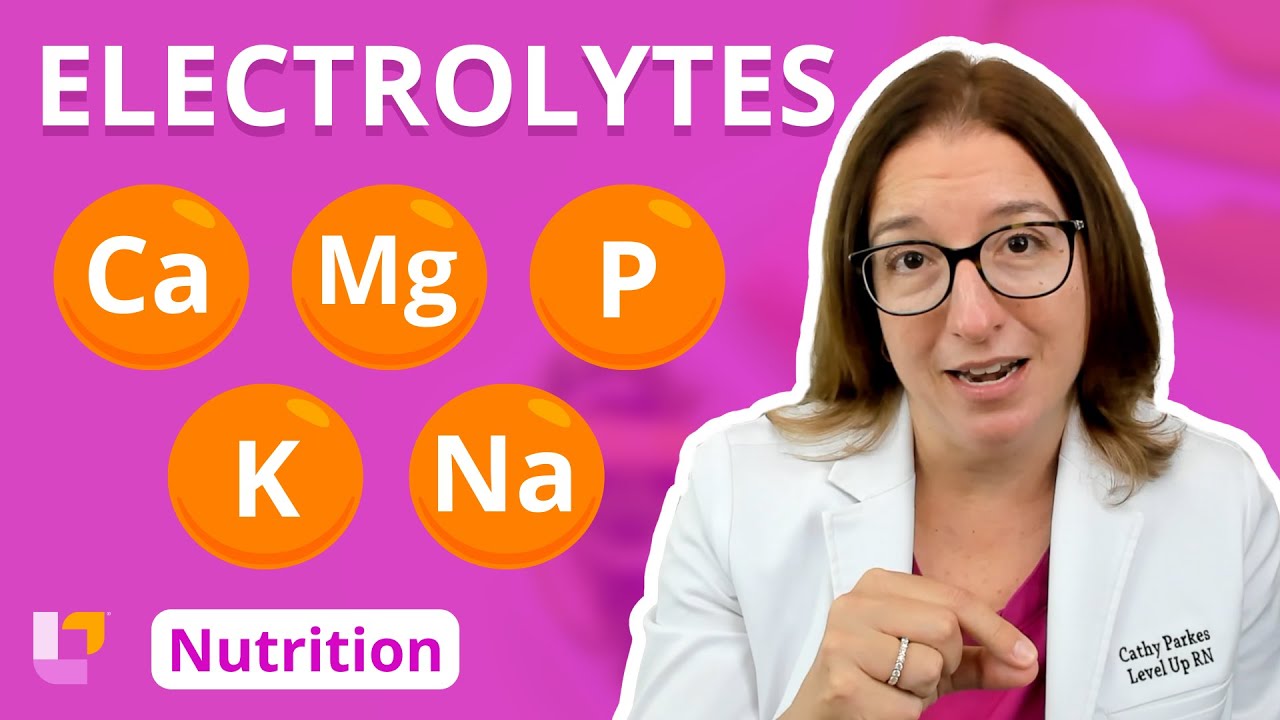
Key information about the following electrolytes: calcium (Ca), magnesium (Mg), phosphorus (P), potassium (K), and sodium (Na). She discusses the function of each electrolyte, the normal range for each electrolyte, our Level Up RN cool chicken hints for remembering the electrolyte ranges, dietary sources for each electrolyte, and signs/symptoms of excess or deficiency. At the end of the video, Cathy provides a quiz where you can NAME THAT ELECTROLYTE! 🙂
Our Nutrition Essentials for Nurses video tutorial series is taught by Cathy Parkes BSN, RN, CWCN, PHN and intended to help RN and PN nursing students study for their nursing school exams, including the ATI, HESI and NCLEX.
#NCLEX #HESI #Kaplan #ATI #NursingSchool #NursingStudent #Nurse #RN #PN #Education #LVN #LPN #Vitamins #Nutrition #electrolytes
0:00 Nutrition flashcards
1:04 Calcium (Ca)
2:27 Magnesium (Mg)
3:38 Phosphorus (P)
4:54 Potassium (K)
6:29 Sodium (Na)
7:25 Quiz Time!
🚨Head over to our interactive study guide and index ANYTIME and find out exactly which card we’re referencing. https://bit.ly/NutritionStudyGuide
🎉 Want to breeze through nursing school and ace the NCLEX? 🩺 With our Comprehensive Nursing Collection, you’ll get EVERYTHING you need to succeed, plus some amazing perks! 🎁 Right now, when you grab the collection, you’ll score a FREE Nursing Planner, a whole YEAR of Level Up RN Membership, AND Flashables – NCLEX Edition (our signature flashcard content in an on-the-go digital format with guided, personalized learning and progress tracking!) 🤩 That’s over $345 in savings—the ultimate deal to set you up for success from day one to NCLEX triumph! 🌟 🔗 Don’t wait—claim your bundle today and start leveling up! https://bit.ly/VeryMindful
🚪 Access our Cram Courses, Quizzes and Videos all in one ad free space with Level Up RN Membership https://bit.ly/LevelUpRNMembership
Want more ways to MASTER NUTRITION? Check out our flashcards, review games, videos, tips & more!
👇👇👇👇👇👇👇👇👇👇
👉 https://bit.ly/ALLNutrition 👈
☝️👆☝️👆☝️👆☝️👆☝️👆
This is your one-stop-shop for materials to help you LEARN & REVIEW so you can PASS Nursing School.
🤔🤔🤔 DO YOU WANT TO PASS your classes, proctored exams and the NCLEX? 🤔🤔🤔 Our resources are the best you can buy. They are built with a single goal: help you pass with no fluff. Everything you need, and nothing you don’t. Don’t take our word for it, though! Check out our hundreds of ⭐️⭐️⭐️⭐️⭐️ reviews from nurses who passed their exams and the NCLEX with Level Up RN.
🗂️ Our Ultimate Nursing School Survival kit is your number 1 resource to get through nursing school and to pass the NCLEX. Whether you’re just starting school or you’re already prepping for the NCLEX, this bundle of flashcards is the best you can buy. It covers all the information you need to know to pass all your exams and it has FREE shipping!
➡️ https://bit.ly/TUNSSK ⬅️
L👀king for EVEN MORE resources to survive Nursing School? Make your Nursing School experience your own! Life’s difficult enough—learning shouldn’t be.
🪅 Games https://nursesquad.com
💻 Digital resources https://bit.ly/NursingStudyCourses
📅 Organizational tools https://bit.ly/OrganizingSchool
✨Want perks? Join our channel!
https://youtube.com/leveluprn/join
🏷 Head to https://leveluprn.com/specials for all our latest deals!🥳️
📧 LOOKING FOR FREE RESOURCES TO HELP WITH YOUR EXAMS? Get exclusive tips, latest video releases and more delivered to your email!
➡️ https://leveluprn.com/signup ⬅️
⚕ 👩 LEVEL UP NURSE SQUAD 👩⚕️
All of the nurses at Level Up RN are here to help! Cathy Parkes started helping her fellow classmates back when she was in nursing school, tutoring so they could pass their exams and graduate. After she got her BSN and started working as an RN at Scripps Encinitas Hospital, she started this YouTube channel to help nursing students around the world. Since then she has built a team of top-notch dedicated nurses and nurse educators who are focused on improving nursing education and supporting career advancement for nurses everywhere. With flashcards, videos, courses, organizational tools and more, we are singularly focused on helping students and nurses Level Up on their exams and nursing careers.
Hi, I’m Cathy with Level Up RN. In this video,
I will be discussing electrolytes. And at the end of the video, I’m going to give you guys
a quiz to test your understanding of some of the key points I’ll be covering. So definitely
stay tuned for that. And if you have our Level Up RN Nutrition Flashcards, go ahead and pull
out your flashcards on electrolytes so you can follow along with me, and pay close attention
to the bold red text on the back of these cards because those are the things that you are
likely to get tested on in nursing school. Before we get into specific electrolytes, I
did want to mention that when we talk about the normal range for an electrolyte, this will
vary across different textbooks, online sources, and hospital systems. So I urge you not to get
hung up on those small differences because when you are given an out-of-range value on a test,
it will likely be very high or very low as opposed to slightly high or slightly low.
Let’s start off by talking about calcium, which is an electrolyte that is critical for bone
and teeth formation, muscle and nerve function, as well as clotting. The normal range for calcium
is between 9 and 10.5 milliequivalents per liter. Our cool chicken hint to help you remember this
range is California, which is abbreviated CA, is due for the big earthquake at some point,
which may measure between 9 and 10.5 on the Richter scale. Key dietary sources of calcium
include dairy products such as milk, yogurt, and cheese, as well as kale, broccoli, fish such
as sardines and salmon, and fortified foods such as cereal. High levels of calcium, which is
called hypercalcemia, can cause constipation, kidney stones, bone pain, muscle weakness, and
confusion. Low levels of calcium, which is called hypocalcemia, can cause muscle spasms as well
as paresthesia, which is a burning, prickling type sensation, kind of like pins and needles.
Next, we have magnesium, which is an electrolyte that is critical for nerve and muscle function as
well as many biochemical reactions in the body. The normal range for magnesium is between 1.3 and
2.1 milliequivalents per liter. Our cool chicken hint to help you remember this range is, if you
have an MG, which is a very small British car, you can only fit 1 or 2 people in it, which is the
approximate range for magnesium. Dietary sources of magnesium include nuts, seeds, legumes,
whole grains, green leafy vegetables, milk, yogurt, and fortified cereal. High levels of
magnesium, which is called hypermagnesemia, can cause lethargy, muscle weakness, decreased
deep tendon reflexes, as well as respiratory depression and cardiac arrest. Low levels of
magnesium, which is called hypomagnesemia, can cause tremors, increased deep tendon
reflexes, as well as dysrhythmias and seizures. Next, we have phosphorus, which is an
electrolyte that is essential for bone and teeth mineralization, cell structure, as well as
energy production. The normal range for phosphorus is between 3 and 4.5 milligrams per deciliter.
Our cool chicken hint to help you remember this range is phos-four-us is normally around 4.
Dietary sources of phosphorus include dairy products such as milk, yogurt, and cheese, as
well as fish, poultry, eggs, and legumes. One key thing to note about phosphorus is that it has an
inverse relationship with calcium. So if calcium levels are high, phosphorus levels will be low.
Therefore, when we have high levels of phosphorus, which is called hyperphosphatemia, we will have
signs and symptoms of hypocalcemia such as muscle spasms. And then when we have low levels of
phosphorus, which is called hypophosphatemia, we will have signs and symptoms of hypercalcemia
such as bone pain, muscle weakness, and confusion. The next electrolyte we’re going to talk
about is potassium, which is essential for the maintenance of ICF, which is intracellular
fluid, as well as the regulation of muscle and heart contractions. The normal range for
potassium is between 3.5 and 5 milliequivalents per liter. One cool chicken hint to help you
remember this range is to think of bananas, which are high in potassium and often come in
bunches of 3 to 5, which is the approximate range for potassium. You can also think of running
a 5K, and K is the abbreviation for potassium, and a 5K is approximately 3.1 miles. Dietary
sources of potassium include fruits such as bananas, apricots, orange juice, cantaloupe, and
tomatoes, as well as vegetables such as potatoes, spinach, and broccoli. Other dietary sources
include legumes, milk, and salt substitutes. So the main thing you need to know about potassium
abnormalities is that they cause dysrhythmias. So whether we have high levels of potassium, which is
called hyperkalemia, or low levels of potassium, which is called hypokalemia, they both cause
dysrhythmias. And that is something you will definitely get tested on in nursing school.
And finally, we’re going to talk about sodium, which is an electrolyte that is essential for
nerve and muscle function as well as fluid volume maintenance. The normal range for sodium
is between 136 and 145 milliequivalents per liter. Our cool chicken hint to help you remember this
range is, if you shake a salt shaker, you will get approximately 136 to 145 grains of salt out of it,
which contains sodium. Dietary sources of sodium include shellfish, meat, table salt, processed
foods, and frozen foods. High levels of sodium, which is called hypernatremia, can cause thirst,
lethargy, and confusion. Low levels of sodium, which is called hyponatremia, can cause
confusion, nausea and vomiting, and seizures. All right. It’s quiz time. And in this particular
quiz, I want you to name that electrolyte. So we went over five electrolytes, so there’s
a question for each one. You guys ready? Question number one. Excess levels of blank
can cause kidney stones and constipation. The answer is calcium.
Question number two. Key dietary sources of blank include
shellfish, frozen food, and processed food. The answer is sodium.
Question number three. Calcium has an inverse relationship with blank.
The answer is phosphorus. Question number four. Low levels of blank can
cause tremors, increased deep tendon reflexes, dysrhythmias, and seizures.
The answer is magnesium. Question number five. Key dietary sources
of blank include bananas, cantaloupe, potatoes, and salt substitute.
The answer is potassium. All right. That’s it for this video. I hope you
found it to be helpful. Thank you so much for watching, and good luck with studying.
[BLOOPERS] Milk and salt– the next electrolyte
we’re going to talk about is potassium, which is– which is essential for
maintaining ICF, which is– it’s essential. I invite you to subscribe to our channel
and share a link with your classmates and friends in nursing school. If you found
value in this video, be sure and hit the like button, and leave a comment and let
us know what you found particularly helpful