Get my 2025 supplement guide: https://www.siimland.co/supplement-list-2025
Timestamps:
00:00 Intro
00:14 Taurine
01:19 Apigenin
01:55 Resveratrol
03:20 Rapamycin
04:55 Metformin
06:11 Calcium AKG
07:30 Melatonin
08:16 SIRT6
09:05 NAC
09:43 NMN, NR, Niacinamide
11:10 Niacin
13:58 Glycine
15:16 Spermidine
16:44 Omega-3s
17:40 Creatine
18:48 Pterostilbene
19:19 Magnesium
20:16 Vitamin K2
20:45 Sulforaphane
21:34 Curcumin
22:08 Methylated B vitamins
22:33 Glutathione
24:08 Lithium
24:55 Lutein & Zeaxanthin
25:30 Vitamin C
26:29 Ergothioneine
27:23 Methylene blue
28:46 Multivitamin
29:37 Aged garlic extract
30:22 Astaxanthin
31:06 TMG
31:50 Ginger
32:15 CoQ10
32:53 PQQ
33:24 Chondroitin
33:45 MSM
32:25 Glucosamine
34:54 Conclusion
100 supplements ranked worst to best: https://youtu.be/W8DZbYyuDmA
➡ Join our LONGEVITY and ANTI-AGING Skool Community: https://www.skool.com/youthspan-society-9710/
Start rewinding your biological clock: https://www.siimland.co/course
P.S. This is not professional medical advice and should not be taken as such. The creator of this video is not held accountable for your health. Consult your doctor first.
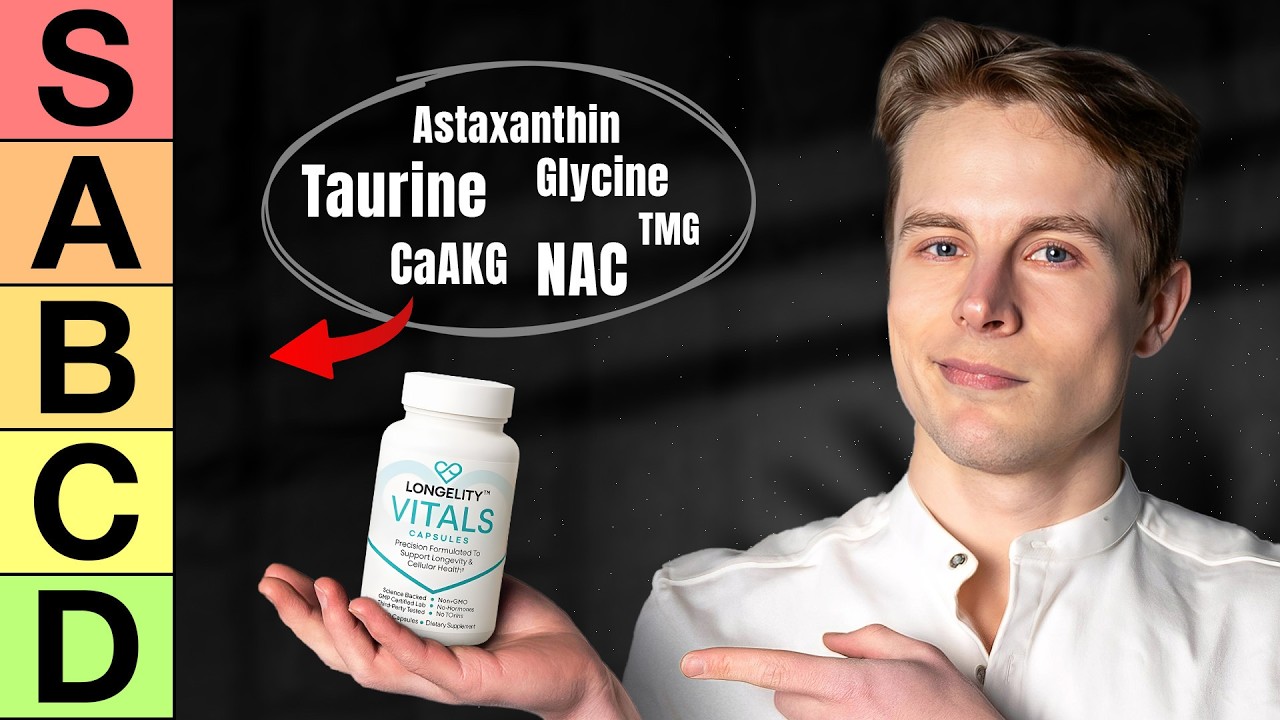
Recently, I ranked a 100 of the most popular supplements from worst to best. In this video, I’m going to focus only on the longevity supplements that have either been seen to extend lifespan in animals or they might have some potential longevity effects in humans. Timestamps for everything are down below. All right, let’s begin. First one, torine. So, torine is quite interesting. There is animal research that um it has been seen to extend lifespan in mice. the from two years ago there was the study and uh in humans we have quite a lot of clinical trials showing that it improves aspects of metabolic health. So it’s uh relatively safe, little to no side effects. It improves exercise performance, improves blood markers, and in animals it has been seen to extend lifespan. So based on this criteria, I would put it into the gut tier because, you know, obviously we can’t say or know if torine is going to extend lifespan in humans, but you know, the human studies indicate that it does help with many aspects of overall health and human longevity. you know the best way to track it is yeah just make sure you have a lower risk of these chronic diseases like lower risk of heart disease Alzheimer’s and metalic syndrome and diabetes etc that would shorten your lifespan so something that would reduce that uh risk would be u quite useful epigenine you know epigenine mostly helps with again the NAD metabolism it inhibits CD38 which is a glyoprotein that lowers your NAD levels now there isn’t any strong evidence that epigenine would extend animal lifespan and obviously human research is much more limited. So I would put it in the okay tier. I do think that inhibiting CD38 with something like apigenine would be a part of a longevity stack and would be part of a longevity strategy when you’re talking about uh long-term um longevity. Uh Reseratrol. Now many people think that reseratrol is one of the best longevity supplements out there but uh you know the actual high quality animal studies even don’t suggest that it is a life extension molecule. Now it was seen to extend lifespan only under one condition which is um essentially like metabolic syndrome and obesity. So mice who are fed and obes diet they have pretty much like obesity and diabetes then uh reseratrol does extend their lifespan but it doesn’t really do that under other conditions and human research also suggests that reseratrol improves lipids and blood sugar and inflammation markers only if you have diabetes or metabolic syndrome and it might have some negative effects as well on things like reducing the um benefits you get from exercise and reducing your V2 adaptation. So, it’s definitely not a useful supplement for an otherwise healthy individual in my opinion. And the animal data also suggests that it’s not particularly um effective. So, you know, I would put it in the junk tier based on all of that. But, um in the previous video, the 100 supplement ranking, I did put it in the junk tier. But here, when we’re talking about just longevity, I’ll just put it in the bad tier. uh because yes under certain conditions under certain criteria it might have some effects but it’s not really that effective. Now rapomycin obviously it’s not a supplement. I’m just going to put it into this video again because people just ask about it. What do you think about rapamy and it’s one of the more you know biggest candidate for extending human lifespan as well. There’s no evidence that it would do so currently, but uh rapamyin is the most consistently shown uh is is a is a molecule that’s been seen to extend animal lifespan most consistently in different organisms and most potently as well. So obviously based on that it would be just got here uh from a perspective of a life extension if we were to look at it from the animal data from human data it’s very early to say but uh I’ve been actually positively surprised by rapamyin over the last few years um in the past I might have been skeptical about it that you know okay it inhibits mTor it might be bad for muscle maintenance it might be bad for um preserving brain cells because you need mtor as well for growing brain cells neurogenesis But uh there have been a few studies on humans over the last few years that show that rapomyin not only didn’t result in muscle loss but actually help to preserve muscle as uh the in older people. So that’s quite interesting. I would say that this uh would really increase potential uh for rapamy for being an otherwise healthy like a longevity pharmaceutical especially for elderly people. So yeah with limited evidence I’m going to put it in the god tier but based on the um animal data it definitely belongs in the god tier from a life extension perspective solely metformin so this is pretty much paired with rapomy always and similar reason it’s a very popular anti-aging uh drug or people take it for anti-aging purposes but you know there’s much better alternatives to metformin such as sgt1 inhibitors that have been seen to extend lifespan in animals and appear to have much fewer side effects than metformin. So metformin obviously is very cheap. It’s uh easy to find. So it has obviously some potential and it definitely is beneficial for diabetics or people with insulin resistance. But um it also has a few more side effects compared to like uh some of these other SGLT one inhibitors. And metformin use in some studies is seen to be associated with longevity. But those studies tend to be um a bit uh poorly done. And if you just look at yeah what what has h what happens to people who don’t have diabetes what if they take mtorine then uh it doesn’t extend their lifespan or it’s not associated with increased longevity in those individuals either. So I’m going to put it in the okay tier from the perspective of longevity and lifespan because the animal data also isn’t that consistent with metformin calcium alpha ketogluterate. So this one um has been seen to uh extend mouse lifespan. It uh has limited data in humans. So there’s not a lot of clinical trials on humans. one of the few clinical trials on humans looked at epigenetic age and calcium alpha ketoglutarate did reduce DNA methylation age in humans. So you know that could be a sign in a positive direction. So you have two I guess indications that it has some potential. Uh firstly the mouse life extension and in humans reduction in biological age but I wouldn’t associate a reduction in biological age in humans with greater life extension or greater longevity. We don’t have that kind of data to claim that but I would put it in the okay tier because of that same same reason. Yes, it uh possibly has life extension effects in animals. It has been seen to do so in humans, you know, because it doesn’t have any other clinical data really. There’s no there’s very limit limited evidence about it helping with wound healing or bone density, but it doesn’t have some other metabolic health benefits compared to something like torine melatonin. So melatonin, I would put it in a good tier based on the longevity and anti-aging perspective. And the reason for that is because we just don’t have that much data about even animal data for longevity or life extension in humans. It again improves many aspects of metabolic health such as lowering uh insulin resistance, lowering inflammation, lowering lipids in higher doses and improving sleep. So it’s definitely very worthwhile for most people with age you see a decline in melatonin. So elderly people will definitely benefit from melatonin and it, you know, improves aspects of metabolic health as well. So I’ll put it in the good tier and it’s not in the gut tier because of the somewhat limited data for life extension from animal studies. Cert 6. So cert 6 is the only certuin seen to extend lifespan and um it uh you know doesn’t really have that much other evidence unfortunately it is possible to buy it as a supplement but uh there’s no really no other clinical trials on six unfortunately and uh you know the only evidence we could use is yeah some that it might extend lifespan or it has been seen to extend lifespan in mice although it’s not that wellstudied compared to something like rapamyin for example. So I’ll put it in the okay tier it doesn’t appear to have side effects or any significant side effects I’ll put it in the okay tier for that reason. NAC. So NAC especially combined with glycine or the glyc combo has been seen to extend lifespan in mice and in humans is also been seen to improve certain functional outcomes, grip strength, walking speed, cognition, body composition, metabolic health markers etc. Then uh it uh also has anti-inflammatory effects. So I would in my opinion it is got tier based on the combination of those factors. So uh animal data plus human data from clinical trials. So it’s much well more much more studied than like melatonin or six in the context of longevity. NN so um N booster doesn’t appear to have you know side effects. So it’s not going to be in the bad tier. It’s not really miraculous either unfortunately. You know a few years ago many people would have had the impression that it is a next miraculous uh molecule but unfortunately the clinical trials out there right now suggest that it does something but it’s not really significant. You know that’s something mostly is a slight improvement in insulin sensitivity reduction in inflammation maybe some improvements in physical function as well and uh in animals it has I have seen one study where it was seen to extend lifespan in mice but nothing or that’s the only one so I’ll put it in the okay tier based on that. So again any longevity stack would have some aspect of NAD support. So uh epigenine for reducing uh CD38 which results in greater NAD recycling and production and some NAD booster such as NMN, NR or ninamide. I’ll put them all here that in the same bucket in my eyes that they do have some benefits. They all raise NAD. So it doesn’t really matter which one you take. And some longevity stack would have some component of NAD metabolism. either one of these three or and an additional u CD38 inhibitor. Nascin is also NAD uh supports NAD production. It also has the additional benefit of increasing HDL cholesterol. But unfortunately uh raising HDL cholesterol doesn’t reduce the risk of heart disease. It’s been seen uh already several decades ago that although you see increase in HDL from NASIN, it doesn’t really reduce heart disease. uh events. So uh again I’ll put it in okay tier for that reason. It’s in the same bucket as other NAD boosters in for me. Next up queretin. So this is a senolytic that um will help with scinesscent cells. There is some potential life extension effects as well from animal studies in human studies. Uh much more limited evidence. Yeah. there some of the synolytic clinical trials will be coming out in the near future so we’ll see what comes from that but other than that I would say they’re yeah all the senyics like queretin and fisetin they’re okay so they uh do work in terms of inhibiting scinesscent cells but based on the human data we can’t really say much about their effectiveness they do reduce scinesscent cells in humans as well. Uh but what is the actual outcome of that? Uh we really based on the information right now I really can’t say. And another issue with the cenotics is that you don’t always want to inhibit the cenolytic scinesscent cells because uh scinesscent cells are also involved in wound healing. They have other benefits. So you don’t always want to uh eliminate your scinesscent cells especially if you’re younger possibly. Um and elderly people also need wound healing obviously. So we don’t have the exact protocol. What’s the best protocol to to use these senolytics? How much? What’s the dose? How frequently? You know a lot of companies uh market that okay take it twice a month, two days a month, that’s it. Well there’s no evidence that that is the protocol that would work. They just come up with their own protocol. So uh you know yeah I I wouldn’t know if that would be the best protocol but similar to NMN and NAD boosters a good longevity supplement stack or a pharmaceutical stack would involve some aspects of cenolytics whether that be coretin does which is the antihistamine that was combined with corsetin seemed to be effective for um life extension in animals and removing sin cells. So I’ll put all I would put all the analytics into this okay category. Yes, they work but we don’t know exactly what the protocol is. Glycine. So glycine I’ll put in tier immediately. You know mostly because it’s an easy win. Now glycine isn’t going to extend your lifespan miraculously. And even in animal studies it hasn’t been seen to extend animal lifespan very significantly. But it is a like a sure bet. It’s a very safe uh compound and it’s just yeah like a easy win. So it’s obviously much less effective as than rapamy in terms of life extension in animal studies and even torine. So torine has also seen to extend lifespan in m mice more so than glycine. So glycine gives like a small extension in life of lifespan in animal studies in mouse studies and when it comes to humans combined with NAC it improves physical function cognitive function body composition and markers of metabolic health other hallmarks of aging. So it is a very consistent consistently shown to have benefits very safe and easy win. So that’s why again I would always add it to someone’s longevity stack for those reasons. It’s an easy win. It’s a safe little to no side effects. Some people might report nausea or headaches or something like that. Uh but in the majority of cases, it’s very safe. Spermdine. So as a supplement, you know, there’s no side effects from it. As a supplement, the only effects that I’ve seen are slight potential improvement in cognition and uh potential skin health benefits. uh but uh in um in terms of life extension uh not so much and uh spermadine is popular mostly because dietary spermine intake is associated with reduced mortality. So if you get over 11 milligrams of spermadine a day from your diet uh then that is associated with a slight reduction if I’m not mistaken 30% reduction in mortality risk. But you know the reason for that is because uh foods that have spermadine are healthy foods mushroom vegetables cheeses uh etc. So uh it’s much better to focus on the dietary spermadine rather than the supplemental spermadine if we were to look at the the actual evidence. So, I’ll put it in the okay tier for that reason that it doesn’t have any negative side effects that I’m aware of. And it might potentially help with cognition in elderly people, but it’s somewhat limited. And it might have skin and aging benefits, which you know is anti-aging effect or benefit. But in this video, we’re specifically focusing on um you know, life extension and longer lifespan, omega-3s. So, uh, in my opinion, omega-3s are god tier because, uh there’s just so much data, so many clinical trials showing that they have benefits for reducing uh cardiovascular events as well as improving insulin sensitivity, lowering inflammation, helping muscle growth, helping cognition and uh a higher omega-3 index is associated also with a reduced uh mortality and reduced Alzheimer’s, reduced heart disease. So, uh, based on that, I’ll put it in the gut tier. There’s no, um, life extension data that I’m aware of from omega-3s, but the human data is u very, um, you know, enormous. It’s, uh, I think it’s equally as studied as creatine, for example, in terms of the amount of studies. And speaking of creatine, so creatine again very studied and uh definitely the most effective sports performance supplement out there. Will have benefits of muscle strength, muscle power, and uh possibly cognition as well. But the thing with creatine is that it’s not going to give you cognitive superpowers. It’s not going to increase your cognition beyond uh the normal. it’s going to make up for some uh deficit in cognition that could be caused by sleep loss, sleep deprivation, jet lag, head concussion, traumatic brain injury and those kind of things. So, uh it obviously has very useful effects and um you know definitely for sports performance, but I wouldn’t consider it an actual longevity supplement for that reason. I would, you know, I guess, you know, it’s still better than some of these other supplements here. It has definitely a lot more evidence. It’s not going to have like a actual life extension effect, but uh it supports health span, I guess, so that uh your physical health will be better for longer and you know, possibly also cognitive health will be better for longer. But there are still bean. So uh this is a cousin molecule for reseratrol. There’s no data that it would extend lifespan in animals and um the only human trials that I’ve seen is that uh it uh actually raises LDL and might lower blood pressure. So, I’ll put it in the that tier because uh there’s just very little data about that and possibly negative side effects in terms of a lipid profile. Magnesium. So, I think magnesium I’ll put it in the good tier just from the perspective of uh longevity and life extension. Most people would benefit from some aspects of magnesium supplementation, but there’s no direct evidence that it would just extend lifespan in animals or that it would significantly reduce future risk of chronic diseases. It’s more effective if you’re deficient in magnesium. So, if you’re deficient in magnesium, it’s going to help you with sleep, stress, blood sugar regulation, blood pressure, etc. But if you’re otherwise healthy, then adding extra magnesium is not going to have a significant effect. it’s going to, you know, the only side effect you could get from magnesium is like diarrhea. So, u I wouldn’t otherwise u consider it like an actual longevity of lifespan supplement, but you know, it’s still something that most people could benefit from. Vitamin K2. So, vitamin K2, I’ll put it also in the good tier. So, has you could also just categorize K1 here as well. I would use them together. K1 has evidence for bone density and uh even reduced atheroscerosis and K2 also seen to reduce atherosclerosis as well as increase bone density. So they’re both pretty uh good. Sulfurophane has been seen to extend lifespan in some animal models like round worms but uh it’s you know significantly less researched than rapamy or glycine or torine or NAC and the human evidence is also a lot more limited. So I’ll um you know I wouldn’t put it in the good tier because of the limited evidence. So I’ll put it in the okay uh tier. So it works through increasing the glutathione levels which is a powerful antioxidant and uh in a lot of cases people need additional antioxidant support but uh not always and you know what’s the specific dose or specific protocol to be used uh that is u you know still to be established in my opinion. Curcumin has also been seen to extend uh lifespan in a few animal models. In uh human studies, the most consistent effect is lower inflammation, so lower CRP, but also better lipid and metabolic health profile in clinical trials. And there’s quite a lot of them. So I would, you know, put it in the gut tier based on those criteria, those conditions. So it improves metabolic health and other otherwise inflammatory status in humans and in animal studies. It also extends um lifespan. Methylated B vitamins. So methylated B vitamins uh can be very effective for people who have poor methylation. So for them it can be got tier in terms of that um helps to lower homocyine and improve just overall metabolic health. But you know there’s no real uh life extension data from methylated B vitamins. So I’ll put him in the okay uh tier. So glutathione you know I mentioned earlier the glycine and NAC have been seen to extend lifespan in mice and all these several clinical trials on humans showing improved uh physical function and overall metabolic health etc. So based on and you know it works through increasing glutathione and glycine being precursors to glutathan. So you know based on that glutathione will also be gutier because you just take the direct compound but the issue is that um it’s actually much better to take the precursors rather than the main compound itself and there is some evidence that um taking glutathion alone or directly might have some negative side effects. Excess antioxidant status or excess antioxidants can surely be uh harmful as well in um in certain aspects. So I wouldn’t put it in the god tier because of that. So it’s better to take the precursors and based on the evidence then these precursors have shown to provide more consistent benefits in animal studies as well as in human studies. But I’ll put it in the um good tier based on that uh reason. it’s better to take the precursors so your body would it has a better control or handle over its own antioxidant defense system rather than just taking the you know the main compound itself in larger quantities. It’s better to give the precursor so your body regulates the glutathione levels based on the the requirement lithium orotate. So recently lithium has become even more popular for um neurodeeneration and there was a recent study that implicated lithium deficiency in neurodeeneration and uh there’s this interesting data that uh regions with higher lithium in the drinking water have lower rates of suicide, lower rates of homicide and greater longevity. So there might be something there. It’s obviously very u rough data these um these drinking water data with lithium but you there’s uh some of these clinical trials as well on people with bipolar disorder where individuals taking lithium have lower rates of uh future dementia and there is some animal data as well that lithium extends lifespan so I’ll put it in the good tier lutein and zeazanthin so carotenoids and they have been seen to extend lifespan animal studies, a few of them uh animal models, mostly some fruit flies, but in humans, it supports vision, possibly uh cognition and possibly skin health as well. So, I’ll put it in the good tier. So, I think that these combination they’re usually taken together, lutein and zanthin for eye health uh is is only not only good for your eyes but possibly for other functions as well. Vitamin C. So vitamin C is a very safe compound and obviously an important one. Essential vitamin you it’s always talked about in the context of um collagen synthesis. The evidence of vitamin C extending animal lifespan is somewhat conflicted and um in human random control trials there is some association with antioxidant supplements and increased mortality but vitamin C was not one of them. So it was vitamin A, beta carotene that we’re to have increased association with mortality, but vitamin C was not one of them. So it’s safe. So I’ll put it in the okay tier, you know, if you is is vitamin C something that you can just, you know, take thousands of milligrams a day and nothing would happen pretty much. You might see some benefits. People who have, let’s say, lower vitamin C intake, they might notice some additional benefits. But um even if you take 1,000 milligrams of vitamin C every day, you’re just at at that point you’re just wasting it essentially. Egoanine. So um this is a molecule that has become also quite popular recently or is u slowly becoming popular and um there is some evidence that it might help with brain aging and brain health. But the the interesting thing about utanine is that the doses seem to provide those effects for the brain and cognition are pretty pretty low. You can easily get that from diet. So I don’t see really see a reason why you would ever supplement erine when you could get you know three to five times more ergoine from eating a regular diet, eating things like mushrooms, vegetables, uh etc. They contain you you get you get all the erggothinine you would want from those foods. So, um, you know, I don’t see really see any reason to supplement erathanine as long as you eat a pretty diverse, uh, and a healthy, uh, diet, but it’s, you know, not going to hurt you either based on the evidence. Methylene blue. So, this is, uh, again, not a supplement, but, you know, people really, people who are into supplements also take methyline blue quite often. So, I’ll just mention it here. And there’s no data that methylene blue would extend lifespan in animals. The human data is more about specific medical conditions and u it’s mostly theoretical. So there’s really no evidence that you get to go with when we’re talking about methylene blue. A lot of people, you know, swear by it that it helps them and, you know, obviously it has a useful role in situations of mitochondrial dysfunction such as cyanide poisoning, possibly neurodeeneration, some severe metabolic disorders, etc. So, it can be like a clutch supplement for certain situations or for certain individuals, but it’s not something that would like add additional health span or lifespan to an otherwise healthy individual. In my opinion, it could possibly be bad for some individuals who are otherwise healthy. And I wouldn’t say that it’s something that you just want to take recreationally if you’re otherwise healthy. So, you know, put it in the bad tier based on that because it has some use case similar to reserrol. It has some use case, but for most people, I wouldn’t really think that it is worthwhile. Multivitamin is okay because um you’re just covering your daily vitamins and minerals to a certain extent. It’s better to take a multivitamin than to be completely deficient in uh certain vitamins and minerals if you’re not getting them from your diet obviously. And uh you know there are some randomized control trials on elderly people as well that it improves cognition uh but mostly through increasing the uh nutrient intake and uh with multivitamins they they don’t really reduce the risk of mortality or future uh risk of these chronic diseases. So they’re benign in my opinion. In most cases, the multivitamin is just going to be like a safe safe bet that you cover your daily nutrients, but chances are you’re already getting it. You’re already getting your daily nutrients. So, garlic extract um I’ll put it in I’ll put it in the um good tier because um there’s quite a lot of uh cling on things like blood pressure, lipids, blood sugar, waist circumference, etc. So it improves metabolic health across the board, improves lipid panel, improves cardiovascular disease risk factors, it has a ton of clinical evidence for that. Yeah, but it doesn’t have that much life extension data from animal studies. So because of that, I’ll put it in the good tier. It’s not going to like probably extend your life, but it uh could possibly reduce the risk factors of uh some of these chronic diseases that could shorten your life, if that makes sense. Axanthin, I’ll put it in the gut tier. So, also recently seen to extend lifespan or it’s it’s been seen to do that before, but um recently was seen to do that again. And um asexanthin in my opinion is also otherwise safe and in human studies, human clinical trials, it appears to lower inflammation. It also has possible benefits on blood pressure and lipids plus uh skin and aging benefits. Now obviously this is not the topic of this video but it’s just just an additional bonus. So life extension in animals plus it’s a cenolytic so it has potential cenolytic effects anti-inflammatory effects lipid effects blood pressure effects. So the combination of all these factors TMG so trimethaglycine supports homocyine I’ll put it in the okay tier it doesn’t have any life extension data from animal studies and obviously not humans as well but in humans it can lower homocyine levels maybe it improves exercise performance and body composition but that’s a bit more um limited more tricky but it does certainly help with homoyine so a lot of people benefit from TMG but it’s not a significant powerhouse in uh longevity and lifespan specifically. I do take TMG myself because I have genetically slightly higher homoyine levels but uh yeah similar to methylated B vitamins it’s kind of useful for homocyine ginger so it has been seen to extend lifespan in animals and in humans it improves inflammation might support uh weight loss as well and joint health but it has slightly less evidence as curcumin so I’ll put it in the the good tier but uh otherwise ginger is quite a good compound when you’re speaking of general longevity. CoQ10 so CoQ10 has some evidence in animal studies that it helps with lifespan and longevity but in humans it only appears to work for heart failure, improving energy in like uh people who have energy issues or chronic fatigue. But um yeah, it uh is significantly less researched as some of these got tier supplements. So it it’s not going to be a gut tier supplement. So I’ll put it in um I’ll put it in the the good tier, the tail end of good tier. PQQ is similar to CoQ10. It supports mitochondrial function. It’s antioxidant, but it has a lot less evidence than CoQ10. Some people say that PQQ is more potent than CoQ10, which could be the case, but uh PQQ is just less researched compared to CoQ10. So, it can’t be on the equal level based on that. So, um I’ll put it in the okay tier mostly because of the limited human trials. Chondroitin sulfate. So, uh this is a sulfur compound mostly in the context of joint health. Out of all these joint supplements, chondroitin is the worst. It has the least evidence. It might have some skin benefits. Has some joint benefits, but it’s the least effective for that. And it has the least evidence for lifespan as well. Put in the okay tier. MSM as well. MSM has better skin health benefits. And I wouldn’t even actually consider the best benefit of MSM being skin health based on the evidence that I’ve seen. So, it’s not nearly as good for joint health either, but it’s good for uh skin, but uh it doesn’t have that much evidence for life extension. In the previous video, I put it into the good tier, but uh that’s because uh I’m mostly impressed by the skin benefits from MSM rather than the potential life extension benefits. So, in this video, it’s going to be okay tier because the limited life lifespan and longevity benefits. But for skin health, it’s uh good in my opinion. Glucosamine on the other hand will be in the good tier as was in the same in the other video uh because uh yes it has joint benefits but glucosamine use is also associated with reduced mortality and reduced heart disease in humans. So uh that’s why in it’s going to be in good tier. Glucosamine also uh increases autophagy and in animal studies it has been seen to have some longevity benefits. So I’ll put it in the good tier based on that. Again, I made this list based on uh the effects on lifespan and longevity specifically. So, uh not skin benefits, not uh some exercise benefits, mostly for let’s say health span which would also extend your lifespan. So, right, if you stay healthier for longer, you have better physical and mental performance for longer in your life, you will also live a bit longer. So the combination of those factors, raw animal life lifespan data plus health span data in humans, health span being better physical and cognitive performance and a reduction in the risk of various chronic diseases. So here’s the list based on that. Obviously it’s going to be slightly different than the total 100 uh most popular supplement list that I made previously. And the reason for that is because yeah in that video I ranked things based on the overall data. So everything that is about this supplement whatever I was ranking but in this video I’m going to yeah just look at raw animal lifespan data plus the human health span uh data because that’s the only thing we can take from human studies. So yeah the list the gut tier supplements you know torine rapomycin glycine omega-3s ccuminanthin uh everything here except rapamyin was in the gut tier from the previous video as well. So again these supplements I would consider one of the best supplements out there. good tier. A few of these supplements were in the gut tier in the previous video, such as melatonin and luteine. So, magnesium as well was in the gut tier with some of them. So, it doesn’t mean that they’re bad. It’s just that in the context of lifespan specifically, they’re less effective as these gut tier supplements. You know, creatine is a god tier supplement for sports and other things, but the evidence for lifespan and longevity are much more limited and okay tier supplements. So these supplements again are not bad. They have a lot of some effects and as I said earlier NAD boosters would be part of a stack would be part of some longevity stack. The same with um you know vitamin C and epigenine and TMG or methylated B vitamins. Most people will have it in their stack but they’re not having specific lifespan uh effects. And yeah, we actually didn’t get any junk tier supplements here because none of these supplements actually shorten your lifespan, if that makes sense. All right, that’s it for this video. Make sure you check out the full video where I rank 100 supplements from worst to best, the overall impression of these supplements, and their overall effects across all aspects.