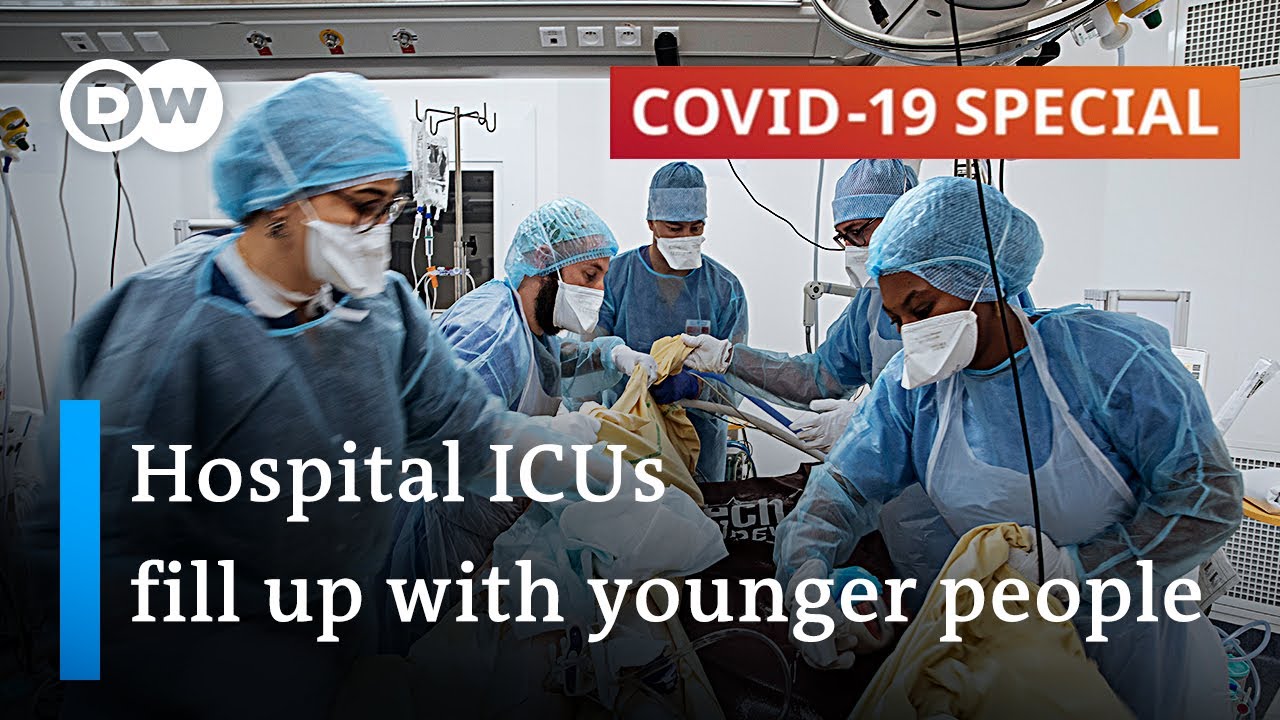
In many countries in the world, we’re seeing that the average age in intensive care is decreasing. Younger people are more likely to recover from severe symptoms that require intensive care, but this means intensive care beds might be occupied for longer than before. Which age group are we talking about here and what are the consequences of this?
Subscribe: https://www.youtube.com/user/deutschewelleenglish?sub_confirmation=1
For more news go to: http://www.dw.com/en/
Follow DW on social media:
►Facebook: https://www.facebook.com/deutschewellenews/
►Twitter: https://twitter.com/dwnews
►Instagram: https://www.instagram.com/dwnews
Für Videos in deutscher Sprache besuchen Sie: https://www.youtube.com/dwdeutsch
#Coronavirus #Pandemic #Hospitalisations
[Music] the profile of the patient that we have at the moment is a young patient between 30 and 50 years old where the periods of stay in icu have been longer this disease knows no age it is very sad unfortunately from one day to another it can take you away it is so sad we are more scared this time there are many young victims so to me this wave looks more dangerous than the last one indeed our feeling is that the patients are younger than they were during the two previous waves a year ago and in october and november welcome to our covered 19 special i’m monica jones in berlin and all of a sudden i’m also in that age group that’s at risk remember when we were told to protect the elderly because the virus is especially dangerous for them and that was right of course but it lulled many younger people into a false sense of security the result even though older people are mostly vaccinated by no hospitals continue to work at the limit like here in berlin we’re at the intensive care unit in berlin’s caritas hospital half of the patients here suffer from covert 19. dr thomas kunig and his team have their hands full and the beds are filling up slowly you can see that there is an increase at the moment we’re not yet in a situation that brings us to the edge of what we can do but we know that if the numbers continue to rise we could certainly have problems in recent weeks the number of covet patients in germany’s icus has been rising sharply again by now the peak of the second wave of the pandemic has almost been reached intensive care beds are becoming scarce and the workload of staff continues to grow intensive care nurse tim cutler has also noticed that now in this third wave it is particularly noticeable that the patients are getting more seriously ill and they are ill for longer also they need a lot of care that means the situation is very challenging and very stressful for us you really need time to relax when you’re off work but it is not just the sheer increase in covered patients that worries the team their patients health is deteriorating faster in this third wave of the pandemic they are also on average younger than before probably also because most people over 80 years old have already been vaccinated the solution’s alter is yet synthetic the average age is now much younger compared to the first or second waves we see that very clearly we don’t really have any patients who are over 80 years old anymore they are almost non-existent to what extent german hospital capacities are reached varies greatly from region to region while some are already completely full others are still copying one thing would help more vaccinations we won’t get out of this without vaccines they are very important but it is also important to stick to hygiene measures keep a distance and observe current covered restrictions each and every one must take this pandemic seriously and can do their part to make us get out of this as quickly as possible if the number of covet patients continues to rise other important treatments would have to be postponed in some areas in germany that is already the case the situation many doctors agree is serious the patients are getting more seriously ill their health deteriorating faster and they’re younger on average than in the first two waves let’s talk about that now with ravindra gupta he’s professor of clinical microbiology at cambridge university good to have you with us so let’s let’s start first of all with the average age in this report we heard that it’s mainly down to the fact that the older generations are vaccinated by now is that all there is to it yes i certainly think that there will be an element of uh the fact that the the elderly have been protected with vaccines of course in first wave the elderly walls are very vulnerable so a certain proportion of the most vulnerable may have been infected may have died um so that leaves a smaller fraction of susceptible elderly individuals and and therefore that is probably part of the explanation but it can’t be the whole truth because we know that this is a phenomenon that we see in many parts of the world even in parts where the vaccination rate is is much higher so there has to be something else to it yes but of course a prior immunity is of course is is potentially an explanation a factor because uh in previous waves there may have been a disproportionate impact on certain age groups in terms of who was infected uh and and also what we call a survivor effect of course some people who are infected will have died and some will have survived now you know the epidemiology is very difficult to tease apart here because a lot of this is about transmission patterns circulation of virus within certain age groups um behaviors of course because um older older individuals and certainly people over certain ages and those with conditions um uh have been shielding themselves and so minimizing their social contacts whereas younger people have been continuing uh a social contact to a greater extent so there are many different factors that could translate uh uh could that could feed into this observation and what would explain that those patients that we’re talking about are not only younger but they’re also getting more seriously ill does this have anything to do with the new variants there’s nothing conclusive at the moment in terms of uh the sort of analysis of this but these are very difficult studies to conduct properly and robustly so i’m not confident that we will get a good answer to this um you know there are there are changes happening in viruses the variants do have mutations in them it is possible that they increase virus infectivity and therefore generate more more virus particles that may cause greater disease in people who previously would have been less impacted it may induce different types of antibody or cell responses which may contribute to damaging inflammation as a result of of of the infection there are many possibilities as to why younger individuals are now observed to become to be getting sick and and and potentially more sick than they used to and of course i mean you hinted at it earlier it also has to do with behavior and the first symptoms of an infection very often they can easily be mistaken for a common cold and people younger people and i’m i’m talking about people who are up to 40 and 50 who go to work in such an age you don’t expect to get that ill do you think that uh they simply wait too long before they get help well it’s possible uh uh that that that certain individuals who are younger feel that they uh are not going to get worse and they’ve been i mean this is the problem part of the part of the the sort of rhetoric or the the sort of narrative around curvature 19 was that young people don’t get ill and they don’t die that that’s clearly wrong we knew that from the first wave that uh early last year even that that young people do get ill they do dice young you know children can get sick and and have severe disease so there’s there’s no absolute and the other problem is of course you need to know what the denominator is how many people are infected in that age group and that’s really quite difficult to understand because many people don’t go for testing so to actually accurately understand what the percentage of infection is in that age group is extremely difficult finally man what are the implications uh for both the health sector because younger people tend to be physically stronger which means they stay longer in intensive care in order to hopefully get well again and what does it mean for society because we’re talking about people who are largely making up the workforce yes again i think that we need to remember that the percentage of people who get severe disease in across age groups is still very small so most people who get infected will be fine you are seeing of course increasing cases of severe disease in young people but that’s probably a reflection on the fact that there is a lot of transmission going on in that age group and the fact that they’re not vaccinated so i do believe that extending vaccination to younger age groups is a priority uh i think that’s clear because of course the number of productive years life lost potentially from young people dying is very significant and these things need to be taken into consideration so what we talk about the death toll now which is still very high uh in some countries more than in others we’re talking about younger people dying yes that’s right and i think that i mean it is it is it’s it’s an important thing to understa we have we have vaccines uh it’s a question of access to vaccines and distribution also the timing of different vaccines needs to be addressed and also the equity of access so we have interventions and in areas where there’s uncontrolled transmission we still know that lockdowns work although they do have very negative effects of the economy but in some cases governments are going to have to make the decision as to whether they will institute lockdowns in order to stem the tide of infection and death professor gupta from cambridge university thank you so much thank you bye time for your questions now and it’s over to our science correspondent derek williams why should people who’ve already had covert 19 also be vaccinated aren’t they protected as your body fights off a pathogen it forms what’s known as an immunological memory of the disease various vaccines on the other hand deceive the immune system into forming this memory by faking an infection using a range of different tricks to do it in fact some vaccines trick the body so effectively they cause an even more powerful and lasting immunity to a pathogen than a naturally acquired infection does but several studies including one from january that’s been cited quite a lot they indicate that naturally acquired immunity in most people who caught covet 19 appears pretty strong even months after recovery so isn’t that enough well there’s a big if involved but we still don’t really know how long immune memory tesoroscopy ii will on average last and that goes for both vaccine induced and disease-induced immunity both currently look good for at least six months and counting but but based on what we know about other coronaviruses there’s a good chance immune memory will lapse over time which is why healthcare authorities recommend getting vaccinated even if you’ve recovered from coca-19 because it’s a safe way to refresh your immune memory and will hopefully lengthen the window of time you’ll remain immune in fact a few studies have shown that in people who recovered from copin 19 even a single dose of vaccine often boosts antibody response beyond what the two-dose vaccine regime causes in people who’ve never had it so it should make you even less prone to get the disease again at least in the short to medium term [Music] and that’s it for today thanks for watching stay safe you