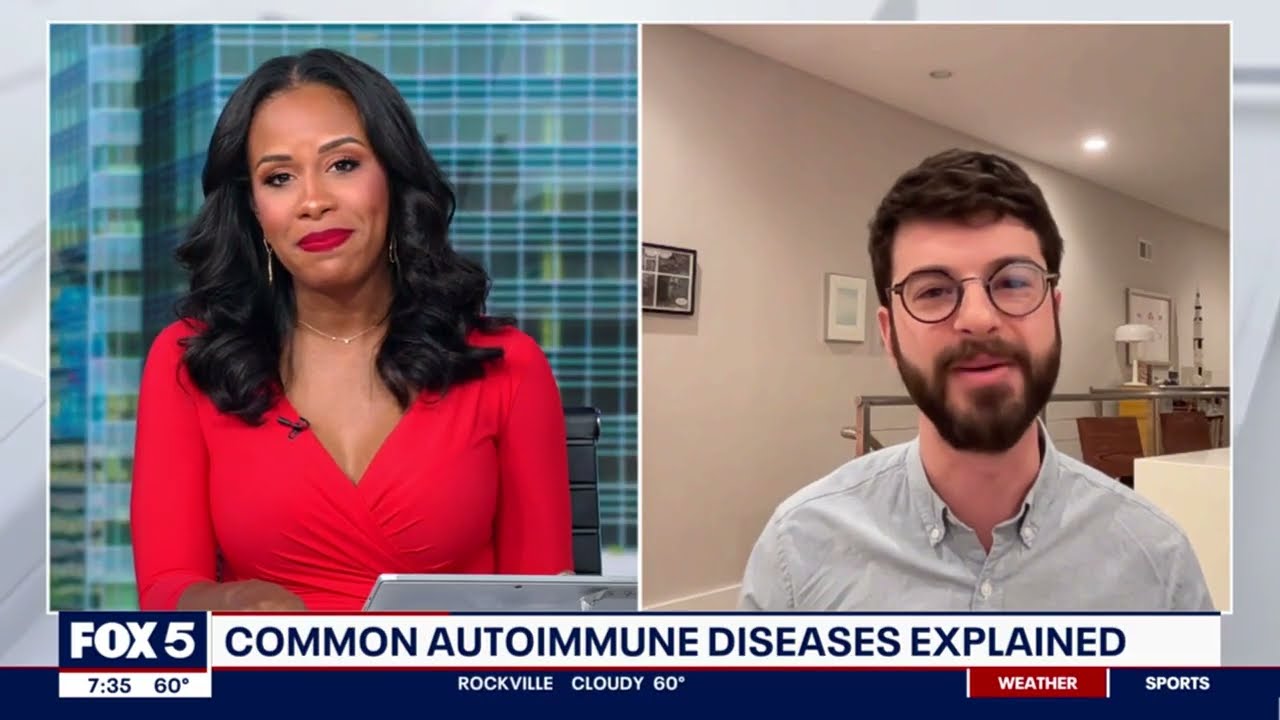
Autoimmune disease affects 50 million Americans. It occurs when the body’s immune system attacks healthy cells and tissues by mistake. Rheumatologist Benjamin Plotz, MD, discusses the causes and symptoms, and why some autoimmune diseases are hard to treat. Watch now via @fox5dc. Learn more: https://bit.ly/3NBMFuR
In Health Watch, March is Autoimmune Disease
Awareness Month. As we wrap up this month, we want to take a look at some of the
causes and symptoms of some of the most common conditions. Joining us now to do
that is MedStar Health’s Dr. Benjamin Plotz. Good morning to you, Dr. Plotz. Thank you for
joining us. Hi, good morning. Great to be here. Let’s start with the basics here. What is an autoimmune disease? So you know, an autoimmune disease is when our
immune system, which usually does a great job of protecting us from germs, bacteria, viruses, like
COVID, for example, when instead of attacking those foreign pathogens, it ends up attacking certain
parts of our body and ourselves. Do we know why the immune system does that why it suddenly
starts to attack the healthy cells? That’s a great question and you know the short answer is we
actually still don’t know. It’s still a very active area of research. One of the popular theories today
though is that it’s called the two-hit hypothesis where we know there are some people who are more
predisposed to have an autoimmune disease. For instance, we know that women are twice as likely
compared to men to have an autoimmune disease. So you know these people may have then some sort
of environmental exposure. Maybe an exposure to a chemical or a certain infection which would
then kind of trigger the immune system, kind of push a button and cause dysregulation,
which could lead to an autoimmune disease. Yeah, I think people would be surprised to know
just how how many people, millions of people, are affected by an autoimmune disease. Let’s go into
the the top four most common ones. What are they? Absolutely, so you know as a rheumatologist, we
see a certain set of autoimmune diseases. Some of the most common diseases that we see are
rheumatoid arthritis, for example, which affects one percent of Americans and causes lots of pain
and swelling in your hands. We also see a lot of lupus which affects, unfortunately, a lot of
young women and can be very serious and can affect their kidneys leading people to go on dialysis
or can even in very bad cases lead to death. There are other sets of diseases that we treat.
Psoriatic arthritis affects, which is an arthritis, that affects people with psoriasis and ankylosing
spondylitis, which can affect typically young men in the bones, in their back. You know considering
how common these are and the medical advancements that we’ve seen. Just in general why
are these conditions so hard to treat, even with lupus? I’ve heard so many stories where ultimately
these people are just left frustrated. That’s a great question and part of the trouble
with treating autoimmune diseases is we’re not we’re not treating something like a bacteria or
a virus where you can give medication that just targets that sort of foreign pathogen. Instead,
you’re actually fighting with your own immune system. So as a rheumatologist, we really have
to strike a balance of weakening the immune system so that we can turn down the volume, so to
speak, on the autoimmune disease and control it without turning it down too much and we can
still allow the immune system to do its healthy functions and keeping us, you know, protected from
the outside world. It’s such a fine balance and as you know the pros and cons to all of that
and I’m sure as you know this is just the tip of the iceberg as far as how much more there is
to know when it comes to autoimmune diseases. MedStar Health doctor Benjamin Plotz, appreciate
your time this morning and insight. Thank you.