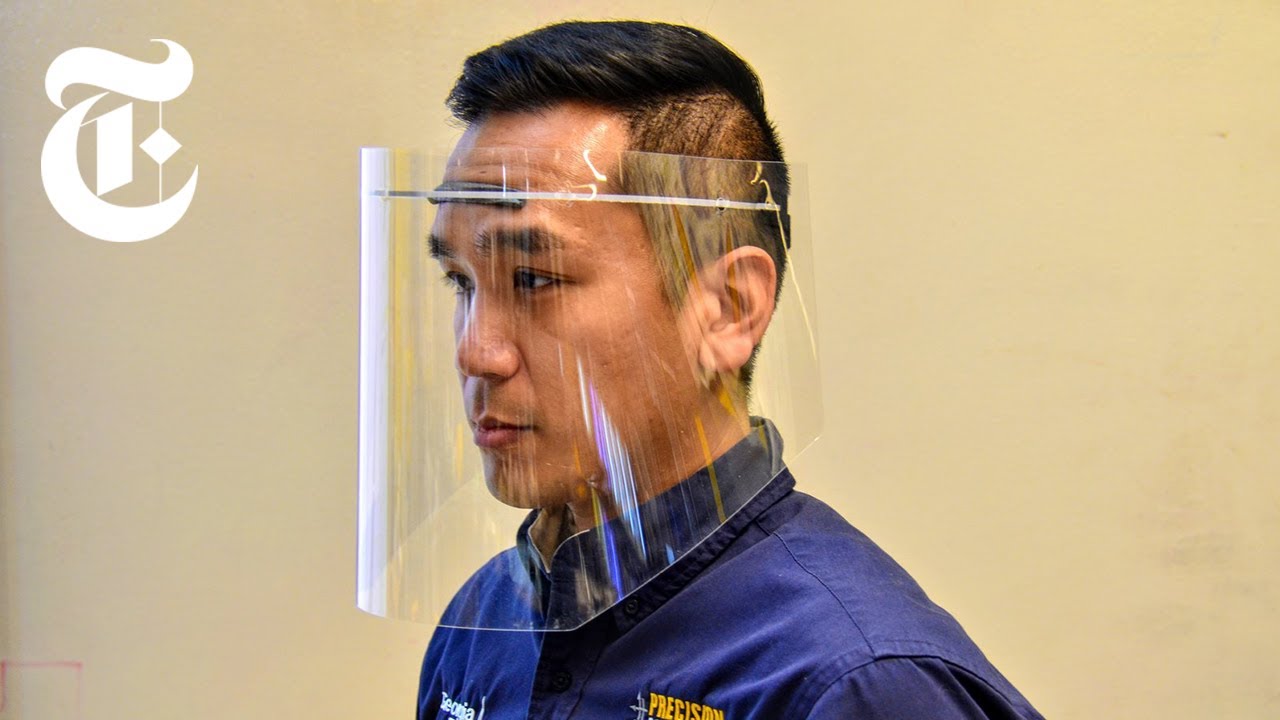
Health care workers are facing a serious shortage of critical equipment needed to treat the coronavirus. We spoke to the makers who are building innovative protective gear and ventilators for them.
Subscribe: http://bit.ly/U8Ys7n
More from The New York Times Video: http://nytimes.com/video
———-
Whether it’s reporting on conflicts abroad and political divisions at home, or covering the latest style trends and scientific developments, New York Times video journalists provide a revealing and unforgettable view of the world. It’s all the news that’s fit to watch.
Health care workers around
the world are asking for help. “What do you want?” “PPE.” “When do you need it?” “Now.” They’re in desperate need
of more PPE, also known as personal protective equipment. Stocks of the
critical gear are disappearing during the
coronavirus pandemic. Doctors say they are
rationing gloves, reusing masks and raiding hardware stores. The C.D.C. has even said
that scarves or bandannas can be used as protection
as a last resort. “I’ve met the doctors, and
talked with them every day. I think there’s an
interesting challenge here in that,
currently, there’s such a need that if
they had anything, they would deploy it.” The cries for help are
mobilizing a wide range of innovators, some of
them even joining forces through online messaging
platforms like Slack. These are engineers, doctors
and even high school students from around the world. They come from
all walks of life, but say their
goal is the same. “It’s amazing because
no one’s asking which country are you from? They’re just like,
how can I help? What do you need?” They’re pitching in by
crowdsourcing designs for masks, face shields
and even ventilators that could be reproduced
around the world. This is Nick Moser. He’s an active player in
one of the maker groups. His day job is at
a design studio. Now, he’s designing
replicable face masks. “We’re focused on
three products: a face shield, a cloth mask and an alternative
to N95-rated respirators. The face shield is the
first line of defense for medical workers. It protects against droplets. If a patient coughs, it’ll hit
the face shield rather than them.” Some designs are
produced using 3-D printers or laser cutters. “There you go.” Then, the prototypes
are field-tested by health care workers. Even some university labs
are experimenting with DIY techniques. A group at
Georgia Tech is working with open-source designs
from the internet to develop products. “My lab works in the
area of frugal science, and we build low-cost tools
for resource-limited areas. And now, we’ve realized that I
don’t have to go that far. It’s in our backyard, right? We need it now. So this is a plastic
sheet I have — not too different
from what you would get out from a 2-liter
Coke or a soda bottle. I actually bought this
from an art store. It’s just sheets of PET,
so we can cut these out. We are calling this an
origami face shield, and it’s the
Level 1 protection. This is one idea. There are multiple
different prototypes.” “This headband can be
reused, and a doctor or nurse could just basically tear
this off and basically snap another one on. We’re hearing that,
in some cases, that they go through close
to 2,000 of these a day.” Because the need is
growing so rapidly, the makers are also
thinking about how to increase their production. “So how do we
get from this one that someone made at home on
a laser cutter or a 3-D printer, and then get it in the hands
of thousands of doctors and front-line workers?” They’re working with
mass manufacturers that can take their tested
designs, and replicate them at a larger scale. “We’ve been on
the phone talking to a number of suppliers,
material suppliers. So I think one of the neat
things that we’ve done is not only the design, proving
that you can make it rapidly, but then also trying to secure
the entire supply chains.” This is Dr. Susan Gunn,
whose hospital system in New Orleans has even
started its own initiative to 3-D print equipment. “So it starts with an idea. We put the idea into place. And then we make sure that
it’s professional-grade first. Infection control
is looking at it, and we’re making
sure that we’re using the correct
materials that would be approved by the
C.D.C. and the World Health Organization.” Dr. Gunn says the gear is
a safe alternative for those who might
otherwise face a shortage. “We’re creating
face shields and we’re creating these different
PPEs, and we’re putting them in the hands where people
felt like they needed them.” Another critical piece of
equipment is the N95 mask, and the supply is
dwindling fast. Nick and his team
are designing a robust alternative
for this mask that can hold any
filter material, and be mass produced. “It is easily printable. This one is used
in medical situations where there’s an actively
infectious patient. So nursing homes or
obviously I.C.U. units would be the target
to receive these.” “These are really hard objects
to manufacture because you’re going to give it
to a nurse, and then I want to be really
confident that it will not let a virus through, right?” This equipment is not
approved by federal agencies, but the designers are testing
their respirator prototypes for safety. “That was basically the first,
almost the first question that was asked. Can we do anything
that’s actually going to be safe and helpful?” Some makers are pursuing
even more ambitious projects. An engineer named
Stephen Robinson in New Haven, Conn.,
is working on designing ventilators
to help patients breathe. Countries are facing a
dire shortage of the lifesaving machines. Right now, these
DIY ventilators are still prototypes. “So really, this
should be thought of as the seed of an idea
that could potentially be grown with, and absolutely
requiring, the medical and the tech communities.” But they could become key if
critical supplies run out. “We’re in very
uncertain times, and I see explorations
and projects as kind of an insurance policy
that could potentially be leaned on if there was
extreme circumstances.” Health care workers are
hopeful that these efforts could prevent an
even worse outcome. “We don’t want anybody — let’s
be clear — to use a bandanna to protect themselves. I hope it never
gets to the point where we have to
wear a bandanna. And I don’t think,
with this initiative that we will get there.” For innovators like Saad,
the challenge is personal. “I just can’t stop. I have to do stuff. And then I’m currently
at a hospital. That’s why I have this
uplifting little flower portrait. We’re expecting a baby boy,
and what do we tell him when he grows up
about what we did when society needed us?”