https://sciencewithsusanna.com has diagrams, notes, and practice questions.
Quizlet Review: https://quizlet.com/_6jggx7
The immune system has two main branches: the innate immune response and the adaptive immune response.
The innate immune response includes cells and mechanisms that are able to react to pathogens from birth. The adaptive immune system can learn and remember new pathogens and then protect from them long-term.
The innate immune system is composed of:
1. physical barriers such as mucous membranes and skin
2. chemical barriers such as lysozyme and stomach acid.
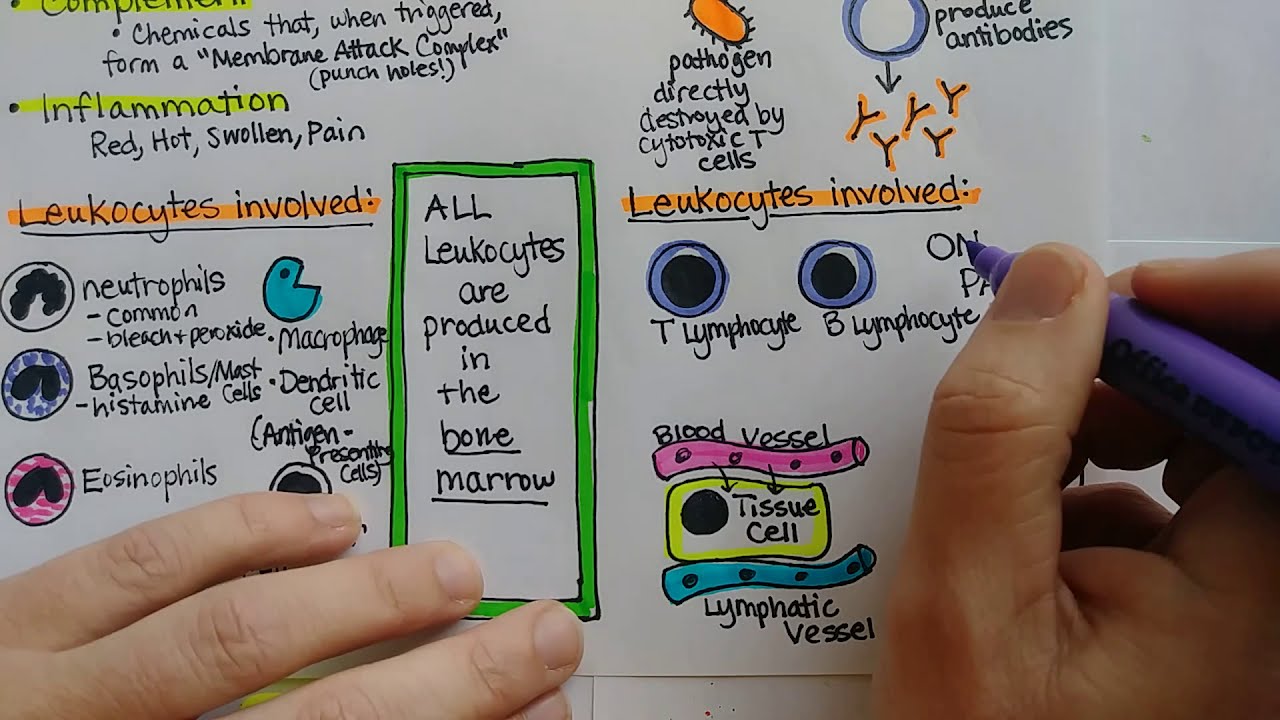
3. Complement is a group of small circulating chemicals that, when triggered, form a “membrane attack complex” that can punch holes in pathogen cell membranes.
The leukocytes that are involved in this response include:
*Granulocytes – neutrophils, basophils, eosinophils
*Agranulocytes – macrophages and dendritic cells, which can be phagocytic and present antigens from invaders to the adaptive immune response cells known as helper T cells.
*Lymphocytes – Natural killer cells (NK cells) can cause apoptosis of tumor cells and viral-infected cells.
The adaptive immune response includes T and B lymphocytes. These cells must be activated to a specific pathogen before they can respond.
Helper T cells stimulate cytotoxic T cells to directly destroy pathogens. Helper T cells stimulate B lymphocytes to enlarge into plasma cells and produce antibodies.
These lymphocytes all reproduce rapidly and form memory cells that remain circulating and passing through lymph organs long-term to patrol for the presence of the specific pathogen in the future.
All leukocytes are formed in the bone marrow in a process known as hematopoiesis.
Welcome to this video on the immune system. This is a review of the immune system and it could be intended for a student that is preparing for an exam on the immune system such um or a standardized exam like the tease test or just a basic overview u maybe when you’re first starting to learn about the immune system. So the immune system is divided into two parts. There’s the innate immune response and there’s the adaptive immune response and we will discuss each of these separately and then talk a little bit about how they are related. Uh if the innate immune response had a nickname nickname it would be I was born ready baby. Now, even though babies might not have as strong of an innate immune system as an adult, they are born with the ability to do um all of these innate uh responses. And compare that with the adaptive immune response, which if it had a nickname, it would be I’m always up to learn. I’m always ready to learn and remember because memory cells are going to be a big part of its response. And then if we were going to give just a couple of important points, the idea is is that in the innate immune system, these uh cells and mechanisms are um immediately able to act upon uh pathogens are able to immediately act on pathogens. They don’t need to be activated. They do not require activation. And let’s go ahead and put a box around that in orange because that’s a key idea to compare it with the adaptive immune response. The adaptive immune response does require activation. So these cells, the TNB cells that we’ll talk about require activation. And then a second thing is that they react and respond to a specific pathogen, not to just anything that is different or strange the way um the innate response would. And then the third thing is that once they do respond and take out the pathogen, they form memory cells. And these will protect you from getting sick with that pathogen hopefully ever again. Okay. So, let’s go ahead and put a box around that in orange. Now, we’re going to go back to the innate immune system and talk more in depth about that. So, the innate immune response has physical barriers, chemical barriers, uh chemicals called compliment that punch holes in cell walls and inflammation. So for physical barriers, these are things like your skin and your mucous membranes. These are the parts of your body that first come into contact with potential pathogens. We can go ahead and highlight physical barriers in yellow. Chemical barriers are things like um saliva that contain or all of your bodily secretions that contain an enzyme called lysosyme and that is capable of breaking um the bacterial cell walls. Uh sweat has chemicals in it uh that are able um to help neutralize pathogens. Things like stomach acid would also fall under this category of chemical barriers. So you can go ahead and highlight chemical barriers in yellow. Next is compliment. And compliment is a bunch of chemicals that are always circulating in your blood. And when they are um uh encounter um a pathogen or somehow are triggered by some other part another white blood cell let’s say that turns them on. So I guess in that sense it’s a tiny bit of they do require a little bit of activation here but these chemicals um will bind together. I’ll put triggered instead of activated. when triggered, I got to turn this a little bit too. Sorry. I’m gonna go like this. Okay. That when triggered um form a complex that’s called a membrane attack complex and they punch holes in the cell membranes of pathogens. And so they can punch holes. And then uh inflammation, most everyone’s heard of this. It has some cardinal symptoms. Those cardinal symptoms are that the area that is inflamed is red because of increased blood flow. It’s hot because of increased blood flow. It’s swollen because of increased blood flow. and it’s painful because the uh pain receptors in the area are both stretched and become more sensitized during inflammation. So these are the cardinal symptoms of inflammation. Notice that all of them have to do with the blood vessels becoming more leaky so that an area can have more blood flow which can contribute to fighting the overall infection. So the luccoytes that are involved in the innate immune system are most of them. Let’s go ahead and put that in orange. And we’re going to compare the luccoytes involved in the innate immune response with the adaptive immune response when we get to that part too. So um these are some different white blood cells that are involved. First of all, neutrfils. These are um granulosytes that are able to secrete chemicals. Uh they’re very common, the most common kind circulating in your blood. And then there are um basoils. And these are named because they are basic loving and they have granules that will take up uh purple colors when we stain them. And so if you see them under a microscope, they usually just look really purple. And these secrete histamine. So um I’m going to put under neutrfils that they’re very common and they can release bleach and peroxide and we compare that with basopils. They release histamine and they’re very closely related to a cell called a basoil that’s found in um uh the mucous membranes. I’m actually going to put um or sorry did I say they’re very rel closely related to a cell called a mass cell that is found in a lot of mucous membranes in the tissues. So basopils are more circulating in the blood mass cells more in the tissues. And then a third kind of granulite meaning it has all these granules in it. These ones are acidloving and they take up an acidic pink dye and so we call them acenopils. that means acidloving in Greek and these seem to be um very important in fighting off like parasitic helmets so worm infections parasitic worms and um they also uh seem to be quite elevated in allergies. Then another kind of white blood cell or luccoyte that is involved in the innate immune response is um a cell called a macrofase. So macrofasages just like they sound they’re big eaters they’re um very good at fagocytosis and um then there’s this kind of cell that’s very similar called a dendritic cell and both of these together are what we call antigen presenting cells and they are going to present antigens to a different kind of white blood cell to to uh start off the adaptive immune response. respond response. So these are antigen presenting cells and those include macrofasages and dendritic cells or antigen presenting cells. Okay. And then we’ll go ahead just a little bit lower down here. And then this last kind of cell that I’ve drawn here is meant to represent a natural killer cell. Now this cell um is a lymphocy. And we sometimes think of lymphocytes as being more associated with the adaptive immune response. But natural killer cells get to stay in the innate immune response category because they do not require activation. Now a note to remember is that all luccoytes no matter what kind they are originate from the bone marrow. They’re all produced in the bone marrow and then they differentiate. That means they become different from each other and the lymphocytes of the adaptive immune response they have to go to the lymph organs generally for their final maturation and what I like to call training to be good lymphocytes and that’s a process called hematopois that makes all of these. Let’s go ahead and box this in green. All right. And now we’ll talk about the adaptive immune response. So I already told you that these h cells have to be activated. Well, how do they get activated? It starts with what’s called a helper T lymphocy. And these helper tea cells are activated by antigen presenting cells and those are the cells that we mentioned the macrofasages and the dendritic cells. So once a helper te- cell is activated by an antigen presenting cell it will stimulate other kinds of white blood cells. These are called cytotoxic tea cells. And so sorry not a lot of room to put this here. Cytotoxic tea cells and then B cells. Let’s go ahead and highlight our lymphocytes in purple. So helper tea cells when they get stimulated and or activated by an antigen presenting cell then they stimulate cytotoxic tea cells and B cells. Now the cytotoxic tea cells they are able to directly attack pathogens. So if you can pretend that this is a pathogen is directly destroyed by the cytotoxic tea cells and then B cells when they are activated they um get really really big which I didn’t draw that too much on here but imagine that it gets really really big because it’s going to become an antib antibbody making machine. So all it’s going to do is make antibodies. And so when we see these under the microscope, instead of calling them B cells at that point, we call them plasma cells because they’re filled with so much cytoplasm um as they are making the all these proteins. And so we’ll make the antibodies in orange here. So these plasma cells produce antibodies and then the antibodies stick to the pathogen and they sort of take it out of commission both um by stopping it from doing what it wants to do and also the presence of the antibodies makes cells like macrofasages really attracted to it and then they’re more likely to engulf that pathogen. Okay, you might notice that I have some little cells right here and these represent memory cells. And so after the B cell has been activated, it will uh multiply itself and some of these will become memory B cells. And when the T- cell is activated, it will then multiply and some of the cells will become memory T- cells. And then those are the ones that will circulate potentially for the rest of your life, occasionally um going through mitosis to keep the population fresh and that will protect you from future onslaught of whatever it was that made you sick the first time and then maybe you’ll never get sick from that again if adaptive immunity works properly. So then just a little more about those luccoytes. Um so the two that are in involved, they’re both lymphocytes. This is a Tlymphocy and I just talked to you about the helper and the cytotoxic um TE-C cells and there’s also suppressor TEA cells. It appears that there are many different kinds of TE-C cells that sort of fine-tune and regulate this response. And then Blymphosytes are the other kind of cell involved and these are patrolling through your body. And I want to end with just a little explanation of how they do that patrolling. So if you look at this bottom picture, this represents a blood vessel and you’re going to have white blood cells um that are circulating, you know, in the bloodstream. These represent blood cells or white blood cells and they um are able to um patrol and they enter the tissues if needed and then they drain from the tissues via the lymphatic vessels. And so they’re these lymphatic vessels don’t have red blood cells in them. So they just contain water and other things that have drained out of the cell. And here I’m going to put this in yellow, this tissue cell. And so these white blood cells are also traveling in your lymph. The lymph is the name for the fluid that is in there. And then they pass through lymph organs like your tonsils, your appendix. Maybe I’ll put a remind you on here. The tonsils, the appendix, uh the thymus. These are all examples of lymph organs. And then all of your lymph nodes, too. So these white blood cells pass through these lymph organs and most of them are actually hanging out there and they are always on patrol. So that in uh just a few minutes is a summary of the immune system. Uh good luck with whatever you’re trying to learn today. See you in the next video.