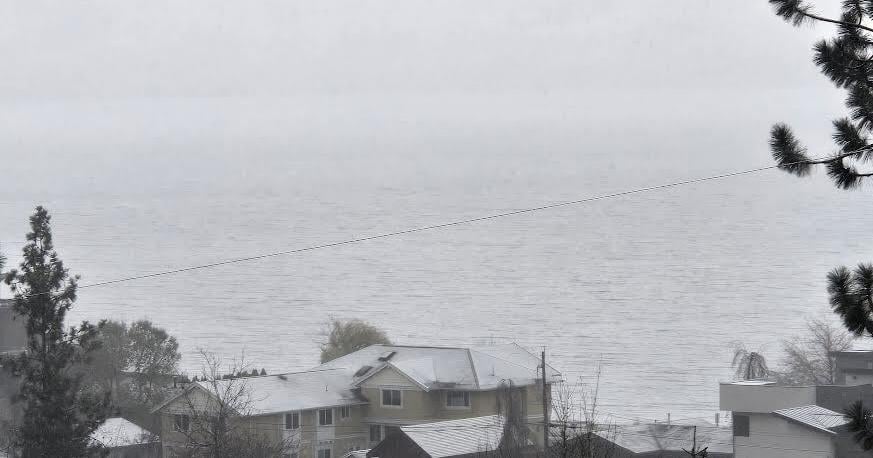
Penticton was warmer and wetter than Kelowna last month.
The average daily high in November in Penticton was 8.4 C, a half-degree more than in Kelowna, according to month-end weather stats from Environment Canada.
Average overnight lows in the two cities were comparable, at 1.8 C in Kelowna and 1.9 C in Penticton.
Total precipitation in Penticton last month was 53.4 mm, compared to 39.8 mm in Kelowna. Penticton had 8.8 cm of snow in November, all of which came on Nov. 27. November snow data for Kelowna is missing on Environment Canada’s website.
A typical November brings about 14 cm of snow to the Valley bottom. It usually gets a lot whiter in December, with 32 cm of snow falling at the Valley bottom.
At its lower levels, the Okanagan is one of the greyest places in Canada during the winter owing to ongoing inversions, in which thick cloud tapped in the narrow valley is not burned off by the weak winter sun.
Kelowna was ranked the 95th gloomiest city in Canada on a ‘Weather Winners’ list produced by Environment Canada in 2003. From December through February, the city only gets 154 hours of sunshine. Calgary is the brightest wintertime city, with 355 hours in the same three months.
Dismal days are so pervasive in the Okanagan during the winter that people are encouraged to eat more foods rich in vitamin D as the skin can’t produce enough of it from sunlight, and/or take vitamin D supplements.
“Studies have found that people with low vitamin D are at higher risk of many serious diseases such as cardiovascular disease, major cancers such as breast and colorectal, autoimmune diseases such as diabetes and multiple sclerosis and even infections, flus, and colds,” says the Woodstock, Ont.-based Vitamin D Society.
Foods that are naturally rich in vitamin D include salmon, sardines, tuna, egg yolks, mushrooms. Foods that are commonly fortified with vitamin D are milk orange juice, yogurt, cheese, cereal, and plant-based beverages.