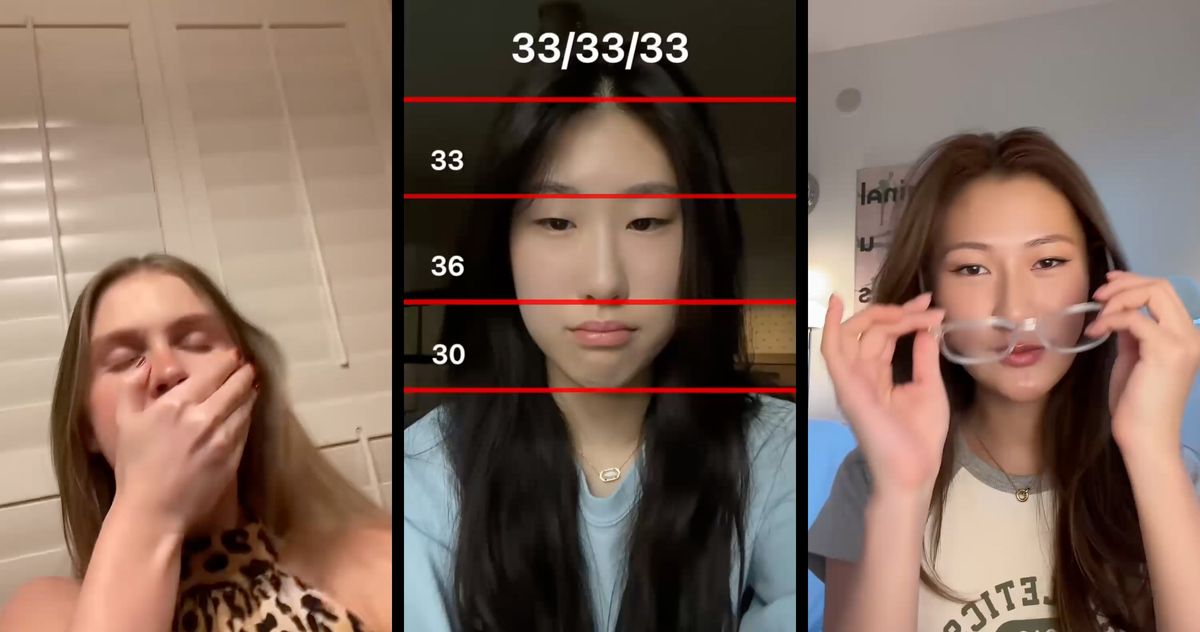
Video: evecatherine, jungkookstoastytoast, lindsiann
Ren Yeung already knew she had a longer face — it was the realization that she had a long midface that surprised her. “I didn’t realize the section of your face matters, whether you have a long chin, long forehead, or long midface,” she says. That is, until TikToks about “facial harmony” crossed her feed. At first, the 28-year-old figured the trend was harmless, just another filter fad.
“Everyone has been talking about how to shorten your midface because apparently having a long midface is ugly,” says one woman on the app. “Long midface, that’s not what you want,” warns another. Naturally, there are filters available to diagnose yourself with a “long” or “short” midface. There are also workarounds: “If you’re someone with a longer midface, here are style tips to increase your facial harmony,” one creator reassures.
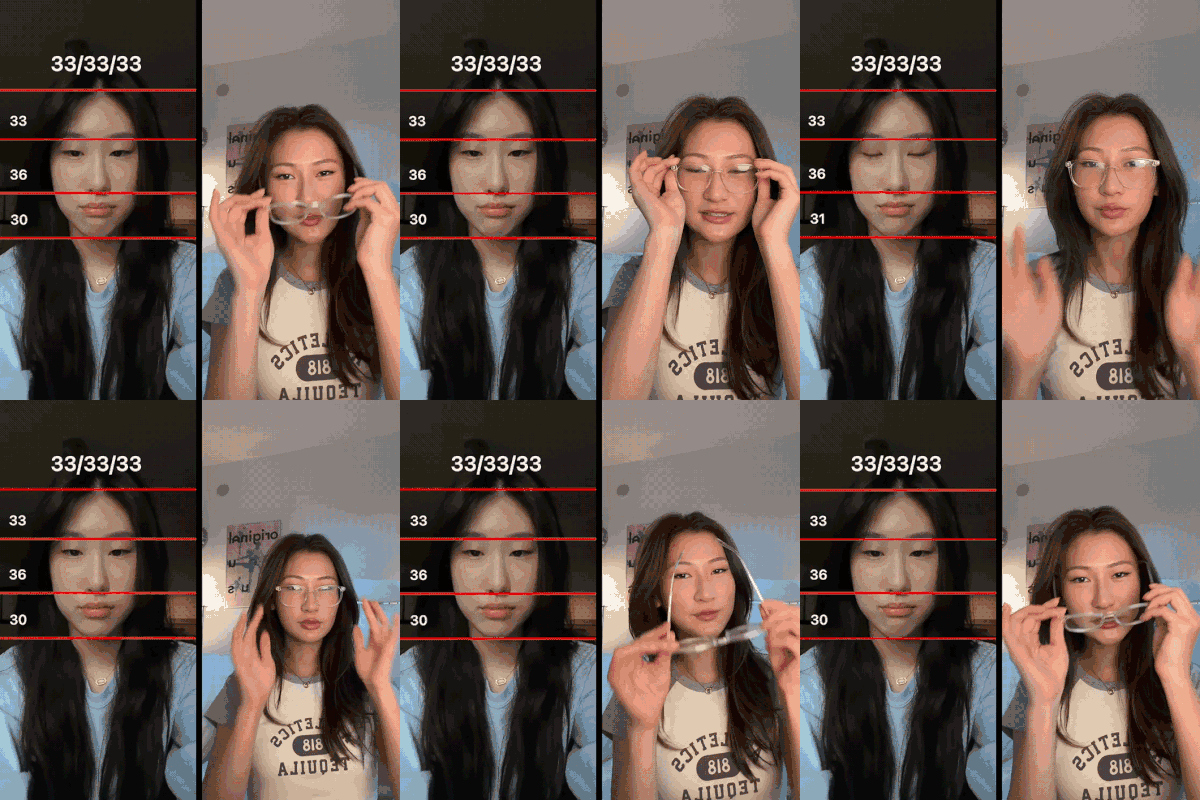
Yeung tried the “33 33 33 face filter” with lines that sliced her face into thirds. “My midface measured longer,” she tells me. Seeing her “long face” quantified onscreen made it feel clinical, like she’d been diagnosed with something. But, as one viral stitch reacting to a “long midface” tutorial puts it, “What the fuck does that even mean?”
The answer lies somewhere in beauty culture’s obsession with self-measurement, pseudoscience, and algorithmic self-surveillance. “Long midface” itself isn’t a medical category; it’s a vibe. A short midface — often associated with K-pop idols like Jennie — is coded as cute, youthful, aspirational. A longer midface is coded as tired, mature, or “imbalanced.” That distinction, as discussed everywhere the internet performs beauty like TikTok, Reddit, Instagram, and increasingly Rednote, has no anatomical basis, yet the hierarchy feels unmistakably moral.
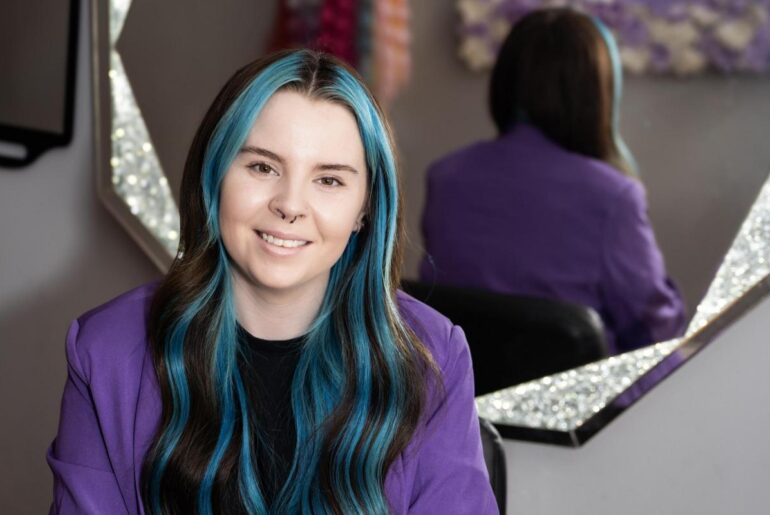
For Alexandria Finley, a 37-year-old model, the “long midface” panic found her last year — but she was mostly intrigued. She’d been aware of her longer proportions for years, and seeing other users talk openly about face shape felt refreshing, not threatening. Shortly after, she posted a tutorial demonstrating how she contours to visually shorten the midface. Her comments blew up. “So many people said, ‘I never thought about contouring my face this way.’”
But to Finley, the trend is about more than makeup tricks. “Gen Z loves naming everything,” she says. “‘Mermaidcore,’ ‘gorpcore,’ ‘siren eyes’ — they categorize because it makes things searchable. It helps people feel like they belong.” Then she pauses. “But it also makes me wonder: Are we actually being authentic or just regurgitating trends we can easily label?”
Sometimes the labeling goes too far. When you start assessing your face like a geometry worksheet, you train yourself to find errors. The term itself — “long midface” — is misleadingly clinical, mimicking medical language despite not appearing anywhere in dermatology textbooks. Once a filter names your “issue,” the algorithm floods you with solutions: orthodontics, buccal-fat removal, jaw filler, mewing, threads, “reverse-aging massages,” and pages of contour diagrams. The diagnosis is always the same: Fix yourself.
When it comes to where the idea that a face can “be more cute or compact” comes from, historian Laura Fitzachary points to ancient Greece, where the sculptor Polykleitos defined beauty as “a system of harmonious, balanced proportions.” “When it comes to beauty, it’s interesting to note which aspects of the face have been chosen as representative of the ideal,” says Fitzachary, who specializes in fashion, art, and beauty history and is based in Dublin. Renaissance artists revived these neoclassical canons. The Italian painter Cennino Cennini wrote in 1437: “The face is divided into three parts … the forehead, one; the nose, another; and from the nose to the chin, another.” With one exception, as Fitzachary notes, “He also says this only applies to men, as women do not have set proportions.”
According to Fitzachary, artistic guidelines became measures for self-diagnosis in the early 20th century. “I would argue this took place in the 1920s, if you look at it through the lens of fixing flaws,” she says. Beauty tools like M. Trilety’s Trados 25 nose shaper and Max Factor’s 1932 Beauty Micrometer claimed to measure flaws down to one-thousandth of an inch. “When plastic surgery gained popularity in the 1950s and 60s, the idea was that there was ‘no need to be ugly any more,’” Fitzachary says. “A similar rhetoric underpins the expectation of surgery today — why not, it’s readily available? But then which trend do you follow? We saw so many people dissolving filler they only got a few years prior.”
But despite the comment-section panic, the “long midface” conversation is still overwhelmingly a makeup trend, not a surgical one. Most of the content that goes viral focuses on contour maps, highlighting tricks, and optical illusions meant to balance proportions on camera. While plastic-surgery terms sometimes surface in the discourse, the actual content is rooted in beauty tutorials and the visual logic of TikTok: quick fixes, shading guides, and face-mapping techniques that promise onscreen transformation.
That disconnect — between normal variation and supposed “fixes” — is exactly what therapist Juli Fraga sees in her practice. “What happens psychologically when someone is told that a totally normal facial variation has a ‘fix’?” she asks. “It sends the message that there’s something wrong even when there’s not.” When the worry becomes chronic — constant mirror-checking, spirals of research, comparing photos — she warns it can cross into body-dysmorphic territory. And intentions matter. “If you imagine you can ‘fix’ something in your life by changing your face, that’s tricky territory. Cosmetic procedures rarely solve emotional problems.”
In the end, the long midface trend isn’t about biology or “harmony.” It’s about turning self-perception into a project. And about the ease with which an algorithm can transform neutral anatomy into a problem that needs management. As Finley puts it: “It’s about managing perception. Online, you can’t control how people see you, so people try to curate their appearance as tightly as possible.” In this way, makeup becomes a tool to control your image before others can define it for you.
Although at first Yeung didn’t feel great about her long midface due to the negative connotations, the more she looked into it, she realized it’s quite a specific look that a lot of runway models have and they’re all “beautiful women.” Now that she’s accepted it, she feels better about the trend. “I’m actually happy that I have this feature.”
Stay in touch.
Get the Cut newsletter delivered daily
Vox Media, LLC Terms and Privacy Notice
Related