
The Suffolk County Water Authority has voted that its controversial North Fork water main project is exempt from local zoning and land-use review, as it commences a full environmental impact study for the 12-mile pipeline.
In a resolution dated Nov. 20, the SCWA board applied the state’s Monroe “balancing of public interests” test and concluded the North Fork Water Main Project is “undisputably” immune from municipal jurisdiction, including the Town of Riverhead’s zoning, site plan and permit requirements. The board found that providing drinking water is an essential government function and said a regional authority operating in 10 towns and 33 villages cannot be subject to 43 different local zoning codes without undermining its mission. The action came after a series of Monroe hearings held by the water authority in October.
The water authority’s determination comes as no surprise, given public statements made by SCWA officials and the authority’s legal counsel during hearings this summer and fall.
The decision directly contradicts Riverhead’s own Monroe determination in October, when the Town Board unanimously ruled that SCWA must comply with local land-use regulations for the 8-plus-mile stretch of 24-inch main proposed to run from Flanders to the Southold town line through Riverhead Town. See: Who’s the decider? Riverhead Town and Suffolk County Water Authority head toward ‘impasse’ (Oct. 10, 2025). Riverhead officials have argued for months that Riverhead would bear the brunt of the project’s construction impacts while deriving no benefit from the new main, which would deliver water only to customers in Southold. See: Suffolk County Water Authority’s proposed North Fork pipeline: officials, residents question needs and benefits at Riverhead Town forum (Aug. 14, 2025).
“You design it, you approve it, and you do it and step all over Riverhead while doing it, with no benefit to us whatsoever,” Supervisor Tim Hubbard said at an earlier Monroe hearing, where board members focused on traffic, tourism and agricultural impacts along Sound Avenue. See: ‘No benefit to us whatsoever’: Riverhead supervisor slams water authority pipeline plan during hearing (Aug. 24, 2025).
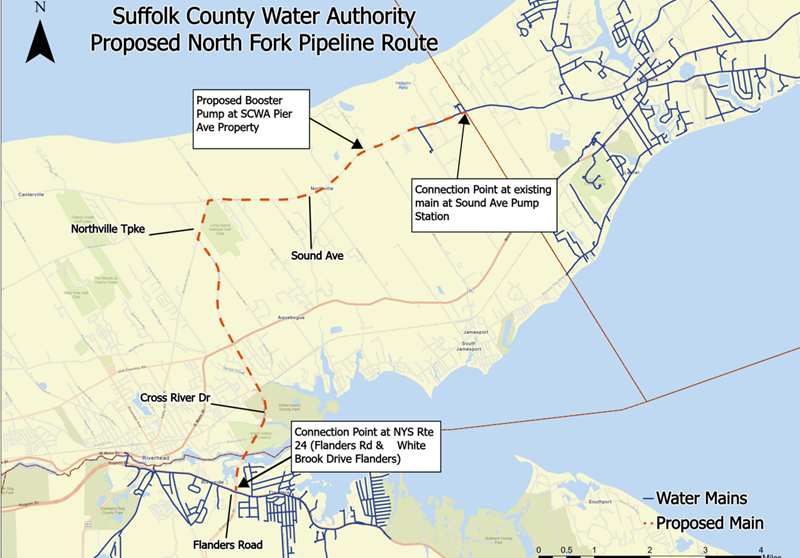 A map of the route for the North Fork Pipeline through Riverhead Town.
Photo: Suffolk County Water Authority website.
SCWA’s North Fork Water Main Project would install about 8.15 miles of 24-inch main from Flanders Road and County Road 105 in Riverside/Flanders, across the Peconic River, north along Cross River Drive and Northville Turnpike, then east on Sound Avenue to Jamesport/Laurel at the Southold town line. A new booster station would be built on SCWA-owned property on Pier Avenue, just north of Sound Avenue in Riverhead. The rest of the main to be built in Southold during the first phase of the project would serve SCWA customers. A second phase, described as long-range planning, would extend smaller-diameter mains about 3.8 miles from East Marion to Orient.
Southold Town has decided to hold its own Monroe hearing and make its own Monroe determination, specifically regarding phase two of the project, the East End Beacon reported last week.
At the same time it adopted the Monroe resolution, the authority finalized the scope of its environmental review. A 67-page Final Scope, dated Nov. 18 and released to the public Dec. 1, sets the agenda for a Draft Environmental Impact Statement on the pipeline, which SCWA officials say could be ready as soon as late January.
The scope, prepared for SCWA by environmental consultants Nelson, Pope & Voorhis, outlines the issues the DEIS must study, many of them centered on Riverhead because nearly the entire first phase runs through the town.
For Riverhead, the document calls for:
A detailed analysis of construction impacts on Cross River Drive, Northville Turnpike and Sound Avenue, including lane closures, detours, work hours, emergency access and pedestrian and cyclist safety. SCWA says trench openings will generally be limited to 300–400 feet per day, with full road restoration after installation, and that work along Sound Avenue will avoid the busy fall tourism season where possible.
Evaluation of effects on farmland and the town’s agricultural-tourism corridor, including soil handling, drainage and access to farm stands, wineries and other businesses during construction, an issue Riverhead officials have repeatedly flagged as a serious economic concern.
Study of potential impacts on surface waters and wetlands at the Peconic River and other crossings, along with erosion and sediment controls during trenching and directional drilling.
Review of potential noise, dust and other temporary disturbances, especially near homes, schools and other sensitive uses along the route.
Comparison of the chosen Sound Avenue route with at least one major alternative: a “south route” that would run east along Main Road (Route 25) from Route 105 to Franklinville Road in Laurel.
Responding to concerns raised by Southold, the Final Scope also requires analysis of whether the new main could spur additional development.
At the same time, the scoping document explicitly excludes some topics. Impacts on individual property values and broad questions about how the project might affect the cost of land preservation, as well as detailed modeling of development at EPCAL, are listed as outside the scope of the environmental review under state SEQRA guidance.
With the scope finalized, SCWA’s consultants are now preparing the Draft Environmental ImpactI Statement, which will examine the proposed route, construction methods, alternatives, mitigation measures and cumulative impacts in detail. Once the draft is released, the water authority has committed to holding public hearings and accepting written comments before issuing a Final EIS and a formal “findings” statement that will clear the way for construction if the board decides to proceed.
Even as SCWA asserts zoning immunity, Riverhead still has several avenues to influence what happens next. Under SEQRA, the town is an “interested agency” and can submit its own technical comments on the Draft EIS, hire experts to critique SCWA’s analysis and proposed mitigation, and urge state and county regulators to condition or deny permits for work in highways, wetlands and waterways. The town can also continue to press for changes to construction timing and traffic control plans on its roads, even if traditional zoning approvals are off the table.
Town officials are also weighing legal options. Riverhead officials have previously said there would be grounds to challenge any self-issued Monroe determination that lets SCWA bypass local codes. The Town Board’s work session agenda Thursday had “legal action with the SCWA” listed as an item for closed-door discussion during executive session.
For now, the standoff continues: Riverhead maintains that a regional authority should not be able to override the town’s land-use decisions on a project that brings no direct water service to its residents, while SCWA insists that protecting Southold’s strained aquifer and water supply is an overriding public purpose that justifies immunity.
The survival of local journalism depends on your support.
We are a small family-owned operation. You rely on us to stay informed, and we depend on you to make our work possible. Just a few dollars can help us continue to bring this important service to our community.
Support RiverheadLOCAL today.