Elizabeth K Hutchins, Changran Niu, Jing Xue, Debin Wan, Carolina V Campos, Molly Warren, Megan M Knuth, Michael B Whalen, Venkata S Voruganti, Rafiou Agoro, James C Fleet, Bruce D Hammock, Folami Ideraabdullah
Endocrinology, Volume 166, Issue 10, October 2025, bqaf138
https://doi.org/10.1210/endocr/bqaf138
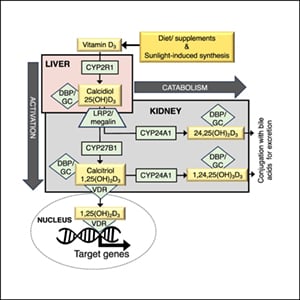
Abstract
Vitamin D insufficiency (VDI) is primarily determined by serum levels of calcidiol, which serves as a biomarker for the less abundant but most potent bioactive metabolite, calcitriol. However, population studies often show discordance between calcidiol and calcitriol. Here, a genetically diverse population of 7 inbred mouse strains was used to investigate the role of interindividual genetic differences in driving calcidiol-to-calcitriol discordance under vitamin D sufficient (VDS) vs depleted (VDD) conditions. We found high interstrain variability in calcitriol that was discordant with calcidiol under VDS and VDD conditions. However, under VDS conditions, stratification by calcitriol level revealed that strains with serum calcitriol >60 pM (HighC) exhibited the expected positive calcidiol-to-calcitriol association, whereas strains with low calcitriol (Lrp2 (megalin), the primary transporter required for renal calcitriol production. LowC strains also exhibited reduced renal expression of the vitamin D receptor (Vdr) and several target genes, demonstrating impaired vitamin D signaling. These findings reveal novel, naturally occurring genetic determinants of VDI that function by disrupting calcitriol production and signaling in a manner that cannot be predicted by calcidiol levels. Cross-species conservation of this phenomenon would have important implications for clinical management of VDI and related disease risks across genetically diverse populations.