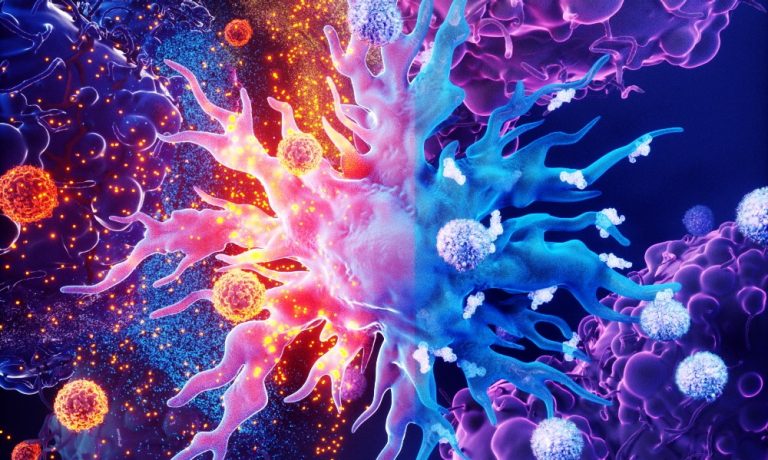
But dendritic cells don’t act alone and instead recruit other immune cells, including T cells, to carry out their missions.
“All T cells, including Tregs, must first be ‘presented’ with a structure called an antigen that is recognized by their receptors for the cells to develop into mature T cells that either attack a target or suppress the immune response to that target,” Engleman said. “Dr. Zhang and I reasoned that this process of tolerance or activation must be initiated by antigen-presenting cells.”
Type 1 conventional dendritic cells, or cDC1s, specialize in engulfing dead or dying cells or pathogens and displaying bits of those cells like immunological fishing lures for T cells.
To learn how cDC1s are involved in the development of immune tolerance, Zhang and Engleman decided to investigate whether and how the genes they express change in mice after total lymphoid irradiation. They found that the gene encoding the receptor for erythropoietin — EPOR, is expressed at much higher levels in the cDC1s of irradiated animals, and that the levels of EPO are elevated in the animals’ blood circulation.
EPO’s other job
Normally this would have been a huge surprise. Erythropoietin is well known as the primary instigator of red blood cell production, and it was named for this function (erythro meaning “red” and poietin meaning “to produce”). But Engleman, Zhang and colleagues now show that signaling through EPOR in cDC1s — the antigen-presenting cells that orchestrate T-cell responses to cell-associated antigens — acts as a central switch controlling immune tolerance. In earlier work, the same researchers demonstrated that EPO produced by immunologically “cold” tumors can suppress antitumor immunity by acting on macrophages. Together, these discoveries establish the EPO-EPOR axis as a fundamental regulator of immune balance, extending its influence from dendritic cell-mediated T-cell programming to broader immune regulation.
When Zhang genetically manipulated the mice to remove the ability of the cDC1s to express the EPOR, the animals rejected transplants of unmatched tissue after total lymphoid irradiation, showing conclusively that the EPO signaling pathway is necessary for the development of immune tolerance. But there was another intriguing finding.
“What was quite a surprise to me is that when you remove or block the EPO receptor on the cDC1s, you don’t just block the development of tolerance,” Engleman said. “Instead, you have now converted these cDC1sminto super stimulators, or powerful activators of immune response. There is a dual opportunity to not just induce tolerance to treat autoimmune diseases, but also to trigger a strong immune response to cancer cells or to life-threatening infections.”
Essentially, cDC1 cells continuously sample their environment by capturing and swallowing dead or dying cells (either self or non-self) as well as pathogens and displaying fragments of the cells on their surfaces to be recognized by many types of T cells, including killer T cells, helper T cells or Tregs. When EPO interacts with its EPO receptors on the cDC1s, it causes the cells to embark on a series of maturation steps that cause them to promote tolerance and selectively activate Tregs that tamp down any immune response to that antigen.
“This mechanism is not only required for physiological tolerance that prevents autoimmune disease, but it is often hijacked by cancers and probably some infectious pathogens, enabling their ability to evade immune attack,” Engleman said.
Conversely, removing the EPO receptor from cDC1s resulted in tumor regression in mice with immune-resistant melanoma or colon cancer tumors.
“It’s fascinating that this fundamental mechanism took so long to discover,” Engleman said. “It’s even possible that this is the primary function of EPO and that its effect on red blood cell formation is secondary. There is no doubt these findings will light many research fires.”
Researchers from University of Tübingen, Germany; Duke University; the University of California, San Francisco; Centre International de Recherche en Infectiologie; ImmunEdge Inc.; the New York Blood Center; Leiden University Medical Center; St. Jude Children’s Research Hospital; University of Cincinnati College of Medicine; and the Centre d’Immunologie de Marseille-Luminy, Aix-Marseille Université, contributed to the work.
The study was funded by the National Institutes of Health (grants CA244114, U54 CA274511, CA251174 and P01 HL149626).
Zhang is a cofounder and shareholder of ImmunEdge Inc. Engleman is a founder, shareholder and board member of ImmunEdge Inc. Zhang and Engleman are Stanford-affiliated inventors of PCT/US2023/063997, entitled “Epo Receptor Agonists and Antagonists.”