As the US prepares to host the 2026 FIFA World Cup, this analysis examines how sportswashing shields liberal democracies from scrutiny on rights and governance
Saaransh Mishra
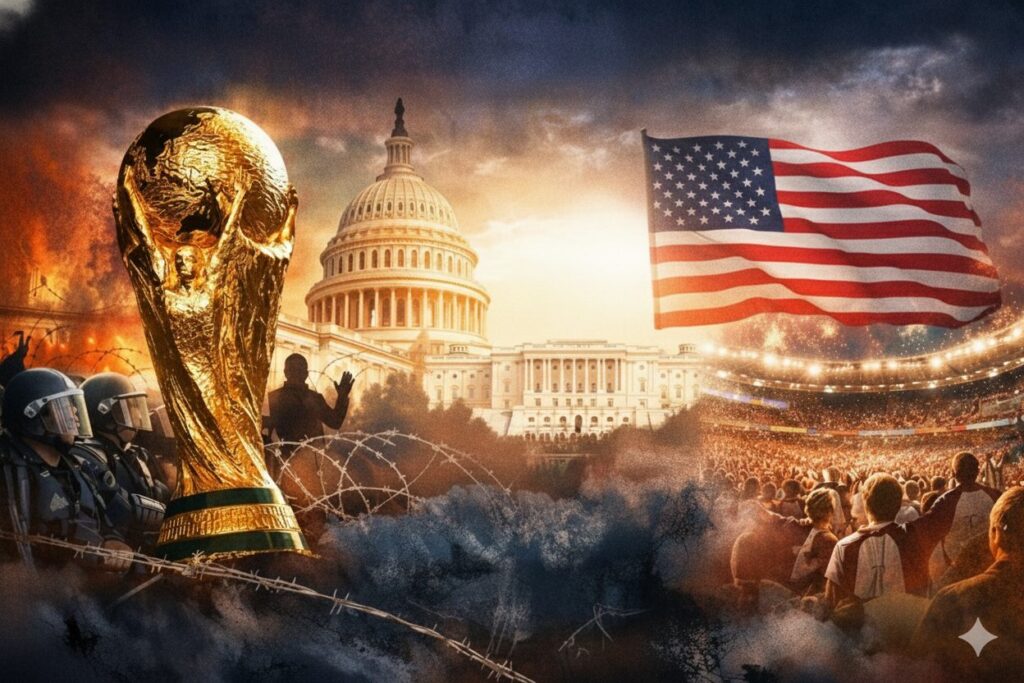 Image Courtesy: AI Generated
As we inch closer to the 2026 FIFA Football World Cup, to be hosted by the United States of America, with Mexico and Canada being auxiliary hosts, one cannot help pondering upon the strategic perception management that unmistakably lies at the core of such iconic sporting extravaganzas.
This perception management, known as “sportswashing” in common parlance, refers to the usage of massive sporting events by authoritarian states and sometimes even non-governmental corporations to divert public attention from misdemeanours pertaining but not limited to political repression, human rights abuses and other socio-political failures. These would draw a significantly higher degree of flak if not masked under the grandeur of a widely popular sporting event that inadvertently grabs all major headlines, leaving minimal room for scrutiny of other issues. .
Although this phenomenon has been omnipresent for centuries, what is particularly striking is the way countries such as Qatar, Russia, Saudi Arabia, and Azerbaijan are routinely— and rightly—harangued through global reportage for attempting to polish their plummeting reputations through sport. In stark contrast, western “liberal democracies,” especially the United States, seem to relish an uncanny immunity, facing negligible scrutiny despite a multitude of reasons that clearly point toward identical tactics. This double standard undoubtedly commands perusal, not merely to uphold fairness but to perpetuate the integrity and sustainability of the future of global sport.
States have historically utilized the universally applicable appeal of sports events to shield themselves from the inevitable dissection of their human rights and political transgressions, dating back to the 1936 Berlin Olympics where Nazi Germany facilitated a frontage of progress while pursuing unthinkably dire policies of suppression and genocide. This grand event set a dark yet normalized precedent of what is contemporarily viewed as sportswashing.
In recent times, authoritarian regimes have doubled down on this phenomenon, by elevating the scale of this dramatically, case in point being the 2022 football world cup held in Qatar where the government made an extraordinary investment of over 200 billion dollars to indulge in utmost displays of splendour by building state of the art (and further) stadiums and other infrastructure, while incessant reports of treatment of migrant workers, abysmal wages and other human rights indiscretions kept flooding the global media landscape to no real effect for years.
Similarly, Russia hosted the 2014 Sochi Winter Olympics and 2018 FIFA World Cup amidst growing international concerns over the quashing of dissent, ethnic discrimination, government corruption and other unacceptable national and foreign policy actions. Countries like Saudi Arabia and Azerbaijan have also managed to buttress their geopolitical influence and portray a humongous facade of progress by strategically investing billions of dollars in global sports sponsorships, international sporting events of various kinds and purchasing popular football clubs while words fail to suffice for the dire state of authoritarianism in these countries.
However, the critique of this dreadful phenomenon is markedly unbalanced, with the United States being the foremost example of the way in which conventional Western Liberal Democracies successfully avert criticism while engaging the very same tactics. The United States, being the principal hosts of the 2026 FIFA Football World Cup and the Summer Olympics of 2028, have successfully dodged almost any such criticisms despite these events happening in the backdrop of systemic challenges pertaining to racial inequalities, surveillance, stifled civil rights, exclusionary immigration policies, among other national crises. Instead, the sporting events falsely present a hunky-dory liberal democracy that must be hailed as a beacon of diversity, openness and opportunity.
This blatant double standard, oftentimes shaped by cultural biases, geopolitical equations, and skewed media framing, has clear implications; granting implicit immunity to conventionally ‘democratic” stalwarts that so called “authoritarian” states cease to enjoy.
The crux of the matter lies not in awarding the same immunity to countries such as Qatar, Saudi Arabia and Azerbaijan but to uphold the sacred principle of equal accountability for all actors, irrespective of variable geopolitical factors. The asymmetry in treatment heavily weakens global sportsmanship ethics and human rights safeguarding mechanisms.
This double standard also bears other pertinent consequences by corroding the foundation and credibility of international sport that is meant to rest non-negotiably on the tenets of fairness, integrity and equality. Moreover, it diminishes sport as a robust platform that has tremendous potential to bolster social progress with such impermissible antics being integrated as tools for socio-political approval in the global arena. This vile phenomenon also isolates critical voices such as international human rights bodies and other ombudsmen who end up being perceived as heavily biased.
The path forward strongly necessitates an equal degree of vigilance towards all potential offenders irrespective of their diplomatic stature. Sports Governing Bodies, civil society actors, the media and other international actors must urgently augment their efforts to identify, report, monitor and question sportswashing irrespective of where it occurs. Ethical standards relevant to human rights impact assessments must be enforced as pre-requisites for hosting and sponsoring any form of global sporting events.
Sportswashing is an indisputably formidable tool that stakeholders must routinely interrogate and address through policy measures and vehement ramifications if the sanctity of global sport and human rights has to be preserved. While countries like Saudi Arabia, Azerbaijan and Russia very rightly deserve to be critiqued for their efforts to leverage sport as a masking tool, so do countries like the United States and other “democracies”. Solely by administering unified standards across all hosts and can sport maintain its intended role as a genuine arena that symbolises cultural exchange and provides a level playing field that can make way for substantial social progress.
(Saaransh Mishra is an independent consultant dealing in HR, Media & Communication. Views expressed are Personal)