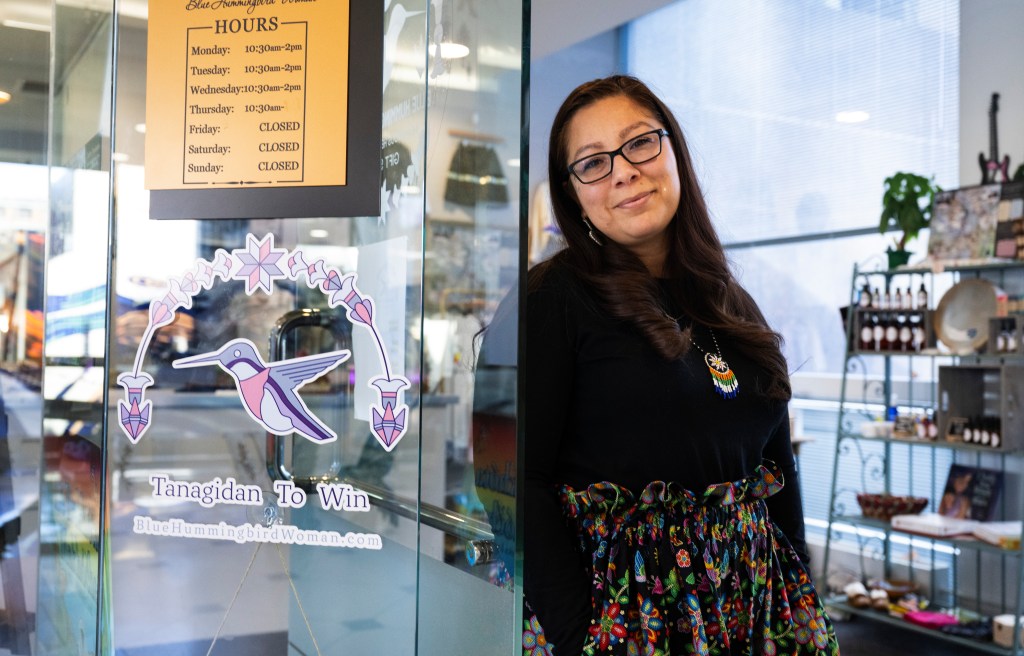
For Tara Perron, or Tanáǧidaŋ Tó Wíŋ, her skyway gift shop Blue Hummingbird Woman feels full-circle — because her first job as a teenager was in the St. Paul skyways, at Hardee’s.
Now, alongside traditional Dakota medicines made by her family and her own children’s books, she also sells a variety of other local Native-made items including Hobby Farmer beverages, wild rice from Leech Lake, and honeys and syrups from producers in the Red Lake Nation.
“That’s the whole point of running a gift shop — to help my relatives and smaller businesses thrive,” she said. “It was one thing to have our tea and have our medicine and have our books, but it was a whole other thing to offer that to other smaller vendors that might not be more publicized and out in the open. Giving back to our community is really important to me because they were some of the first people that believed in me and believed in this dream.”
As an artist and writer, Perron has helped create murals and gallery works around the Twin Cities and, last year alongside illustrator and designer Marlena Myles, was an artist-in-residence at Battle Creek Regional Park. Her first children’s book, “Takóza: Walks with the Blue Moon Girl” was released in 2020.
But due to the pandemic, she was not able to do the readings and school visits she had planned. A forebear had been a medicine woman for Little Crow’s band of Dakota in the mid-1800s, and her family has remained knowledgeable about Indigenous herbal remedies, so Perron began making the kinds of medicines her grandmother taught her, to pair with the book.
This proved popular, and in early 2022, she launched Blue Hummingbird Woman as a business. She opened the skyway gift shop in November of that year. Blue Hummingbird Woman was an early beneficiary of the Grow Downtown program, a collaboration between the Downtown Alliance and building owners to place small businesses in vacant storefronts for six months with free rent. Successful businesses, like Blue Hummingbird Woman, can then negotiate longer-term leases going forward.
In recent years, Perron said, Native-owned business names have become attached to high-profile downtown spaces, from Treasure Island Center to Grand Casino Arena. Meanwhile, spots like the Indigenous Roots Cultural Arts Center on the East Side, where Perron also co-runs Eagle and Condor Native Wellness Center, are also becoming stronger community hubs.
“To see our people come down here and be part of this beautiful space, being downtown, is really important to me,” she said. “Seeing cultural businesses open up down here really impacts the community. I don’t know how many times I’ve had people come in and say, ‘This is amazing. I’m glad downtown is honoring Native people.’”
Between holiday gift-givers and people in search of remedies during cold and flu season, early winter tends to be Perron’s busiest time, she said. But she sees fairly strong foot traffic year-round — especially because she does not ship Indigenous medicine.
“This medicine is sacred to our family, and we don’t want it to be dormant (in transit) or go through a whole bunch of hands,” she said. “It’s from me to you. … But it brings people downtown. Tribal members come here. We had a group of young people from Alaska visit here to get medicines to bring back.”
Of course, downtown has changed since Perron’s Hardee’s days — but from her viewpoint, looking out the floor-to-ceiling windows that separate her small shop from the Wells Fargo Place concourse, things are headed in the right direction.
“It was really alive when I was little, and I loved being down here,” she said. “It kind of died off and there was a lull, and now I feel like there’s investment happening, where entertainment and cultural spaces are coming back. And little by little, I think it’s going to keep growing.”
More from Double-Decker Downtown
Read our deep dive into the past, present and future lives of the St. Paul skyways, and explore more profiles of skyway businesses: