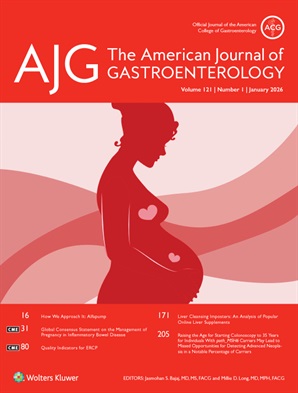
Newswise — The January issue of The American Journal of Gastroenterology includes a an analysis of popular liver supplements touted as cleansers and detoxes and an accompanying editorial. The current issue also includes a global consensus on pregnancy and inflammatory bowel disease (IBD), and articles on cannabis use in gastroparesis, quality indicators for endoscopic retrograde cholangiopancreatography (ERCP), eosinophilic esophagitis, pediatric GI, and more.
Access to any articles from this issue, or past issues, is available upon request. The College is also able to connect members of the press with study authors or outside experts who can comment on the articles.
Current Issue:
Liver Cleansing Imposters: An Analysis of Popular Online Liver Supplements
Telbany, et al.
This study examined the top 20 liver “cleansing” supplements sold on Amazon, a market of nearly $39 million in revenue. These supplements claim to detoxify and enhance liver function with little, inconclusive scientific evidence. The average product rating was 4.4 stars, but review reliability was only 73%, suggesting a need for better regulation and evaluation of these products and the role of healthcare providers in guiding patients towards evidence-based liver health practices.
Accompanying Editorial
The Impact of Cannabis Use in Gastroparesis: A Propensity-Matched Analysis of 41,374 Gastroparesis Patients
Kilani, et al.
This study explored the impact of cannabis use on healthcare outcomes of over 41,000 patients with gastroparesis. Cannabis use was linked to more frequent emergency department visits and hospitalizations, but fewer esophagogastroduodenoscopy (EGD) procedures, suggesting that cannabis may increase healthcare utilization in gastroparesis patients.
Advance Access:
Ethical and Legal Considerations for Responsible Use of AI in Clinical Gastroenterology
Megan A. Adams, MD & Andrew Feld, MD, JD, FACG
This overview discusses key principles for responsible AI use. The authors highlight both advantages and risks of AI technology in gastroenterology and offer predictions on how AI will impact legal and ethical standards in the field.
This study found that losing more than 3% of body weight significantly improved liver conditions, with 12% of patients achieving complete resolution of MASH which increased to 25% with observed weight loss >3%. Body mass index, type 2 diabetes, and Hispanic/Latino ethnicity did not affect these outcomes.
About the American College of Gastroenterology
Founded in 1932, the American College of Gastroenterology (ACG) is an organization with an international membership of over 21,000 individuals from 86 countries. The College’s vision is to be the preeminent organization supporting health care professionals who provide compassionate, equitable, high-quality, state-of-the-art, and personalized care to promote digestive health. The mission of the College is to provide tools, services, and accelerate advances in patient care, education, research, advocacy, practice management, professional development and clinician wellness, enabling our members to improve patients’ digestive health and to build personally fulfilling careers that foster well-being, meaning and purpose. Learn more at www.gi.org.