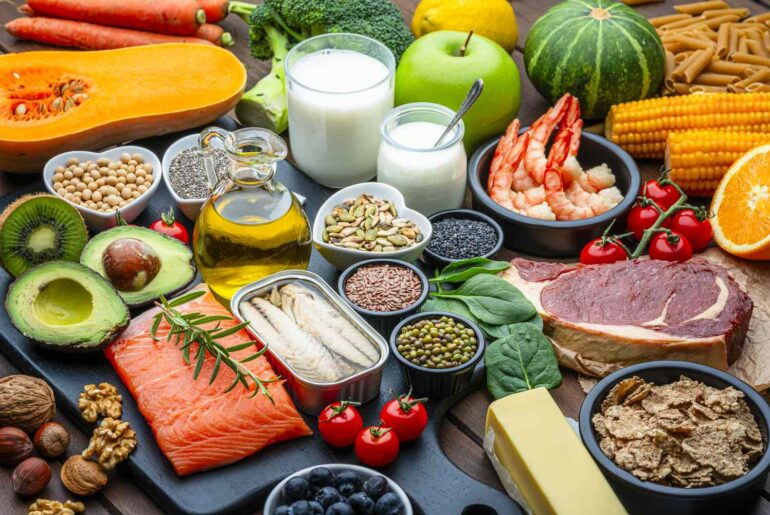
 Credit: Unsplash/Dan Dennis.
After repeated delays, the United States Department of Health and Human Services published new dietary guidelines on Jan. 7, which for the first time prioritize certain sources of saturated fats. “We are ending the war on saturated fats,” HHS Secretary Robert F. Kennedy Jr. declared at a press conference. Food and Drug Administration Commissioner Marty Makary lamented that for decades there’s been a “myopic focus on demonizing natural, healthy saturated fats.”
While the new guidelines say that generally, “saturated fat consumption should not exceed 10% of total daily calories,” the document’s new food pyramid features red meat, cheese, and whole milk at or near the top. The guidelines also advise Americans who cook with oils to use those “with essential fatty acids,” while offering butter and beef tallow as additional options. Christopher Gardner, a professor at Stanford University and a member of the most recent guidelines advisory committee, told NPR that he is “very disappointed in the new pyramid that features red meat and saturated fat sources at the very top, as if that’s something to prioritize. It does go against decades and decades of evidence and research.”
These are significant changes. For more than 45 years, the guidelines have cautioned against overconsumption of saturated fats. And while nutrition research is notorious for producing conflicting findings on the risks and benefits of a range of foods — including fats — this particular pivot has many experts worried. This is partly because the health risks associated with higher consumption of saturated fats are well-documented, and partly because the new guidance could inadvertently create a situation in which foods such as red meat end up displacing healthier fiber-filled options.
The guidelines are a cornerstone of federal food and nutrition guidance, updated every five years to reflect changes in science. National dietary guidance has historically been quite impactful. Health care providers and dietitians refer to them when advising patients. The guidelines also influence federal nutrition policy and programs and inform school lunch menus.
 The Trump administration has unveiled a new food pyramid, which stresses protein and whole foods and calls for an end to “the war on saturated fat.” Credit: U.S. Department of Agriculture
Concerns about dietary fat intake broadly go back at least to the 1940s, when studies demonstrated a correlation between high-fat diets and high-cholesterol levels, suggesting a low-fat diet could help guard against heart disease in high-risk patients. By the 1960s, a low-fat diet emerged as something that could be adopted not just by high-risk heart patients, but others, too. Congress convened a hearing in the late 1970s in which experts weighed in on the harms of overconsumption of fat.
National dietary guidelines were first published by the administration of President Jimmy Carter in 1980. The document highlighted limiting overconsumption of saturated fat and other unspecified fat, cholesterol, sugar, and sodium. Saturated fat, cholesterol, and sodium were seen as risk factors for developing cardiovascular issues.
The 1980 guidance advised Americans to avoid too much saturated fat. Then, the 1990 update introduced a numeric limit of 10 percent. Ironically, as the low-fat approach gained traction, Americans got more obese. And the rate of diabetes soared.
While nutrition research is notorious for producing conflicting findings on the risks and benefits of a range of foods — including fats — this particular pivot has many experts worried.
A PBS Frontline discussion from 2004 illuminates some of the paradoxes and unintended consequences of promoting a low-fat diet. The 1980 guidance suggested that when limiting fat intake, people should increase calories from carbohydrates, with an emphasis on whole grains, fruit, and vegetables. But the Frontline episode noted that as caloric intake from fat went down, overall calories increased. Interviewee Marion Nestle, a renowned nutritionist, underlined the point that total calories matter, something she maintains today, along with cautioning that substituting saturated fat for unsaturated fat raises the risk of higher blood cholesterol and heart disease.
×
Thank you! One more thing…
Please check your inbox and confirm your subscription.
As it turned out, and as many now know, not all fats are bad. While the American Heart Association says that less than 6 percent of a person’s total daily calories should derive from saturated fat, it pushes replacement of saturated with unsaturated fats. These can reduce low-density lipoprotein cholesterol (sometimes known as “bad” cholesterol) and inflammation, while providing nutrients the body requires to develop and maintain cells. Good choices include sunflower and flaxseeds, several cooking oils, a variety of nuts, avocado, and fatty fish, among other things.
An article in Tufts University’s Health & Nutrition Letter notes that Dariush Mozaffarian, director of the school’s Food is Medicine Institute, cites “evidence that a higher proportion of calories from fat is not harmful for either cardiovascular disease (CVD) or obesity, and in fact can lower risk if healthy (poly-and mono-unsaturated) fats replace refined starches and sugars.”
While the new set of national dietary guidelines still recommend that saturated fat make up less than 10 percent of a person’s calories per day, the limit doesn’t appear to square with the promotion of red meat, butter, whole milk, and beef tallow — all of which have long been criticized because they are high in saturated fat. With a 2,000-calorie diet, the limit would mean no more than 200 calories from saturated fat, or about 22 grams. Consuming three servings of full-fat dairy and one serving of red meat a day, for instance, could come in just under target, leaving little wiggle room for other foods.
While the science on unsaturated fats has evolved, it hasn’t to the same degree with respect to saturated fats. Even nuanced reviews of saturated fats point to harms for people with cardiovascular risk factors.
In an email to Undark, Ronald Krauss, a professor at the University of California San Francisco, wrote that there is “no evidence at all” to suggest benefits from increase saturated fat consumption. He warned that “very high consumption could put some (perhaps many) at risk for heart disease.”
It is true, however, that scientists debate the degree to which all foods that contain saturated fats are harmful. Full-fat dairy products may be less detrimental than red and processed meat, for example. Like Kennedy, Mozaffarian supports saturated fat consumption in the form of whole-fat dairy products, based on evidence that suggests beneficial health outcomes. Other experts dispute this, however. “We don’t have good evidence that low-fat milk is better than full-fat milk for controlling body weight or obesity risk,” Walter Willett of Harvard University told STAT. “However, compared to plant sources of fat, high intake of dairy fat increases risk of cardiovascular disease,” among other issues.
It is true that scientists debate the degree to which all foods that contain saturated fats are harmful.
But there’s an additional concern: If guidelines promote more sources of saturated fats, “people will eat more red meat and bacon, and fewer lentils and salads,” Gardner wrote in an email to Undark. This could end up increasing an individual’s bad cholesterol levels while reducing the many physiological benefits of fiber.
The “research literature supports replacing any of the three main food sources of saturated fat (meat, dairy, tropical oils), with plant foods that include Legumes (beans/peas/lentils), whole grains, vegetables, and vegetable oils for cardiovascular health benefits,” he wrote. The advisory committee on which he sat found heart benefits from swapping meat for other protein sources with little or no saturated fat.
The new guidelines also warn of the dangers of ultra-processed foods. This is in line with the Make America Healthy Again Commission report, released in May, which outlines the dangers of “industrially manufactured food products that undergo multiple physical and chemical processing steps and contain ingredients not commonly found in home kitchens.” (This would be a more proactive approach than the one taken by the advisory committee, which punted on including advice on ultra-processed foods because it said there is no clear definition of UPF, adding that more study is needed.) Interestingly, the scientific foundations underlying the guidelines suggest reducing intake of “highly processed foods” could help meet the goal of staying under the 10 percent of total daily calorie limit for saturated fat.
Consuming three servings of full-fat dairy and one serving of red meat a day, for instance, could come in just under target, leaving little wiggle room for other foods.
There likely is merit to discouraging UPF consumption: While not all ultra-processed foods are equally unhealthy, there is an emerging consensus on their adverse effects. Researchers published a systematic review in the BMJ of dozens of meta-analyses from 2009 to 2023 that suggested negative health outcomes associated with consumption of ultra-processed products. Additionally, an article published recently in Nature highlighted a randomized controlled trial showing harmful effects on metabolic and reproductive health.
Still, Gardner cautioned against replacing ultra-processed foods with increased consumption saturated fats, which also carry documented harms if consumed in excess.
Of course the human body does need some saturated fats, as they can boost energy, support hormone production, and help the body absorb certain fat-soluble vitamins. The important thing is to keep overall intake low and to consume more unsaturated fats than saturated fats, says Alice Lichtenstein, a professor of nutrition science and policy at Tufts University and member of the 2015 dietary guidelines advisory committee. The key is the relative amount of each fat we consume, she added.
This article was originally published on Undark. Read the original article.