This week, I analyze the “new year new you” activations leading the wellness industry into 2026, including fast-casual restaurant collaborations and the embrace of “Quitters’ Day.” Additionally, fitness app Strava files for IPO, an executive shakeup at Alo Yoga, and a rush of creatine products are hitting shelves after a meteoric rise in popularity in 2025.
There are few marketing initiatives more tried-and-true in the wellness industry than “new year, new you.” But as the industry accelerated its growth in 2025 — it’s on track to reach $10 trillion in the next three years, according to industry trade group Global Wellness Group — standing out has become brands’ primary challenge.
“To break through, brands need to do something different and deviate from the ‘new year, new you’ energy that overwhelms consumers at the start of the year,” said Allison Collins, co-founder and managing director of The Consumer Collective market research firm. “I feel like there’s almost a burnout regarding the pressure that comes at the start of the year, specifically, though we do see many people continuously strive for ‘self-improvement’ in a variety of ways.”
According to a December survey by the trade group The Health & Fitness Association, 54% of responders cite health, fitness and exercise as their biggest 2026 resolution or goal, more popular than finance-, diet- and relationship-focused resolutions, which were mentioned by 49%, 40% and 37% of responders, respectively. According to the group, goal-setters plan to spend an estimated $60 billion to support their 2026 fitness goals. That is, if goal-setters can stay consistent.
According to market research company Drive Research, 80% of consumers give up their resolutions by mid-January. This is one reason why an influx of fitness brands has centered this year’s campaigns around “Quitters’ Day,” an unofficial holiday on the second Friday of January that gained popularity in 2019.
For example, strength training fitness class brand Solidcore, which has more than 100 locations, launched a campaign on Friday to reframe the day into quitting negative self-talk, judgment and self-doubt. Oura Ring launched a similar campaign, calling on its users to quit trends and unrealistic goals.
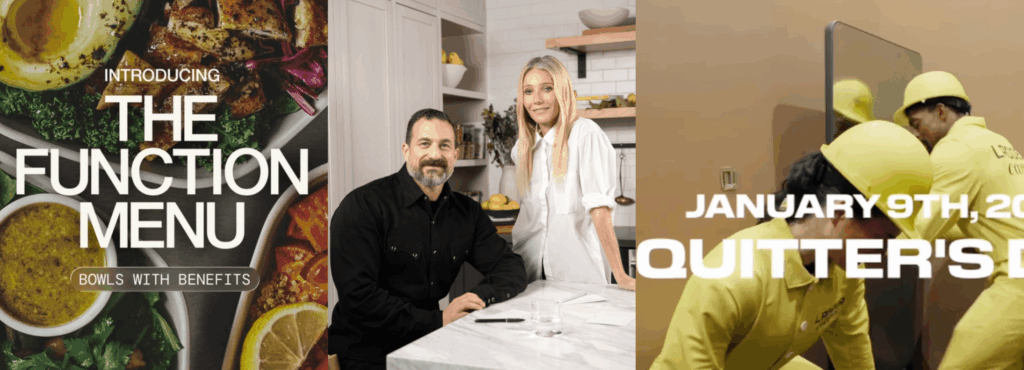
Then there were the brands that attached humor. Ladder, an at-home strength-training equipment and programming company, took a more literal approach to the holiday in a series of social videos. The team cosplayed junk removal workers to “quit bad fitness equipment.” Meanwhile, Apple launched a digital-first Quitters’ Day campaign that explained the holiday, plus included a series of shorter social clips featuring Apple Watch users running from fast-moving beds, couches and bar stools. The message was simply: “Don’t give in [to quitting].”
“Wellness consumers are looking for something that speaks to them, on either an emotional or functional level. Does the thing being marketed to them actually help or improve or add value to their lives? If so, great — there’s buy-in,” Collins said. “[However,] does the thing being marketed to them make them feel bad about themselves or seem like a silly cash grab? Today’s consumers can see through that and will avoid it.”
Longevity-focused brands are attempting to make a splash through a series of fast-casual restaurant partnerships. For example, the telehealth platform Function Health, valued at $2.5 billion last year, partnered with salad chain Sweetgreen, which has nearly 900 locations in the U.S., to launch a special menu designed by Function Health founder Dr. Mark Hyman. The menu includes an “omega salad” with salmon and a “spicy reset bowl” with chicken, available through February.
A similar launch happened between Gwyneth Paltrow’s Goop Kitchen, which has 13 locations in California, and longevity heavyweight Andrew Huberman, Ph.D., host of the Huberman Lab longevity podcast. Its single offering is called “Huberman’s organic turkey chili,” available for a limited time.
Elsewhere, famous faces are helping brands to make their announcements. For example, Alo Yoga tapped spokesperson Rosie Huntington-Whiteley to announce a major overhaul of its fitness programming app, Alo Wellness Club (formerly called Alo Moves), through a free, one-week reset program.
Announced at the end of December, Alo removed the app’s paywall in an effort to grow its subscriptions. Now, users must only be enrolled in its free loyalty program, Alo Access, to gain access. To drive awareness, the company launched a campaign called “7-day reset ritual” that promotes at-home pilates workouts, mindful movement, recipes and self-care practices like journaling, taking baths and using face masks, among other detoxifying rituals meant to be practiced over a week.
The combination of modalities taps into the wellness industry’s shift toward more holistic programming where blurred lines separate health, wellness, beauty and fitness. According to a 2025 Mintel market research company survey, 48% of U.S. consumers say their most important goal in life is improving themselves.
Executive moves:
Benedetta Petruzzo is the new CEO of international at Alo Yoga. Petruzzo’s CV includes managing director at LVMH-owned Dior and CEO of Prada Group-owned Miu Miu.
Cher Fuller is the new vp of digital experience at Vuori fitness apparel company. In January, Fuller stepped down from her role as senior director of digital marketing and loyalty at Alo Yoga.
Andrea Burman has stepped down from her role leading internal PR at Alo Yoga. She was with the company for four years, most recently with the title of global director of public relations and VIP talent marketing. She is now the PR director at Brilliant Earth, a lab-grown diamond retailer.
News to know:
Wellness brands are rushing to launch creatine products after a meteoric rise in popularity in 2025. According to a report released this month from market research company Spate, creatine popularity grew by more than 100% last year, making it the second-highest-growing supplement search after magnesium. So far this year, brands like Lemme, Cymbiotica and GNC have launched creatine gummies, single-serve liposomal supplements and drink mixes, respectively.
Strava may soon go public. The health tracker-meets-social media platform that tracks and shares a user’s workouts, has reportedly filed for an initial public offering. The app launched in 2009 and was valued at $2.2 billion last year.
Health Secretary Robert F. Kennedy, Jr., unveiled the FDA’s new, inverted food pyramid last week. The reorg, which seeks to influence American nutritional goals, prioritizes meat, dairy and produce over grains and breads. Absent from the new chart are oils and sweets, which held the smallest serving section in the former food pyramid, launched in 1992.
The business of sleep is expanding again. The American Council on Exercise, a nonprofit industry organization that certifies fitness and health coaches, has added sleep and recovery training to its available courses. The organization seeks to train fitness professionals to add sleep and recovery science into health coaching.
Mark Mastrov, the American businessman who launched and sold 24-Hour Fitness, has re-acquired the popular gym chain. Mastrov launched the first location in 1983 and scaled it to 420 locations before selling to private equity in 2005. He partnered with LongRange Capital to make the acquisition and will now serve as executive chairman through another stage of growth.
There’s a new sexual wellness parent company in town. Spurred by the brand Hello Cake’s acquisition of the personal care manufacturer Trigg Laboratories, which sells lubricants and devices at Walmart and Target, a new parent company called Sexual Wellness Group was formed. The group also owns DTC-sold Turn On Lubricants and Wet Lubricants, which sell across mass retailers. As reported by Beauty Independent, the newly formed group hopes to provide competition to conglomerates like Church & Dwight and Lifestyles.
Stat of the week:
The global femtech market, which includes products and services to support fertility, menstruation, hormone health and pregnancy, is set to reach $267 billion by 2035, according to data released last week from market research company Astute Analytica. The market was worth an estimated $63 billion last year and is growing at a 15% compound annual growth rate, according to the firm. North America is a major player: It accounted for approximately 38% of this market in 2024.
In the headlines:
GymNation’s newest innovation: a workout class inside a hot air balloon [Athletech News]. The men who are super competitive about sleep—and the gear they swear by [WSJ]. 4 reasons to try hyperbaric oxygen therapy In 2026 [Vogue]. The blooming interest in ear seeds [New York Times].
Need a Glossy recap?
CEO Tom Hale on Oura Ring’s $1 billion year. Paula’s Choice makes a bet on longevity and sports with its first campaign of 2026. In 2025, Gen Alpha arrived as beauty consumers — in 2026, they will reshape the industry. Neiman Marcus and US luxury’s shrinking footprint. Inside Sabrina Carpenter’s plan for global fragrance domination. Injectable peptide therapy went mainstream in 2025, priming consumers for the next big wellness wave. Who the heck is buying the wellness industry’s most expensive offerings?