WASHINGTON, D.C. — Six days after 37-year-old Minneapolis mother Renee Good was shot and killed by a U.S. Immigration and Customs Enforcement (ICE) agent, Massachusetts congressional lawmakers Sen. Ed Markey and Rep. Ayanna Pressley on Tuesday reintroduced legislation first filed in 2020 that would end qualified immunity for federal law enforcement officers.
The federal legislators unveiled their “Qualified Immunity Abolition Act of 2026,” which is a more developed version of a 2020 bill they filed in the wake of George Floyd’s murder in Minneapolis. That bill never passed.
The theory of qualified immunity has given officials a legal shield from wrongdoing or misconduct in their positions for decades. If the updated legislation filed by Markey and Pressley were to pass, it would ensure that not only state and local officials, but also federal officials, could be sued by victims for civil rights violations.
The two legislators said that the measure will help defend families who are being “abused” by law enforcement, including ICE agents.
“When masked ICE agents are allowed to kill and harm people with impunity, we have crossed a dangerous threshold in our nation,” Markey said in a statement. “All too often, the flawed and judge-made doctrine of qualified immunity shields law enforcement officers from liability, even when they commit egregious misconduct or use excessive force.”
Markey said the updated act seeks to abolish this unjust defense in cases against federal law enforcement officers, allowing victims their rights in court.
“With ICE agents trampling over our laws, our rights and our communities, we must demand justice and hold wrongdoers accountable,” he said.
Paul Collins, a professor of legal studies and political science at the University of Massachusetts Amherst who has a focus on bias and the legal system, gave some insights into the history of qualified immunity.
“Qualified immunity is a controversial topic. On the one hand, some view it as desirable since it enables government actors — including police — to do their jobs without great fear of legal liability,” Collins said. “On the other hand, others view it as undesirable since it makes it difficult to hold government actors accountable for harmful actions, including killing another person.”
He said that qualified immunity was introduced to protect police officers, but doesn’t appear in the U.S. Constitution.
Since 1871, the law of the land has been that officials can be tried for their actions. In its passage of the Civil Rights Act of 1871, also known as the “Ku Klux Klan Act,” Congress allowed individuals to sue government officials, including law enforcement officers, who violate civil rights.
That changed in 1967 when the Supreme Court, in Pierson v. Ray, introduced the concept of qualified immunity, ruling that police could be protected if they acted in “good faith” with probable cause, even if mistaken. Since then, immunity has expanded over the decades.
“The court further clarified qualified immunity in 1982, when it established the current rule, which holds that police have immunity as long as their conduct ‘does not violate clearly established statutory or constitutional rights of which a reasonable person would have known,’” Collins said. “In short, qualified immunity is a judge-made doctrine that makes it exceptionally difficult to hold police accountable for actions that violate individuals’ constitutional rights, including instances of police killings.”
Both Markey and Pressley have been on the front lines tackling qualified immunity since 2020 when Police Officer Derek Chauvin, who is currently serving a more than 20-year sentence, murdered Floyd.
Following Floyd’s murder, Markey joined Sen. Cory Booker, D-New Jersey, then-Sen. Kamala Harris, then-Congressional Black Caucus Chair Karen Bass, and Rep. Jerrold Nadler (NY-12) in introducing the “Justice in Policing Act” to increase data collection on police violence and improve police training.
In May 2025, ahead of the fifth anniversary of Floyd’s death, the two reintroduced their “Ending Qualified Immunity Act,” a measure that died in the Senate.
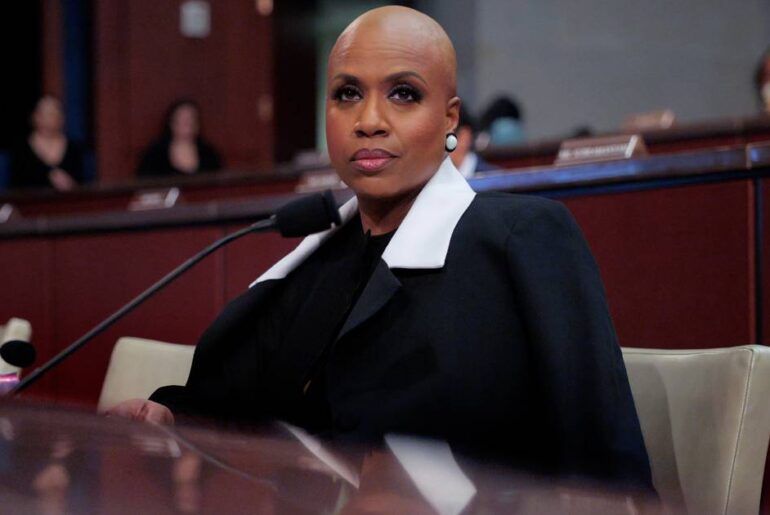
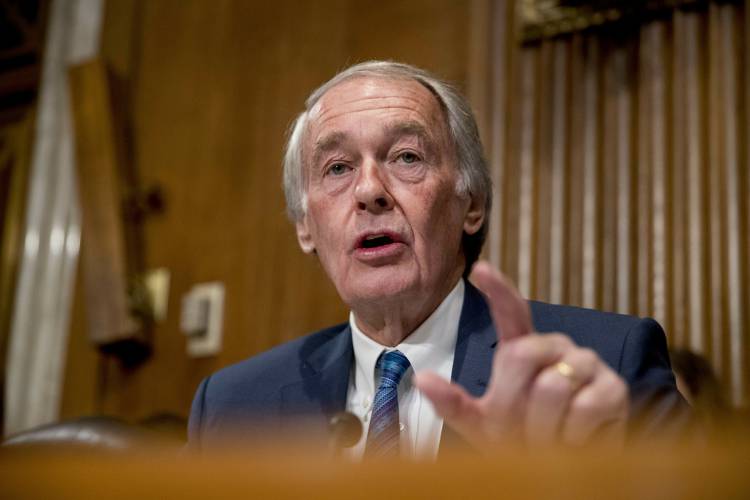
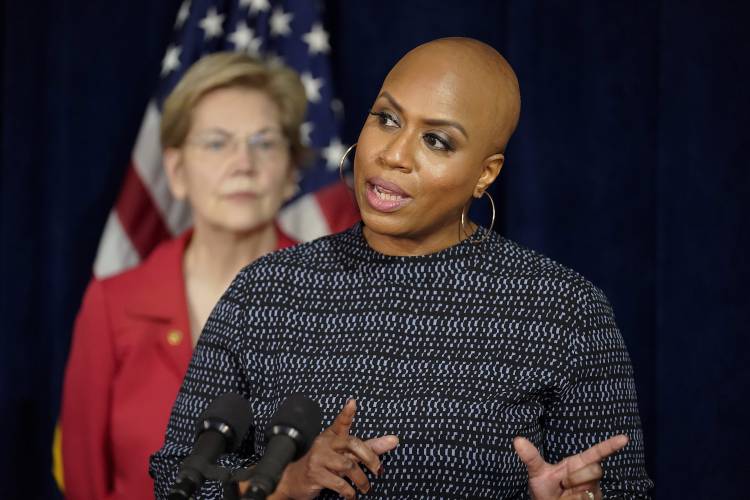 U.S. Rep. Ayanna Pressley and U.S. Sen. Ed Markey have reintroduced a bill to end qualified immunity for federal law enforcement officers in the wake of the shooting death of a Minneapolis mother last week. FILE PHOTO Credit: Steven Senne
In a statement Tuesday, Pressley said, “We cannot stand idly by while rogue federal agents — emboldened by the Trump White House — ravage our communities, brutalize families and kill our neighbors on the street in cold blood. Our bill sends a powerful message to everyone in America — citizen or not — that when ICE agents break the law, they should and will be held accountable. For Renee Good, Keith Porter, Nenko Gantchev, and every death at the hands of federal law enforcement, Congress must end qualified immunity.”
Porter and Gantchev were also ICE victims. On New Year’s Eve 2025, Porter was killed by an off-duty ICE agent in Los Angeles. Gantchev died in late 2025 while in ICE custody at the North Lake Processing Center in Michigan, with natural causes being ruled the official cause of death.
Democratic Congressman Jim McGovern is also backing the bill.
“I fully support the Qualified Immunity Abolition Act of 2026. Americans do not want to live in a police state,” he said. “And despite this administration’s absurd and outrageous claim that federal law enforcement agents have absolute immunity — whatever the hell that means — wearing an ICE uniform does not give you permission to shoot an unarmed, innocent mother in the face.”
Meanwhile, in Minneapolis on Tuesday, federal officers dropped tear gas and sprayed eye irritant at activists during another day of confrontations while students miles away walked out of a suburban school to protest the Trump administration’s bold immigration sweeps.
The government’s immigration crackdown is next headed to a federal court where Minnesota and two mayors are asking a judge to immediately suspend the operation. No hearing has been set on the request.
With the Department of Homeland Security pledging to send more than 2,000 immigration officers into Minnesota, the state, joined by Minneapolis and St. Paul, sued Trump’s administration Monday to halt or limit the surge.
The lawsuit says the Department of Homeland Security is violating the First Amendment and other constitutional protections by focusing on a progressive state that favors Democrats and welcomes immigrants.
“This is, in essence, a federal invasion of the Twin Cities in Minnesota, and it must stop,” state Attorney General Keith Ellison said.
Minneapolis Mayor Jacob Frey said, “What we are seeing is thousands — plural — thousands of federal agents coming into our city. And, yeah, they’re having a tremendous impact on day-to-day life.”
Dozens of protests or vigils have taken place across the U.S. to honor Good since the 37-year-old mother of three was killed, including last weekend locally. In Franklin County, demonstrations have been held in Orange, Greenfield and Montague.
Homeland Security says it has made more than 2,000 arrests in the state since early December and is vowing to not back down. Spokesperson Tricia McLaughlin, responding to the lawsuit, accused Minnesota officials of ignoring public safety.
“President Trump’s job is to protect the American people and enforce the law — no matter who your mayor, governor or state attorney general is,” McLaughlin said.
The Trump administration has repeatedly defended the immigration agent who shot Good, saying he acted in self-defense. But that explanation has been widely panned by Frey, Minnesota Gov. Tim Walz and others based on videos of the confrontation.
Material from the Associated Press was used in this report.