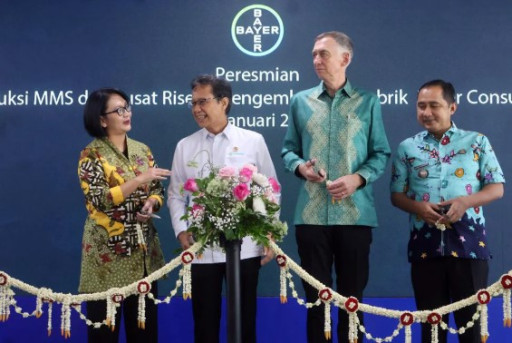
PT Bayer Indonesia has added an investment of €3.6 million (Rp71.21 billion) to support the Indonesian government’s maternal health program through the production of pregnancy supplements.
The fresh investment takes the form of a new production line designed to manufacture up to 1.2 billion units of Multiple Micronutrient Supplementation (MMS) tablets for government procurement programs.
Head of Product Supply Consumer Health at Bayer Indonesia, Priscilla Silvan Prarizta, said the new line is currently configured to produce around 552 million MMS tablets per year, but the company is prepared to expand capacity should market demand increase.
“We are ready to add further investment to meet domestic demand. Our installed capacity and production potential are still far greater than what we are currently utilizing. That is the commitment we conveyed to Health Minister Budi Gunadi Sadikin,” Priscilla said at Bayer’s manufacturing facility as quoted by Katadata.co.id, on Wednesday, January 14, 2026.
Large domestic demand, import dependency remains
Data from the Ministry of Health shows that Indonesia had 5.3 million pregnant women in 2020. Based on daily consumption of one tablet throughout pregnancy, the annual MMS market potential is estimated at 1.48 billion tablets.
Priscilla said the primary objective of the new production line is to serve the government MMS procurement program. However, Bayer Indonesia acknowledged that all active pharmaceutical ingredients (APIs) used in MMS production are still fully imported.
Under government procurement rules, products must meet a minimum 40 percent local content requirement. Currently, Bayer’s MMS local content is limited to packaging and excipients, as pharmaceutical-grade active ingredients are not yet produced domestically.
“Honestly, none of the active pharmaceutical ingredients used in MMS are currently manufactured in Indonesia. Once local APIs are available and meet global standards, we will immediately shift to domestic sourcing,” Priscilla said.
The global standards referenced follow the United Nations International Multiple Micronutrient Antenatal Preparation (UNIMMAP) guidelines, which require 10 vitamins and 5 minerals as active ingredients.
High-risk regions
Health Minister Budi Gunadi Sadikin officially launched the MMS consumption program for pregnant women in October 2024. The program targets 209 districts and cities across 15 provinces, selected based on five indicators: incidence of low birth weight (LBW), chronic energy deficiency among pregnant women, stunting prevalence, population density, and the number of pregnant women.
The government has prepared 234 million MMS tablets since the fourth quarter of last year. According to the Health Ministry, 27 percent of pregnant women suffer from anemia, largely due to insufficient nutritional intake.
Budi said maternal health is critical to reducing low birth weight and stunting rates, noting that MMS contains essential nutrients needed during pregnancy – particularly iron and folic acid, which are two of the 15 active ingredients.
“If you want your child to be healthy and intelligent, take 180 MMS tablets for 180 days, or six consecutive months during pregnancy. God willing, the child will be healthy and smart,” Budi said on October 17, 2025.
Pharmaceutical investment
Budi also criticized Bayer AG for its limited pharmaceutical investment in Indonesia, arguing that rising national healthcare spending makes the country too large a market for global pharmaceutical companies to ignore.
The former banker estimates that Indonesia’s healthcare spending per capita will increase from US$140 currently to US$300 within five years. As a result, the national healthcare market is projected to reach US$86 billion (Rp1,451.25 trillion) by 2031, alongside an increase in life expectancy from 72 to 76 years.
“If I were Bayer’s CEO, I would target a 10 percent share of Indonesia’s pharmaceutical market and capture an additional US$8.6 billion in revenue. If you don’t see this opportunity, then you are either blind or foolish,” Budi said during a visit to PT Bayer Indonesia’s factory as quoted by Katadata.co.id on Wednesday.
Budi noted that Bayer AG’s consolidated assets total around US$44 billion, meaning Indonesia’s healthcare market could accommodate the equivalent of two Bayer-sized companies by 2031. He further projected healthcare spending per capita could rise to US$3,100 by 2040, pushing the national healthcare services market to an estimated US$860 billion annually.
Pharmaceutical manufacturing
Bayer operates three main business segments: agriculture, pharmaceuticals, and consumer health. In Indonesia, the company currently operates two agricultural product plants and one consumer health facility.
Budi pointed out that Bayer’s largest revenues globally come from agricultural products, followed by pharmaceuticals and consumer health. Given this structure, he argued that Bayer should establish at least two pharmaceutical manufacturing plants in Indonesia.
“Why should Bayer build pharmaceutical factories in Indonesia? Because we have a massive market opportunity, relatively low labor costs, and a skilled workforce,” Budi said.