In this fourth installment of our series on sacred and religious artists, a local iconographer and Denver Catholic columnist reflects on the interplay between truth and beauty and how both can lead us to Heaven.

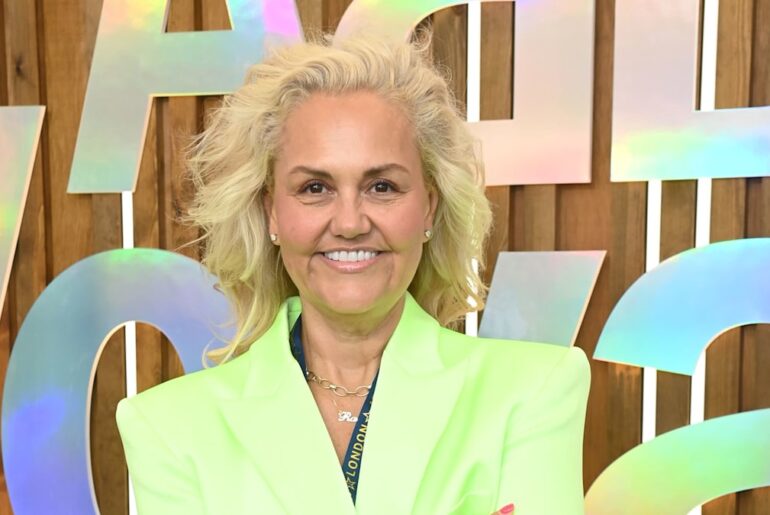
“I want more people to stop and look at art again,” said artist, iconographer and Denver Catholic columnist Elizabeth Zelasko.
As a frequent collaborator with churches and religious institutions in the development of sacred art for sacred spaces, Zelasko’s goal is to remind Catholics of their dignity and the promise of salvation.
“It’s one of those things that we have taken for granted,” she explained. “We really have to consider how we engage with art and to what capacity. We have to remember its role in our sanctuary and be really intentional.”
Originally from New Jersey and now based in Northern Colorado, Zelasko spends her time improving her craft as a commissioned artist and giving talks on the importance of sacred art in our lives and the impact images have on our brains.
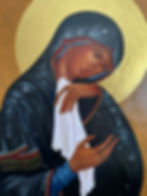
Windows Into Heaven
“When given the opportunity, I really do like to explain iconography to people,” said Zelasko. “Because I think it’s misunderstood by the West. It’s a problem of comparison, somehow. People who are used to classical art can see an icon and look at it as a little too primitive or flat or even unattractive, I might dare to say.”
Even for those who have been surrounded by sacred art their whole lives, the traditional sensibilities that form the base of iconography can feel foreign and strange. Some might look at an icon and think, “They’re too stoic,” or ask, “Why does Jesus look like that?” But, in Zelasko’s eyes, such reactions are rooted in a misunderstanding.
“The idea is that you’re seeing something that’s in Heaven currently. It’s a lifting of the veil,” she explained. “So sacred art should look a little strange. This person is in Heaven right now; they’re not on earth anymore. It’s not our realm.”
Praying with sacred art can help remind us of the immaterial nature of Heaven. Meditation with art that reminds us of the difference between our physical existence and the metaphysical one of the saints can help drive us higher.
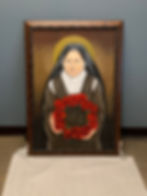
Commissioned by the Augustine Institute, this piece features St. Therese of Lisieux. (Photo provided)
An Artistic Conversion
Zelasko’s personal journey reflects the power art can have in effecting change, especially for the better.
“I was born and raised Catholic and had a very vibrant faith as a little kid,” she said. “It was very warm; I loved the Rosary; I loved the Virgin Mary. But like most young adults, I started to question some things as all sorts of changes were going on, and I just got off track. I started doing things that weren’t good for me and my soul.”
That all changed through a providential, prolonged encounter with religious art in her own home.
“During that time, my mom noticed that I was struggling, and somebody told her to hang a picture of Our Lady of Guadalupe outside my bedroom. She’d kiss it every day, and I’d see her kissing it,” she continued, highlighting how seeing such a beautiful image and act of devotion led her to a deeper truth. “I’m seeing something that’s beautiful, and my mom kissing it revealed that the truth of the image is that it’s sacred and it’s holy. The theology was there through the actions of my mother. Eventually, I started kissing the image too. It reminded me of my dignity and the call to holiness that I was rejecting. It was a long road after, but that was the start of the conversion.”

Commissioned by St. Elizabeth Ann Seton Parish, this piece features St. Joan of Arc. (Photo provided)
Beauty and Truth
While Zelasko’s full return to the Church took much more than the simple event of hanging and honoring the picture of Our Lady, it served as a catalyst, and more begets more.
“Sometimes the images that we see, because they’re not using words, because they’re speaking the truth silently by existing, can knock down the walls you build up around yourself,” she said. “The strength of art is to penetrate so rapidly because we’re so visual. The first step for moving towards something is to be attracted to it.”
Zelasko went on to the School of Visual Arts in New York City, but wasn’t satisfied with the lack of traditional instruction, and so left to study Russian Orthodox Iconography at the Prosopon School of Iconology, also in Manhattan. There, her philosophy of beauty developed, inspired by the traditional rules of Eastern Iconography, which focus heavily on the deeper truth that sacred art symbolism points towards: Jesus Christ.
“If it’s just beauty alone, then all of these European cities that are just dripping with art, they would all be on fire for Christ, no?” said Zelasko. “But our brains are so good at tuning things that we see all the time out. So, I don’t think that beauty will save the world. It’s funny for an artist to say that, but I do think that it’s crucial. Beauty without the truth can only really stir the heart a bit.”
Even still, beauty is a powerful attractor. In her talks, Zelasko pays significant attention to the things we consume and their natural impact on our brains.
“I think it’s something like 90% of our learning as children is visual,” Zelasko said. “So, we’re very visual people. What you see has a huge impact on your soul. What you see, you literally consume. Being on our phones all the time is not good for our spirits at all; it can be really quite destructive to our brains, but the opposite can happen when we go into a church and when we have sacred art in our homes. The same is true: we are taking that into us, we are ingesting that beauty and truth in a real way.”
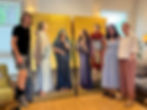
Elizabeth Zelasko (right) poses with Ben and Berkley, two models she worked with for this commission by Annunciation of the Blessed Virgin Mary Parish in Wisconsin. (Photo provided)
A Prayerful Ministry
For such a lofty vocation — depicting truth with beauty — Zelasko is sure to integrate prayer and meditation into her artistic process in order to bring others into an encounter with the divine.
“There are certain prayers that you have to say before you do sacred art. That’s the tradition anyway,” she explained. “Now, Caravaggio probably didn’t say one single prayer, so I want to be clear that my images aren’t holy because I’m holy. They’re holy because what I’m depicting is holy. Does it help that I pray? Absolutely. For me, it’s crucial that I go to Confession because I am Catholic, and I am faithful. I do see a difference when I’m living a good life. When I go to receive the sacraments regularly, my art is easier then. It feels easier.”
At the core, Zelasko’s prayerful ministry of beauty aims to help others see with new eyes, to grow in faith and to encounter truth in a life-changing way, allowing beauty to influence our everyday existence.
“When my brother first moved to Colorado, and I came out here to visit him, before I also moved here, I remember driving on the highway and just losing my mind about the beauty. He said, ‘Yeah, I guess you kind of don’t think about it after a while, ’” said Zelasko. “Not to throw my brother under the bus, but I don’t want anybody to live that way. I want everybody to look at the mountains as if for the first time, all the time. And to look at the art in our churches as if for the first time, all the time. To see the crucifix for the first time, every time. That’s my prayer for everybody, to wake up to these things that are in front of us and not to tune out beauty.”