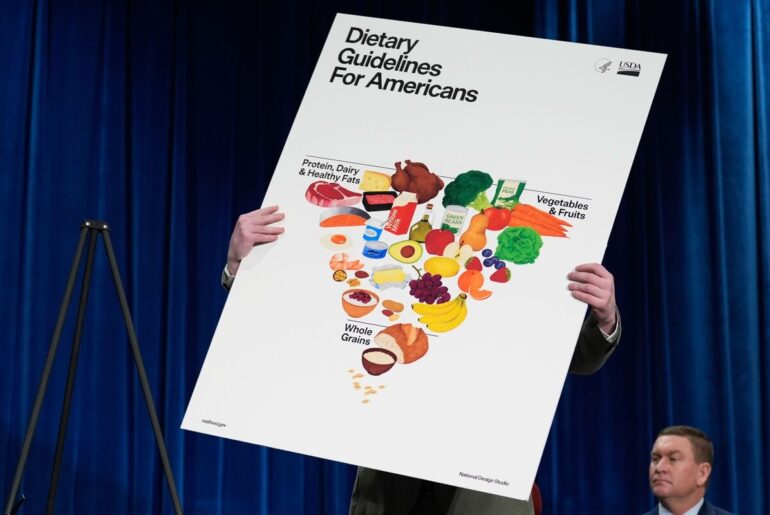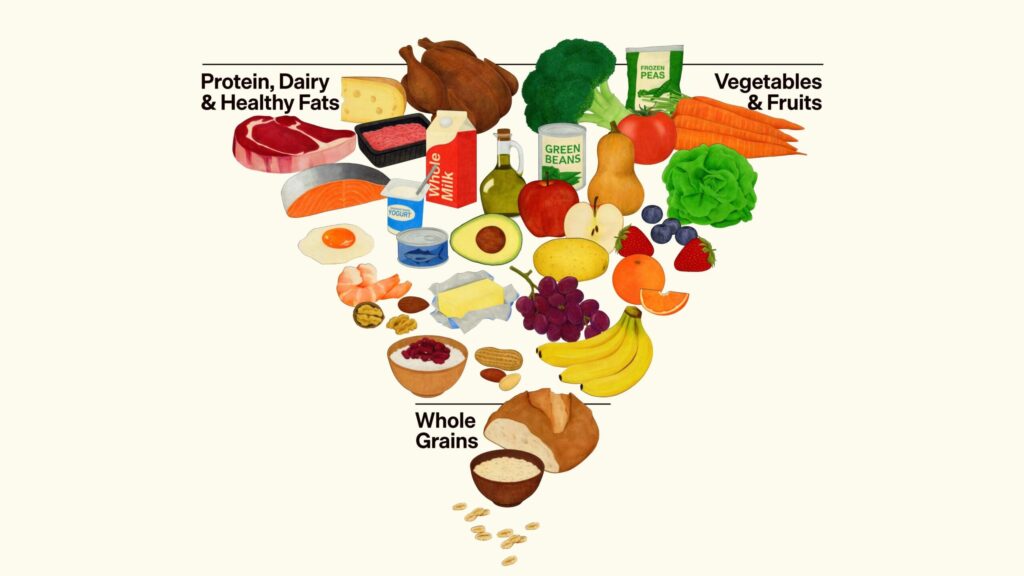
The Trump administration recently unveiled new dietary guidelines, changing the longstanding “food pyramid” model by putting protein, healthy fats and vegetables at the top of a triangle now pointed down.
These guidelines, known as the Dietary Guidelines for Americans, provide advice on what to eat and drink to meet nutrient needs, promote health and prevent disease. They are revised every five years and help guide programs like school lunches and Supplemental Nutrition Assistance Program, or SNAP.
Portions of the guidelines have gotten praise. In a statement to WPR, the Wisconsin Academy of Nutrition and Dietetics said it supports the move to avoid highly processed foods and refined carbohydrates.
News with a little more humanity
WPR’s “Wisconsin Today” newsletter keeps you connected to the state you love without feeling overwhelmed. No paywall. No agenda. No corporate filter.
But the organization and other nutritionists have raised concerns about the emphasis on foods high in saturated fat like red meat, beef tallow and butter.
Michelle King Rimer is a clinical assistant professor at the Zilber College of Public Health at the University of Wisconsin-Milwaukee and a registered dietician. She said the messaging is unclear, and people should continue to eat lots of fruits and vegetables, whole grains, lean proteins and healthy fats.
She spoke with WPR’s “Wisconsin Today” about her key takeaways.
Eat quality protein
The new guidelines prioritize protein at each meal, with a goal of getting around 1.2 to 1.6 grams per kilogram of a person’s body weight each day.
King Rimer said that’s about twice what was previously recommended. She said protein needs are highly variable person to person, but most Americans already consume more than enough.
What’s missing, she said, is clarity on the quality of different protein foods. Evidence suggests plant-based proteins and fish are generally associated with more favorable health outcomes.
She gave the example of eating a 4-ounce sirloin steak. The consumer will get about 33 grams of protein and about 5 grams of saturated fat; whereas one cup of cooked lentils will contain about 18 grams of protein, and you’d also take in 15 grams of fiber and virtually no saturated fat.
Avoid highly processed foods
The top of the Dietary Guide reads, “The message is simple: eat real foods.” It says to avoid highly processed, packaged, prepared, ready-to-eat foods “that are salty or sweet, such as chips, cookies and candy that have added sugars and sodium (salt).”
King Rimer said most dietitians and nutritionists are behind this message. But, she added, there needs to be more clarity on what is meant by “highly processed.” She said a baby carrot is considered processed even though it has nutritional value.
In her classroom, King Rimer uses the Nova classification system, which categorizes foods into four groups based on their level of processing. This classification helps explain the nutritional quality and the health implications of different food types.
“We should consider ultra-processed foods as maybe not forbidden, but as foods to be mindful of in our frequency and also in our portion,” she said.
 Vegetables are displayed on a table Friday, Sep. 11, 2020, at Cameron Park Farmers Market in La Crosse. Angela Major/WPR
Messaging needs clarity
King Rimer said although the guidelines are on a short 10-page document, the messaging is inconsistent and confusing for the average person.
In the visual food pyramid, red meat is at the top. But in the text of the guidelines, there is a recommendation to limit saturated fats to 10 percent of your daily diet even though red meat can be high in saturated fats.
Another example is whole grains, which are at the bottom of the new inverted pyramid — meaning we should eat less of them than food in the rows above. But the written dietary guidelines instruct Americans to prioritize “fiber-rich whole grains,” which matches decades of research showing whole grains are associated with lower risk of heart disease, diabetes and certain cancers.
King Rimer said overall, people should eat real foods and take a “food-is-medicine” approach.
“My advice is to focus less on any single graphic and more on a consistent theme that hasn’t changed. And that’s: eat plenty of fruits and vegetables, choose whole grains, often include a variety of protein sources, limited sugars and also be mindful of saturated fat,” she said.