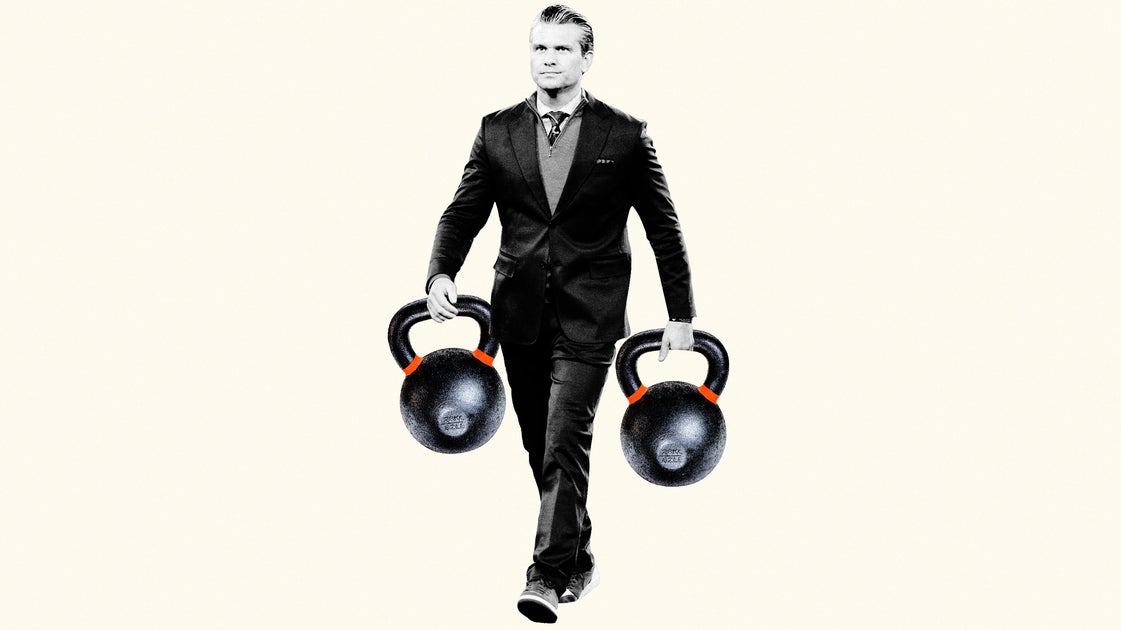
Defense Secretary Pete Hegseth keeps working out. For him, physical fitness is important for the military, and he uses himself as an example.
“If the secretary of war can do regular hard [physical training], so can every member of our joint force,” he has said.
“At every level, either you can meet the standard, either you can do the job, either you are disciplined, fit and trained, or you are out,” Hegseth said in his September speech to officers about why being physically fit matters so much.
But a recent video promoting Hegseth’s workout has exercise enthusiasts and trainers up in arms on social media about what exactly are his kettlebell standards. On his “Arsenal of Freedom” tour, Hegseth worked out with Army recruits from UCLA and had the session filmed by a news channel.
However, what we see him do with the kettlebell doesn’t bear any resemblance to what a strong and proper kettlebell swing typically looks like. It’s possible he was trying to squat with the weight while swinging it, but even then, it’s not entirely clear, according to video observers (including me).
“First they did half reps and I said nothing…But then they ruined kettlebell swings, and I had to make a post about it,” begins one popular TikTok takedown of Hegseth’s form. The video has been recirculated across every social media platform and sparked debates in the Reddit community for kettlebells, with one top comment reading: “As a coach, I rejoice in knowing that my job is secure.”
In journalism, it’s standard to reach out to subjects who are being criticized to hear their perspective. I had a simple quest: Ask Hegseth what kettlebell exercise he was doing. But when HuffPost asked this question, along with a request that Hegseth respond to trainers’ criticism of his kettlebell form, Pentagon spokesperson Kingsley Wilson told me I had asked the “stupidest question” of the year.
So my larger question remained: What exercise was Hegseth doing with his kettlebell? Because if it were a two-armed kettlebell swing, it was being swung all wrong, according to fitness professionals.
Illustration: HuffPost; Photo: Getty Images
Defense Secretary Pete Hegseth keeps doing publicized workouts to promote physical fitness, but his kettlebell form is raising eyebrows to trainers.
Jahkeen Washington, the owner and founder of the Harlem Kettlebell Club in New York City, said he is “pretty certain that it was meant to be a swing” based on the whole group’s movements and if “this is being presented as the right way to do kettlebell swings, then I would argue that [the swing] is being butchered, because you just have too many people doing too many different things.”
Even if it was kettlebell squat-swing, “a squatty swing is not necessarily wrong, but I don’t believe that they knew what they were intending to do” based on the different variations, Washington said.
“I would assume he’s new to kettlebells, which is completely fine,” said Samantha Ciaccia, New York City-based founder and CEO of Bell Mechanics, noting that Hegseth’s kettlebell swing was “not optimal” because it’s too easy for Hegseth to raise the weight.
“That kettlebell is way too light for him,” she said. “If you’re able to front-raise a kettlebell, it’s too light to swing, so you would want him to go a little bit heavier to then incentivize him and his hips to be more powerful and explosive.”
“It isn’t just the secretary that could improve his form — every candidate I saw in the video with the exception of one, a female candidate to his right — two away from him – needed to improve their technique in the swing,” said Brett Jones, certified trainer and strength and conditioning specialist in Pittsburgh, Pennsylvania.
“There’s no power from coming from the ground and the hips. It’s just a ‘front raise’ with the shoulders,” Jones said. “The swing is this ballistic exercise that repeats. You can do great metabolic and power conditioning with it when you treat it as a ‘front raise,’ but it’s just a very ineffective way to perform the movement.”
This is what a strong kettlebell swing should look like.
The kettlebell forms in the filmed workout session are not unusual because “the kettlebell swing is probably the most butchered exercise,” Washington said. But there are easy tips that Hegseth, or anyone else, could learn from. Here’s how.
Jones said that if he were training Hegseth, he would first have him practice kettlebell deadlifts, in which a person hinges at the hips, lifting the kettlebell up and down while keeping their back straight. This way, you can “reintroduce what a good hip hinge is, then bring it into the swing with a good hike and pop.”
When you are ready to practice the swing, grab the kettlebell with both hands and stand about shoulder-width apart; everyone’s body is different, so the exact position may vary. Then, “tip the bell at an angle towards you” on the ground, Washington said. And as you inhale, you will “basically bring that bell to your crotch,” he said. And then as you pull the bell back through and raise it [up], you’re exhaling to stand tall,” Washington added.
“You can think of it as a vertical leap without leaving the ground,” Jones said.
You know you are doing the swing right when the ball floats up from the power behind it, trainers said. “The arms are kept against the body as long as possible, and then as the power from the hips comes to the top — boom — then you get the float of the bell,” Jones said.
Once you hit full hip extension and explosiveness through your hips, it causes a “chain reaction” of that weight, so that your arms and kettlebell float up, Ciaccia said.
Your shoulders should be retracted down and back at this point so the bell is about “shoulder height,” Washington said. This is meant to be a lower-body-dominant movement, so it should feel like “an explosive deadlift,” Washington said. In the video, Hegseth’s ball goes above his head, but to get the most out of a kettlebell swing, it wouldn’t. When your bell is high above the head, “you are using more upper body than you should or want to,” Washington said.
The reason kettlebell swings are a uniquely powerful exercise for so many strong athletes is that lifting the kettlebell up and down with the power of our lower bodies teaches us to accept all that energy from the bell as it comes down and redirect it into our next power movement, Jones explained.
“That ability to absorb and redirect force…That’s everything you want to be doing in athletics,” Jones said — just in case anyone wants to take note.