Happy Friday, and welcome to Food Fix. I’m not sure how we’re already halfway through January.
New pod alert: Forked, the food politics podcast I co-host with Theodore Ross over at the Food & Environment Reporting Network, is back with a new episode! This week, we discussed SNAP restrictions and made predictions about 2026.
Food Fix in the news: Thanks to Bloomberg for citing Food Fix as first to report key details of the dietary guidelines. I also recently joined WBUR’s “Here and Now” to discuss SNAP restrictions and the Food Safety Matters podcast to discuss dietary guidelines (and all things MAHA).
Avoid FOMO: The best way to make sure you don’t miss a beat is to upgrade to a paid subscription and get Food Fix twice per week. Most people who upgrade work in the food, ag or health space and get their workplace to pay for it — always worth asking!
As always, I truly welcome your feedback. Send me your thoughts by replying to this email, or drop me a line: helena@foodfix.co.
Alright, let’s get to it –
Helena
***
The Trump admin is making a lot of claims about food and nutrition — what’s true?
Food policy doesn’t often break through to the top of the news cycle, but when it does I tend to hear from friends and family I haven’t talked to in a while.
Mostly, I get a whole lot of questions. Navigating our information landscape right now is pure chaos — trust in media has cratered, social media is full of conflicting info and most podcasts (god love ‘em) don’t do any fact checking. As a reporter, this can feel overwhelming at times — there is so much to fact-check on a daily basis that it’s hard to know where to start or what’s most useful to readers.
For this week’s newsletter, I thought I’d do something a bit different — I’m going to unpack a couple of recent claims made by this administration that I’ve been asked about and fact-check them.
This is a non-exhaustive list of claims that are either misleading, only partly true or false.
“For decades we’ve been misled by guidance that prioritized highly processed food, and are now facing rates of unprecedented chronic disease.” – Realfood.gov (the government’s new dietary advice website)
Fact check: Misleading. We are facing unprecedented rates of chronic diseases, but as I wrote last week very few Americans actually follow the dietary guidelines so it makes little sense to place outsized blame on them for our current challenges. It’s true that the government didn’t explicitly tell Americans to avoid highly-processed foods until this year, but it’s not true that the previous guidelines were actively prioritizing these foods.
Past dietary guidelines ignored the issue of processing altogether — and you can argue, as many do, that this a serious flaw — but the guidelines did recommend that consumers cut back on foods that are high in saturated fat, added sugars and sodium, a recommendation that overlaps quite a bit with the highly processed foods this administration is now warning against.
Diet-related diseases were already rising in the U.S. before we got our carb-loving food pyramid in 1992. It’s simplistic at best to blame the guidelines that most people don’t follow (and not capitalism, our rapidly changing food environment, unfettered food marketing, farm subsidies, the list goes on).
The Trump administration has ended the “war on saturated fat.”
Fact check: Partly true. Most nutrition experts would disagree that we’ve had a “war” on saturated fat, per se, but it’s certainly true that federal dietary advice has long urged Americans to cut back on this nutrient (top sources include things like meat, cheese, butter, etc.).
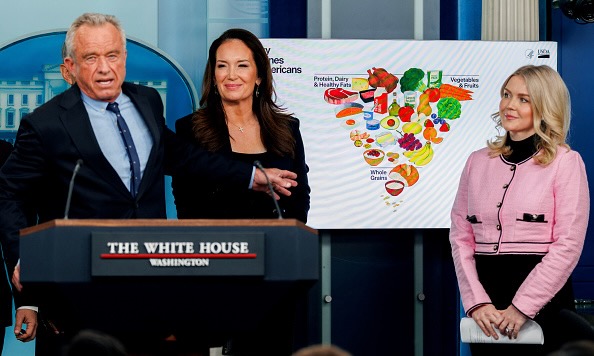
The long standing advice has been to not get more than 10 percent of your calories from saturated fat. The 2025-2030 dietary guidelines actually kept this limit, which surprised a lot of people. Still, the overwhelming message from top officials has been that the sat fat war is over and that meat and whole fat dairy are back. In other words, they’ve ended the “war” in their rhetoric (and also in the food pyramid graphic) more so than the actual policy, but rhetoric matters, and that message has fully left the barn.
The Trump administration has declared war on added sugars.
Fact check: Mostly false. HHS Secretary Robert F. Kennedy Jr. keeps saying this, but the Trump administration has so far taken no substantive actions against added sugars writ large. The dietary guidelines recommend consumers cut way back — no more than 10 grams per meal — and that parents keep added sugar from their kids until age 10. Calling this a “war” is a bit much, when the levers of the federal government aren’t being used. The FDA could set targets or limits for added sugars. The USDA could radically reduce how much added sugar is allowed in millions of school meals and snacks every day. None of this has happened in year one of MAHA. The federal government also still subsidizes domestic sugar (and corn) production, so there’s also that!
The Trump administration has pulled sugary drinks and candy from SNAP.
Fact check: Partly true. While the administration has done nothing to reduce added sugars across the board, USDA’s move to let states drop sugary drinks, candy and some desserts from SNAP is a major change in policy that affects millions of consumers. So far this policy has kicked in across five states — Indiana, Iowa, Nebraska, Utah and West Virginia. In 2026, 13 more states have been approved to begin testing restrictions, including some biggies like Florida. This is a big deal, but sometimes Kennedy makes it seem like the whole program has dropped all sugary drinks and candy, which is simply not true. (To nix these products nationwide, you’d need Congress.)
The Trump administration will no longer subsidize junk food.
Fact check: False. As I’ve previously noted, Kennedy has been suggesting that the U.S. government’s subsidization of junk food is in the rear view mirror, and that is not the case.
The White House posted on X this week: “The most expensive thing we can do as a country is keep government incentives for food that sickens Americans & skyrockets healthcare costs. 💸
The new Dietary Guidelines change that — prioritizing real food to lower chronic disease & slash healthcare costs for all.”
The dietary guidelines could shift things if they were implemented across federal nutrition programs, but that requires further action, in some cases regulation or additional resources. But the biggest hole here is any acknowledgement of the many incentives we have that prop up our current system, including agricultural research and farm policy.
Fox News host Laura Ingraham asked Agriculture Secretary Brooke Rollins about this mismatch in a segment last week alongside Kennedy. She asked whether USDA planned to shift billions in subsidies away from processed foods toward promoting whole foods: “We subsidize a lot of what’s poisoning our kids, do we not?”
Rollins agreed, but immediately pivoted to nutrition programs, noting that USDA spends $400 million per day in nutrition aid (this includes SNAP, school meals programs, etc.).
“But we still subsidize sugar, don’t we?” Ingraham interjected.
Rollins pivoted again to SNAP restrictions and said USDA was implementing reforms and “moving away from that very quickly.”
Even in the MAHA era, farm subsidies remain politically untouchable.
The Trump administration has banned synthetic food dyes.
Fact check: False. Kennedy recently claimed on a podcast that he’d already banned food dyes, but the FDA has not banned a single food additive in year one of MAHA. In September, FDA proposed a ban on one obscure food dye that hasn’t been used in decades.
It’s true that many major players in the food industry have pledged to voluntarily phase out synthetic food dyes in the next few years ahead of West Virginia’s state-wide ban, which is supposed to kick in January 2028. That state law, however, has been challenged in court and a federal judge has temporarily halted implementation. I’m not sure where all of this will ultimately land, but it’s simply not accurate to claim the administration has banned dyes.
You tell me: What other claims have you seen that you’re wondering about? Drop me a line: helena@foodfix.co.
***
What I’m reading
Federal judge sides with Minnesota, lets SNAP benefits continue (Minnesota Star Tribune). “Food aid will continue flowing into Minnesota after a federal judge ruled against demands by President Donald Trump’s administration that state officials verify residents’ eligibility for the Supplemental Nutrition Assistance Program (SNAP),” Kyeland Jackson reports. “The U.S. District Court for Minnesota announced an injunction against the U.S. Department of Agriculture on Jan. 14. It pauses the Dec. 16 demands by the USDA, which ordered Minnesota to interview within a month around 100,000 households to verify their eligibility for the program. Federal officials vowed to cut SNAP funding across Minnesota if state officials failed to meet those demands, threatening to stop food supplies for an estimated 440,000 Minnesotans who receive SNAP benefits each month. Nearly half of the program’s recipients are children.”
How the MAHA era is changing grocery aisles (Wall Street Journal). “Make America Healthy Again. Ozempic. Fibermaxxing. Powerful forces are pushing the U.S. food industry to make what could be the biggest overhaul in decades to supermarket shelves,” writes Jesse Newman. “Cities, states and the federal government are scrutinizing ingredients in processed food as concern escalates over the state of Americans’ diets. For a lot of consumers, protein and whole milk are in. Seed oils are out. In response, top food companies from Kraft Heinz to General Mills are reimagining familiar brands as they work to ditch artificial dyes, or stuff protein into their products. New federal dietary guidelines released last week could accelerate many such moves. ‘We’ve never seen this many changes being demanded all at once,’ said Lynn Dornblaser, client adviser at the market-research firm Mintel, who has studied the packaged-food industry for the past 40 years.”
Democrats mock Rollins over chicken, broccoli, tortilla comment (The Hill). “Democrats pounced on Agriculture Secretary Brooke Rollins after she suggested Americans could save money by eating a piece of chicken, a piece of broccoli, a corn tortilla and ‘one other thing’ to afford a nutritious dinner,” writes Sarah Fortinsky. “In a NewsNation interview, Rollins addressed concerns that the White House’s newly revamped dietary guidelines — which prioritize protein and healthy fats over ultra-processed foods and sugars — would be costly for the average American already facing financial constraints. Footage of the interview quickly circulated on social media, as Democrats seized on the moment to mock the secretary and paint the administration as out of touch with the American people.”
House Ag Dems launch $17B farm aid plan (E&E News). “House Agriculture Committee Democrats are pushing to include a second $17 billion tranche of economic aid for farmers along with new nutrition and tariff policies in congressional spending plans due by the end of this month,” reports Grace Yarrow. “The proposal spearheaded by House Agriculture ranking member Angie Craig (D-Minn.) faces long odds amid complicated funding talks, even as Republicans feel more pressure from farmers and home-state officials to cushion the blow from President Donald Trump’s tariffs and the GOP’s cuts to the Supplemental Nutrition Assistance Program. Craig’s legislation, first reported by POLITICO, would also give Congress sole authority over new tariffs and delay when states start paying for some SNAP costs under the Republicans’ One Big Beautiful Bill Act.”
A Maine Democrat gave RFK Jr.-aligned groups a win. Is it an opening for a political realignment? (Boston Globe). “As activists and groups aligned with Health Secretary Robert F. Kennedy Jr. celebrated a victory in a battle against pesticides this week, they had perhaps an unlikely person to thank,” Tal Kopan reports. “It was Democratic Representative Chellie Pingree who emerged as its most consequential champion in Congress, leading the effort to remove a provision from a government funding bill that could have given pesticides protection from new scrutiny by regulators and courts. Last week, the House passed the funding bill without the language MAHA had been opposing for months. The Senate did the same on Thursday, sending the law to Trump’s desk. Pingree fought the provision independently of MAHA. Still, she embraced and courted them as allies, making the fight a rare instance of a Democrat tapping the power of this coalition. The issue highlighted the political schisms within MAHA that activists say leave their alliance open for either party.”
RFK Jr. says Trump has the worst diet in the administration: ‘I don’t know how he’s alive’ (MASS Live). “Secretary of Health and Human Services Robert F. Kennedy Jr. says President Donald Trump eats the worst food of anyone in the administration and doesn’t ‘know how he’s alive,’” writes Gustavo Atencio Flores. “‘The interesting thing about the president is that he eats really bad food, which is McDonald’s, and, you know, candy and Diet Coke,’ Kennedy said. ‘He drinks the Diet Coke at all times.’ He also commended the president for his stamina, saying he has the ‘constitution of a deity.’ Kennedy concluded by saying that the president is in incredible health, sharing that Administrator for the Centers for Medicare & Medicaid Services Mehmet Oz said Trump has ‘the highest testosterone level that he’s ever seen for an individual over 70 years old.’ Despite Kennedy’s comments, concerns about the president’s health have emerged throughout his second term.”
Despite Trump’s claims, grocery prices are rising (New York Times). “The price of beef has risen 16.4 percent over the last year. The price of coffee is up a whopping 19.8 percent. The price of lettuce is up 7.3 percent and frozen fish 8.6 percent,” Kevin Draper and Julie Creswell write. “Yet Mr. Trump continues to falsely claim otherwise. ‘Grocery prices are starting to go rapidly down,’ he said Tuesday afternoon during a speech in Detroit. It’s not the first time that he has said food prices are down, even when data show they’re not. Higher prices are particularly affecting low-income consumers, some of whom temporarily lost their SNAP benefits during last year’s government shutdown. Those consumers are prioritizing essentials, trading down to cheaper products, buying less and making more frequent trips to the store instead of stocking up, according to grocery executives.”
Karoline Leavitt, MAHA mom, on whole milk, vaccines and Food Babe (Politico). “President Donald Trump on Wednesday signed a bill allowing public schools to offer whole milk and 2 percent milk, a reversal of an Obama-era initiative to encourage skim milk,” writes Diana Nerozzi. “The move was cheered by MAHA moms, a contingent important to the White House because of their role in expanding the MAGA coalition. ‘There’s a lot of formerly Democrat women who have joined the Republican Party or have joined MAGA or MAHA in large part because of these issues and the president’s decisions on [them],’ said White House press secretary Karoline Leavitt, a self-proclaimed MAHA mom, who recently announced she is expecting her second child in May. Leavitt, 28, is the youngest person to serve as press secretary and first to serve while pregnant. Leavitt spoke with POLITICO on Wednesday about being a MAHA mom and the policies that she believes are reaching voters.”
***
Why you should upgrade to a paid subscription to Food Fix
Become a paid subscriber to unlock access to two newsletters each week, packed with insight, analysis and exclusive reporting on what’s happening in food, in Washington and beyond. You’ll also get full access to the Food Fix archive — a great way to get smart on all things food policy.
Expense it: Most paid subscribers expense their subscriptions through work. It’s worth asking!
Discounts: We also offer discounts for government, academia and students. See our subscription options. Individuals who participate in SNAP or other federal nutrition programs qualify for a free Food Fix subscription — just email info@foodfix.co.
Get the Friday newsletter: If someone forwarded you this email, sign yourself up for the free Friday edition of Food Fix. You can also follow Food Fix on X, Bluesky and LinkedIn.
See you next week!