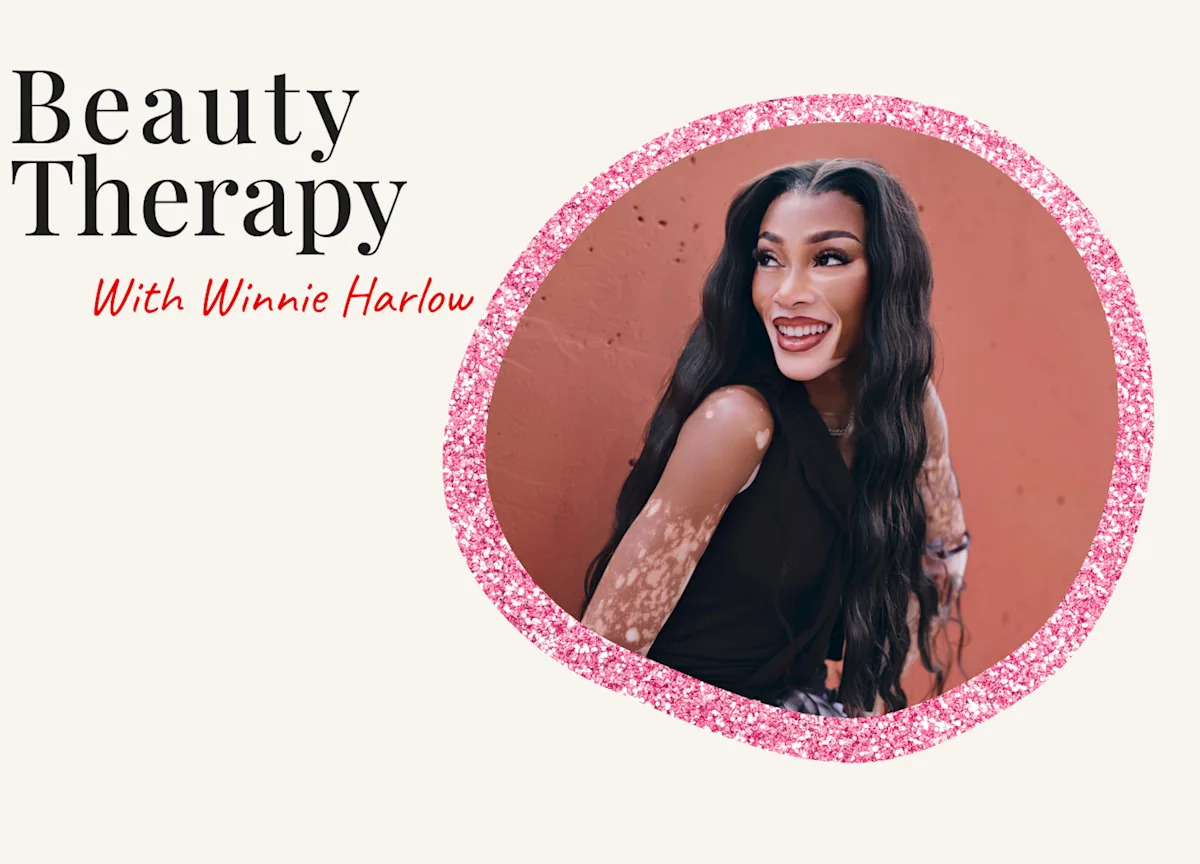
Long before she was a globally renowned supermodel redefining beauty, Winnie Harlow was a kid being bullied for the very thing that would one day make her iconic. Her vitiligo—the pigmentation condition that gives her skin its striking pattern—is now inseparable from her image; as a child, it set her apart in painful ways. The magazine covers (Vogue, Elle, Cosmopolitan—the list goes on) and major campaigns (Marc Jacobs, Fendi, and Victoria’s Secret, to name a few) tell one version of her story. What they don’t show is how confidence became a daily practice—a choice she learned to make long before the industry caught up.
“Growing up, I never saw people who looked like me,” Harlow tells me over Zoom. “There also wasn’t much information. I really wanted to learn more about vitiligo, but I couldn’t, because the research just wasn’t there.”
The cost of that invisibility is more than skin-deep. For many people living with vitiligo, being visibly different can quietly shape self-esteem, social comfort, and mental health—an emotional weight that often goes unacknowledged. Research suggests anxiety and depression are common among those with the condition, underscoring how closely appearance and well-being are intertwined.
For Harlow, that emotional gap is precisely what makes her current work feel so personal. After years of advocating for representation for people with visible skin conditions, she recently partnered with Incyte to help people with vitiligo “feel seen, supported, and empowered to explore options that are right for them.”
“I was really excited about this partnership,” she says. “Now that there’s so much more information about vitiligo, I wanted to make sure it was readily accessible to anyone looking for it. For so long, I didn’t have that representation—so to be that, and to bring awareness to resources like ThisIsVitiligo.com, feels full circle.”
Confidence isn’t a finish line
Though it may seem inevitable in hindsight, Harlow didn’t set out to become a champion for change. “I wasn’t thinking, ‘This is powerful,’” she says. “I was just being myself. I did really want to break open that space of inclusivity and representation.”
That authenticity—paired with confidence—ultimately propelled her from model to role model. But for Harlow, confidence has never been a finish line. It’s a practice.
“People think confidence is something you arrive at,” she says. “But it’s not really a becoming—it’s a choice you make every day.”
Even now, that choice isn’t automatic. “I may have been confident from the beginning, but I’m not confident every day,” she admits. “You’re not going to feel super cute all the time—but you can still choose to stand tall.”
When she needs an extra boost, she turns to ritual. “I love getting my hair done,” she says. “When your hair is done, you can serve bare face and it’s going to eat every time.” Raised by a hairdresser, she learned early on how deeply beauty rituals can affect self-perception. “You see it happen in real time,” she adds. “Someone’s whole demeanor starts to change.”
That same philosophy guides her approach to beauty more broadly: she gravitates toward what makes her feel good, not what’s trending. “You have to focus on what makes you feel beautiful or confident—not what a beauty standard says,” she says. “Trends come and go, but you need to stick to what suits you.”
For her, that often looks like simplicity: a long, hot shower (“Washing off the day is just so renewing—it cleanses the soul”) followed by a rich, hydrating body butter from head to toe; and *always* taking off her makeup before bed.
Beauty as care, not performance
Today, Harlow’s definition of beauty has less to do with how she looks and more to do with how she feels. “Feeling beautiful to me is being healthy,” she says. “I feel my best when I’m up on my vitamins, taking care of my health, drinking enough water. That all shines through — even in your skin, your hair, your nails.”
That holistic approach extends beyond her own routine. As someone who once grew up without representation or resources, she’s acutely aware of what visibility can mean to the next generation. “It feels so full circle that little kids who look like me are able to see someone that looks like them,” she says.
And while she’s clear that there’s still work to be done, she doesn’t discount the progress that’s already happened. “I’m really proud of where we’ve gotten to,” she adds. “There will always be room for growth, but we don’t always allow ourselves to reflect on the changes that have been made. I’m proud to see those changes.”
For Harlow, confidence, care, and representation aren’t destinations—they’re practices. And that, more than any campaign or cover, may be her most enduring impact.