(SOUNDBITE OF MUSIC)
MARIELLE SEGARRA, HOST:
You’re listening to LIFE KIT…
(SOUNDBITE OF MUSIC)
SEGARRA: …From NPR.
Hey. It’s Marielle. The federal government updates its dietary guidelines every five years. And I don’t know if you heard, but we got a new food pyramid. And guess what. It says that you can eat as much steak and cheese as you want. Just kidding. Not actually – but sort of. The guidelines are confusing that way.
ALLISON AUBREY, BYLINE: You know, on one hand, you’ve got the secretary, who has, like, a personal philosophy of eating. On the other hand, you have the science. And in this document and in the release of the new guidelines with this pyramid, you see kind of the clashes, the mashups.
SEGARRA: This is Allison Aubrey, a longtime health correspondent at NPR. When she says the secretary, she’s talking about the U.S. Secretary of Health and Human Services, Robert F. Kennedy Jr. On this episode of LIFE KIT, I talk to Allison about the new food pyramid, the written guidelines, and what they both say about red meat, saturated fat, highly processed carbs, and alcohol. Allison has interviewed lots of nutrition experts on this topic, so she will also tell us what they say.
By the way, when we talk about these guidelines, I want to acknowledge they may not be the first place your average American is going to go when deciding what to eat, but they are important.
AUBREY: The dietary guidelines provide kind of a scientific foundation for federal nutrition programs. So they’re guiding standards for school lunch, for programs like WIC and SNAP, for military meals. Basically, they dictate the types and the composition of foods served in these government feeding programs. And they also influence industry decisions.
SEGARRA: For instance, they’re used to develop labeling on food, to tell companies when they can use words like healthy on their products. We’ll have more on those dietary guidelines after the break.
(SOUNDBITE OF MUSIC)
SEGARRA: All right, so we’ve got these new dietary guidelines from the federal government. What are the big changes here?
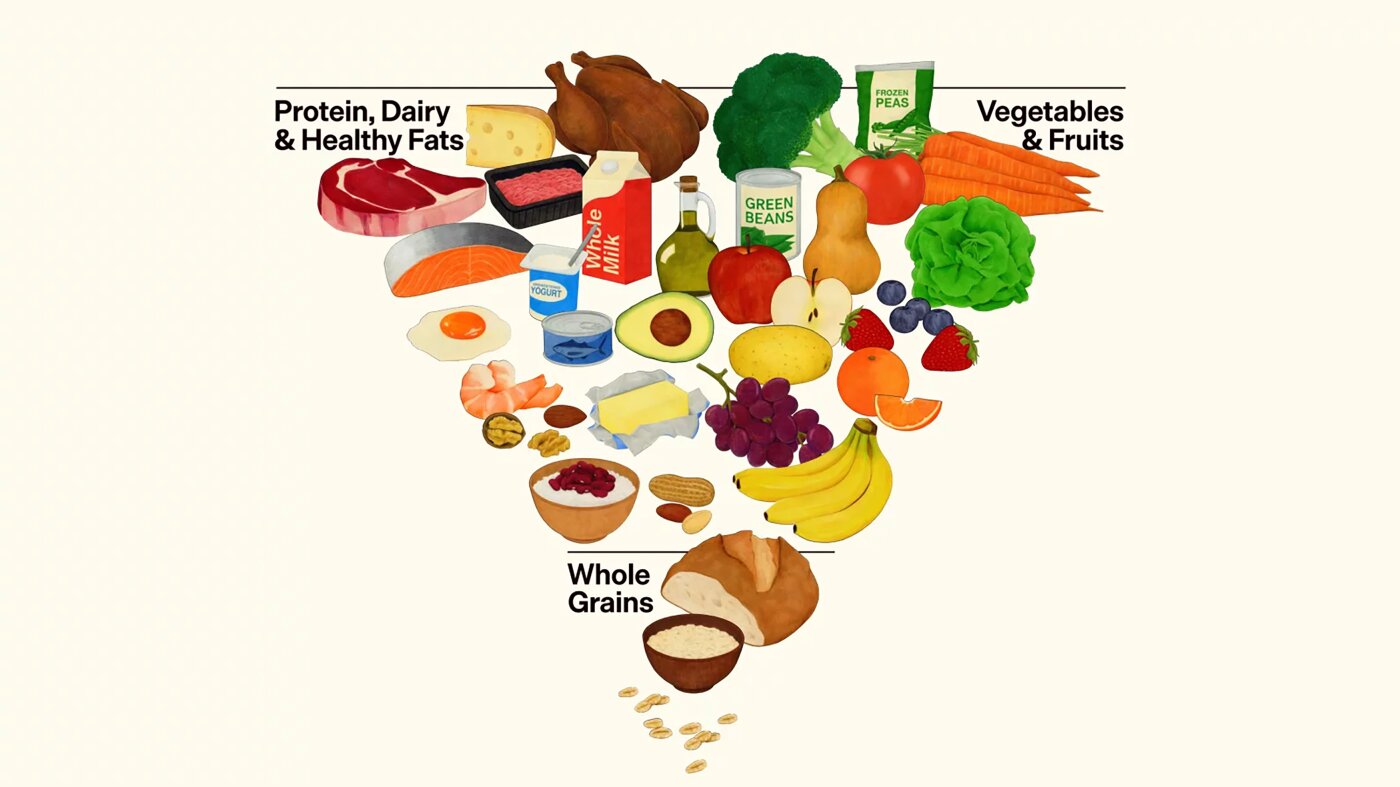
AUBREY: I would say the big changes you’ll see if you look right to the top of that new food pyramid at the top, you see a cut of steak, a big – like, a whole chicken or turkey, and a wedge of cheese. This is really emphasizing protein and full-fat dairy. This wasn’t a big surprise. RFK Jr. has touted his eating habits as sort of a, quote, “carnivore diet.” He loves to talk about beef tallow. Here he is at the unveiling at the White House.
(SOUNDBITE OF ARCHIVED RECORDING)
ROBERT F KENNEDY JR: Protein and healthy fats are essential and were wrongly discouraged in prior dietary guidelines. We are ending the war on saturated fats.
AUBREY: So RFK Jr. has made his disdain for prior dietary guidelines very clear. And what’s notable and a bit confusing is that despite this emphasis of meat and cheese and him touting his own personal philosophy here of, you know, ending the war on saturated fat, the actual guidelines, if you look at the details, actually maintain a long-standing recommendation to limit saturated fat – that’s the type of fat found in animal products – to no more than 10% of your daily calories.
SEGARRA: OK, so, like, a steak, for instance, is at the top of the food pyramid – the new one.
AUBREY: Yes.
SEGARRA: But in the guidelines, the recommendation stays the same as it’s been.
AUBREY: That’s exactly right.
SEGARRA: OK, that is confusing.
AUBREY: Yes, I agree.
SEGARRA: Can you explain a little bit more here about saturated fat? How is that different from unsaturated fat?
AUBREY: Sure. Well, saturated fat is a type of dietary fat that is found in animal products and in some plant-based fats, such as palm oil. It’s often solid at room temperature. Think of butter. Cheese and red meat have high amounts. In contrast, fats such as olive oil are high in unsaturated fats. Now, of course, our bodies need fats for energy, but too much saturated fat can raise LDL cholesterol. That’s bad cholesterol, and that can build up in our blood vessels. This doesn’t happen to everyone. Some people are more at risk than others. But high LDL cholesterol can increase the risk of heart attacks and strokes.
SEGARRA: And is it possible to eat animal products and not get a big serving of saturated fat?
AUBREY: Well, yes. Not all cuts of meat, not all animal products have the same amounts of saturated fat. So, for instance, you can choose, you know, lean turkey over ground beef. That will cut saturated fat. You can choose chicken breast over fatty cuts of meat. That will cut saturated fat.
SEGARRA: Takeaway one – saturated fats are a type of fat that we get through our diet, and they can raise your LDL cholesterol and increase your risk of having a heart attack or a stroke. You’ll find these in high levels in things like butter and cheese and red meat, but you’ll also find them in some plant-based foods, like palm oil. And palm oil, by the way, can be an ingredient in a lot of the ultra-processed foods you might buy.
So it sounds like there’s a disconnect between RFK Jr.’s rhetoric and this image of the upside-down food pyramid and what the guidelines actually advise Americans to eat.
AUBREY: Yes, there is definitely a disconnect. Now, you know, both the American Heart Association and the Academy of Nutrition and Dietetics, which includes thousands of nutrition professionals, have long pointed to the evidence that excess saturated fat is linked to heart disease. And this science goes back to, you know, the 1950s or ’60s. That’s when studies began to emerge that people who ate a lot of red meat tended to get this rise in cholesterol. Here’s the Academy’s Alison Steiber.
ALISON STEIBER: In medicine and certainly in nutrition, it is our responsibility to follow where the preponderance of evidence lies. And that for saturated fat means a reduction in saturated fat.
AUBREY: So really, despite RFK Jr.’s talk of, quote, “ending the war on saturated fat,” the administration seems to have heard loud and clear from many nutrition experts that the limits on saturated fat should remain in place. In fact, that was the recommendation of the Dietary Guidelines Advisory Committee, which had reviewed all the evidence, and, indeed, the administration left them in place.
SEGARRA: So just to confirm, the new guidelines do not actually change the recommended limits on saturated fat at all.
AUBREY: That’s exactly right, which is confusing. I get it. So what we’re really dealing with here is sort of, like, this muddling of ideology and science. I mean, that’s how former FDA official Susan Mayne put it. You know, on one hand, you’ve got the secretary, who has, like, a personal philosophy of eating. On the other hand, you have the science. And in this document and in the release of the new guidelines with this pyramid, you see kind of the clashes, the mashups.
(SOUNDBITE OF MUSIC)
SEGARRA: Takeaway two – the new dietary guidelines flip the old food pyramid and they put red meat and cheese at the top, implying that you should eat more of those, even though they’re packed with saturated fat. But the written guidelines don’t actually change the recommendations for how much saturated fat people should eat every day. The suggested limit is 20 grams of saturated fat for folks who eat a 2,000-calorie-a-day diet. Another way of putting this is 10% of your daily calories. The dietary guidelines emphasize protein, but there are ways to get enough protein without eating red meat all the time or even without eating animal products at all.
AUBREY: There are lots of plant-based proteins, everything from beans and legumes such as lentils, nuts and seeds. And I’ll point out that the committee of experts that reviewed all the evidence leading up to the new guidelines, they really emphasize the importance of plant proteins. I spoke to Christopher Gardner at Stanford University. He served on the committee. They spent about two years on this process reviewing all the evidence.
CHRISTOPHER GARDNER: I’m very disappointed in the new pyramid that features red meat and saturated fat sources at the very top as if that’s something to prioritize. It does go against decades and decades of evidence and research.
AUBREY: And he pointed out to me that if your diet is heavy on these foods featured at the top of the pyramid – the meats and the cheeses – it’s going to be hard to stay within the recommended limits on saturated fat.
(SOUNDBITE OF MUSIC)
SEGARRA: We’ll dig deeper into the new dietary guidelines when LIFE KIT returns.
OK, well, something RFK Jr. has spoken about and something we’ve also talked about on the show is the health risks of eating ultra-processed food. So what do the new guidelines say on that?
AUBREY: The new guidelines are very clear on this matter. They state, quote, “significantly reduce” your “consumption of highly processed, refined carbohydrates.” Now, they don’t use the term ultra-processed food, and that’s simply because there is not an agreed upon definition of what this is. But what they’re talking about here is, you know, white breads, sweet treats, junky snacks, ready-to-eat or packaged options, things that you’re getting out of bags and boxes that are full of highly refined carbohydrates. And on this recommendation, RFK Jr. and the administration have a lot of support among nutrition experts. I spoke to Dariush Mozaffarian. He’s a cardiologist. He directs the Food is Medicine Institute at Tufts University.
DARIUSH MOZAFFARIAN: To have the U.S. government recommend that a wide class of foods be eaten less because of their processing is a big deal and I think a very positive move for public health.
AUBREY: The challenge is that these processed foods make up about 70% of our food supplies. So, you know, these are the inexpensive, shelf-stable foods. So this is really easier said than done to move the whole country to a way of eating that emphasizes whole foods. This is going to require a big shift.
SEGARRA: What do the guidelines say about alcohol?
AUBREY: The guidelines say that some people should completely avoid drinking alcohol. This includes pregnant women, of course, people recovering from alcohol use disorder, and those who are unable to control the amount they drink. But for everybody else, the guidelines actually remove specific daily limits. Now, let me take you back. Previously, the recommendations explicitly stated up to one drink a day for women, up to two for men. Now they simply state, consume less alcohol for better health. Literally, that’s the recommendation. Consume less alcohol for better health, without specifying any amounts.
SEGARRA: The thing is, consume less seems vague to me. It could be interpreted in lots of ways. It really depends how much you consume right now. But if you’re drinking a lot right now and you just drink a little less, that’s probably still not healthy, right? I mean, I think the experts say that there’s no safe amount of alcohol to drink.
AUBREY: Yeah, and really a step back from the more evidence-based recommendations. I think some public health groups are really critical, pointing out that there’s no, quote-unquote, “safe level” of alcohol vis-a-vis cancer risks. And the American Institute for Cancer Research generally says it’s best not to drink alcohol for cancer prevention, citing some pretty strong evidence that, you know, even moderate drinking could increase risks for cancers like breast cancer.
(SOUNDBITE OF MUSIC)
SEGARRA: Takeaway three – the guidelines also recommend that Americans eat way fewer highly processed, refined carbohydrates, something that has a lot of support from nutrition experts. And when it comes to alcohol, the guidelines say that in general, folks should drink less. It’s a vague recommendation considering that experts say no alcohol consumption is technically safe because it does things like increase your risk of cancer.
Allison, it occurs to me that nutrition advice should not be changing with the political winds. So I wonder, what is the foundational advice that you’d say remains the same when it comes to nutrition, as someone who’s covered this for a long time?
AUBREY: Yeah, I would say the science does evolve slowly, and there are some changes. But big picture, if you kind of strip away all of the spin, what Americans are really left with is a recommendation for a pattern of eating that emphasizes real, whole foods. You know, I started counting up my servings of fruits and vegetables last week. Keep in mind we’re now told to consume three servings of vegetables and two servings of fruit each day. And when you start focusing on, you know, consuming whole foods and consuming more fruits and vegetables, by default, that helps displace the processed foods, the refined carbohydrates, the added sugars that we’re being told explicitly to eat less of. So I would say that, you know, the focus really is on nutrient-dense and minimally processed foods with plenty of fruits and vegetables, nuts, seeds, whole grains, healthy fats, and protein.
SEGARRA: OK, and what does it mean to eat nutrient-dense foods?
AUBREY: Well, you know, Marielle, it really goes along with the advice to eat the rainbow. And why? Why are we supposed to eat such colorful food? Why are blueberries so good for us? Well, in that pigment, there are phytonutrients, compounds like carotenoids and flavonoids and anthocyanins. Those are all big words for compounds that actually really can protect us.
I remember the very first time that this made sense to me. I was on a reporting assignment at UC Davis. I was visiting a scientist who was leading a study to evaluate the levels of antioxidants and other compounds in tomatoes. And we were squatted down in this field, and he was showing me this tomato, and he described how it was packed with these compounds, like flavonoids and antioxidants. And I kind of looked at him like, what’s going on here? And I recall what he said to me. He said, look; the more a plant has to struggle to defend itself from the sun, from the rain, you know, from extreme temperatures, the more it develops these kind of defensive compounds, which in turn can help protect us, too. These are the things that can help stave off chronic disease and keep us healthy, which is why we’re told to eat daily servings of fruits and vegetables.
SEGARRA: Isn’t that beautiful?
AUBREY: I thought so. I mean, it really struck me. So my advice is this. Skip DoorDash. It’s really becoming this cultural norm now that, you know, every time we get hungry we just push a few buttons on an app. But to eat well, my advice is to go to the grocery or the farm market and spend time cooking in your kitchen. This is likely the best strategy to start eating whole, nutrient-dense foods. You don’t order that from Starbucks or anywhere else.
SEGARRA: Allison, thank you so much.
AUBREY: You’re welcome.
(SOUNDBITE OF MUSIC)
SEGARRA: OK, time for a recap. Saturated fats come from our diet, and they can raise our LDL cholesterol and increase our risk of having a heart attack or a stroke. You’ll find high levels of these in things like butter and cheese and red meat. But you also will find them in some plant-based foods, like palm oil.
Takeaway two – the new dietary guidelines put red meat and cheese at the top of the food pyramid, implying that you should eat more of those, even though they are packed with saturated fat. But the written guidelines don’t actually change the recommendations. The suggested limit for how much saturated fat you should eat every day is 20 grams for folks who eat a 2,000-calorie-a-day diet. The dietary guidelines also emphasize protein, but remember there are ways to get enough protein without eating red meat or even animal products.
Takeaway three – the guidelines also recommend that Americans eat way fewer highly processed, refined carbohydrates, and they say that in general, we should drink less alcohol. Experts say no alcohol consumption is technically safe, in part because it can increase your risk of cancer. The consensus from nutrition experts is this. Eat lots of vegetables and fruits, whole grains, nuts and beans, lean sources of animal protein like fish and chicken and lean turkey. Don’t eat a lot of refined carbohydrates, added sugar, or fatty animal products.
That’s our show. For more LIFE KIT, check out our other episodes. We have one on meal prep and another on how to travel solo. Also, we love hearing from you. So if you have episode ideas or feedback you want to share, email us at lifekit@npr.org.
This episode of LIFE KIT was produced by Clare Marie Schneider. Our visuals editor is Beck Harlan, and our digital editor is Malaka Gharib. Meghan Keane is our senior supervising editor, and Beth Donovan is our executive producer. Our production team also includes Andee Tagle, Margaret Cirino, Sylvie Douglis and Mika Ellison. Engineering support comes from Zoe vanGinhoven (ph). Fact-checking by Tyler Jones. I’m Marielle Segarra. Thanks for listening.
(SOUNDBITE OF MUSIC)
Copyright © 2026 NPR. All rights reserved. Visit our website terms of use and permissions pages at www.npr.org for further information.
Accuracy and availability of NPR transcripts may vary. Transcript text may be revised to correct errors or match updates to audio. Audio on npr.org may be edited after its original broadcast or publication. The authoritative record of NPR’s programming is the audio record.