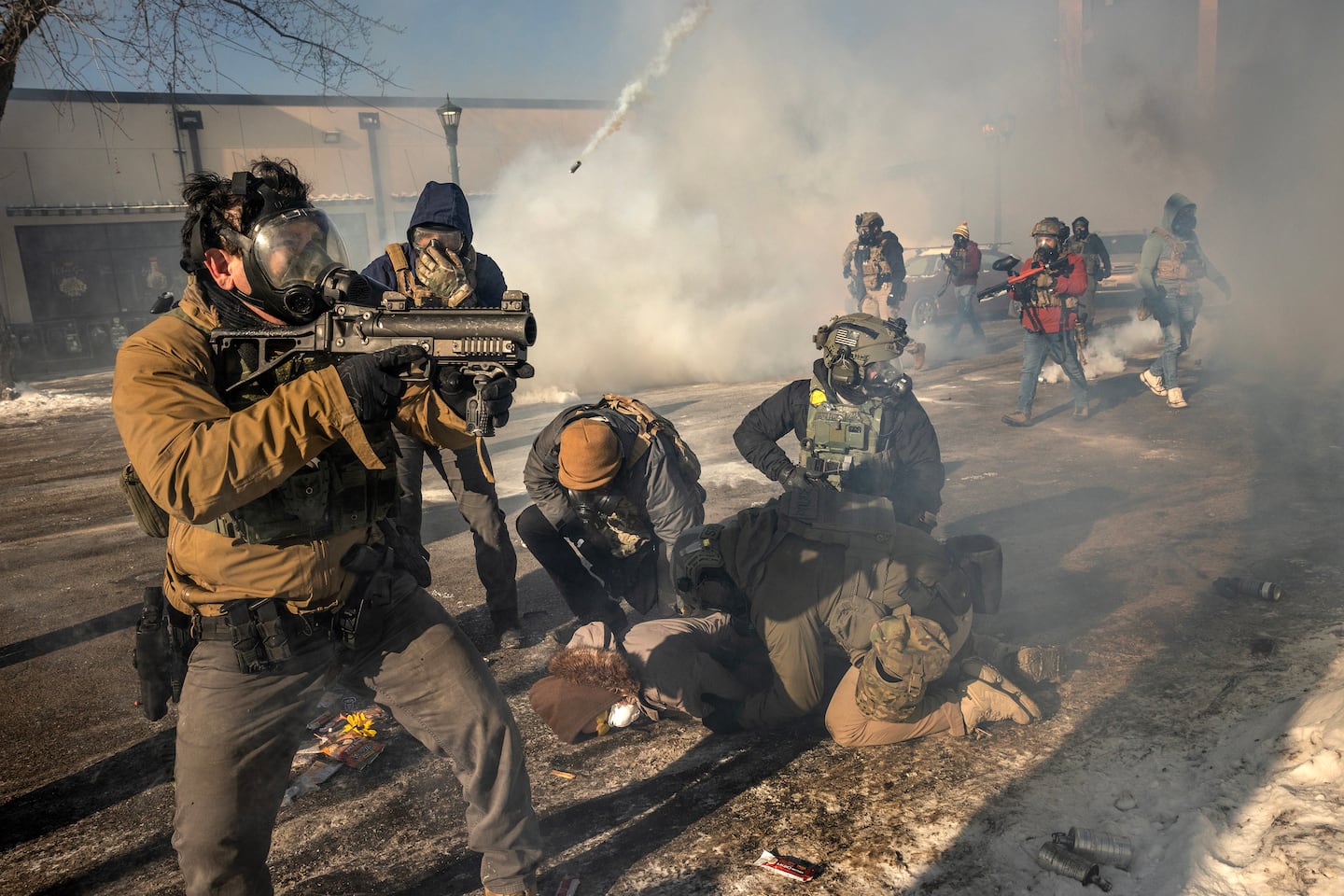
Just days after Renee Good was shot and killed by an ICE agent in Minneapolis on Jan. 7, the Department of Homeland Security posted a disturbing message from White House deputy chief of staff Stephen Miller on social media.
“To all ICE officers: You have federal immunity in the conduct of your duties,” the X post begins, quoting Miller’s statement on Fox News.
It’s easy to dismiss such a dangerous statement as untrue. Nothing in the Constitution nor federal law gives preemptive absolution to federal law enforcement officials for actions they take in the line of duty. Such absolute immunity would amount to a license to kill, and the fact that Alex Pretti was gunned down by Customs and Border Protection agents just days after Miller’s statement, and that the two agents who fired their weapons in that incident have still not been identified by the department, only punctuates that point.
But is Stephen Miller wrong? In reality, sadly, I don’t think he is.
The Department of Justice has refused to investigate Pretti’s or Good’s shootings, let alone bring criminal charges against the agents involved. And a recent Supreme Court ruling all but closes the door to any other form of accountability.
In its 2022 decision in Egbert v. Boule, the justices implemented a new rule that makes it nearly impossible to bring claims against federal officials, even when they overstep constitutional limits.
Previously, people could bring what are known as Bivens claims against the federal agents. This could happen if, for example, an agent conducts a warrantless search or seizure that damages property or uses excessive or deadly force absent a threat of serious harm to the agent, both of which violate the Fourth Amendment. It also applies when an agent harms or kills someone for exercising their First Amendment rights to free speech or assembly.
But in Egbert, the court foreclosed Bivens claims in circumstances that involve “national security concerns,” such as incidents involving federal immigration agents.
The effect of that decision has been devastating. As NBC News’s Lawrence Hurley reported a year after the decision, “lawsuits alleging a wide range of constitutional violations are now routinely tossed out.”
“People mistreated by federal officials aren’t getting their day in court, instead being denied the chance to find out if a jury would agree that their constitutional rights were violated,” Hurley wrote.
Here’s the kicker. “The court has also made it harder to sue government officials by continually strengthening the legal defense known as qualified immunity — a point that drew the direct ire of protesters during the rise of the Black Lives Matter movement in 2020 in the wake of the police killing of George Floyd,” Hurley wrote.
As a result, it will be difficult if not impossible for the families of Good and Pretti to seek redress for the clear violations of their constitutional rights that were captured in the videos taken by those on the scenes.
Some states are trying to fight back against this unjust legal scheme. Lawmakers in California, New York, Virginia, Maryland, and Connecticut are pressing legislation that would allow claims against federal agents for civil rights violations to be brought in state courts. Illinois became the first state to pass such a measure last month, allowing those who are arrested in or near courthouses or in violation of their constitutional rights to sue in state court.
Such laws, if passed, will all but surely be challenged in federal court and could ultimately land before the Supreme Court.
But for the families of Good and Pretti, finding accountability through the courts will be difficult if not impossible. And the Supreme Court is a big reason why.
This is an excerpt from The Gavel, a newsletter about the Supreme Court from columnist Kimberly Atkins Stohr. Sign up to get The Gavel in your inbox every Wednesday evening.
Kimberly Atkins Stohr is a columnist for the Globe. She may be reached at kimberly.atkinsstohr@globe.com.