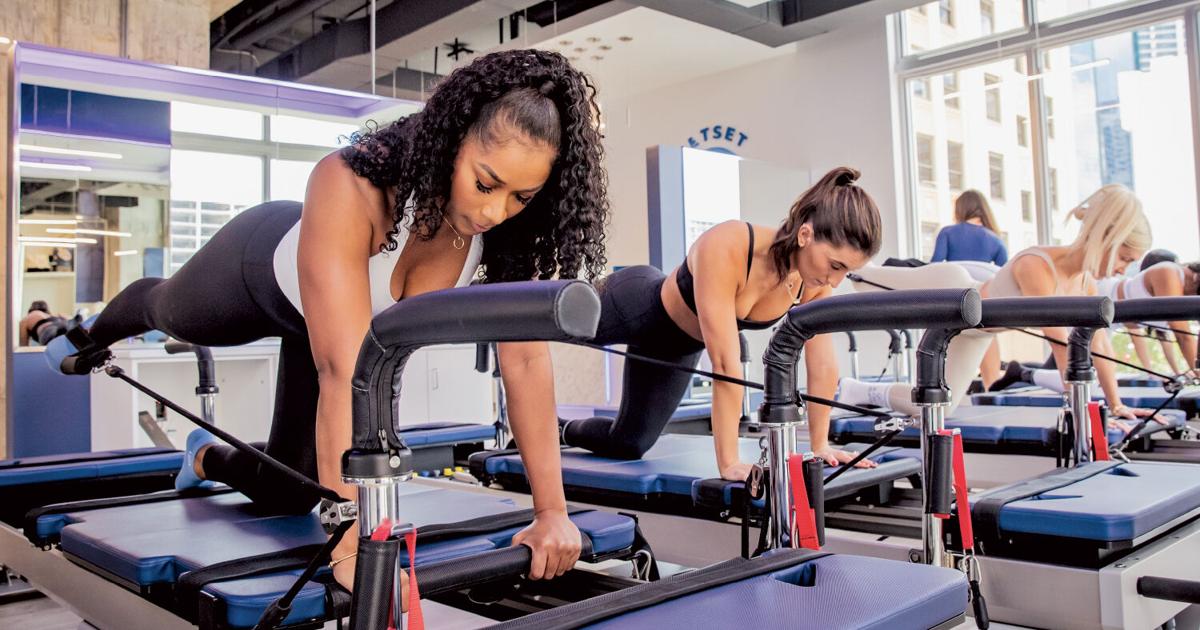

Miami-based Jetset Pilates has more than 40 locations after adding about 25 new studios in 2025.
Group training and modalities such as Pilates and yoga are powering franchises angling for a share of a fitness market that keeps getting bigger. As Discover Strength’s CEO puts it: “You’re either in the high-volume, low-price-point gym space or you’re operating a boutique model. There really is no in between.”
When Stacy Dykman was studying exercise science in college, she said a lot of people questioned her career plans.
Those people included members of her own family.
“I remember my great uncle, who was in his 80s at the time, kind of laughed at me. He looked at me strange and was like, you really think you’re going to be able make a career out of this?” she said. “I told everyone who couldn’t understand what I was doing to just wait. More and more people are going to start exercising and taking their health more seriously, and they will be looking for people like me to help them achieve goals.”
Twenty-five years after graduating with dual exercise science degrees, Dykman is having the last laugh. She’s a multi-unit Fitness Together franchisee with three locations in the Washington, D.C. area, including one of the brand’s most profitable studios. The first Fitness Together she opened in upscale Georgetown in 2012 grossed nearly $1.9 million in sales last year, more than triple the systemwide average for studios open more than a year.
Fitness Together, owned by WellBiz Brands, finished 2025 with about 90 studios.
Fitness Together franchisee Stacy Dykman operates one of the brand’s most profitable studios.
Like a lot of other franchisees who operate boutique gyms, Dykman is reaping the rewards of a doing business in a growing niche of the fitness space by servicing those who seek personalized strength and cardio workouts and tailored training programs in cozy studios. Those studios are in contrast to the big-box chains such as Planet Fitness and Crunch Fitness, which operate gyms filled with rows of cardio machines and strength equipment.
Of note, CR Fitness Holdings, a large Crunch franchisee, is putting a reformer Pilates studio in its new 40,000-square-foot gym in McKinney, Texas, signaling that brand’s emphasis on mixing in group fitness offerings.
The boutique fitness market, with franchises that offer yoga, Pilates, barre, kickboxing, cycling and dance classes, is a booming business despite typically charging higher membership costs. The segment is valued at more than $5.4 billion globally with projections to reach $13 billion by 2032, according to global market research firm Metastat Insight.
“To be successful in the health and fitness space now, you’ve got to be one of two extremes. You’re either in the high-volume, low-price-point gym space or you’re operating a boutique model. There really is no in between and those who try to appeal to everyone often lose. In this industry and in this market we have now, it’s really all about differentiating yourself and staying true to your mission,” said Luke Carlson. He is the founder and CEO of Discover Strength, an emerging fitness franchise based in St. Louis Park, Minnesota, with 35 studios in more than 10 states.
Power of strength training
Discover Strength is one of the many small gym concepts that are riding the health and fitness wave. The boutique gym market is valued at $5.4 billion globally, with projections to reach nearly $13 billion by 2032.
As vice chairman for the Health & Fitness Association, Carlson has access to a lot of the data on the ever-shifting industry trends. He said in the last five years, or since the pandemic, strength training has replaced cardio workouts as the most popular workout.
“Gym memberships are up throughout the industry, but we’re seeing more and more people taking up strength training as more medical evidence comes out about the long-term benefits of building muscles and increasing mobility,” Carlson said. “We feel very fortunate to have been a leader in this space since 2006 when we first started and really being ahead of the game in many regards.”
Discover Strength, which began franchising in 2020, is not for everyone, acknowledged Carlson. He said clients tend to be affluent, high-powered company executives and entrepreneurs, typically about 50 years old who are making between $600,000 to $800,000 a year. He said they pay between $38 and $68 per small group session and up to $80 for an individual session.
Luke Carlson is the founder and CEO of Discover Strength.
What they receive for their investment, said Carlson, is an intense, 30-minute personalized weight training workout twice a week from trainers in suits and ties.
“Our clients value their time more than anything, so we have come up with an incredibly efficient workout that gets results. And they tell us all the time how much they appreciate the professional dress code of our trainers and not having a guy in front of them in tight or sleeveless shirts with his biceps in their face or a female trainer in a tank top and showing off their bare belly,” Carlson said.
Discover Strength’s business strategy appears to be working. Its average unit volume is $939,000, and the top 25 percent of studios do $1.3 million in sales. Carlson said their best-performing studios are conducting between 400 and 500 workouts a week and their client base sways slightly toward females.
“Strength training is the most popular trend right now. But I don’t like to say trend, because trend means it’s going to it’s going to fall out of fashion. The reality is the interest in strength training has only increased every year since 1971 and will continue to increase the more people learn about it being a scientifically proven preventative medicine,” Carlson said.
Pilates franchises push growth
Thanks in large part to endorsements from celebrities such as Jennifer Anniston, Kate Hudson, Lady Gaga and Reese Witherspoon and from superstar athletes LeBron James and Cristiano Ronaldo, Pilates has seen the biggest workout uptick in popularity. According to the Sports and Fitness Industry Association, active participation in Pilates has grown nearly 40 percent over the last six years, from 9.2 million in 2019 to nearly 13 million in 2025.
Bodybar Pilates has 75 locations and is growing quickly as demand for its workouts increases.
For comparison, the second-fastest-growing studio exercise modality, yoga, increased by 23.6 percent, followed by kettlebells at 21.2 percent and barre at 19.1 percent. The modality that saw the biggest decrease? Cycling, which was down 33.5 percent over five years, according to the association.
Bodybar Pilates and Jetset Pilates have both reaped the rewards of the shift toward the low-impact, full-body workout system that focuses on core strength, flexibility, posture and body awareness through controlled movements that emphasize breath, precision and centering. Trainers often choreograph their classes with rhythmic, instrumental music.
Bodybar expanded from 48 locations in 17 states to 75 locations in 26 states over the last few years. Jetset ended 2025 with 44 studios in 10 states and 280 franchises sold, many of them in top-tier markets such as New York City, Boston, Denver and Salt Lake City. Jetset is also expanding its global reach with studios in Australia and a six-unit agreement signed in London.
“It’s crazy to think that we could potentially be at 200 units open in the next year. Things are moving real fast for us and that’s why we expanded our corporate staff from 18 to 34,” said Kamille McCollum, president, chief brand officer of Bodybar Pilates.
“We feel very fortunate in that we were one of the early innovators in the Pilates space when we opened our first studio in Miami in 2010. We’re growing fast and next year is going to be roller coaster openings for us,” Tamara Galinsky, the founder and brand president for Jetset, said in November.
Bodybar and Jetset both operate high-touch membership models, with Bodybar clients paying around $200 per month for 10 classes depending on the location and Jetset charging between $229 and $269 per month. They also both draw mainly women, with Bodybar seeing 97 percent female clients and Jetset at 82 percent female versus male clients.
Tamara Galinsky is the founder and brand president of Jetset Pilates.
Jetset members work out on customized Jetset reformers that feature unique elements such as platform eyelets and rope cabling for varied resistance, plus they incorporate light dumbbells and Pilates rings for a 50-minute full-body workout. Jetset’s core age demographic is 20- to 45-year-olds, while Bodybar sees a wider age range of participants, from 18 to 80.
“Our reformer machines are what really differentiates us from other Pilates studios,” Galinsky said. “We’ve customized and improved our reformers over the years so that we are working all the muscle groups. But the biggest differentiator for us and why our clients come to us is probably our brand and the culture we’ve created with our Miami workout vibe. The merchandise we sell, whether it be the clothes, travel bags, scented candles, makes up 4.5 percent of our studio sales. I’d like to see that increase to 10 percent.”
The differentiator for Bodybar? McCollum said it is the high-touch customer service. Each of their locations employs 10 to 15 trainers, a studio and a fitness manager and a sales associate. The company has also invested in a number of technology upgrades to make scheduling and tracking the health progress of clients easier. The brand is rolling out a targeted social media, print and TV and radio advertising campaign that aims to challenge the fitness stereotypes and position their studios as a “gym rebel,” said McCollum.
The largest Pilates franchise, Club Pilates, is likewise in the midst of more expansion in the U.S. and several global markets. Part of Xponential Fitness, Club Pilates has more than 1,200 locations.
Also offering low-impact workouts are barre concepts such as The Bar Method. It integrates elements of ballet, Pilates, yoga and traditional strength training to build muscle endurance, increase flexibility, and tone the body. With 80 studios in the U.S., Canada and Japan, Brand President Stephanie Schon said its clientele is 98 percent female, although it’s seeing an increase in male members, and class sizes average 24 to 28.
The Bar Method was acquired by Roark Capital-backed Purpose Brands, the parent company of Anytime Fitness, in 2019.