Action Against Hunger warns that in the top 10 countries experiencing acute food insecurity, 196 million people urgently need food. The convergence of global crises is also contributing to rising maternal malnutrition and 30 million malnourished children. Nutrition Insight speaks with the organization, which calls for nutrition companies to collaborate with NGOs and innovate essential food distribution methods, rather than increasing production.
Action Against Hunger underscores that conflicts are not just a humanitarian crisis. They can impact ingredient sourcing and logistics, affecting the entire nutrition industry during crises.
Action Against Hunger’s 2026 Global Hunger Hotspots report identifies people at acute food insecurity levels across 10 countries: Nigeria (31.9 million), Sudan (24.6 million), the Democratic Republic of Congo (25.6 million), Bangladesh (23.6 million), Ethiopia (22 million), Yemen (16.7 million), Afghanistan (16.7 million), Myanmar (14.4 million), Pakistan (11.8 million), and Syria (9.2 million).
Severe hunger conditions are also seen in Gaza, where 94% of the population is acutely food insecure. This figure is 56% in South Sudan and 56% in Haiti.
These estimates may be even higher in reality. A recent study on the Integrated Food Security Phase Classification system in Nature Food led by the University of Illinois, US, flags that global food insecurity analyses systematically underestimate hunger. While this tool is commonly used to assess malnutrition, the researchers found that one in five, who are in urgent need, could go uncounted.
In light of these realities, Action Against Hunger’s associate director of Research and Innovation, Heather Stobaugh, Ph.D., explains key ways nutrition players can get involved to help tackle global hunger, especially during times of armed conflict, extreme weather events, economic shocks, and structural inequalities.
When famine is caused by conflict rather than food shortages, what can the industry do?
Stobaugh: The nutrition industry can save lives but cannot solve the root cause. Humanitarian nutrition programs can prevent mass death by delivering life-saving treatments, such as ready-to-use therapeutic foods (RUTF), adapting distribution to insecure environments, and keeping vulnerable children and mothers alive when access to food is deliberately disrupted.
Conflict-driven hunger is rising across 10 hotspots, with nearly 200 million people facing acute food insecurity as access — not food supply — becomes the main constraint.However, these interventions only buy time and reduce suffering in the short term; more must be done to address the root causes beyond what the nutrition industry can do: end wars, reopen blocked borders, or reach political solutions.
In short, nutrition can stop hunger from becoming a death sentence — but it cannot stop conflict from causing hunger in the first place.
In Sudan and Gaza, where access and funding are the main constraints, how should companies engage when products exist but delivery does not?
Stobaugh: In crises like Sudan and Gaza, nutrition companies must shift from simply producing more food to helping ensure it can actually reach the populations in need. That means aligning production with real delivery windows, designing products that can survive extreme logistical conditions, and working with humanitarian agencies to open and sustain access corridors — without becoming political actors.
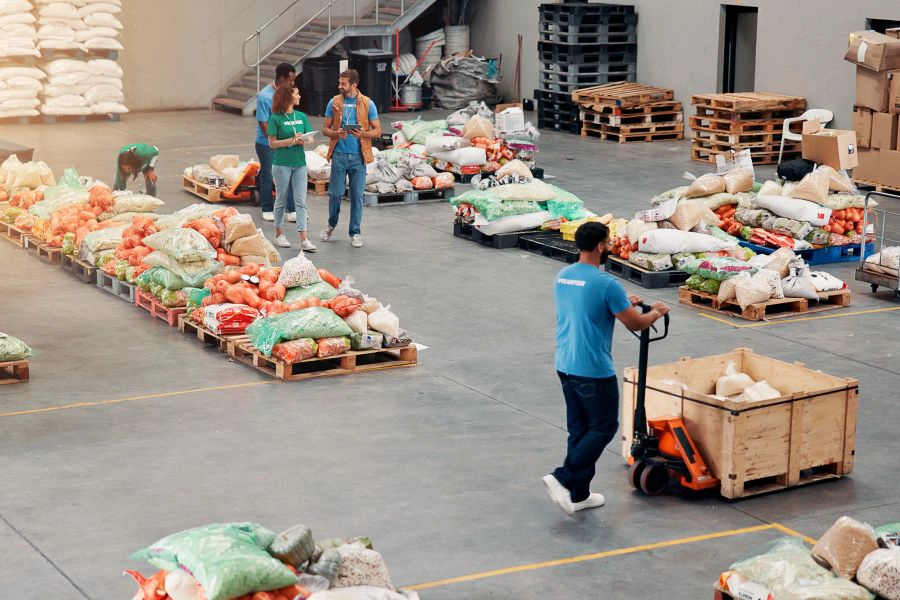
Their impact should be measured not by how much food they make, but by how much is safely consumed by people in need. For example, nutrition companies can collaborate with NGOs to support last-mile innovation through mobile distribution models, utilize digital tracking to reduce diversion, and shift to local or regional co-manufacturing.
What companies should not do is oversupply blocked pipelines, publicly politicize conflicts, which can jeopardize humanitarian operations, or assume production equals impact.
As humanitarian funding shrinks, what role can private-sector nutrition players fill without replacing public responsibility?
Stobaugh: Private nutrition companies can add the most value by making humanitarian aid work better — not by trying to replace governments or aid agencies. That means cutting costs through innovation, designing food that lasts longer and travels farther, strengthening delivery systems, and reducing waste and losses along the way.
 Action Against Hunger warns that wars are no longer just humanitarian crises but growing supply-chain risks for the global nutrition and ingredient industry.Done right, their role can help ensure that every dollar for nutrition reaches more people who need it. The right role for private nutrition actors is therefore not to replace shrinking public systems, but to strengthen them, acting as force multipliers rather than stand-ins.
If acute malnutrition is rising among women and children, why does therapeutic and fortified nutrition remain confined to emergency response rather than larger food systems?
Stobaugh: Therapeutic nutrition intervention (e.g., RUTF) remains confined to emergency response because it is designed as a life-saving medical intervention, not as a routine part of everyday food systems. It is a tightly regulated, relatively expensive, and targeted treatment for an extreme acute condition (severe acute malnutrition) rather than preventing malnutrition at the population scale.
As a result, it sits outside normal markets and public food programs, even as malnutrition rises. While it is an extremely effective approach to saving lives, it is unlikely to be cost-effective, sustainable, or scalable for improving the diets of large-scale populations. The growing challenge now is how to integrate nutrition more deliberately into mainstream food systems — so fewer women and children ever reach the point of needing emergency treatment in the first place.
By contrast, large-scale food fortification — such as adding iodine to salt and iron or folic acid to flour — is one of the most successful public health interventions, dramatically reducing conditions like goiter, anemia, and neural tube defects across entire populations. By quietly improving the nutritional quality of everyday foods, fortification has raised baseline diets and prevented malnutrition at a scale that emergency feeding programs could never reach alone.
The challenge still lies in access to these foods, and, mostly, fortified foods only address micronutrient deficiencies in locations where food markets are functioning well and stable. As such, these are not necessarily viable solutions to the short-term crises at hand.
With global hunger amid conflicts, how exposed are global nutrition and ingredient supply chains to instability?
Stobaugh: Global hunger is not necessarily concentrated in conflict-affected regions, though it can often be exacerbated in such contexts (e.g., Sudan and Gaza). Here, food production’s raw ingredient supply chains are very exposed to prolonged instability. Even for emergency response foods such as RUTF, specialized ingredients depend on a small number of corridors, ports, and politically fragile regions.
Conflict can disrupt everything from peanut and dairy sourcing to premix production and shipping routes, driving up costs, delaying deliveries, and shrinking access just when needs are rising.
In effect, wars are no longer only humanitarian crises — they are supply chain risks for the entire nutrition industry.