 Dr. Kimberly Haynie, associate professor of nutrition and food science, and Dr. Marilyn Bailey, interim chair for the Department of Human Sciences.
PINE BLUFF, Ark. — A two-day Food and Nutrition Entrepreneurship Camp hosted by the University of Arkansas at Pine Bluff gave Arkansas high school students hands-on exposure to careers in agriculture, food systems and entrepreneurship, according to Dr. Kimberly Haynie, associate professor of nutrition and food science.
The camp was hosted by UAPB’s School of Agriculture, Fisheries and Human Sciences (SAFHS) in partnership with the National Black Grower’s Council (NBGC) and supported by UAPB’s Office of Institutional Advancement. Students from Marvel and Pine Bluff, Ark., participated in immersive learning experiences that blended agricultural economics, nutrition, artificial intelligence technology and business development.
Day one focused on the economics of agriculture and its connection to health, technology and entrepreneurship. The program opened with welcome remarks and introductions from Dr. Bruce McGowan, interim provost and vice chancellor of academic affairs, and Dr. Marilyn Bailey, interim chair for the Department of Human Sciences.

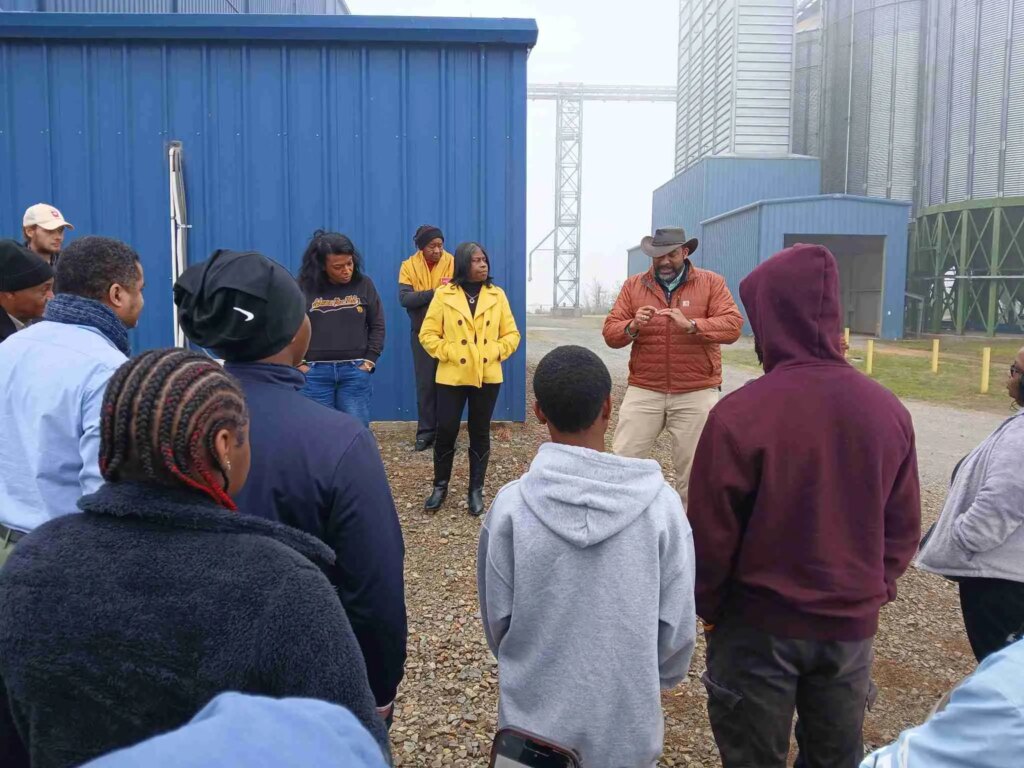
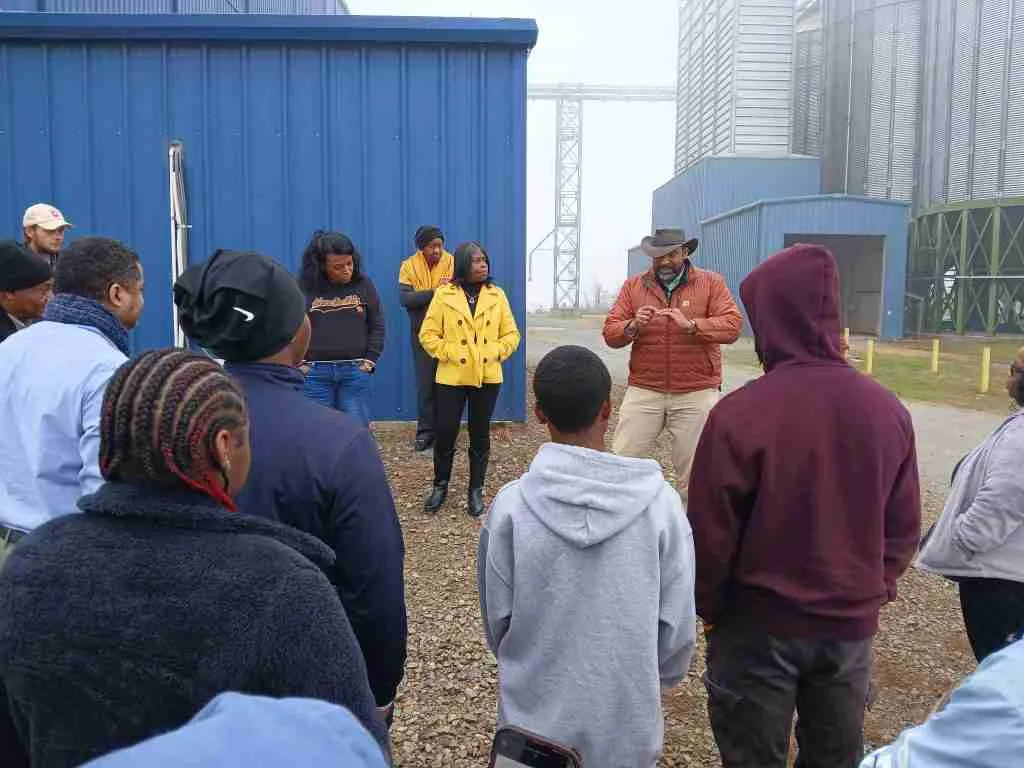 Philip “PJ” Haynie III tells students about how rice is processed and explains how a grain tank works.
Dr. Paul W. Hannam, a family medicine doctor in Pine Bluff, spoke with students about the importance of eating local, nutrient-dense foods and how food choices influence long-term health and wellness. His presentation highlighted the relationship between agriculture, nutrition and community well-being.

Students then visited Arkansas River Rice Mill, where co-owner Philip “PJ” Haynie III led a guided tour of the facility. He shared his path into agriculture and entrepreneurship, shaped by his family’s farming background, his education in agricultural economics at Virginia Tech and his leadership experiences, including serving as president of Minorities in Agriculture, Natural Resources and Related Sciences.
Following the rice mill visit, students got an up-close look at a UAPB John Deere combine and learned how artificial intelligence is integrated into modern agricultural equipment to improve efficiency, productivity and crop yields. Additional campus activities addressed career readiness and entrepreneurship through programming led by Teki Hunt, director of 4-H Youth Programs. Dr. Tomeka White, Extension specialist and outreach director, shared information about UAPB’s 1890 Scholars Program, and Dr. Grace Ramena, associate professor of fish pathology, guided students through a tour of the university’s fish pathology research lab.
“The first day concluded with an interactive agricultural economics activity co-facilitated by Philip Haynie and Elzadia Washington, associate director of the National Black Grower’s Council,” Dr. Haynie said. “The activity allowed students to experience how data, technology and economic decision-making shape modern agriculture.”
Day two shifted the focus to food systems and entrepreneurship in the hospitality industry. Students toured Magnolia Food Hall, where they met restaurant owners and learned about business operations, customer service and pathways to owning and operating food-based businesses.
“Dr. W. Jinnings Burruss Jr., assistant professor of food service and restaurant management, facilitated a hands-on cooking activity in which students prepared a healthy meal using professional restaurant equipment,” Dr. Haynie said. “The session reinforced lessons in nutrition, food safety and practical culinary skills while demonstrating how healthy foods can be prepared efficiently in commercial settings.”
The camp concluded with closing remarks from Dr. Andrea Stewart, special assistant to the chancellor, Lawrence Conyers, UAPB alum and National Black Grower’s Council board member, and Dr. Hazel Reed, former dean of UAPB-SAFHS. Speakers encouraged students to pursue education and careers in agriculture, food and nutrition while emphasizing leadership, innovation and entrepreneurship.
“The National Black Growers Council is excited to have partnered with the University of Arkansas at Pine Bluff to expose high school students to entrepreneurship through the lens of agriculture,” Dr. Dawn Mellion, executive director of the National Black Grower’s Council, said. “NBGC’s core values support teaching young men and women about the virtues of farming, the importance of agriculture and the commitment it takes to be successful in the global business of agriculture.”
This programming exemplifies the mission of UAPB, according to Jaimie D. Wright, corporate and foundations relations officer at UAPB.
“The university provides teaching, outreach and service programs that respond to the social and economic needs of the state,” she said. “In line with our mission, the Food and Nutrition Entrepreneurship Camp provided the next generation of agronomists, food systems innovators and entrepreneurs with exposure and training that will shape their future professional and academic careers.”
Pursuant to 7 CFR Section 15.3, the University of Arkansas at Pine Bluff and the School of Agriculture, Fisheries and Human Sciences, 1890 Research and Extension Programs, offers all its Extension and Research programs and services (including employment) without regard to race, color, sex, national origin, religion, age, disability, marital or veteran status, genetic information, sexual preference, pregnancy, or any other legally protected status, and is an equal opportunity institution.
About the University of Arkansas at Pine Bluff
The University of Arkansas at Pine Bluff (UAPB) is an 1890 Land-Grant HBCU with a diverse student population, competitive degree offerings and stellar faculty. For over 150 years, UAPB has worked to create an environment that emphasizes learning, growth and productivity while affording a basic need to its students: a chance to advance. UAPB offers certificate and associate degree programs, more than 50 undergraduate and master’s degree programs, and a doctoral program in Aquaculture/Fisheries. Students are active in more than 100 organizations, including an internationally renowned Vesper Choir, Marching Musical Machine of the Mid-South (M4) Band, Concert Bands, Wind Symphony and an accomplished athletics program.