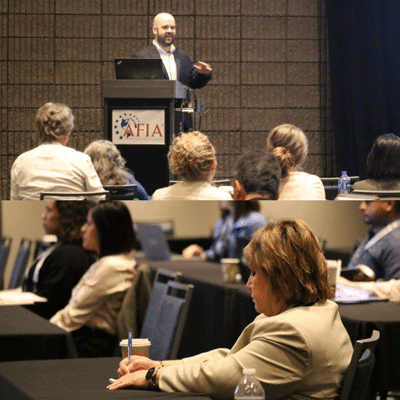
(Top) Jarred Oxford, Ph.D., shares insights on optimizing energy and amino acids to better align nutrition with performance goals at AFIA’s Nutrition Program.
(Bottom) Participants taking notes during AFIA’s Nutrition Program.
Image courtesy of IPPE.
The American Feed Industry Association (AFIA)
hosted a two-hour nutrition education program focused on new research
and evolving perspectives on long-established feed ingredients. Held
Wednesday, Jan. 28, in conjunction with the International Production
& Processing Expo (IPPE), AFIA’s “New Understanding About ‘Old’
Ingredients” session brought together academic and industry experts to
examine performance data, formulation practices and emerging insights
related to micro and macro ingredients used in animal nutrition.
“The
feed industry continues to refine its understanding of traditional
ingredients as new research becomes available,” said Yuan-Tai Hung,
Ph.D., IFEEDER’s senior manager of research. “This program demonstrated
how updated data and modern tools can help nutritionists make more
informed formulation decisions.”
Su A. Lee, Ph.D., research
scientist in the Department of Animal Sciences at the University of
Illinois Urbana-Champaign, discussed the impact of excess and variable
calcium levels in feed ingredients, emphasizing how variability can
affect nutrient utilization and animal performance.
Katelyn
Gaffield, assistant research professor in the Department of Animal
Sciences and Industry at Kansas State University, addressed commercial
formulation practices with protein ingredients, outlining key
considerations nutritionists face when balancing performance, cost and
ingredient consistency.
Jarred Oxford, Ph.D., a poultry
nutritionist at Cargill North America, presented on optimizing energy
and amino acids to support animal performance, sharing strategies to
better align nutrient supply with production goals.
Michael Kidd,
Ph.D., professor of poultry nutrition at the University of Arkansas,
concluded the technical program with a discussion of the industry’s past
and current understanding of protein ingredients for poultry, and how
historical knowledge continues to inform modern feeding strategies.
Attendees
were able to ask questions on the evolving role of traditional
ingredients in feed formulation following the final presentation. The
agenda has been approved for two American Registry of Professional
Animal Scientists continuing education units.
Read more from IPPE here.