It’s not everyday you can credit one of the world’s biggest pop stars for rekindling your memories of a place.
So, thank you, Harry Styles, for reminding us of the mesmerizing, confounding, iconic and the brashly weird wonders of the Bonaventure Hotel in downtown L.A.
Last week, the singer returned to pop music after a four-year respite with the surprise release of a new album. Along came the first music video for “Aperture,” a breezy electronic number that unfolds as a non-sequitur romp through a sleek hotel — beginning as an inexplicable chase, then breaks into a long, nifty dance sequence, and crescendos in a hat tip to Dirty Dancing.
Keep up with LAist.
If you’re enjoying this article, you’ll love our daily newsletter, The LA Report. Each weekday, catch up on the 5 most pressing stories to start your morning in 3 minutes or less.
The absurdity makes for a nice fit.
In the video, when Styles steps onto the escalator before realizing he is being followed, a distant recognition went off in my head.
The escalator at the Bonaventure.
The Bonaventure has no bad angles.
That hunch grew more certain when he and his pursuer tumbled down a spiral of staircases that’s almost Hitchcockian in its composition.
Spiraling staircase inside the Bonaventure.
The Bonaventure’s curved skylight.
And later, when the two somersault through a cocktail lounge with Los Angeles twinkling in the backdrop, the setting could only have been The BonaVista, the revolving restaurant (yes, it really spins) on the 34th floor of the Bonaventure.
Making a cameo
Styles is the latest among a long list of artists and moviemakers to make use of the location. In 1993’s In the Line of Fire, Clint Eastwood and John Malkovich had their big shoot-out finale there, and managed to squeeze in a little repartee inside one of its famous capsule elevators. More recently, Kendrick Lamar and SZA’s “Luther” and Maroon 5 and LISA’s “Priceless” prominently featured the hotel.
Bonaventure under construction in the mid-1970s.
(
Los Angeles Public Library Institutional Collection / LAPL
)
The Bonaventure in 1987.
(
James Ruebsamen
/
Los Angeles Herald Examiner Photo Collection / LAPL
)
Since it opened in January 1977, the behemoth — towering hundreds of feet over Figueroa Street with some 1,400 rooms and the reigning title as Los Angeles’s largest hotel — all but demanded the attention.
The Bonaventure was built between 1974 and 1976 in the midst of Bunker Hill’s redevelopment that started two decades back with land seizures through eminent domain and the evictions of thousands of low-income Angelenos.
The ambition was to remake the urban core into a world-class arts and cultural destination.
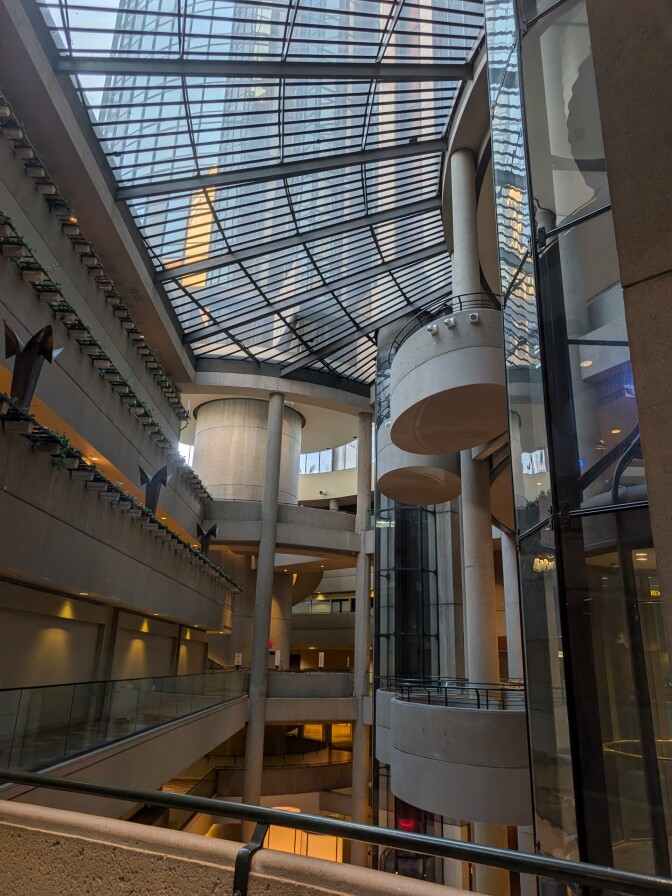
The atrium of the Bonaventure.
Architect and real estate developer John C. Portman brought his signature vaulting atrium to the task. For the Hyatt in his hometown of Atlanta, that feature was 22 stories high. For the Bonaventure, the atrium was seven.
Raw concrete of the Bonaventure.
Portman’s idea was to create a city within its walls, and populated his creation with shops, restaurants and other amenities so people simply wouldn’t have to leave.
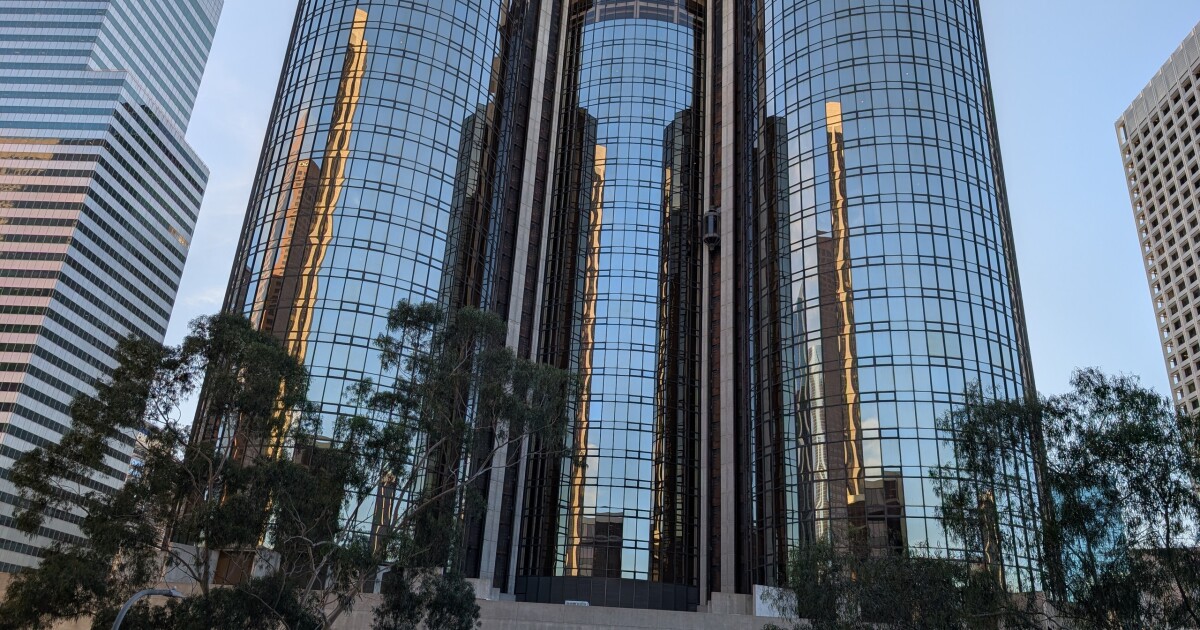
The Bonaventure’s interior has been described as Brutalist in style, a raw concrete maze of dangling lounges, shooting columns, swirling staircases, curved walkways, glass elevators and seemingly dead ends. Its mirrored and cylindrical exterior has been called postmodern and futuristic.
Bonaventure in 1977.
(
Tom LaBonge
/
Los Angeles Photographers Photo Collection / LAPL
)
The Bonaventure in 1989.
(
William Reagh
/
Los Angeles Photographers Photo Collection / LAPL
)
A returned visit
I have always thought of it looking a little dated, like a sad disco ball.
A few days ago, I went to the Bonaventure again for old times’ sake. I took this same walk several times a week for six years, when I worked downtown in the mid-aughts. Back then, this network of pedways was really our only way to get to any place for coffee or lunch.
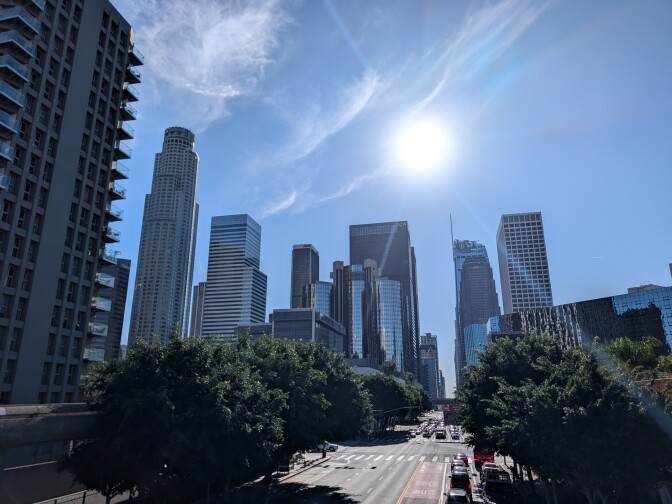
View of the Bonaventure taken from the 3rd and Fig. pedway.
The Bonaventure was one of our options, with its food court on the fourth floor. Sometimes, I spent my lunch simply walking its various floors, entranced by the vast, hushed space that felt somehow endless and somewhat abandoned. I have always thought it was the perfect setting for a chase scene.
On my latest visit, the lines and curves were clashing and crisscrossing in ways that I hadn’t before noticed. Cultural theorists have famously written about the disorientation the building is said to inspire — how easily you can feel lost.
And what a privilege it is.
Thanks, Harry, for the nudge to go and spend a couple leisurely hours getting lost in a quintessentially Los Angeles riddle.
Everyone should do it.