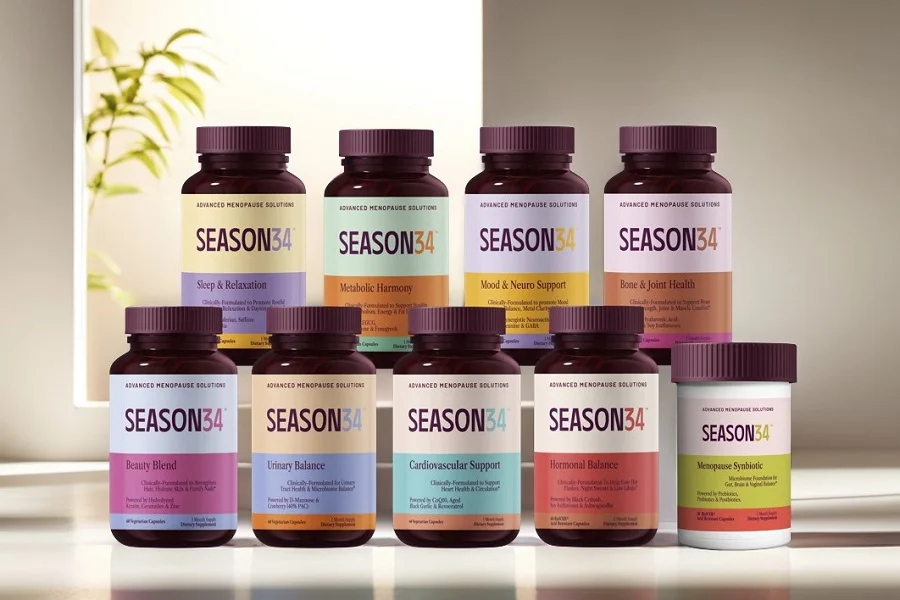
Evolving beyond a one-size-fits-all menopause supplement, Season34 has launched a “first-of-its-kind” personalized symptom-management system to support women across the 34 most common signs of perimenopause and menopause.
Women often experience 12 or more symptoms simultaneously, the brand highlights. However, each woman’s journey through perimenopause, menopause, and post-menopause is unique, and symptoms shift throughout the transition.
With nine patent-pending formulas, Season34’s hormone-free blends contain multiple targeted, high-potency actives, including 13 clinically studied, trademarked ingredients to address the unique physiological and microbiome changes during this new season of life.
For instance, Beauty Blend uses keraGEN-IV keratin and CeraLOK rice-derived ceramides to strengthen hair and skin, while Cardiovascular Support helps deliver heart energy using CoQ10.

Hormonal Balance helps to cool night sweats with Menofelis rhubarb, and the Menopause Synbiotic uses a three-in-one blend to tackle bloating. For mental clarity and rest, Mood & Neuro Support features KSM-66 ashwagandha, while Sleep & Relaxation blends saffron and black cohosh to support melatonin-free sleep.
Additionally, Metabolic Harmony replenishes energy with epigallocatechin-3-gallate (EGCG), thymoquinone, and fenugreek, while Urinary Balance uses high-PAC Exocyan cranberry to support bladder comfort.
Season34 was founded by a mother-daughter team. Co-founder Dr. Maria Stanbury is a gynecologist with more than three decades of experience in women’s long-term health.
Nutrition Insight speaks with her daughter, co-founder and CEO Irene Rojas Stanbury, who discusses changing the way women experience menopause by personalizing treatment based on where they are along their menopause journey, delivering precision, safety, and lasting results.
What gaps in menopause supplement formulations did you identify that led to developing a multi-formula system?
Stanbury: After extensive market research and formulation review, we identified a fundamental issue with most menopause supplements: they treat menopause as a single condition rather than a complex, multi-system transition.
While many women experience symptoms such as hot flashes, sleep disruption, and mood changes, those symptoms do not share a single biological cause. Science shows that different symptom clusters are driven by different mechanisms and require distinct ingredients at precise dosages.
It is now widely accepted that there are 34 commonly reported menopause-related symptoms/signs, but menopause is also deeply individual. Women don’t experience all at once; they experience clusters that change over time.
Most “multi-symptom” products focus on one primary mechanism, often vasomotor symptoms, which may indirectly improve other areas, such as sleep or mood. However, they rarely address the underlying drivers of cognitive changes, sleep, vaginal health, or metabolic shifts.
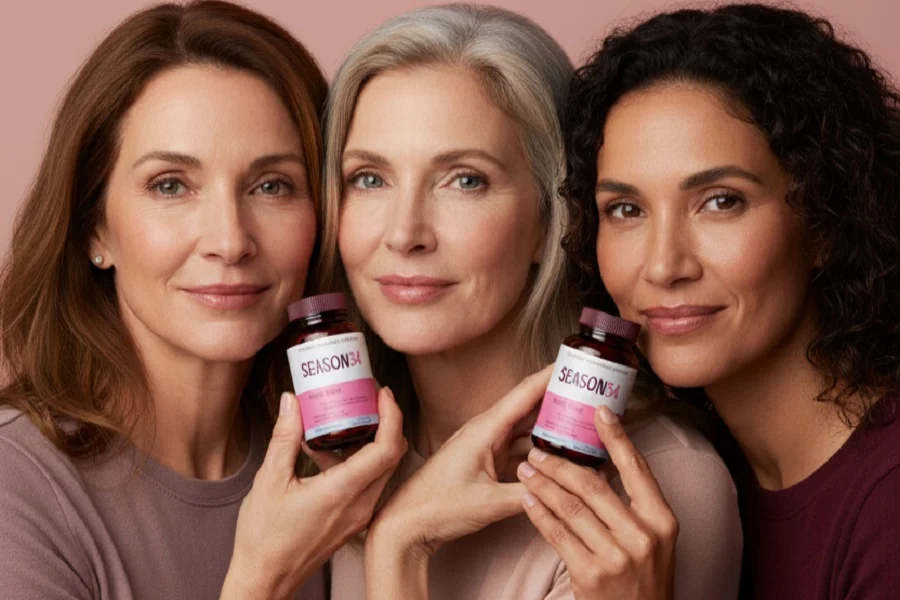 With nine patent-pending formulas, Season34’s hormone-free blends contain multiple targeted, high-potency actives, including 13 clinically studied, trademarked ingredients.Season34 was created to move beyond correlation-based relief and instead offer a modular, stackable system that allows women to address the root causes of the symptoms they are actually experiencing when they are experiencing them.
What lessons from building Season34 could inform how the industry approaches personalization in women’s health?
Stanbury: Claiming to address many symptoms is not the same as meaningfully treating them. Many products rely on a single mechanism of action and then market downstream improvements as comprehensive relief. This approach often forces women to take ingredients they don’t need while failing to address the symptoms that matter most to them.
Women in midlife are not a monolith. Age, genetics, medical history, and even past trauma influence how menopause is experienced. Personalization must be rooted in biology, not marketing convenience. The industry needs to move away from broad, one-size-fits-all formulations and toward systems that respect how women’s bodies actually function during this stage of life.
How did clinical experience and patient feedback shape decisions around ingredient selection and dosing?
Stanbury: Clinical experience was foundational to the design of Season34. My co-founder and mother, a physician and clinical researcher with over 35 years of experience in women’s health, began by mapping patient-reported symptoms to the biological mechanisms that drive them.
Rather than grouping symptoms by how they feel, we clustered them based on shared pathways, for example, identifying what breaks first when sleep becomes disrupted during menopause and which other systems that mechanism influences.
Equally important was rigorous evaluation of the research itself. Clinical experience teaches you not just what studies say, but whether they are reliable. Over the course of a year, we reviewed hundreds of clinical studies to identify ingredients with reproducible outcomes and well-defined standardized actives.
From there, we selected core ingredients that support the broader system and formula-specific ingredients that target the disrupted mechanisms directly, using dosages aligned with those shown to be effective in human studies.
What formulation or compliance challenges arise when creating hormone-free products to address multiple menopause symptoms?
Stanbury: One of the biggest challenges was designing a system that could adapt to changing needs without compromising safety. Because women may combine multiple formulas depending on their symptoms, we had to ensure that no combination, not even all nine formulas together, would exceed globally accepted intake limits for any ingredient.
That requirement significantly shaped formulation decisions. Each product had to work independently while also being fully stackable. This is where many hormone-free products fall short. Our approach focuses on addressing mechanisms at the source while maintaining strict compliance and long-term safety across all possible combinations. Personalization only works if it’s safe, and that principle guided every formulation decision we made.
How does accounting for microbiome changes during perimenopause and menopause influence formulation strategy?
Stanbury: Hormonal shifts significantly alter gut and vaginal microbiota. Without a functioning microbiome, many other systems struggle to communicate effectively. Initially, we explored adding probiotics to all formulas, but quickly learned that they are highly sensitive and can be compromised by other ingredients.
That realization led us to create a dedicated synbiotic as a standalone product. A synbiotic combines a prebiotic, probiotic, and postbiotic. We view this as the foundation of the system, something that supports and enhances the effectiveness of the other formulas rather than competing with them.