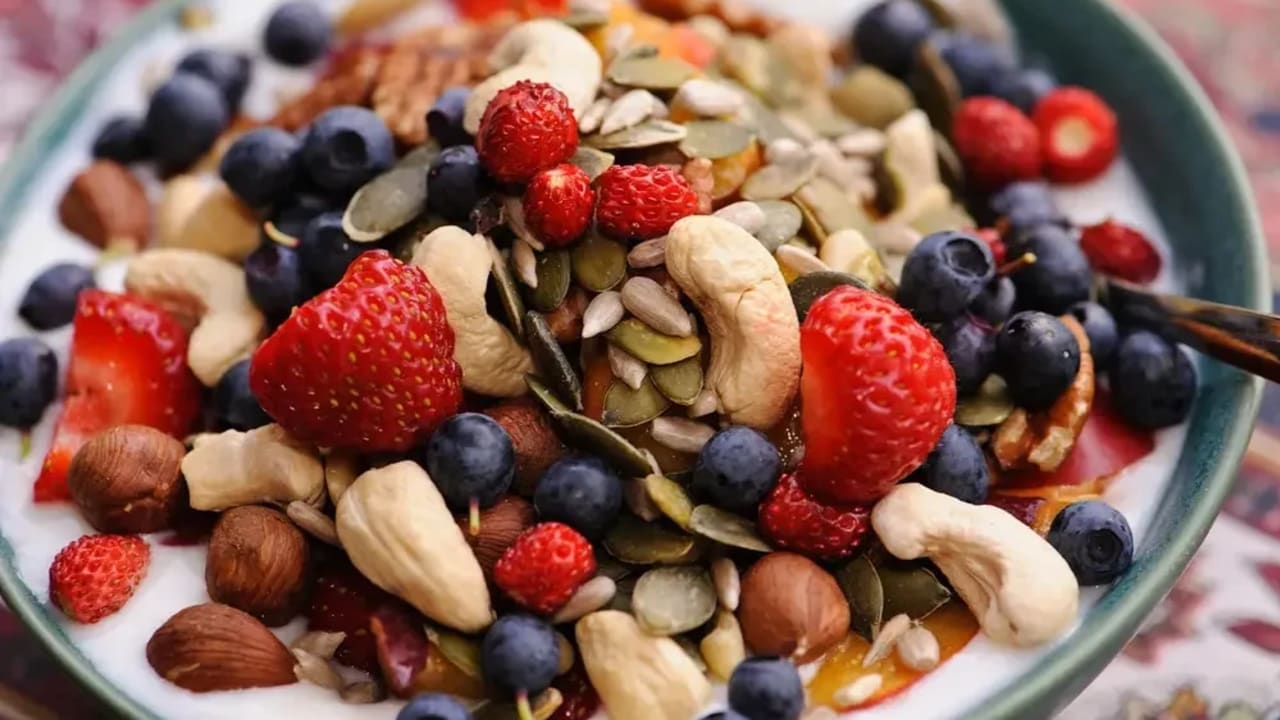
This myth comes up again and again, and many believe that “something sweet in the morning opens the appetite and causes cravings for sweets all day.” And yes, there is no doubt that it is preferable to eat a healthy, non-sweet breakfast – whole-grain bread, vegetables, an omelet, cheese. But is it true that a sweet breakfast will ruin our entire day?
And I’m raising this topic because there are also healthy sweet breakfasts – for example, yogurt with a tablespoon of oats and berries, a green smoothie with raw tahini, chia, and banana. And there is no shortage of examples.
So because many are convinced that if you start the day with something sweet – it’s like pressing a button that turns on a craving for sugar, sometimes for the whole day – I prepared the following article. Because when you check what the research actually says, it turns out that this is not really proven, and is mainly far less clear-cut.
For Dr. Maya Rosman’s online diet course click here

In recent years, several experiments were conducted that explicitly examined the effect of a sweet breakfast on cravings for sweets later in the day. I realize that the moment I said the word “studies” it sounds less interesting, but I promise you, it’s worth reading these results:
• In one experiment, published by Cambridge University Press, participants ate a sweet breakfast based on sweetened breakfast cereals for three weeks, compared to a group that ate a non-sweet breakfast – with the same number of calories.
The results were as follows: No increase was found in the desire for sweets, not in enjoyment of sweets, and not in the consumption of sweet foods later in the day.
• And no, it’s not just one study; here’s another example: In an experiment published on the Nutrients website, porridge with a very high sugar addition was compared to porridge with no added sugar. Here too, no differences were found in daily hunger, satiety, total energy intake, or the amount of sugar eaten later in the day.
Even prolonged exposure to sweetness did not change preferences
At this stage it is important to check: Is this a one-time meal? What happens with a regular habit of something sweet in the morning?
So that was also studied: The most significant examination on the topic was conducted in a large study that lasted half a year, called the “Sweet Tooth Trial,” and was published on the ScienceDirect website.
In this study, the researchers deliberately changed the level of exposure to sweet taste in the diet: Low, regular, or high – and examined whether this affects liking for sweets, selection of sweet foods, calorie intake, or body weight. Here too, the findings were surprising: No significant differences were found.
The conclusion from all these studies is that a sweet taste in the morning, in and of itself, does not necessarily cause an “opening of the appetite” or addiction to sweets throughout the day.
“Sensory satiety”
Let’s pause for a moment on this concept, because it’s important. What does “sensory satiety” mean? It refers to a temporary decrease in desire and enjoyment of a specific food while we are eating it, while the desire for foods with other flavors remains high.
An example: Sometimes after a meal you feel really “stuffed” and can’t take another bite, but when dessert arrives (a sweet flavor), suddenly “space opens up in the stomach.” This happens because satiety is not only physical in the stomach, it is also sensory in the brain.
According to this theory, why can a sweet taste in the morning actually reduce cravings later on?
In our brain there are taste receptors. When we are exposed to a sweet taste (like coffee with a bit of milk and sugar or porridge), the receptors receive the sweet stimulus, and the craving for that specific stimulus decreases.
Another explanation: In order for our diet to include everything it needs, the brain encourages us to eat a wide variety of nutrients. The moment we’ve eaten something sweet, the brain signals “I got that part, now I want something else.”
In other words, our taste does not “get addicted” to sweetness just because we were exposed to it.
On the contrary, eating in a satisfying way can actually prevent that feeling of deprivation that leads to binges later on. For how long does this work?
The most significant factor: The composition of the meal
Science shows that this reduces cravings immediately after the meal (which prevents a “dessert for breakfast”), but if there is an effect over a range of 6–8 hours, it is more related to the composition of the meal (protein/fiber). Here it is important to distinguish between sweet taste and meal composition.
For many people, “sweet in the morning” is not limited to taste alone, but combines several rather problematic characteristics: A meal low in protein, low in fiber, soft or liquid and eaten quickly, and sometimes based on white flour or sugar with a high glycemic load.
In such situations, in some people, a feeling of hunger may appear earlier.
Note: It’s not a question of whether breakfast is sweet or savory, but its nutritional composition.
A study published in the journal American Journal of Clinical Nutrition examined what happens among overweight adolescent girls who were accustomed to skipping breakfast. They saw that the very act of eating breakfast, and especially one richer in protein, reduced cravings for sweet and salty foods in the hours that followed.
In other words, protein, fiber, and sometimes also fat and a texture that requires chewing, contribute to more stable satiety and a reduction in “cravings” later in the day, regardless of whether the meal is sweet or savory.
In short: There are no clear-cut studies showing that “sweet in the morning,” in and of itself, causes more craving for sweets all day long. On the contrary, several high-quality experiments published in leading journals point to the absence of this effect. What is true is that if “sweet in the morning” in practice means a meal that is too light, low in protein and fiber – like a pastry, cornflakes, a cookie, or juice – for some people this may lead to earlier hunger and a search for something additional.