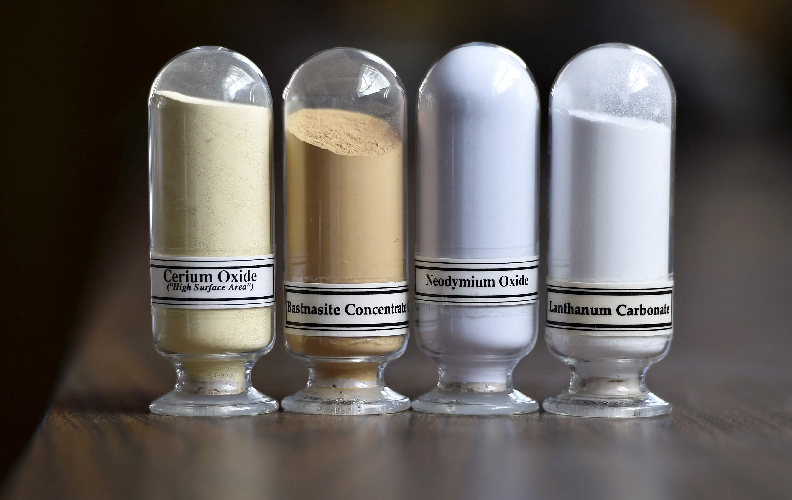

In today’s high-tech world, a group of metals is increasingly mentioned in political and economic discussions: rare earth elements, or rare earths. Despite their name, they are actually quite common in the Earth’s crust, but their extraction and purification are highly complex and expensive. These 17 chemical elements are indispensable components of the global economy, from smartphones to missile systems.
Why are they so important
These elements are often called the “vitamins of industry” because, when added in small quantities to various materials, they impart exceptional magnetic, luminescent, and chemical properties.
Green energy: Without neodymium or dysprosium, it is impossible to imagine powerful electric car engines or wind turbines. The production of one electric car can require 1.2 to 3.5 kilograms of rare-earth compounds.
Military industry: They are vital to the production of high-precision weapons, radars, night-vision devices, and fighter jets (such as the F-35).
Everyday technology: The colors of a smartphone screen, the power of a speaker, and the longevity of a battery depend mainly on these elements.
A new target for geopolitics
China currently dominates the rare-earth market, accounting for about 90% of global supply. This has raised serious concerns in the West. As of 2026, both the United States and the European Union are investing billions of dollars to create their own extraction and processing chains.
In the chemical industry, cerium is widely used in oil refining and glass polishing, as well as in flints for cigarette lighters.
Erbium is used in various medical fields, including dentistry, dermatology, and ophthalmology.
Erbium and neodymium are also crucial in making lasers for industrial engraving and cutting.
The environmental challenge
The article also highlights the flip side of the coin. The extraction of rare earth elements is often accompanied by severe environmental pollution and the generation of toxic waste. This is forcing scientists to look for alternatives, such as:
Recycling – the extraction of metals from old electronics and light bulbs.
Synthetic substitutes – the creation of new alloys that will reduce dependence on natural resources.
Rare earth elements are no longer just chemical elements: they are strategic weapons that will determine which countries will lead the technological revolution of the 21st century.