Photo-Illustration: The Cut; Photos: Getty
There was a time, not long ago, when Tay would have done anything to get to a HIIT class. If work kept her up till 1 a.m., so be it. She’d still haul off to a workout at 7. The people who asked “When do you sleep?” just didn’t get it. When her corporate-law job made her stress cry and a 15-hour day could come out of nowhere, that one hour of suffering at Barry’s, her studio of choice, was the hour of suffering she chose. “You could say it was toxic,” says Tay. “But it was everything to me. It wasn’t like I thought I ‘should’ work out. I genuinely need to do it to survive.” She’d started going hard on boutique fitness classes around 2015, when the workouts in vogue were the ones that wiped you out: the cardio-heavy bootcamps at Barry’s, the delirium of SoulCycle, hyperspeed power yoga in a 100-degree room. High intensity, big sweat, no thoughts. Then, last year, Tay started to think something was wrong. “To someone who doesn’t know how my body is supposed to look, I would have looked normal,” she says. “But when I watch the videos I posted back then, I see the inflammation in my body.”
Tay is a petite woman in her 30s who describes herself as “very much online.” She posts wellness content on TikTok, sharing videos of her workout classes, massages, and facials in feeds where other influencers surface health threats inspired by some science and more fear: What if your body was full of inflammation and you didn’t know? What if your cortisol, the so-called stress hormone, was spiking every time you worked out? What if that was making you puffy? What if it was setting you back? From now on, the key words were low impact. “For my girlies who have high cortisol or want to lower it, start doing more pilates or low intensity workouts,” reads a TikTok with more than a million likes. “Your body will lean out, you’ll tone every inch and won’t hold onto unnecessary weight.” Tay did want to “lean out.” She didn’t want to get “too wide.” So she did the same thing everyone else seemed to be doing: She went all in Pilates.
That only recently became the obvious choice. Invented over a century ago, Pilates spent the aughts floating in the culture’s peripheral vision, evidenced by the bodies of rich middle-aged blondes. When Sex and the City’s Samantha Jones is caught naked by her lover’s gay assistant, he nods to her body and says, “If it’s any consolation — wow.” Samantha smiles: “Pilates.” When Alec Baldwin and Meryl Streep in It’s Complicated get drunk and regress into bed, he pats her side like it’s a horse’s flank and says, “And the Pilates are payin’ off, by the way.” You never actually saw these women do Pilates. But then you started seeing women do Pilates everywhere.
In 2021, a studio opened near my Brooklyn apartment. Then another. And another. Lori Harvey arrived at the Met Gala in a black dress that exposed her oiled-up six-pack; when asked for her secret, the model and beauty-brand founder said, “It’s Pilates. It changed my life.” When Miley Cyrus won her first Grammys and performed her biggest hit, it was her sinewy muscles that made news, her little pops of bicep dubbed “Pilates arms.” Chain gyms like Life Time flipped spin rooms into Pilates studios. On ClassPass, Pilates became the top-booked workout worldwide. And companies making equipment could barely keep up. The CEO of Balanced Body says “coming out of the pandemic, it was like a catapult” — suddenly, their business was growing at twice the usual rate. Another company, Merrithew, sold so much equipment that it had to double its production capacity. The cost of a class shot up. At many New York studios, a single group class is $50. Some cost $75. At luxury gyms like Chelsea Piers, where a membership can already be around $295 a month, members pay an additional $30 to take a group reformer class. Even adjacent workouts benefited from the boom: In 2023, the founder of the fitness chain Solidcore, where workouts are done on apparatus that look like Pilates reformers on steroids, sold her business for about $88 million.
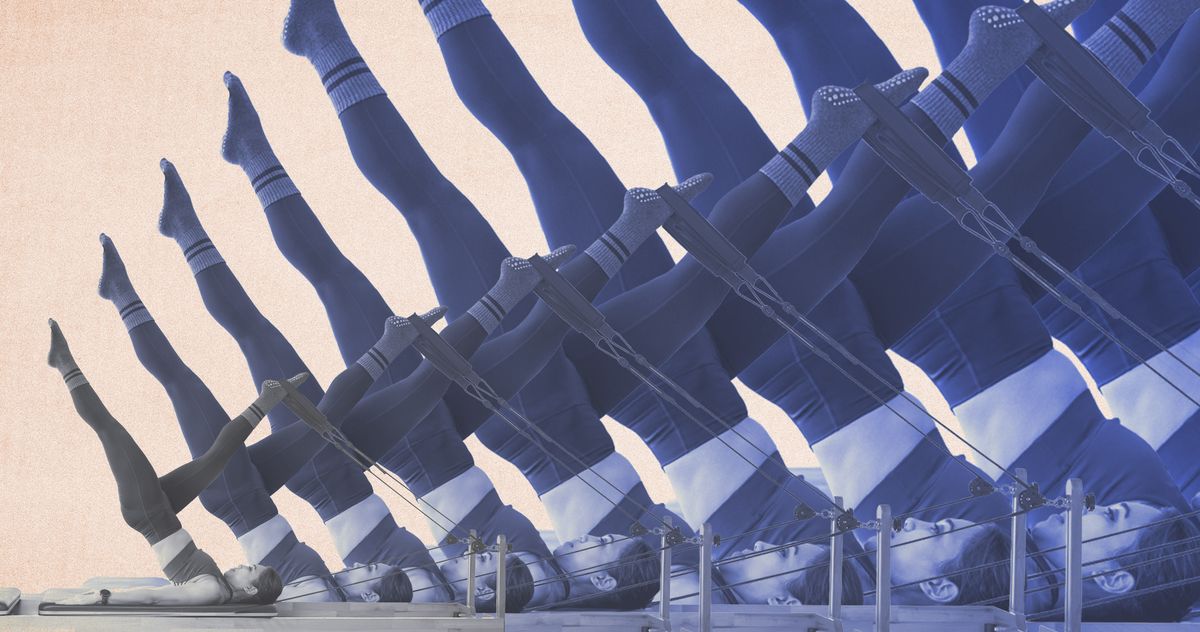
Pilates spread with a kind of authority. Physical therapists recommend it. Dancers swear by it. Whether it’s performed on equipment or on a mat, Pilates can strengthen your core, improve your mobility, upright your posture, and help you regain strength after injury. It can seem careful and anatomical, even medicinal. But the Pilates culture that manifested online had more to do with how Pilates can look — and with the people who seemed to do it. In endless, looping videos on TikTok and Instagram, thin (nearly all thin), white (nearly all white) women (nearly all women) glided back and forth on the wide, low-slung exercise machine called a reformer, performing slow, swooping, repetitive movements. They piked their hips, they planked, they lunged. It became routine to claim that Pilates bodies were different from weightlifting bodies, that they were “longer and leaner,” not “bulky,” as if Pilates were the feminine way to get strong. Maybe it was inevitable that social-media feeds would fill with photos of abs: fatless and tanned and disembodied, sleek and gleaming like slabs of wet marble. Or that Pilates would start to piss people off.
Last spring, a 24-year-old personal trainer and barre instructor named MaryBeth Monaco-Vavrik posted a video asking, “Does anyone want me to explain the connection between the popularization of Pilates…and the rise of extreme American authoritarianism?” She suggested women were being steered away from strength training by “a rise in rhetoric that praises women for shrinking” — and she was deluged by angry commenters who said she was reading politics into a situation where there were none. Monaco-Vavrik is still convinced she was right. She’s sick of Pilates marketing that emphasizes “lean muscle,” which, she points out, is just muscle, period. “The whole Pilates aesthetic is about striving for the economic capability of a wealthy white woman,” Monaco-Vavrik, who is Chinese American, tells me. That’s what some people like about it. Last fall, Pilates instructor and Love Is Blind alumnus Raven Ross, a biracial woman, went viral for posting a TikTok in which she defended the lack of diversity and high class prices of Pilates by comparing it to a luxury good: “Like, you would never walk into Bottega and be like, ‘Where’s the diversity? Where’s the accessibility?’” There was outcry. Brief cancellation. She deleted the video and posted an apology. That didn’t stop other TikTokers from parodying her logic. In one sketch, a Black person is shown trying to enter a Pilates class while a voice offscreen heckles them. “You don’t understand,” says the voice. “It’s not for everyone. Let me see your W-2s, please.”
We keep hearing that thin is back in, as if the ideal of the skinny woman ever went away. The size discourse is a mess of celebrity weight loss, GLP-1 shaming, retrograde gender politics, and disordered eating that’s masked in a host of new ways: You could be avoiding seed oils. Doing intermittent fasting. Or you could just be trying not to eat. In its cleanness and precision, Pilates is the perfect vehicle for the body neuroses and gender performance of the post-pandemic era. In a time of restless searching for the right ways to be healthy, it offers an easy answer, sliding right into the kind of routine that so many are looking to build: one touched by the suggestion, if not always the reality, of science. Who could blame us for wanting what we’re told we’re supposed to have? After Cyrus’s Grammys appearance, and the revelation of her “Pilates arms,” an instructor did numbers with a video in which she claimed that she sees those kinds of arms all the time — that Pilates “gives this copy-and-paste body type.” Of course, she meant that as a good thing.
You might start on your back. You won’t jump, or run, or lift heavy weights. Instead, you’ll do something that sounds boring until you’re fighting for your life trying to complete it. Like lying flat on your back with legs outstretched and, without the use of your arms, peeling your torso up vertebra by vertebra until you’re sitting upright. Or curling into a ball and rocking back and forth along your spine. Or lying down on the reformer, pressing the soles of your feet against a bar at one end, and pushing out until your legs are straight. Joseph Pilates, the inventor of Pilates, created a method that incorporated dozens of movements to perform on the mat or on the special apparatuses he designed, pitting his clients against the resistance of a spring and their own body weight, forcing them to activate small muscles in their abs, back, and pelvic floor. He worked out of a gym near Columbus Circle in Manhattan, close to the dance studios that supplied his most reliable clients. If you wanted to work with Joe, you had to be willing to see the body his way. He was a maniac for deep breathing. A stickler for form. One of his most fiendish exercises, called the Hundred, has been adopted by so many other kinds of training that it can be hard to see it as Pilates until you compare it to the rest of Joe’s repertoire: It demands that you lie on your back with straight legs pointed at an angle, then curl up your neck and shoulders and pump your outstretched arms while counting to one hundred — or until your abs fail you, whichever comes first.
Joe was wild-haired and stocky and never called his method “Pilates.” He called it “Contrology,” and to him his exercises were science. He and his wife, Clara, who also trained clients, opened their Manhattan studio in the mid-1920s after they both immigrated from Germany. He was, to the best of our knowledge, an autodidact, inspired by German gymnastics culture. Usually, Joe told clients and journalists he’d been a boxer. Sometimes he said he’d been a circus performer. One of the few confirmable facts about his pre–New York life is that he was held in a British prisoner-of-war camp during World War I, where he started to develop what would become Contrology — and where, he said, he spent hours observing stray cats, whose way of stretching inspired his philosophy of movement. He was convinced the human body needed fortifying. The enemy, to him, was modernity. Writing his 1945 book, Return to Life Through Contrology, Joe is doomish: “Our bodies are slumped, our shoulders are stooped, our eyes are hollow, our muscles are flabby and our vitality extremely lowered, if not vanished.” The solution, obviously, was his invention, which “develops the body uniformly, corrects wrong postures, restores physical vitality, invigorates the mind, and elevates the spirit.”
For everything Joe got wrong about the body (like his belief that muscle fatigue was “poison”), it’s uncanny how much he got right. Such as that regular conditioning of the muscles between the shoulders and glutes could totally change someone’s life. His clients — busted-up ballerinas, injured office workers, opera singers — found themselves standing better, walking better, dancing better. Joe and Clara taught series of movements that they adjusted for what each client needed most, working with both the mat and Joe’s inventions, objects and apparatus small and large: the flexible metal ring, now called the Magic Circle, that a client could squeeze between their limbs; the Universal Reformer, which combines a flat, moving carriage with springs, straps, and pulleys to create resistance; the Cadillac, which looks like a four-poster hospital bed; the step-stool-like Wunda Chair, whose bottom step can be pushed against with foot or hand. George Balanchine sent people to Joe. Martha Graham did too. In John Howard Steel’s book Caged Lion, a personal history of training with Joe in the mid-1960s, Steel, a lawyer with a desk job, describes showing up at the studio with a stiff neck. His first session was so intense that he threw up in the gym’s shower. But he went back the next week. His neck pain had disappeared.
Several years after Joe’s death in 1967, Romana Kryzanowska, a longtime student, took over the original studio as head teacher and manager. Her daughter, Sari Mejia Santo, also became an instructor. Former clients fanned out, opening studios in places like Los Angeles and Santa Fe. In the 1970s, a dancer named Kathy Grant, whom Joe had certified to teach, became one of the first Black women to run a Pilates studio when she took over a Pilates gym in the Henri Bendel department store. It was a close, territorial world, and Kryzanowska claimed her practice was closer to Joe’s than anyone else’s was. Her style was called “classical,” implying it was more authentic, while others (including Grant’s) became “contemporary” — labels that longtime instructor and studio owner Blossom Leilani Crawford feels are arbitrary. She trained with Kryzanowska and Grant and respected both. Even so, she says, “Classical was just whatever Romana said it was, and sometimes she’d change it.” By the ’90s, pissing matches turned to lawsuits; a physical therapist who’d bought the dregs of the original company trademarked the word “Pilates” and spent the decade sending cease-and-desists to the tiny, struggling studios that used it. When in 2000 a federal judge struck down the trademark and declared Pilates a generic term, it was a relief to nearly everyone. But also, says Crawford, “All hell broke loose, because everything became Pilates.”
It was bound to change. Those who have dedicated their lives to Pilates often speak of it as a calling. They feel responsible for a trove of knowledge passed down through teachers who might be discussed in terms of generations, from those who trained with Joe personally, to their students, and so on. Although they know what they teach is a workout, the word they prefer is system; clients’ bodies are best tended through close, personal time with each one. But asceticism can’t always pay the bills. Soon the practice that had usually been taught in private, one-on-one sessions or to just a handful of students at one time expanded into larger group classes. Pilates joined the maturing field of boutique fitness, and the instructors who taught it wanted to play. They pulled from dance and kinesiology and physical therapy and strength training, pouring what they each knew about the body into the Pilates they taught. Studios followed what clients wanted. And it seemed like what clients were most excited to pay for was not mat Pilates — which longtime instructors call “the bread and butter” — but the apparatus. (As Kryzanowska once put it, “People love toys.”) The group reformer class was born, popping up in studios from San Diego to Manhattan, where Heather Andersen, a self-described former “baby ballerina” who founded New York Pilates with her boyfriend Brion Isaacs in 2013, became an early adopter. They millennialized it, blasting dance music during classes, hanging selfie mirrors in the lobby, and pushing the limits of how many reformers could fit in one room. “Pilates was so different back then,” says Isaacs. “There was no music, pretty much no talking. It was quiet, like you were at the doctor’s.” “It was not cool,” says Andersen. “Not a fun vibe.” The new generation they were part of added more props, more reps, and an element that’s more Jane Fonda than Joe Pilates: the pulse — that tiny repetitive movement often tacked on to the end of a sequence, where the moving limb is bobbed in place for what feels like forever.
“They’re doing something,” says Mejia Santo, Kryzanowska’s daughter, who is appalled by what’s passed off as Pilates now. “But they’re not doing Pilates. They’re not doing Romana’s Pilates. I hate to use the word: They bastardized it.” It echoes what happened to yoga: Changes that seem trivial to the punter are a betrayal to those who have practiced for decades. (When I told my Pilates-loving 70-year-old mother, who’s only ever practiced in private or semi-private sessions, that I was taking a group reformer class, she was confused and a little annoyed. “Pilates doesn’t have those,” she said.) For others, the new Pilates made more sense than classical ever had. The instructor Helen Phelan, a 34-year-old dancer who’s been teaching Pilates for over a decade, didn’t fall in love with the method till she realized that she could experiment with it. “Classical Pilates feels like ballet to me,” she says. “Like, I love it. But it can be restrictive. Repetitive. It just doesn’t feel good on my body. And a lot of people, myself included, need more novelty to stay engaged.”
In the 2010s, Pilates was still just one weird option in a sea of boutique fitness offerings. Yoga was a default choice. Spin classes were ascendant. In a 2015 story in this magazine, titled “The Pilatespocalypse,” a reporter speculated that interest in the workout had peaked. One source suggested it had been a fad. He compared it to Zumba.
The fitness world has always enjoyed a little punishment. Perhaps that’s because so much of the industry plays on feelings of shame. In the years before COVID, it was not unusual for women’s publications to write headlines like “I Tried the New SoulCycle Class and Almost Puked All Over My Bike — but I Loved It.” There was a sense that pain was the price of getting healthy. Of being good. Of being hot. Suffering wiped the slate clean.
Lockdown changed that. For every Peloton subscriber spinning furiously at home, for every runner pounding the empty roads, there were thousands of YouTube exercisers clicking around for something they could do with no money and no equipment. Something, for example, like mat Pilates. A different worldview was coming into focus too. While actual global wellness plummeted — mentally, physically, financially — the industry of wellness was on the rise. Health panic floated freely, looking for somewhere to land. Suddenly, believing that all you had to do was eat vegetables and exercise seemed naïve and misinformed. Discourse about the dangers of chronic inflammation entered the chat, as did the risk of high cortisol. “Inflammation is the root to all of your issues. Weight gain, anxiety, pain, swelling, illness,” claimed one typical post. Influencers were speeding ahead of the science they understood: There are actual medical conditions that come with chronic inflammation, such as rheumatoid arthritis, and with chronic high cortisol, such as Cushing’s syndrome. But doctors say that for most of us, inflammation and cortisol levels rise and fall within the body every day, and it’s normal for both to be elevated after physical activity. While some researchers suggest you could be more susceptible to getting sick in the days following a hard workout, regular exercise is good for your immune system and for managing inflammation long term.
That didn’t stop people from spiraling out. The swelling that could come with conditions like Cushing’s was equated with the puffiness people saw in their own faces and around their waistlines. Health anxiety became interchangeable with size anxiety. Was it possible that all those HIIT classes were actually ruining their appearance? “You are putting so much stress on your body and you’re spiking your cortisol and your stress hormones are really out of whack!” preaches a slim blonde woman in one video. “My cheeks used to be so puffy! I literally looked like a chipmunk!” “Why intense workouts might be making you BLOATED,” blared one TikToker. “People started looking into lower-impact workouts, and then they were like, Oh my God, I can do something that, like, sort of feels easy and I’m not dying, and I get better results,” says Andersen, who thinks the rise of cortisol fear and Pilates are correlated. “Everyone’s mind was blown.”
When New Yorkers emerged blinking post-vaccine, their proclivities had shifted. Among them was Georgia Wood Murphy, a svelte blonde who had completed her Pilates certification through New York Pilates’s online training program in 2021, just in time to meet a wave of demand for instructors once studios began opening in earnest over the following years. One Monday morning, I head to TERA, the referral-only Pilates studio in Soho that Murphy founded in 2024, where a spot in a group class costs $70. Before getting into Pilates, Murphy was a serious runner, doing half-marathons for fun. She started thinking that was a mistake. “The changes that I saw in my body were more than I was looking for. I didn’t need to run a six-minute mile and, you know, have all this muscle on me,” the 29-year-old says. “I felt like with Pilates, I really leaned out and liked the way I looked and felt.” Murphy isn’t teaching the class I attend because at the time of our conversation she’s 38 weeks pregnant. Right after we finish, though, she appears, smiling and rosy and looking like she could give birth any second. “I’m being induced on Thursday!” she says, settling onto a reformer.
Dr. Soyoung Choi, a kinesiologist and community-health scientist at the University of Illinois Urbana-Champaign, says the benefits of Pilates are clear. If you practice regularly, it will strengthen your core and make you more flexible. Its emphasis on muscle awareness, often called the “mind-body connection,” is good for your brain. It can’t make you “longer,” because no workout can: You’re only as long as your bones. Whether it will snatch your waist may be a matter of optics or simply how much body fat you have. “Pilates is effective because it trains this entire deep-core system to work together,” says Choi. “Improving neuromuscular coordination and alignment can make the torso appear more lifted and streamlined, which may be interpreted visually as a smaller waist.” It’s also not the most efficient exercise for weight loss because it simply does not burn that many calories. You would, as always, need to change your diet as well. “Maybe this will discourage women who are interested in that,” Choi says, “but weight is not always the most meaningful health outcome.” Many Pilates instructors agree, although they don’t always get the opportunity to tell their clients that. Teneice Bowie, who teaches in Miami, encounters a lot of clients who seem loath to admit this is what they’re looking for. “It’s okay that somebody wants to be long and lean,” she says. “I just want them to have an honest conversation with me, because I don’t think that’s necessarily going to be answered through Pilates — and then I can direct them to someone who can answer that for them.”
Online, Pilates content skews bodychecky and rigid and trad. Instagram and TikTok are stuffed with before-and-after videos in which the before looks no larger than a size six, and influencers refer to thin bodies as “skinny fat” or their own pre-Pilates weightlifting bodies as “bulky.” (Weightlifting may actually increase your metabolism and decrease body fat.) This is a world of two strictly demarcated genders. Influencers tout their engagements and marriages to men who meet the only standard that matters: rich enough to pay for Pilates classes. A Miami influencer in a pearl-gray matching set sweats it out under the words “when someone asks what my biggest fear is but i can’t say getting fat and marrying a lazy broke looser who believes in 50/50 so i just say heights.” Another: “Me as my man runs 4 companies.” A blonde woman twirls at her wedding, waving thin, muscled arms above her head: “When someone asks me why I did Pilates 4 times a week before the wedding.” I linger on a video captioned “this & no job.” It shows a thin brunette in a cream matching set wearing her baby on her front while small children gallop around her in a mat studio.
Shaye Belle, a 25-year-old Black woman, says that even though the concept of Pilates appealed to her, the online culture kept her away. She waited until she had lost 60 pounds — and found a Black-owned studio — before she dared venture into a class. “When I was larger, I heard some people say things like, ‘Well, of course, you aren’t able to do the moves in Pilates. You have too much weight on you to operate the reformer,’” she says. “I felt ashamed.” One 40-something tells me she feels as if Pilates is designed for someone who is already small. “I’m not particularly naturally thin, nor do I have low body fat,” she says. “And my friends who swear by Pilates and say that it’s transformed their life tend to be naturally much slimmer.” Lindsey Leaf, a content creator who posts under the handle fatbodypilates, says that when she first started taking Pilates, instructors seemed to have no idea what to do with her as someone who is both tall and fat. “I had all of the skills but my body didn’t match what they were expecting to see,” she says. They didn’t know how to cue her posture or that she might need different spring tension on the reformer than someone whose body weighed less. Leaf ended up signing up for instructor training just so she could understand how to better advocate for herself in class. But Pilates instructors aren’t safe either. “When I talk to students, I hear them say things that I can be taken aback by. If the instructor’s body doesn’t look a certain way, they’ll say, ‘Well, I don’t want to take class from them,’” says Andersen. “From my perspective, that is not related to this person’s strength, or their understanding of anatomy or biomechanics, or their ability to give you a badass workout.”
The person whose body has inspired more class signups than any other might be Lori Harvey. That 2022 video of her walking the red carpet is referenced again and again, both online and by people I speak to. “Oh my gosh, she is everything,” says Tay. “She’s the perfect mix of not looking like she’s in the gym all the time, not too muscular, while still having this feminine aura about her. People are just like, Whatever she’s doing, I need to do that immediately.” Harvey tells me she was shocked how influential her mention of Pilates was. She had been doing it for years before her abs went viral, turning to it after a horseback-riding injury, and got hardcore about it around 2021 — especially in the leadup to the Met Gala where she was interviewed. At the time she said she was trying to lose “relationship weight.” (She was then dating Michael B. Jordan.) “At the end of day, we all want to be snatched,” Harvey tells me. “We all want to know, What’s the thing? So why not share it when you find out?”
But Pilates wasn’t the thing. Soon after that first video, Harvey posted a video of her own where she talked about the rest of her routine: working out twice a day, five to six days a week, and following Pilates classes with intense bouts of cardio, like doing sprint intervals on a treadmill. The real X factor was what she ate, or didn’t: In the months before that video she’d been operating at a calorie deficit, “consuming 1,200 calories a day, max.” If women were inspired by Harvey’s original clip, they were annoyed by the follow-up. “Oh my God, I still get attacked for that video,” she says. “Every few months people resurface it to be like, ‘She’s promoting anorexia.’ I was just explaining what worked for me! Consult your doctor!” Her body doesn’t look like that all the time, she adds. “My abs were intense at the Met because I was prepping for that. Sometimes I’ll look back and be like, Oh, I was super-ripped. Love that for me,” she says, and laughs. “They’re not so ripped now. They’re underneath.”
One of the people who got Harvey ripped was Liana Levi. The 35-year-old founder of the referral-only Pilates studio Forma is deeply tanned, very thin, and bestowed with an eight-pack that she has made the main character of her internet presence. She posts photos of herself with head and legs cut off, tightly cropped on her claim to fame. “Washboard,” she captioned a 2022 mirror selfie that shows her from the chest down, pulling down the waistband of her pale green leggings to expose her torso. Although Levi had been attending Pilates classes for years, she never taught before 2020, when she bought herself a reformer and installed it in her mother’s pool house in the wealthy L.A. neighborhood of Holmby Hills. By her telling, she started teaching during the pandemic because people begged her to. “My acquaintances would be like, ‘Oh, my god, I want to try it. Your body looks insane,’” she told a reporter in 2021. “It just kind of spread through word of mouth.”
Levi started teaching Hailey Bieber. Kendall Jenner. Kaia Gerber. Harvey describes Levi as “no nonsense” and says her workouts incorporate movements she’d never done in other Pilates classes, “hitting muscles I didn’t even know I had in my body.” Over the past four years, Levi went from her home studio to opening a second location, a third, a fourth. In 2022, the New York Times published a story about Levi headlined “Is This the Most Expensive Pilates Class?” in which Levi shared her rate for a private session: $500 an hour. Although the story drew incredulous comments online, it seems to have only helped business. Forma now has nine locations, including two in New York, and is currently hiring instructors for a location in London. A single group reformer class at the Upper East Side Forma costs $105.
Levi is one of the most successful examples of a type of Pilates instructor that emerged during the pandemic. She didn’t have to pay her dues teaching poorly attended mid-morning classes at whatever local studio would have her; she opened up shop on her own with the benefit of social-media presence, paparazzi shots of her celebrity clients walking to and from class, and the kind of family that owns a property with a pool house. Online, people began to wonder about her bona fides. It’s fair to be skeptical. The Pilates industry is both unregulated and decentralized, and certification programs are multiplying. It’s up to each studio to decide how much they care whether instructors are properly trained in anatomy and have received certification through a reputable program, most of which demand at least 450 hours of work and a practical exam. The stakes of certification can be high: You’re dealing with people’s bodies, doing exercises on potentially dangerous equipment and working with clients who come to Pilates after injury or during pregnancy. The rise of the influencer-teacher has only made it easier to bypass that honor system altogether. As instructor Helen Phelan puts it, “There are certainly people on social media who are going by the ‘My body is my business card’ thing without any actual training.”
I ask Levi how she feels about the idea of her body being her business card. “I mean, for me, definitely,” she says. “I realized along the way that I was my best marketing tool.” Over the past few years, Levi has recounted the origin story of Forma to the press many times, but she never seemed to mention where she was certified, save in one of her earliest profiles: a 2021 Wall Street Journal story that mentions Levi was certified through the American Sports and Fitness Association, an organization that offers certificates for those who pay to take a multiple choice test online and that did not respond to my emails. When I ask her about it, she says only that she was certified before the pandemic at the studio where she used to practice in L.A. — “it’s super-credible, I just prefer not to mention the name of the studio because we are not on great terms” — and that she was also certified through STOTT, a Toronto-based program that is considered one of the more prestigious in the Pilates world. When I press her on this, she admits that she hasn’t completed her STOTT certification yet. “I always think it’s great to have that credibility, almost like a diploma,” she says. “So it’s like, you can get it from a community college, or you can get it from an Ivy League. To me, STOTT is Ivy League. More time consuming, harder to find, and a bit more expensive.”
A STOTT representative confirms to me that Levi is not yet STOTT certified. As for the L.A. studio where she trained, I reach out, on a hunch, to Natural Pilates, which is one of the longer-standing studios near Levi’s home in L.A. and one of the pioneers of the group-Pilates-class format. The owner, Laura Wilson, confirms that Levi attended classes at Natural Pilates for many years and started her teacher training there but didn’t complete her certification with them. “We’re proud to have been part of her early Pilates journey and are happy to see her success,” she says, but declines to say more. When I reach out to Forma to follow up, its representatives do not respond.
Perhaps none of this matters if Levi’s workouts (or her abs) inspire you. Or perhaps you think she’s part of the problem. Many people who love Pilates will try to defend it against what they see as its corruption, even its gentrification, by citing loose interpretations of the story Joe Pilates told about inventing his method in a World War I POW camp; as one commenter on a video about the Ross scandal asked, “Wasn’t Pilates invented in prison?” But exclusivity has been part of Pilates since Joe opened his studio in New York. As Steel writes in Caged Lion, the Contrology gym was mostly frequented by professional performers, dyspeptic businessmen and -women, and Manhattan housewives. Joe, who loved his showbiz clients, made it clear what kinds of bodies he approved of. “Imagine yourself, for instance, carrying a well-filled traveling bag weighing 20 pounds … You are doing exactly the very same thing when you persist in carrying 20 needless pounds of excess weight on your body … Why not relieve yourself of this truly ‘excess baggage’?” he writes in Return to Life Through Contrology. Nor was he immune to glamour. The photos for a 1950s magazine story headlined “Pretty Opera Star Trains Like a Boxer” show then–star soprano Elaine Malbin, in full makeup and leotard, working out with Joe on his apparatus. “Time was when a grand opera singer could be spotted by waistline almost as fast as by voice … Elaine is of the new school that believes a singer has to look nice as well as sound nice,” reads the caption. “So she keeps in trim.” In a 1998 Vogue story, illustrated by a photo of a thin, naked white woman hanging from the top frame of a Cadillac, the writer gushed that Pilates was “hot right now among the professionally beautiful” — actresses Sharon Stone and Uma Thurman, models Stella Tennant and Shalom Harlow — because “nobody wants to end up with a body that makes you look like Sylvester Stallone’s separated-at-birth twin sister.”
One day a few years ago I realized that my upper body, which I’d never considered to be strong, now felt weak. What Arnold Schwarzenegger once called the “pump,” the euphoric muscle swell he could feel after a round of weightlifting … I felt the inverse. The slump. Too intimidated by the gym, too tender-kneed for running, I started going to group fitness classes because I wanted to be told what to do — to be nudged, 50 minutes at a time, toward a glimmer of understanding of how to move. It often feels as if the pleasure of these workouts lies in submission. We want to be bossed by someone who knows more. For that we need a boss we can trust. Pilates became so popular in part because it seemed trustworthy, as if a standard of care was baked into it. If most classes mean following a program that’s designed for no one in particular, the precision associated with Pilates seems to offer something deeper. It rarely feels that way in real life.
We go looking for the care we were promised. We assemble in dimly lit spaces filled with stern lines of reformers or grids of oblong black mats, lying down together like it’s bedtime at the palo-santo-scented orphanage. We crunch. We do Hundreds. We listen to the instructor and struggle to obey — to slowly lower our legs toward the ground while we “knit our ribs together,” “imagine we’re wearing a corset,” “pull the belly button to spine.” We shake through lunges and squats, crushing Pilates balls beneath our heels, between our thighs, between our hands. We balance on boxes on top of our reformers while hovering our knees and doing bicep curls with our hands in the straps and we are definitely about to fall off. Is this hard because we’re doing it right or hard because we’re doing it wrong?
It is easier than ever to find a Pilates class. What remains a rarity — and, yes, a luxury — is the kind that helps you understand why it’s something you’d want to do for the rest of your life. One Sunday afternoon, I visit Flatiron Pilates, owned by Amy Nelms, who has been teaching for over 25 years. She’s taught Lily Allen and Emma Corrin and dresses for work in a tight black long-sleeve shirt, flowing pants, and chunky leather platform boots. She speaks in a firm, calm voice that eases blood pressure downward. She has me clocked before I can get my coat off. “Is your neck feeling a bit tight?” she asks within moments of my arrival at her studio near Madison Square. “A little more on the right side?” I admit it is, slip off my boots, and walk toward her. She stands in the natural light by the north-facing, Empire State Building–framing window, her bleach-blonde curls neatly parted in the middle, and assesses the damage. “A little bit of hyperextension in the arms,” she says. “Knees — a little bowing.” She says this neutrally as if naming shapes in the room: The trampoline is round, the reformer is a rectangle, my chin lists two clicks to the right. “Okay,” she says gently, laying a clean white hand towel down on the bed of the apparatus of her Cadillac. “Put your tushy here.”
She takes me through a series of stretches and asks: Does my neck hurt when I do mat work? Yes? Here’s something I can focus on to prevent that. She asks me to roll up, to lower one leg, switch it out, lower both. Like Joe Pilates or Kathy Grant, she is taking my measure, moving me from the Cadillac to the reformer to the chair. All the while she watches like a hawk, gently nudging my hip downward, encouraging me to engage my left side. She praises me, tells me I’m strong, and corrects me. When the hour is up she stands me in front of the mirror to show me how I’ve straightened myself out. I feel so loose and rubbery and soft it’s like I could float all the way home. I grieve that I’ll never feel this way again. Nelms’s usual rate is $500.
Nelms considers herself “a traditionalist, but open to contemporary.” She loves to learn and is always curious about what other instructors are doing. Recently, she agreed to accompany her daughter to a group class at a studio in Soho. “It was heated Pilates. I said, ‘I’m not gonna like this.’ She goes, ‘Just try it,’” she says. “There were weights and a lot of balancing, stuff you would do in your normal workout class. It wasn’t bad, but there wasn’t one exercise that was Pilates in the entire thing.” This makes me curious what she would think of moves I’ve done in other classes. A few weeks later, I come back to Nelms’s studio and demonstrate a few: the awkward plié that strained my inner thighs in a reformer class, the donkey kicks that always seem to show up in mat sessions. Nelms shakes her head and gets down on all fours. “This” — she bobs her right leg out behind her — “or this” — she bends that leg and points her knee to the side — “is not Pilates.” So what is it, I ask? She looks at me. “It’s exercise,” she says.