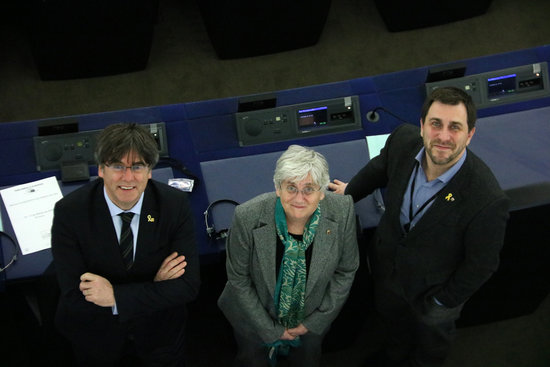
Spain then petitioned the Parliament to lift the separatists’ immunity, and in 2021 a majority of lawmakers voted in favor of doing so. Although Puigdemont, Comín and Ponsatí challenged that waiver, the EU’s General Court upheld it in 2023, weakening their ability to evade Madrid’s extradition requests.
But Thursday’s appeals ruling by the top court annuls the Parliament’s decision, finding the institution failed to “ensure the impartiality” of the procedure to waive the lawmakers’ immunity. The high court’s doubts regarding the neutrality of the process focused on Spain’s far-right Vox party, which was involved in filing the criminal case at the origin of Madrid’s extradition request.
The court found that the Parliament violated the principles of impartiality by permitting former Bulgarian MEP Angel Dzhambazki, whose European Conservatives and Reformists Group then included the Vox party, to serve as the rapporteur overseeing Spain’s waiver request in the Legal Affairs Committee. EU law establishes that examinations of petitions of this kind cannot be led by lawmakers connected to the prosecution.
As additional evidence of Dzhambazki’s lack of impartiality, the ruling notes that the Bulgarian lawmaker participated in a 2019 event titled “Catalonia is Spain,” at which the Vox party’s secretary-general declared, “Long live Spain, long live Europe and lock Puigdemont up!”
In addition to having its 2021 decision annulled, the Parliament is ordered to pay the legal costs incurred by Puigdemont, Comín and Ponsatí in their initial challenge before the EU’s General Court, and their appeal to the Court of Justice. The ruling represents a stark rebuke of the Parliament and its handling of the Catalan separatist saga. The Parliament declined POLITICO’s request for comment.
Of the lawmakers involved in the case, only Comín remains a member of the EU legislature. Ponsatí returned to Spain in 2023 and was briefly detained before being released by authorities.