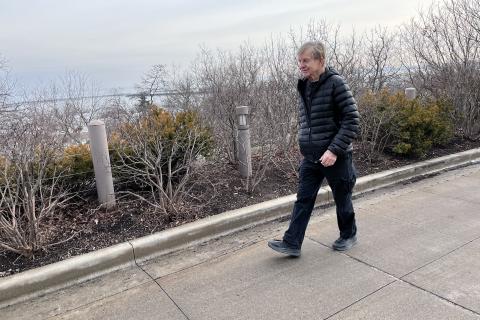
Walking those 15 flights each day is just one of the many ways Quindel puts a premium on his health.
He logs 20,000 steps each day — regardless of the weather — and does his share of push-ups, sit-ups, weightlifting and other exercises to keep himself as fit as possible.
“I work out religiously,” he said. “I’ve never stopped. I’ve been a walker forever.”
He walks every day, no matter the weather. He has routes around his neighborhood and often walks every aisle of a nearby grocery store.
“It’s use it or lose it; that’s what I tell people,” he said. “If you give in to weakness, then weakness ends up winning. I’ve seen people die because they gave up, and I don’t want to do that.”
Research backs up Quindel’s philosophy: According to the Federal Interagency Forum on Aging-Related Statistics, only 15% of adults age 65 or older and 5% of those 85 and older report they are regularly physically active. A significant body of evidence links low physical activity to poor health outcomes including death, obesity, cardiovascular disease and cognitive impairment.
“There is never a time in life when we do not need physical activity,” said Jill Taxman, occupational therapist with the Milwaukee VA. “Staying physically active throughout life allows a person to participate in tasks that they need to do and want to do and maintain independence for as many years as possible.”
If you are ready to get started or fine tune your physical activity plan, the Milwaukee VA is here to support you. Physical activity programs such as tai chi, yoga, walking groups, chair aerobics and exercise on equipment (treadmills/bikes/weights) are available on the Milwaukee campus! Please call (Whole Health) or ext. 42893 (Occupational Therapy Lifestyle clinic) for more information.
A lifetime of fitness
Physical fitness has always been a part of Quindel’s life. As a child, he often would run to and from school, not because of tardiness but just from the exhilaration of it.
Picked on by bullies and involved in occasional altercations with his alcoholic father, Quindel was no stranger to fighting, which sometimes landed him in juvenile detention. But in high school, he got involved in wrestling, which turned his life around.
He quickly took to the sport, which he found was as much about smarts and reactions as strength and speed. His senior year at Custer High School in Milwaukee (now the Barack Obama School of Career and Technical Education), he was never beaten in a wrestling match.
“That’s what changed me. That sport helped me channel all that anger, and I got my act together,” he said, noting his grades went up after he began wrestling. “Wrestling gave me that discipline, and I could prevent my father from being abusive to my mother.”
In the Army
He went on to wrestle in college but left after two years, enlisting in the Army in 1967.
His physical fitness shone through during basic training, where he could do hundreds of push-ups, including “triple-clap” push-ups — pushing himself off the floor so far that he could clap his hands three times before hitting the floor.
“If you’re not really strong, you’re going to break your nose (doing those),” he said.
He was sent to Vietnam as a radio operator and was severely injured in a Viet Cong ambush at Hoc Mon. The attack killed 49 men and injured another 29. Quindel was the only survivor of his group of nine.
After three months recovering in a Japanese hospital, he was sent back to Vietnam, where he finished his tour as a member of the Aircraft Warning Control Command.
Back in Milwaukee, Quindel returned to college and became active in groups protesting the war in Vietnam, including Veterans for Peace and Vietnam Veterans Against the War. His work with Jobs With Peace earned him a Peace and Justice Award from the Milwaukee chapter of the World Federalist Association.
Working with kids
While in college, Quindel began working with a youth wrestling program, which led to his starting the City Kids Wrestling Club in Milwaukee. He’s still active with the club, mentoring and coaching young wrestlers in the spring and summer, which is the off-season for school-based wrestling teams.
“We have so many kids who’ve been successful — kids who came from really tough lives,” he said, noting he has seen students with grade-point averages near zero go on to become honor roll students. Many others have gone into the military, with one going to West Point.
“It was fun watching these kids who had a lot of issues, seeing their grades and behavior turn around,” he said.
He served as a Milwaukee County supervisor for 16 years but eventually left the post when he learned that the severe back pain he would experience during his tenure was tied to the stress of the job. That informed his understanding of the connection between mental health and physical health.
Keeping sharp mentally
“I try to stay physically active and mentally active,” he said, noting that many older people can become isolated. That’s why Quindel makes a point of staying involved in activities that stimulate his brain and keep him connected socially.
He serves on the resident council of his apartment building, is a top-notch bridge player and is part of a group of Veterans who gather six days a week at a nearby coffee shop. And while their common bond as Veterans brought them together, their discussions center mostly around their day-to-day lives as opposed to reminiscing about their service.
His mental health journey has been aided by the Milwaukee VA, where he has participated in group therapy sessions on and off over the years. They have helped him grapple with issues, including the recent mental decline of his wife, who is now in memory care.
“The VA really helped me on every level with the mental part,” he said. “When you work with someone, you have a chance to figure out where you want to be. And I think I’ve gotten there pretty much. I think I’m at peace with myself at this point in my life.”
Leaning into physical fitness
And as he’s gotten older, he’s leaned into physical fitness, instead of retreating from it, which is easy to do later in life.
“The older you get, the faster the decline comes,” he said. “None of us, as we age, are going to get all the things we want in life. But they’re not going to get better if you do less. You need to stay active in whatever level you are — even if you’re in a wheelchair.
“You’re in control, and you can do certain things, and make your life, even as you age, pretty good.”
Taxman agreed, noting that even a little physical activity is better than nothing at all.
“Just get up and move, even if that means taking a brief lap around the room,” she said. “The important thing is to move something.”
She noted that adults should get at least 150-300 minutes per week of moderate-intensity physical activity, or 75-150 minutes per week of vigorous-intensity physical activity.
“Ideally, this aerobic activity should be spread throughout the week,” she said. “Adults should also do resistance training exercises two or three days per week for health benefit.”