Europe’s Fortified Foods Boom: A Market Built on Health, Science, and Smart Consumption
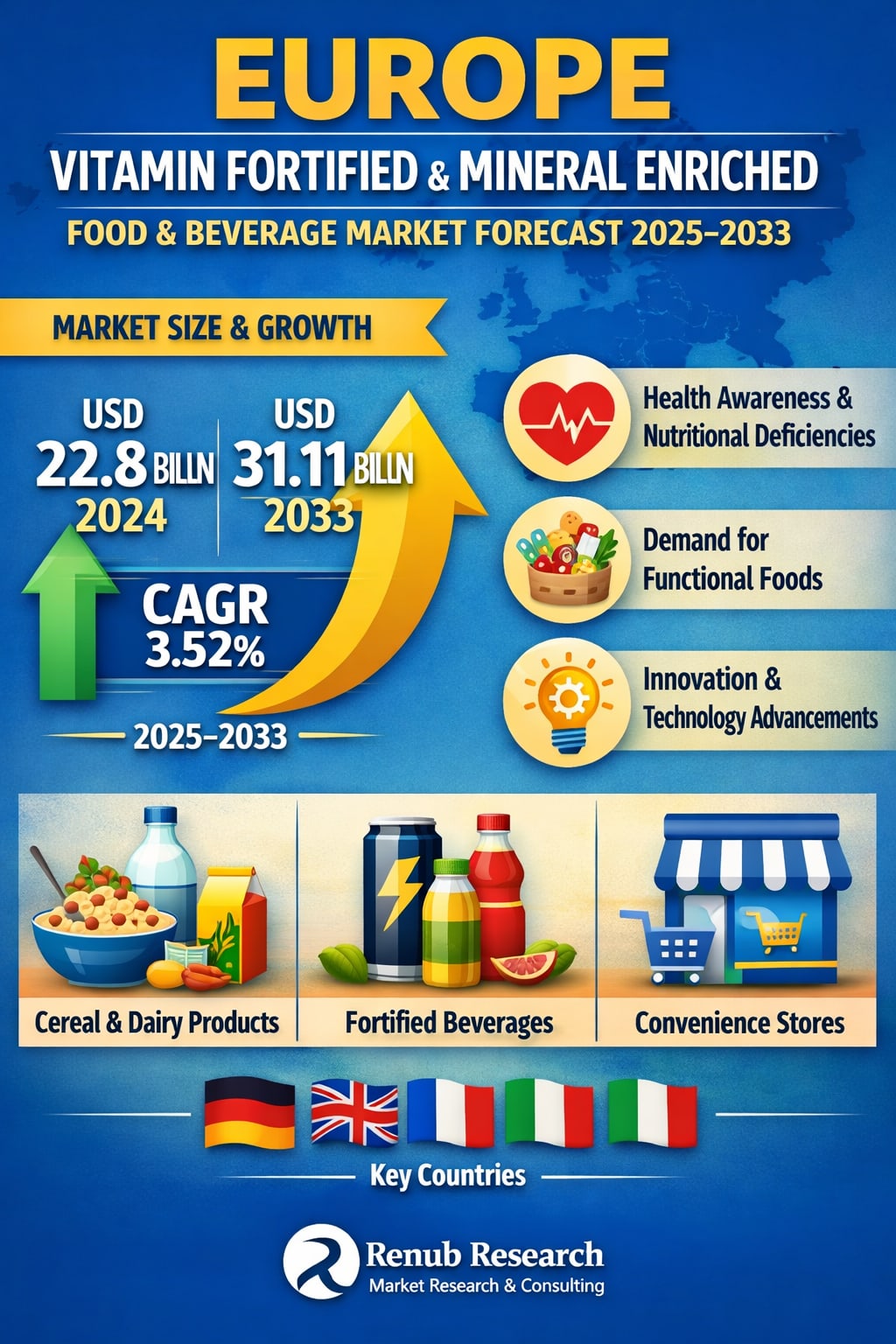
The Europe Vitamin Fortified and Mineral Enriched Food & Beverage Market is entering a decisive growth phase, driven by a powerful combination of health awareness, demographic change, and evolving consumer expectations. According to Renub Research, the market was valued at USD 22.8 billion in 2024 and is projected to reach USD 31.11 billion by 2033, expanding at a compound annual growth rate (CAGR) of 3.52% during the forecast period 2025–2033.
As healthcare costs rise and lifestyles become more demanding, Europeans are looking for convenient, science-backed nutrition solutions that fit seamlessly into daily routines. This shift is reshaping product portfolios, retail strategies, and innovation pipelines across the continent’s food and beverage industry.
Understanding Vitamin Fortified and Mineral Enriched Foods in Europe
Vitamin fortified and mineral enriched foods and beverages are designed to enhance the nutritional value of regular food products by adding essential micronutrients such as vitamin D, B-complex vitamins, iron, calcium, zinc, and magnesium. In Europe, these products play a particularly important role due to changing dietary patterns, urban lifestyles, and the growing prevalence of nutrient deficiencies in specific population groups.
Common examples include fortified milk and plant-based alternatives with calcium and vitamin D, breakfast cereals enriched with iron and B vitamins, fruit juices boosted with vitamin C, and functional drinks containing electrolytes and minerals. These products are not only used to address deficiencies but also to support immunity, bone health, cognitive performance, and energy metabolism.
Regulation in this space is overseen by the European Food Safety Authority (EFSA), which sets strict guidelines on the types and levels of vitamins and minerals that can be added, as well as the health claims that can be made on packaging. While this ensures high safety and quality standards, it also shapes how companies formulate, market, and position their fortified products across different European countries.
Key Growth Drivers Shaping the European Market
Rising Health Consciousness and Preventive Nutrition
One of the most powerful forces behind market growth is the increasing focus on preventive healthcare. European consumers are becoming more proactive about managing their health through diet, particularly in response to rising rates of obesity, diabetes, cardiovascular diseases, and age-related health concerns.
An aging population across many European countries has further accelerated demand for foods that support bone density, immunity, and overall vitality. Vitamins such as D and B12, along with minerals like calcium and iron, are increasingly seen as essential daily nutrients rather than optional supplements. Public health campaigns and medical recommendations have also played a role in normalizing fortified foods as part of a balanced diet, especially for children, women, and older adults.
This shift in mindset has created a favorable environment for manufacturers to expand their fortified product lines and for retailers to dedicate more shelf space to functional nutrition categories.
Expansion of Functional and Convenient Food Categories
Modern European lifestyles are busier than ever, and convenience has become a major purchasing driver. At the same time, consumers are unwilling to compromise on health. This has led to strong demand for ready-to-eat, on-the-go, and easy-to-consume products that also deliver meaningful nutritional benefits.
Fortified breakfast cereals, snack bars, meal replacement drinks, and functional beverages are perfectly positioned at this intersection of convenience and health. Millennials, urban professionals, and students are especially drawn to products that promise energy, focus, and immune support in a quick, accessible format.
Manufacturers are responding by launching innovative grab-and-go options, while retailers are expanding health and wellness sections in both physical stores and online platforms. The result is a steadily widening consumer base for vitamin-fortified and mineral-enriched foods and beverages across Europe.
Technological Advancements and Product Innovation
Advances in food science have significantly improved the quality, taste, and effectiveness of fortified products. Techniques such as microencapsulation and improved nutrient stabilization methods allow manufacturers to add vitamins and minerals without negatively affecting flavor, texture, or shelf life—issues that once limited consumer acceptance.
At the same time, there is growing interest in personalized and targeted nutrition. Companies are increasingly designing formulations aimed at specific needs, such as immunity support, cognitive performance, sports recovery, or bone health. Innovation is also extending to plant-based formulations, clean-label products, and fortification using natural sources rather than synthetic additives.
These technological and formulation improvements are helping fortified foods move beyond basic supplementation into the realm of premium, lifestyle-oriented nutrition solutions.
Challenges Facing the Market
Regulatory Complexity and Labeling Restrictions
While Europe’s strict regulatory environment ensures consumer safety and product quality, it also presents challenges for manufacturers. The EFSA requires strong scientific evidence for any health or nutrition claims, and different countries may interpret and enforce regulations in slightly different ways.
This complexity increases compliance costs and can slow down product launches, especially for companies operating across multiple European markets. Clear labeling requirements, limits on nutrient levels, and restrictions on marketing language all require careful navigation. For smaller players and new entrants, these regulatory hurdles can be particularly demanding.
High Production Costs and Nutrient Stability Issues
Producing high-quality fortified foods is more expensive than making standard products. Many vitamins and minerals are sensitive to heat, light, and pH, meaning manufacturers must invest in specialized processing technologies, protective packaging, and rigorous quality control systems to ensure nutrient stability throughout the product’s shelf life.
In addition, natural and highly bioavailable nutrient sources often cost more than synthetic alternatives. These higher production costs are typically passed on to consumers, making fortified products more expensive than their non-fortified counterparts and potentially limiting adoption among price-sensitive shoppers.
Market Segmentation Insights
Cereal-Based Fortified Products: A Daily Nutrition Staple
Cereal-based products hold a strong position in Europe’s fortified food landscape. Breakfast cereals, granola, and oat-based products are widely consumed and seen as an easy way to deliver essential vitamins and minerals on a daily basis. Fortification with vitamin D, iron, and folic acid is particularly common, addressing well-known deficiencies among children and women.
As consumers become more label-conscious, manufacturers are also focusing on whole grains, high-fiber formulations, and reduced sugar content, combining health benefits with clean-label appeal.
Fortified Beverages: One of the Fastest-Growing Segments
The fortified beverages segment is among the most dynamic in the market. It includes vitamin waters, functional juices, energy and sports drinks, plant-based milks, and meal replacement beverages. These products appeal to consumers looking for hydration plus added health benefits such as improved immunity, energy, and mental focus.
Trends toward low-sugar, natural, and plant-based formulations are especially strong in Europe, aligning fortified beverages with broader clean-label and wellness movements. Single-serve packaging and strong presence in convenience stores and online channels further support rapid adoption.
The Broader Fortified Food Market
Beyond cereals and beverages, fortification is increasingly common in dairy products, bakery items, snacks, and even infant foods. By integrating vitamins and minerals into everyday staples like bread, yogurt, and snacks, manufacturers are making functional nutrition a normal part of daily eating habits rather than a special-purpose choice.
This approach also helps brands differentiate themselves in highly competitive categories, using claims related to immunity, bone health, and cognitive performance to stand out on crowded shelves.
Distribution Trends: The Rising Role of Convenience and Digital Channels
Convenience stores are becoming an increasingly important sales channel for fortified foods and beverages in Europe. Located in city centers, transport hubs, and fuel stations, these stores cater to busy consumers looking for quick, healthy options. Energy drinks, fortified snacks, and breakfast bars perform especially well in this environment, supported by impulse buying and strong in-store visibility.
At the same time, online retail is playing a growing role, particularly for health-focused and premium fortified products. E-commerce platforms allow brands to communicate detailed nutritional benefits, reach niche audiences, and offer subscription-based or personalized nutrition solutions.
Country-Level Market Highlights
Belgium
Belgium’s market is characterized by a strong focus on premium quality, clean-label products, and transparent sourcing. Functional drinks, fortified cereals, and dairy products are especially popular, with consumers showing high interest in natural fortification and sustainable packaging.
Switzerland
Switzerland stands out for its highly educated consumer base and willingness to pay for premium, science-backed nutrition. Fortified dairy products, high-quality cereals, and functional beverages dominate, supported by strong trust in domestic brands and strict quality standards.
United Kingdom
The UK is one of Europe’s most dynamic markets for fortified foods and beverages. Demand is particularly strong for fortified cereals, plant-based milk alternatives, juices, and functional drinks. Public health campaigns and widespread awareness of vitamin D and iron deficiencies continue to drive category growth, with supermarkets and e-commerce playing a central role in distribution.
Competitive Landscape and Key Players
The European market features a mix of global food and beverage giants and well-established regional brands. Key players include:
Abbott Laboratories
Kellogg Company
Nestlé SA
PepsiCo Inc.
Amway Corporation
The Coca-Cola Company
The Hain Celestial Group Inc.
Danone SA
Marks and Spencer
These companies compete on the basis of product innovation, brand trust, scientific credibility, and distribution reach. Many are investing heavily in research and development, clean-label reformulations, and sustainability initiatives to align with evolving consumer expectations.
Market Outlook: Steady, Strategic, and Health-Driven Growth
With the market projected to grow from USD 22.8 billion in 2024 to USD 31.11 billion by 2033, the Europe Vitamin Fortified and Mineral Enriched Food & Beverage Market is set for consistent, sustainable expansion. Growth will be driven less by hype and more by long-term structural trends: aging populations, preventive healthcare, busy lifestyles, and rising demand for functional, convenient nutrition.
Innovation in formulation, packaging, and personalization will continue to shape competition, while regulatory standards will ensure that quality and safety remain central to the category’s credibility.
Final Thoughts
The European market for vitamin fortified and mineral enriched foods and beverages is no longer a niche segment—it is a core part of the region’s modern food system. As consumers increasingly expect their everyday foods and drinks to support immunity, energy, and long-term health, fortification is becoming a standard rather than an exception.
With strong fundamentals, steady CAGR growth, and continuous innovation, this market is well-positioned to play a central role in Europe’s future of food—where nutrition, convenience, and science come together on the plate and in the bottle.