image:
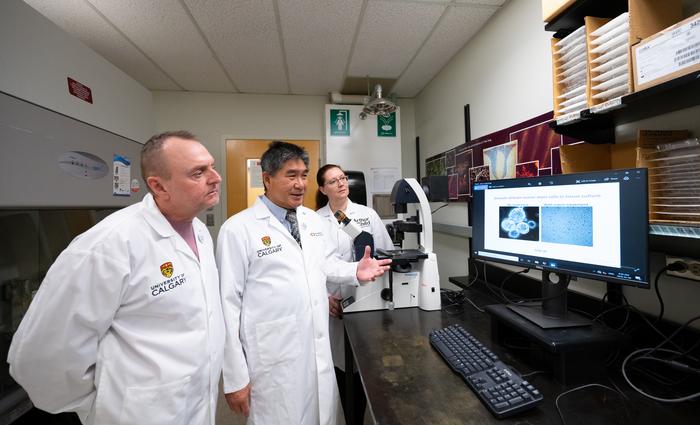
Left to right: Edward (Ed) Waldner (study participant), Dr. Gloria Roldan Urgoiti, MD, (oncologist), Dr. Wee Yong, PhD, (scientist)
Credit: Riley Brandt, University of Calgary
Edward (Ed) Waldner had no idea why he didn’t feel well but he knew he didn’t feel like himself. At 55-years of age he felt exhausted all the time. It didn’t seem to matter how hard he had worked that day. He wondered if he had sleep apnea. He noticed his walking was off. His heels would drag now and again. One day, when his symptoms were worse than usual, he decided to go to the Emergency Department.
“The doctor said I had a mass on my brain and needed to see an oncologist,” says Waldner.
The mass was glioblastoma, a deadly brain cancer. Treatment often involves a three-pronged approach: surgery to remove as much of the tumour as possible, followed by radiation and chemotherapy. However, despite advances in cancer treatment, the aggressive cancer comes back.
University of Calgary researchers are investigating whether adding high doses of vitamin B3 or niacin, to the treatment plan could be beneficial. They approached Waldner about being in the trial.
“I have no problem trying to help anybody. I agreed. I want to help myself too,” says Waldner. “I can tell you being part of this research helps me mentally because we’re trying. When I left the hospital after surgery I was told, that’s it, that’s all we can do.”
The research is led by two members of both the Hotchkiss Brain Institute and Arnie Charbonneau Cancer Institute, Drs. Gloria Roldan Urgoiti, MD, an oncologist specialized in brain cancers, and Wee Yong, PhD, a neuroscientist whose research focuses on immune effects on the brain. Together they designed a study to investigate whether niacin could rejuvenate compromised immune cells to kill tumour cells. The research began in the Yong lab, with mice, where findings showed niacin prolonged survival. That work evolved into a Phase I and II clinical trial.
“Normally the immune system will try to counter and prevent tumour growth, however, this brain cancer supresses the immune system,” says Yong, a professor at the Cumming School of Medicine (CSM). “Niacin treatment rejuvenates immune cells so they can do what they are supposed to do, attack and kill the cancer cells. I see it as an ongoing ‘battle for the brain’.”
The clinical trial was designed to determine the maximum dose and potential benefit of controlled-release niacin that could be added to the recommended chemotherapy and radiotherapy treatments. Researchers decided the study would stop if the progression-free survival over six-months did not improve by at least 20 per cent compared with older studies. Early results involving 24-patients showed 82 per cent of the participants were free of progression of the cancer at six-months; an increase of 28 per cent from previous studies. The researchers say this is a promising advancement for this incurable cancer.
“Glioblastoma is the most aggressive brain cancer in adults. Survival of patients with this condition hasn’t changed significantly for 20-years”, says Roldan Urgoiti, a clinical associate professor at the CSM. “Anything that may help should be explored but it requires strict protocols and safety monitoring.”
Findings are published in the Journal of Neuro-Oncology
The researchers caution that high amounts of vitamins, like niacin, have toxicity and can have a negative impact on someone’s health if not monitored closely by medical professionals.
The team hopes to be able to do the final analysis, that will include 48-participants by the end of 2026 or early 2027.
Waldner says he’s feeling really good these days and is just happy to hear the word stable when he goes for his regular scans.
The research is supported by the Canadian Institutes of Health Research and the Alberta Cancer Foundation.
Method of Research
Experimental study
Subject of Research
People
Article Title
A phase I-II study of niacin in patients with newly diagnosed glioblastoma: safety and interim phase II analysis
Article Publication Date
25-Nov-2025
COI Statement
Competing interests The authors declare no competing interests
Disclaimer: AAAS and EurekAlert! are not responsible for the accuracy of news releases posted to EurekAlert! by contributing institutions or for the use of any information through the EurekAlert system.