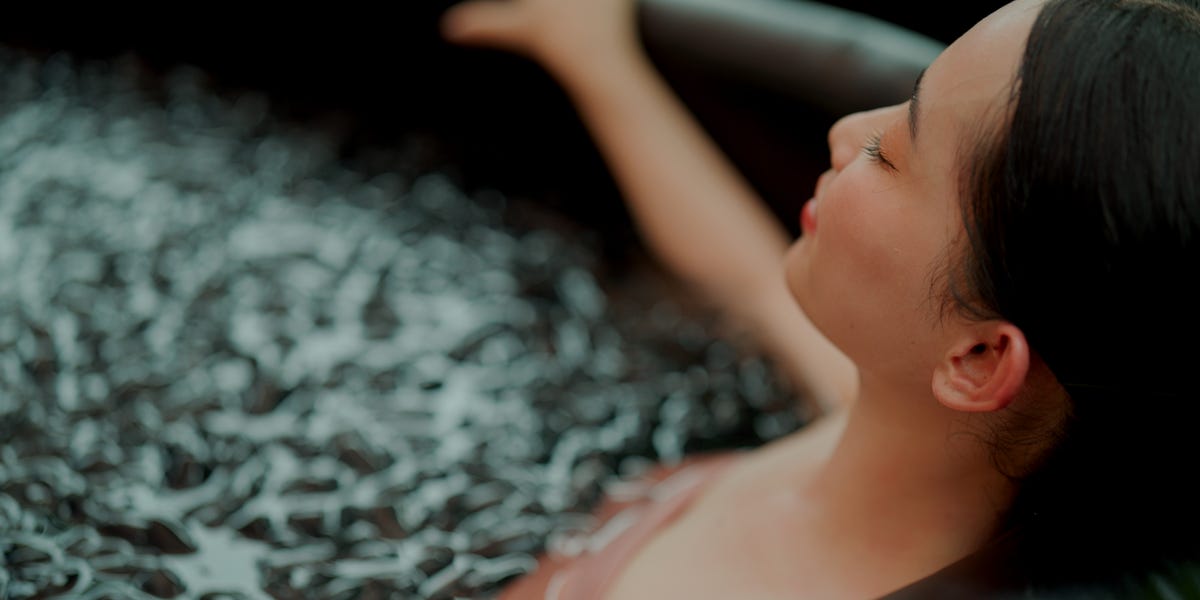
Hailey Bieber dunks herself into a metal bathtub filled with frigid water for anxiety and a mood boost. Lady Gaga posted a photo of herself up to her neck in ice chips, explaining that a freezing dip is part of her post-show recovery routine. And in a recent interview, Gwyneth Paltrow told ELLE that she tries to submerge herself every single day as part of her wellness ritual. It’s not just celebrities. Women everywhere are taking the plunge—the cold plunge, that is. Many of them officially serve as ambassadors for these tubs, including professional surfer Brianna Cope for Plunge and model Romee Strijd for Icetubs.
Bathhouses prominently featuring freezing soaks are popping up all over the place, like Saint and Lore Bathing Club in New York. The wellness practice is purported to have a host of benefits that sound incredible: it could reduce muscle damage after high-intensity exercise, help tamp down inflammation, improve your mood and ability to focus, lead to better and deeper sleep, encourage weight loss, and even improve your insulin sensitivity. Though there isn’t data available that indicate how many women are diving into ice water, a Grand View Research market analysis showed that the market as a whole was valued at about $330 million in 2024 and is expected to double to nearly $660 million by 2033. But recent research shows that women may want to consider pumping the brakes before diving full speed ahead into freezing water.
A 2025 study conducted on 30 healthy women, for example, found that cold plunging had virtually no effect on them. Most research that shows upsides, like this 2015 study that demonstrated icy dips helped maintain muscle strength after resistance exercise and encouraged recovery, has been done on men. Another 2021 analysis found that intermittent cold exposure could potentially even cause harm to women, as it led to abnormal ovarian follicle development in rats. The study showed that below-freezing temperatures damaged the rodents’ ovarian function and reserves. Most cold plunges are between 50–59 degrees Fahrenheit, but some like to submerge themselves in temperatures as low as 32 degrees. It begs the question: should women be cold plunging at all?
As you might expect, the answer is complicated. Doctors agree that cold plunges shouldn’t be written off entirely for women, when there isn’t enough research available, but they’re certainly not for everyone. According to Stephanie Wallman, MD, the medical director at The Lanby, those going through menopause, perimenopause, or postpartum should avoid dunking themselves in freezing water, since their bodies are already in a state of heightened strain by default. “The body will perceive cold plunging as an additional stress,” she says. “It will go into storage instead of the fat-burning state that they need to be in for it to have all the longevity benefits that they’re looking for.”
For women who are of reproductive age, to plunge or not to plunge is even murkier. The 2021 study about sub-zero temperatures disrupting typical ovarian function in rats gave some doctors pause, though they agree that you can’t extrapolate rat data to humans. What makes this data interesting, according to Gouri Pimputkar, DO, an OB/GYN for Allara Health and Anate Brauer, MD, reproductive endocrinologist at RMA New York, is that it shows a duality. On one hand, the rats exhibited some of the positive side effects of cold plunging. “They saw a conversion of potential fat around the ovaries, which leads to thermogenesis and can help with weight loss,” says Pimputkar, who noted that some of the rats did shed excess mass.
But on the flip side, the research also demonstrated damage to the ovarian reserve, which was reflected by changes in different stages of the follicular development. “These rats seemed to have a faster recruitment of resting follicles, depleting their reserves faster in comparison to their counterparts,” said Brauer, who once again stressed that you can’t assume the same happens to humans. Still, it’s something worth thinking about. “It makes sense—you’re throwing a stressful experience onto these poor rats, and they probably have an activation of the sympathetic nerves and a neuroendocrine response, which creates a lower response out of the follicles,” says Pimputkar. “This is not great for the health of the ovaries. The million-dollar question is if somebody is continuously doing this, what would the long-term effects be?” Until a similar study is done on women, however, we can’t know for sure. Because of this, experts hope for more clarity in the form of meaningful human trials—on women, not men.
Doctors add that there should be more research done about not just if women should cold plunge, but when. “There has to be more research out there, not only looking at premenopausal women versus postmenopausal women, but even within the timing of the menstrual cycle,” says Pimputkar. “Maybe it would make sense to do cold water therapy at a certain time of the menstrual cycle.”
Wallman echoes that thinking about menstruation is key, as women’s bodies change and adapt based on where they are in their cycle, which is made up of four phases—menstrual, follicular, ovulatory, and luteal. During the menstrual phase, hormones are low and typically so are energy levels. Hormones rise during the follicular phase and peak during ovulation, which are both typically periods of higher energy. And hormones begin to dip as women enter the luteal part of their cycle, which can lead to mood swings and fatigue. “During your ovulatory phase, you’re a super woman,” says Wallman, suggesting that it could be a more suitable cold plunge time.
“You have to do it in moderation and smartly, in terms of how you feel.”
Pimputkar explains that for cold plunging to work well for women, it needs to be thought of as a tool rather than a cure-all. “You want to make sure that all the other parts of the puzzle are lined up,” she says. “You’re prioritizing sleep, getting adequate nutrition, and working to regulate your stress management and response. Knowing that we don’t have good information yet to say yes or no, you have to do it in moderation and smartly in terms of how you feel.”
If you’re primed for handling extreme situations (like if you regularly participate in high-intensity workouts), submerging yourself in ice water might give you the same benefits as Bieber and Paltrow tout. “The women who are capable of handling it, get nice stress resilience training,” says Wallman. “They’re actually training their stress resilience when they’re appropriately set up to engage in cold plunges.” But even if you’re used to high intensity, you should check in with your body before cold plunging—and if you’re unsure, it doesn’t hurt to talk to your doctor.