Clean Beauty Market Size & Trends | Mordor Intelligence
Clean Beauty Market Size and Growth Outlook
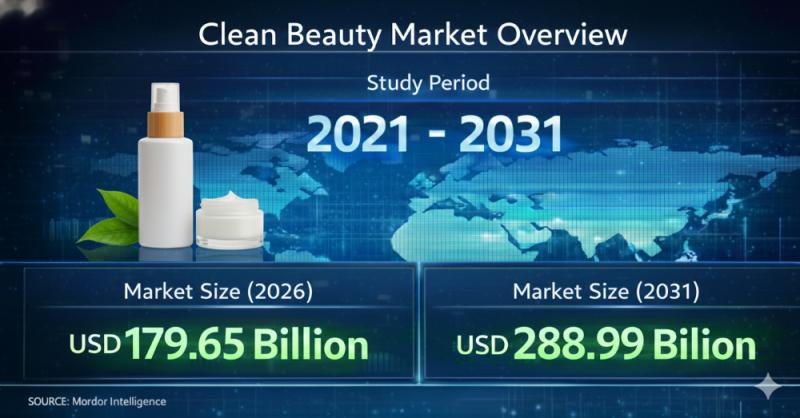
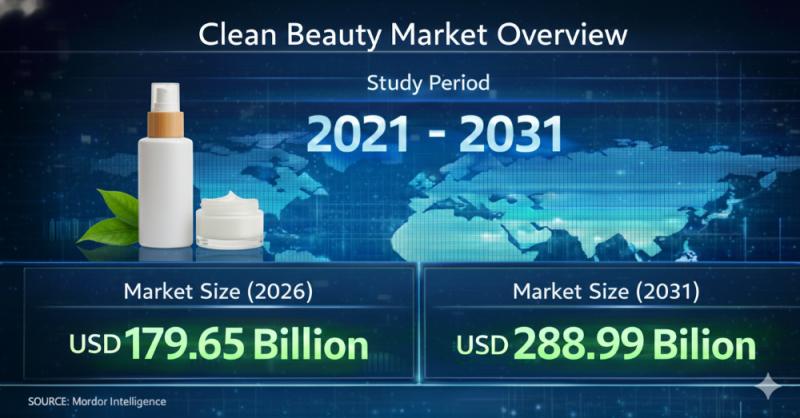
The global Clean Beauty Market is projected to grow from USD 179.65 billion in 2026 to USD 288.99 billion by 2031, reflecting strong expansion driven by ingredient transparency, regulatory compliance, and sustainability-focused innovation. The Clean Beauty Market Size continues to expand as consumers increasingly prioritize safe, natural, and ethically sourced cosmetic and personal care products.
Skincare currently dominates the Clean Beauty Market share, supported by rising demand for non-toxic formulations and clinically backed active ingredients. Meanwhile, color cosmetics are gaining momentum, particularly among Gen Z and millennial consumers influenced by digital commerce and social media education around ingredient safety.
Access the complete data-driven outlook on the Clean Beauty Market:
https://www.mordorintelligence.com/industry-reports/clean-beauty-market?utm_source=openpr
Key Trends Driving the Clean Beauty Market Growth
Heightened Focus on Health and Safety
Consumers are increasingly scrutinizing cosmetic ingredient lists due to concerns over toxic chemicals and long-term exposure risks. Regulatory frameworks, including the FDA’s Modernization of Cosmetics Regulation Act (MoCRA), require brands to substantiate safety claims and improve adverse event reporting, strengthening consumer trust and accelerating Clean Beauty Market growth.
Environmental Sustainability as a Core Strategy
Sustainability has transitioned from a marketing differentiator to a strategic imperative within the Clean Beauty Market. Refillable packaging solutions, biodegradable materials, and biosurfactants derived from renewable feedstocks are becoming mainstream. Consumers demonstrate a growing willingness to pay premium prices for environmentally responsible products, supporting premium segment expansion.
Ingredient Transparency and Clear Labeling
Detailed ingredient disclosure and clean-label positioning are now baseline expectations. Consumers actively seek non-toxic, organic, and cruelty-free alternatives, often guided by social media education and digital ingredient databases. Transparent labeling practices are reshaping competitive strategies across both mass and premium brands.
Biotech-Driven Clean Formulations
Biotechnology is transforming product development within the Clean Beauty Market. Fermentation-derived actives, vegan collagen, plant-based preservatives, and lab-grown ingredients enable brands to deliver high-performance results without synthetic chemicals. These biotech solutions balance efficacy with sustainability, meeting demand for safe and functional cosmetics.
Clean Beauty Market Segmentation Overview
By Product Type
Skincare
Haircare
Make-up and Colour Cosmetics
Fragrances
Bath and Shower
Other Product Types
By Price Tier
Mass
Premium
By End User
Kids
Adults
By Distribution Channel
Supermarkets and Hypermarkets
Health and Beauty Stores
Online Retail Stores
Other Distribution Channels
By Geography
North America (United States, Canada, Mexico, Rest of North America)
Europe (Germany, United Kingdom, Italy, France, Spain, Netherlands, Poland, Belgium, Sweden, Rest of Europe)
Asia-Pacific (China, India, Japan, Australia, Indonesia, South Korea, Thailand, Singapore, Rest of Asia-Pacific)
South America (Brazil, Argentina, Colombia, Chile, Peru, Rest of South America)
Middle East and Africa (South Africa, Saudi Arabia, UAE, Nigeria, Egypt, Morocco, Turkey, Rest of Middle East and Africa)
Explore the full Consumer Goods and Services research library:
https://www.mordorintelligence.com/market-analysis/consumer-goods-and-services?utm_source=openpr
Competitive Landscape of the Clean Beauty Market
The Clean Beauty Market is characterized by strong competition between global conglomerates and emerging digital-native brands. Major companies are expanding clean-label portfolios, investing in biotech innovation, and strengthening sustainable sourcing strategies.
Key Players Include:
L’Oréal SA – advancing biotech-driven clean formulations and digital engagement
Unilever PLC – expanding through sustainability-focused acquisitions
Coty Inc. – strengthening premium and mass clean beauty lines
The Estée Lauder Companies Inc. – integrating ingredient transparency across brands
The Procter & Gamble Company – emphasizing safety validation and ethical sourcing
These companies are leveraging regulatory compliance, R&D investments, and digital marketing strategies to maintain or expand Clean Beauty Market share.
Clean Beauty Market Forecast and Strategic Outlook
The Clean Beauty Market forecast points toward sustained long-term expansion as ingredient transparency, regulatory enforcement, and consumer awareness continue to intensify. Skincare remains the largest revenue contributor, while rapid growth is expected in color cosmetics, kids’ personal care products, and premium clean segments.
Digital-first distribution models are accelerating brand discovery and reshaping retail dynamics, allowing new entrants to compete effectively alongside established players. Companies prioritizing sustainability, biotech innovation, and ethical sourcing are well-positioned to capitalize on evolving consumer expectations.
For more insights on the Clean Beauty Market, visit:
https://www.mordorintelligence.com/industry-reports/clean-beauty-market?utm_source=openpr
Industry Related Reports:
Beauty Tools Market
The beauty tools market is projected to grow from USD 19.43 billion in 2025 to USD 26.73 billion by 2030, registering a CAGR of 6.59%. Growth is driven by rising consumer interest in personal grooming, increased adoption of innovative tools, and the expansion of e-commerce channels for beauty products.
https://www.mordorintelligence.com/industry-reports/beauty-tools-market?utm_source=openpr
Beauty and Personal Care Products Market
Valued at USD 636.16 billion in 2026, the global beauty and personal care products market is expected to reach USD 817.34 billion by 2031 at a CAGR of 5.14%. Demand is fueled by rising consumer awareness of personal care, premiumization trends, and expanding online sales platforms.
https://www.mordorintelligence.com/industry-reports/global-beauty-and-personal-care-products-market-industry?utm_source=openpr
Brazil Beauty Market
The Brazilian beauty market is forecasted to grow from USD 36.97 billion in 2025 to USD 56.11 billion by 2031, at a CAGR of 7.2% over 2026-2031. Market expansion is supported by a strong beauty culture, increasing disposable incomes, and growing popularity of premium and natural cosmetic products.
https://www.mordorintelligence.com/industry-reports/brazil-cosmetics-products-market-industry?utm_source=openpr
For any inquiries or to access the full report, please contact:
media@mordorintelligence.com
https://www.mordorintelligence.com/
Mordor Intelligence, 11th Floor, Rajapushpa Summit, Nanakramguda Rd, Financial District, Gachibowli, Hyderabad, Telangana – 500032, India.
About Mordor Intelligence:
Mordor Intelligence is a trusted partner for businesses seeking comprehensive and actionable market intelligence. Our global reach, expert team, and tailored solutions empower organizations and individuals to make informed decisions, navigate complex markets, and achieve their strategic goals.
With a team of over 550 domain experts and on-ground specialists spanning 150+ countries, Mordor Intelligence possesses a unique understanding of the global business landscape. This expertise translates into comprehensive syndicated and custom research reports covering a wide spectrum of industries, including aerospace & defense, agriculture, animal nutrition and wellness, automation, automotive, chemicals & materials, consumer goods & services, electronics, energy & power, financial services, food & beverages, healthcare, hospitality & tourism, information & communications technology, investment opportunities, and logistics.
This release was published on openPR.